
Screening Employees the Right Way with E-Verify
Why E-Verify Employee Screening Matters for Your Business
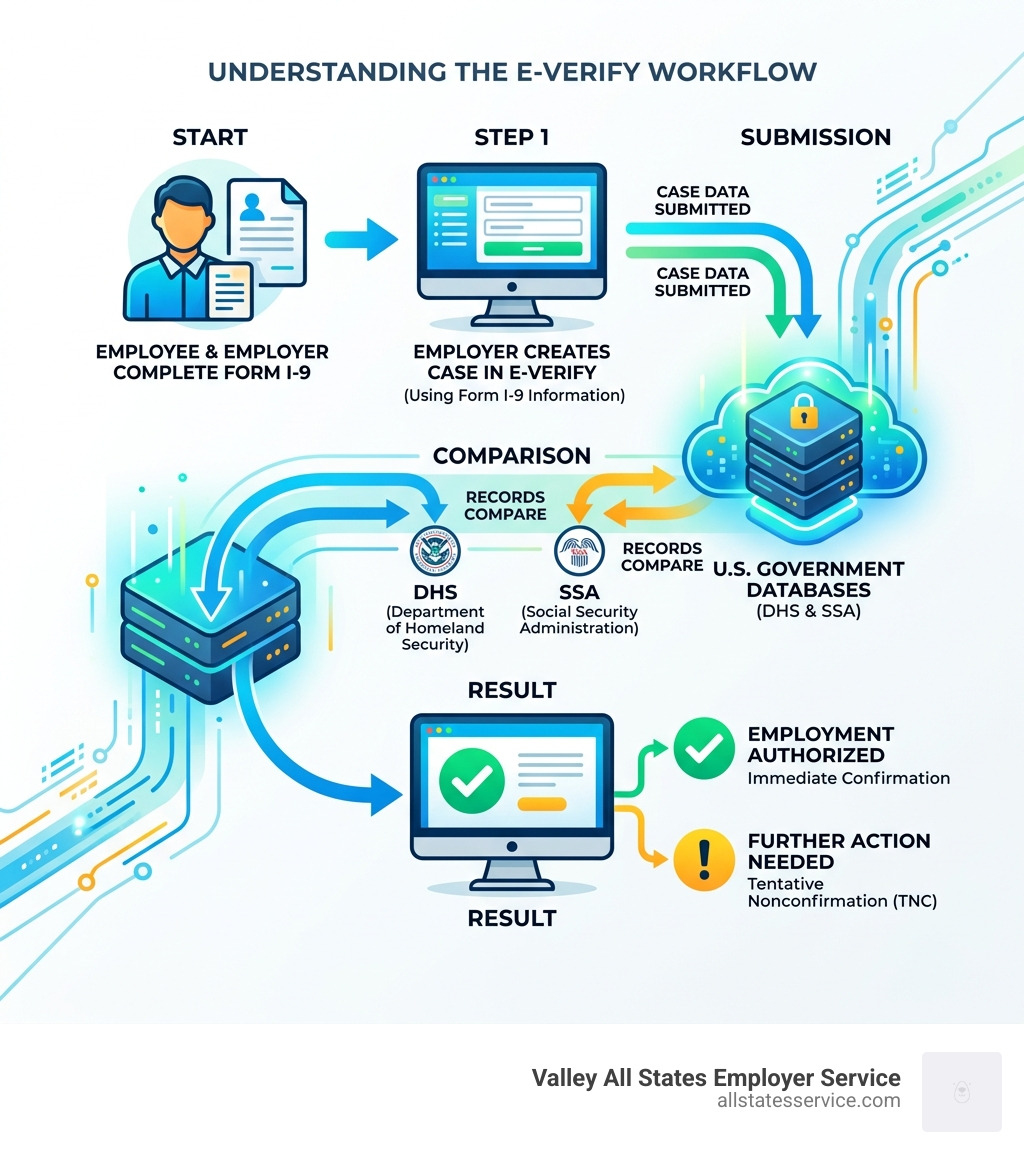
E-Verify employee screening is an internet-based system that lets employers confirm a new hire’s work authorization by comparing their Form I-9 information against records held by the U.S. Department of Homeland Security (DHS) and the Social Security Administration (SSA), returning results in as little as three to five seconds.
Here’s a quick look at what you need to know:
| Question | Quick Answer |
|---|---|
| What is it? | A free, government-run online verification system |
| Who manages it? | U.S. Department of Homeland Security (DHS) |
| Is it mandatory? | For federal contractors and in many states, yes |
| How fast are results? | As little as 3-5 seconds |
| Who does it affect most? | Over 85% of cases involve U.S. citizens |
| What’s the cost? | Free for employers to use directly |
Every time you bring on a new employee, you’re responsible for verifying they’re legally allowed to work in the United States. That’s not optional. And getting it wrong, whether through an honest mistake or a missed deadline, can expose your business to audits, fines, and serious legal risk.
For HR managers juggling onboarding, benefits enrollment, and a hundred other tasks, that’s a real problem.
E-Verify takes the guesswork out of employment eligibility. Instead of relying solely on paper documents that can be difficult to assess, the system cross-checks your new hire’s information against millions of government records automatically. It’s faster, more reliable, and increasingly required, not just at the federal level, but across a growing number of states.
Whether you’re a federal contractor who must comply, a business operating in a state with a mandate, or simply an employer who wants to hire with confidence, understanding how this system works is the first step to getting it right.
Know your e-verify employee screening terms:
What is E-Verify Employee Screening and How Does It Work?
At its core, e-verify employee screening is the digital bridge between a company’s hiring process and the vast databases maintained by the federal government. When you hire someone, you already have them fill out a Form I-9. E-Verify simply takes that information and runs it through an electronic check to make sure everything lines up.
The system is managed by the Department of Homeland Security and the Social Security Administration. It is currently the only free, fast, and secure online service that electronically confirms an employee’s information against millions of government records. You can learn more about the official mission at the E-Verify home page.
When an employer submits a case, the system looks for a match. It checks the Social Security number, name, and date of birth against SSA records to ensure they are valid. Simultaneously, it checks immigration and citizenship status against DHS records. If you want to dive deeper into the basics, check out our guide on what is E-Verify or explore the mechanics of E-Verify employment verification.
The Difference Between Form I-9 and E-Verify Employee Screening
A common point of confusion for many business owners is whether E-Verify replaces the Form I-9. The short answer is no. Think of the Form I-9 as the foundation and E-Verify as the inspection that confirms the foundation is solid.
While every employer in the U.S. is required by law to complete a Form I-9 for every hire, E-Verify is an additional layer of legal employment verification. Form I-9 relies on a physical inspection of documents, which can sometimes be forged. E-Verify provides an electronic confirmation that acts as a powerful tool for identity fraud prevention. For a full breakdown of how these two work together, our E-Verify vs I-9 guide is a great resource.
Key Statistics for 2026
As we move through April 2026, the scale and speed of this system are truly impressive. Here are some numbers that highlight its impact on the modern workforce:
- Lightning Fast: E-Verify provides employment eligibility results within as little as three to five seconds.
- Massive Reach: The system confirms information against millions of government records daily.
- Broad Impact: More than 85% of workers impacted by E-Verify are U.S. citizens, proving it is not just for foreign nationals.
- Trusted by Millions: Major providers like Equifax Workforce Solutions process millions of transactions annually, helping businesses maintain workforce verification solutions.
Navigating Mandates and State Requirements
While E-Verify started as a voluntary program at the federal level, the landscape has changed significantly. Today, whether you need to use it often depends on who you are doing business with and where your employees are located.
Federal contractors and subcontractors are a major group required to use the system. If your company has a contract that includes the Federal Acquisition Regulation (FAR) E-Verify clause, you are legally obligated to use the system for all new hires and sometimes existing employees assigned to the contract. You can find more details on these specific federal E-Verify rules to ensure you stay compliant.
Who is Required to Use E-Verify Employee Screening?
State mandates are where things get a bit more complex. Some states require E-Verify for all employers, while others only require it for public employers or those receiving state contracts. For example, states like Arizona and Mississippi have broad requirements, while others have more targeted rules.
If you are a subcontractor, don’t assume you are off the hook. Often, the prime contractor’s requirement flows down to you. To stay on top of these shifting laws, we recommend checking the 2025 E-Verify requirements by state or our E-Verify state laws complete guide. Knowing what employers are required to use E-Verify is essential for any growing business, especially federal contractors.
Compliance Rules and Penalties
Compliance isn’t just a “nice to have,” it is a legal necessity. Failing to follow E-Verify rules can lead to more than just a slap on the wrist. If you are a contractor, non-compliance can lead to the loss of government contracts or being barred from future bidding.
Regular audits are a reality in employment eligibility verification. Civil penalties and fines can add up quickly if paperwork is missing or if the three-day rule is ignored. For a closer look at the risks, see our E-Verify compliance fines guide for contractors.
The Step-by-Step Verification Process
Using E-Verify doesn’t have to be a headache if you follow the established steps. It all starts with the Form I-9. Once that is completed, you have a strict deadline to meet.
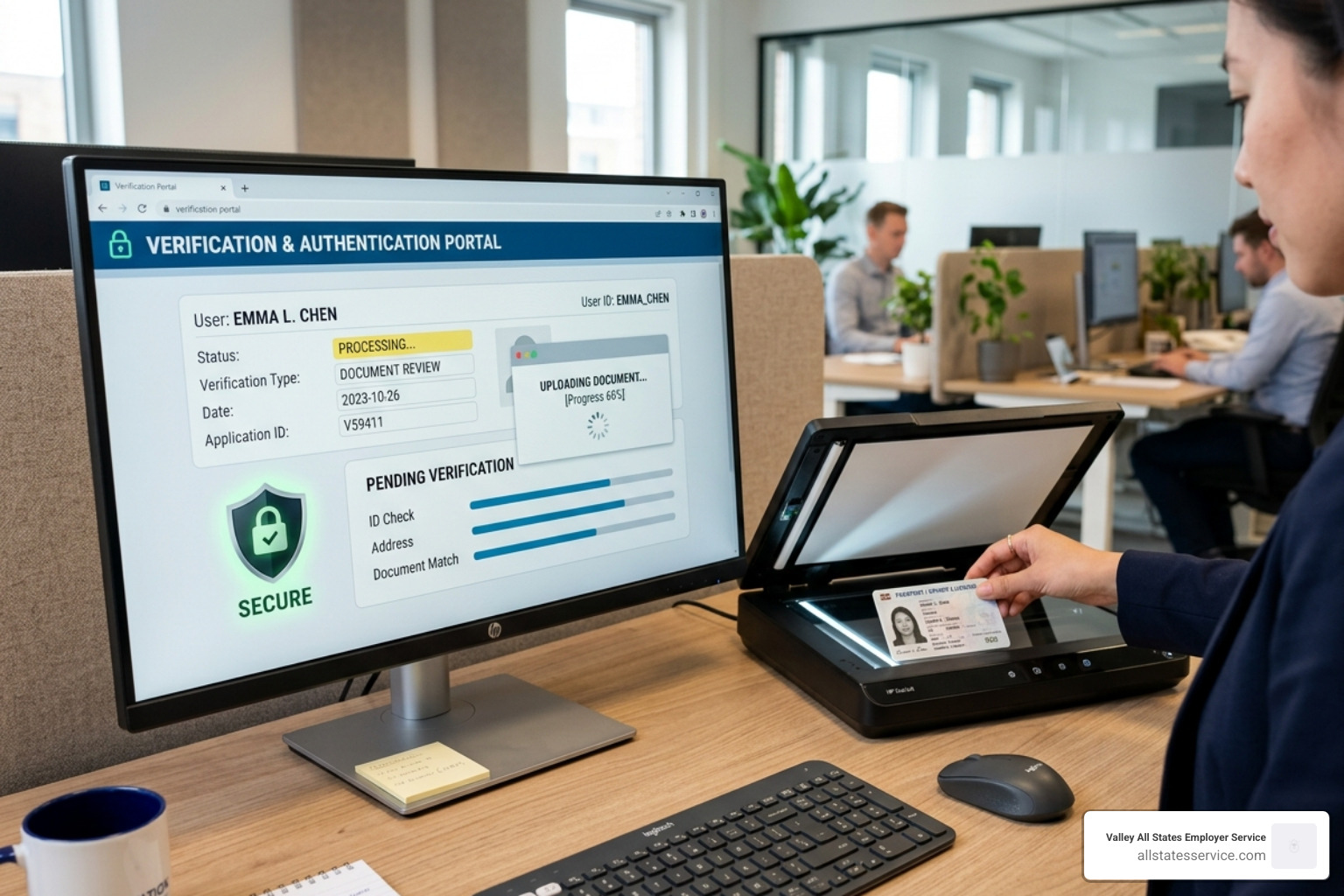
The “Three-Day Rule” is the most important timeline to remember. You must create a case in E-Verify no later than the third business day after the employee starts work for pay. If you hire someone on a Monday, you need to have that case submitted by Thursday.
During case creation, you might encounter a feature called Photo Matching. This happens when an employee presents certain documents, like a Permanent Resident Card or an Employment Authorization Document. The system will display the photo they have on file, and you must compare it to the photo on the document the employee provided. This ensures the document is genuine and belongs to the person standing in front of you. You can find a detailed breakdown of the verification process on the official site or through our E-Verify onboarding process guide.
Handling a Tentative Nonconfirmation (Mismatch)
Sometimes, the system doesn’t return an immediate “Employment Authorized” result. Instead, you might get a Tentative Nonconfirmation (TNC), often called a mismatch. This does not mean the employee is not authorized to work, it just means something didn’t line up in the records.
Common reasons for a mismatch include:
- Unreported name changes (like after a marriage).
- Typographical errors during data entry.
- Naturalization status that hasn’t been updated in SSA records.
If a TNC occurs, you must notify the employee privately and provide them with a Further Action Notice. The employee then has eight federal government working days to contact the appropriate agency to resolve the issue. During this time, you cannot take any negative action against them, such as firing them or delaying training. For more help, read about E-Verify tentative nonconfirmation or how to resolve your E-Verify case today.
Final Nonconfirmation and Case Closure
If the employee chooses not to contest the mismatch, or if the agency cannot confirm their eligibility after the contest, the result will change to a Final Nonconfirmation. At this point, the employer is usually required to terminate the employment.
Closing the case correctly is just as important as opening it. You must record the final result and close the case in the system to remain compliant. Keeping a close eye on your E-Verify case status ensures you never miss a step in this critical process.
Modern Tools and Compliance Best Practices
The E-Verify system is constantly evolving to become more user-friendly. In April 2026, we are seeing some fantastic new features that make life easier for both employers and employees.

One of the most exciting updates is E-Verify+. This new service streamlines the process by allowing employees to take a more active role in their own verification. It brings more transparency and efficiency to the table, letting you “click, confirm, and carry on.”
Other helpful tools include:
- myE-Verify: A free service for employees to check their own work eligibility and protect their identity.
- myUploads: A tool that allows employees to electronically send documents to DHS to resolve a mismatch.
- Status Change Reports: A new tool for employers to identify cases affected by specific immigration status changes.
To stay ahead of the curve, it is wise to follow E-Verify best practices and regularly consult an E-Verify reporting compliance guide.
Employee Rights and Responsibilities
It is vital to remember that e-verify employee screening is not just about employer compliance, it is also about protecting workers. Employees have specific rights under the program. They must be notified of a mismatch, they have the right to contest it, and they are protected from discrimination based on their citizenship status or national origin.
Employers cannot use E-Verify to prescreen applicants before a job offer is made and accepted. Doing so is a violation of the program’s rules. For a complete look at these protections, check out our E-Verify employees complete guide.
Remote Hiring and Virtual Verification
With the rise of remote work, the DHS introduced an Alternative Procedure for document verification. Eligible employers who are in good standing with E-Verify can now complete the Section 2 verification via a live video call rather than in-person inspection.
This is a game-changer for companies hiring talent across the country. However, there are strict rules to follow, such as retaining copies of all documents verified virtually. Our E-Verify remote complete guide covers everything you need to know to stay compliant while hiring from afar.
Streamlining Your Compliance Strategy
Managing all these moving parts can be overwhelming. Between the three-day rule, the TNC process, and the varying state laws, it is easy for a busy HR department to make a mistake. That is where we come in.
At Valley All States Employer Service, we provide expert, outsourced E-Verify workforce eligibility verification. We act as your E-Verify employer agent, taking the administrative burden off your shoulders. Our team ensures that every case is handled with impartiality and precision, minimizing errors and keeping your business safe from audit risks.
By partnering with us for your E-Verify services, you can focus on growing your business while we handle the technical details of government compliance.
Is E-Verify mandatory for all small businesses?
This is one of the most common questions we hear. At the federal level, it is generally voluntary for small businesses unless you have a federal contract with the FAR clause. However, many states have passed their own laws.
In some states, every single business, regardless of size, must use it. In others, only those with a certain number of employees are required to participate. Even if it isn’t mandatory for you yet, many small businesses choose E-Verify for small businesses voluntarily to ensure they are building a legal and reliable workforce.
Can I use E-Verify for 1099 contractors?
This is a tricky area. E-Verify is designed for employees—people who fill out a Form I-9. Independent contractors (1099s) generally do not fill out an I-9, so they are not put through the E-Verify system.
However, the line between an employee and a contractor can sometimes be blurry. If the government determines a “contractor” is actually an employee, you could be in trouble for not verifying them. We’ve put together an E-Verify 1099 contractors complete guide to help you navigate these legal waters safely.
How do I enroll in the program?
If you’re ready to start, the enrollment process involves several steps, including signing a Memorandum of Understanding (MOU) with the government. You’ll need to provide your company’s basic info, EIN, and designate a program administrator.
Preparation is key because you cannot save your progress once you start the online enrollment. We recommend reviewing an E-Verify account setup guide or an enrollment checklist before you begin.
Ready to simplify your hiring and stop worrying about compliance? Explore our E-Verify employment verification solutions today and let our experts handle the heavy lifting for you. We’ll make sure your e-verify employee screening is done the right way, every time.