
What employers are required to use e verify 2025 Guide
Understanding E-Verify Requirements Made Simple
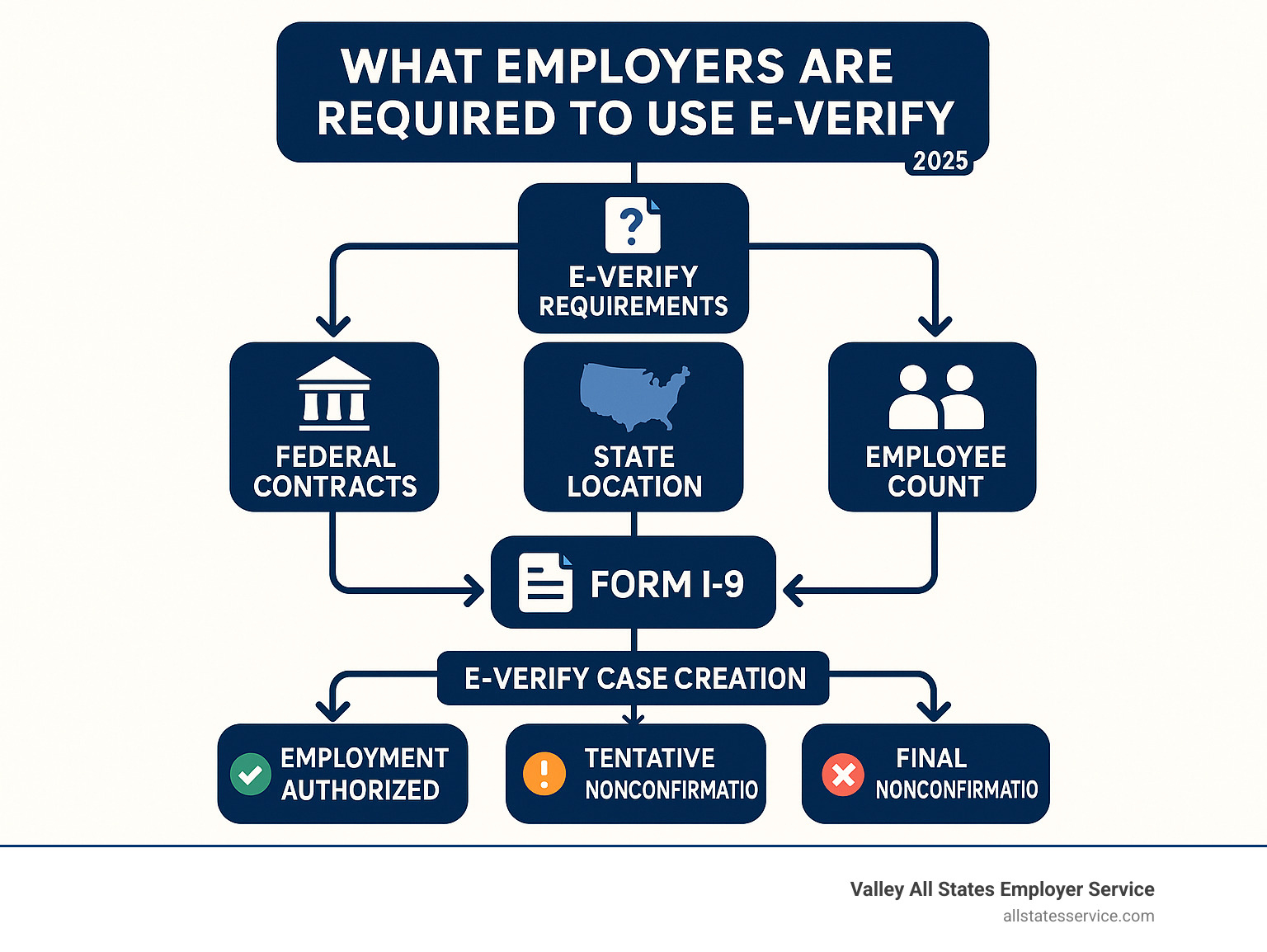
What employers are required to use e verify depends on several factors including your location, business type, and employee count. Here’s the quick answer:
Federal Requirements:
- All federal contractors with qualifying contracts containing the FAR E-Verify clause
- Their subcontractors working on covered federal contracts
State Requirements:
- All employers: Alabama, Arizona, Mississippi, South Carolina
- Large employers: Tennessee (50+ employees), North Carolina (25+ employees), Georgia (11+ employees), Utah (15+ employees)
- State contractors/agencies: Texas, Virginia, Georgia, and many others
- Varies by jurisdiction: Some cities and counties have additional requirements
Most private employers in other states can use E-Verify voluntarily, but it’s not required by law.
The confusion around E-Verify requirements is understandable. While E-Verify started as a voluntary federal program, a patchwork of state laws, federal contractor rules, and local ordinances has created a complex landscape that leaves many HR managers scratching their heads.
If you’re managing hiring and compliance, you need clear answers about whether your business must use this employment verification system. The stakes are real – non-compliance can result in contract loss, fines, or even business license suspension depending on your jurisdiction.
Whether you’re a federal contractor navigating FAR requirements, a growing business hitting employee thresholds in certain states, or simply trying to understand your options, this guide will walk you through exactly when E-Verify is mandatory versus optional for your specific situation.
What is E-Verify and How Does It Work?
Think of E-Verify as your digital employment verification assistant. This web-based system, run by U.S. Citizenship and Immigration Services (USCIS) working hand-in-hand with the Social Security Administration and Department of Homeland Security, helps you confirm that your new hires are legally authorized to work in the United States.
Here’s the straightforward part: you enter information from your employee’s Form I-9 into the system, and it checks that data against millions of government records. We’re talking names, birth dates, Social Security numbers, and document details. The best part? You usually get an answer in seconds, and it’s completely free to use.
What employers are required to use e verify varies by location and business type, but understanding how the system works is essential whether you’re mandated to use it or considering it voluntarily. The system operates across all 50 states, Washington D.C., Puerto Rico, and other U.S. territories, making it a powerful tool for maintaining employment authorization compliance.
The beauty of E-Verify Employment Verification lies in its simplicity and speed. You’re essentially getting an automated connection to government databases that would otherwise take much longer to verify manually.
The E-Verify and Form I-9 Connection
Here’s something important: E-Verify doesn’t replace your Form I-9 process. Instead, it works as a digital companion that strengthens your employment eligibility verification. The Form I-9 has been the backbone of employment verification since 1986, and E-Verify simply takes that information and electronically confirms it.
When your new employee fills out their Form I-9, you’ll take the key details from Section 1 and Section 2 and enter them into E-Verify. Remember the three-day rule: you must complete this process no later than the third business day after your employee starts work for pay.
Here’s some good news for remote employers. Since August 2023, E-Verify employers can now examine Form I-9 documents remotely, thanks to new Form I-9 and remote verification rules. If an employee presents List B documents, they must include a photo, and E-Verify’s photo matching feature works with documents like U.S. passports and Permanent Resident Cards to help ensure the person presenting the document is the rightful owner.
The connection between these two processes creates a comprehensive verification system. You can learn more about how these systems work together at E-Verify and I-9.
Understanding E-Verify Case Results
Once you submit an E-Verify case, you’ll typically see results within 3 to 5 seconds. The system gives you one of four possible outcomes, each requiring different actions on your part.
Employment Authorized is what you’re hoping to see. This means your employee’s information matched government records perfectly, and they’re cleared to work. You simply close the case and move on.
Sometimes you’ll get E-Verify Needs More Time. Don’t panic. The system just needs additional processing time, usually resolving within 24 hours but potentially taking up to three federal working days. Neither you nor your employee needs to do anything during this waiting period.
A Tentative Nonconfirmation (TNC) or mismatch doesn’t mean your employee can’t work. It simply indicates that the information didn’t immediately match government records. Here’s where things get important: you must notify the employee privately, provide them with a Further Action Notice, and let them decide whether to contest the mismatch. Employees have the right to resolve TNCs and can continue working while doing so.
If a TNC isn’t resolved or the employee chooses not to contest it, you’ll receive a Final Nonconfirmation. At this point, the system has confirmed the employee is not authorized to work in the U.S., and you may terminate their employment.
Understanding these results and following proper procedures protects both employee rights and your business from discrimination claims. You can track your cases and their outcomes through E-Verify Status Check to stay on top of all your verifications.
Federal Mandates: The Baseline for E-Verify
Here’s something that surprises many business owners: E-Verify is actually voluntary for most employers at the federal level. The government can’t force every private company to use it. But there’s one big exception that changes everything for certain businesses.
If you’re a federal contractor, E-Verify becomes mandatory the moment your contract contains the Federal Acquisition Regulation (FAR) E-Verify clause. This isn’t just a suggestion or best practice. It’s a legal requirement that can make or break your ability to work with the government.
The rules get even more specific. You’ll need to use E-Verify for all new hires company-wide, plus any existing employees who work directly on the federal contract. This is one of the rare situations where E-Verify can be used for current employees, not just new ones. Understanding these Federal E-Verify Rules isn’t optional if you want to keep those government contracts.
When did this all start? The FAR E-Verify clause applies to federal contracts issued on or after September 8, 2009. So if your contract is newer than that date, you’re likely covered. The requirement also flows down to subcontractors working on these covered federal contracts. Even if you’re not the prime contractor, you still need to comply if you’re part of the project.
The legal foundation comes from two Executive Orders. Executive Order 12989 started the ball rolling, and Executive Order 13465 refined the requirements for federal contractors to use electronic employment eligibility verification. You can review the details in Executive Order 13465 if you want to see the exact language.
What happens if you don’t comply? The penalties are serious. You could lose your current federal contracts or become ineligible for future ones. For businesses that depend on government work, this essentially means losing your livelihood over a compliance issue.
If you’re already a federal contractor or hoping to become one, getting familiar with E-Verify for Contractors requirements isn’t just smart business. It’s the difference between keeping those valuable contracts and watching them disappear.
State-by-State Breakdown: What Employers Are Required to Use E-Verify?
The federal government might keep E-Verify mostly voluntary, but states have been busy creating their own rules. Over the past two decades, a patchwork of state laws has emerged that can make your head spin. Some states require nearly every employer to use E-Verify, while others focus on specific situations or business sizes.
What makes this particularly tricky is that what employers are required to use e verify changes dramatically depending on where you do business. You could have offices in three different states and face completely different requirements in each location.

The penalties for getting it wrong aren’t just a slap on the wrist either. Depending on your state, you could face hefty fines, lose your business license, or even have it permanently revoked. That’s why staying on top of your local requirements isn’t just good practice – it’s essential for keeping your doors open.
The landscape keeps evolving too. States regularly update their laws, adjust employee thresholds, or expand requirements to new types of businesses. Because these rules can change, staying current is a major challenge, and the complexity means many employers benefit from professional guidance.
States Mandating E-Verify for Most or All Private Employers
Four states have decided to go all-in on E-Verify, requiring virtually every employer within their borders to use the system. These states don’t mess around with exceptions or thresholds – if you hire people there, you’re using E-Verify.
Alabama jumped on board in April 2012, making E-Verify mandatory for all employers in the state. Arizona was actually one of the early adopters, implementing their requirement back in December 2007. Mississippi and South Carolina (since July 2010) round out this group of states with universal mandates.
If you’re doing business in any of these four states, there’s no guessing game about whether you need E-Verify. You do, period. Even if you’re a small business with just a few employees, you’re still required to participate. The good news is that this clarity eliminates confusion, but it also means you need to get up to speed quickly if you’re not already compliant.
For smaller businesses feeling overwhelmed by these requirements, our E-Verify for Small Businesses guide breaks down the process in manageable steps.
What employers are required to use e verify based on state contracts or public employment?
Many states take a more targeted approach, focusing their E-Verify requirements on businesses that work with government entities. The logic is simple: if taxpayer money is involved, the state wants to ensure only authorized workers benefit from those contracts.
Georgia requires all public employers to use E-Verify, plus any contractors and subcontractors providing services to public entities. Texas implemented requirements for state agencies and higher education institutions starting in September 2015. Virginia covers state agencies and extends requirements to larger employers (50+ employees) entering contracts over $50,000 with state agencies. Oklahoma casts a wide net, covering all public employers and their contractors and subcontractors.
The contract requirements often depend on specific dollar amounts or contract types, so it’s crucial to review the fine print of any government work you’re considering. What seems like a straightforward contract can come with E-Verify obligations that catch unprepared businesses off guard.
These requirements make sense from a policy perspective, but they can create operational challenges. You might need E-Verify for employees working on certain contracts but not others. Many of the compliance principles we cover in E-Verify Essentials Every Federal Contractor Should Master apply to state contractor requirements as well.
What employers are required to use e verify based on company size?
Several states have found a middle ground by tying E-Verify requirements to business size. This approach recognizes that larger employers typically have more resources to handle compliance requirements, while smaller businesses might struggle with the administrative burden.
Tennessee sets the bar at 50 or more employees under the same Federal Employer Identification Number. North Carolina requires private employers with 25 or more employees to verify new hires. Georgia (beyond their public employer requirements) mandates E-Verify for private employers with 11 or more employees, but only for newly hired full-time workers. Utah requires employers with 15 or more employees to use E-Verify or another approved verification system.
These thresholds create an interesting dynamic. Your business might operate happily without E-Verify requirements, but growth can suddenly trigger new compliance obligations. It’s one of those “good problems to have” situations, but it requires planning and awareness.
The employee counts typically refer to your total workforce, not just employees in that particular state. So if you’re a growing company with locations in multiple states, you need to monitor these thresholds carefully. Our E-Verify Employer Requirements page provides detailed guidance on navigating these size-based requirements as your business evolves.
Employer Responsibilities and Employee Rights
Using E-Verify isn’t just about running names through a system and calling it done. It comes with real responsibilities that protect both your business and your employees’ rights. Think of it as a partnership where everyone needs to play by the rules to keep things fair and legal.
What employers are required to use e verify must understand that the system has built-in safeguards designed to prevent misuse. You absolutely cannot use E-Verify to pre-screen job applicants. That’s a hard no. The system only gets used after someone accepts your job offer and completes their Form I-9. It’s verification, not a hiring filter.
Here’s something that catches many employers off guard: you cannot fire or suspend someone just because they get a Tentative Nonconfirmation (TNC). That TNC might simply mean there’s a typo in government records or the employee recently got married and changed their name. They deserve the chance to sort it out, and they can keep working while they do.
Non-discrimination sits at the heart of proper E-Verify use. You must run E-Verify checks consistently for all new hires. You can’t pick and choose based on someone’s accent, appearance, or name. If you’re enrolled in E-Verify, everyone gets verified equally.
Posting requirements matter more than you might think. Those official notices about employee rights and your E-Verify participation aren’t just bureaucratic paperwork. They need to be displayed prominently where job applicants and employees can easily see them. The Right to Work and E-Verify Participation posters spell out everyone’s rights and responsibilities clearly.
Data security becomes your responsibility the moment you start handling employee information through E-Verify. All that personally identifiable information needs protection from unauthorized access or disclosure. It’s not just good practice; it’s required.
When a TNC does pop up, proper employee notification becomes crucial. You need to tell the employee privately about the mismatch and hand them a “Further Action Notice” that explains what happened and how they can resolve it. No public announcements or office-wide emails about someone’s verification issues.
Employees have solid protections under the E-Verify system. They have the right to know if you participate in E-Verify before they’re hired. If they get hit with a TNC, they can contest it and contact either the Social Security Administration or Department of Homeland Security to fix the problem. Most importantly, they can usually keep working while sorting out the mismatch.
Protection against discrimination extends beyond the hiring process. Employees can’t be treated differently because of assumptions about their work authorization status. Someone with an accent or a foreign-sounding name gets the same treatment as everyone else.
Getting these responsibilities right isn’t just about avoiding penalties. It’s about building trust with your workforce and maintaining a reputation as a fair employer. Following E-Verify Best Practices helps create a smooth process that respects everyone’s rights while keeping you compliant with the law.
Navigating Compliance and Finding Support
The reality of E-Verify compliance hits differently when you’re facing real consequences. What employers are required to use e verify isn’t just an academic question when penalties can shut down your business or cost you lucrative contracts.
For federal contractors, the stakes are particularly high. Non-compliance with the FAR E-Verify clause doesn’t just mean a slap on the wrist. You could face complete ineligibility for future federal contracts or even debarment from your existing contracts. Imagine losing a multi-million dollar government contract because of paperwork errors.
State penalties can be even more brutal. Arizona doesn’t mess around with first-time offenders, they’ll temporarily suspend your business license. Get caught again? That suspension becomes permanent. South Carolina takes a different approach, hitting you with civil penalties up to $1,000 per violation plus potential license revocation. These aren’t theoretical threats, they’re real consequences that have shuttered businesses.
The administrative burden alone can overwhelm your HR team. Managing E-Verify across multiple states means tracking different requirements, submission deadlines, TNC procedures, and recordkeeping standards for each jurisdiction. The true E-Verify Compliance Cost goes way beyond direct fees. You’re looking at training costs, staff time, potential legal expenses, and the hidden cost of errors that could trigger audits or penalties.
Many smart employers recognize they need backup. That’s where an E-Verify Employer Agent becomes invaluable. Think of them as your compliance safety net. These agents handle the entire verification process on your behalf, bringing specialized training and experience that your internal team might lack. They know the system inside and out, which means fewer errors, faster processing, and reduced risk of compliance issues.
Your HR team gets to focus on what they do best instead of wrestling with federal databases and state regulations. The agent handles the technical stuff, the deadline tracking, and the TNC resolution process. It’s like having a specialist on your team without the overhead of hiring one full-time.
When issues do arise, official E-Verify Customer Support is available through the E-Verify Contact Center. They can help with technical glitches, policy questions, and case resolution. Whether you’re working directly with the system or through an employer agent, knowing these resources exist gives you a safety net when things get complicated.
The bottom line? E-Verify compliance isn’t something you want to wing. The penalties are too severe and the requirements too complex to handle casually. Getting proper support, whether through expert agents or comprehensive customer service, isn’t just smart business, it’s essential protection for your company’s future.
Simplify Your E-Verify Compliance
By now, you’ve probably realized that figuring out what employers are required to use e verify isn’t exactly straightforward. It’s like trying to solve a puzzle where the pieces keep changing shape depending on whether you’re a federal contractor, which state you’re in, or how many people you employ.
The reality is that this patchwork of federal rules, state mandates, and local requirements creates a real headache for business owners. You’re juggling Form I-9 completions, making sure E-Verify cases get submitted on time, handling those tricky Tentative Nonconfirmations properly, and keeping up with ever-changing regulations. It’s enough to make anyone’s head spin.
The administrative burden is real. Between training your HR team, staying current on rule changes across multiple jurisdictions, and making sure every case is processed correctly, E-Verify compliance can easily become a full-time responsibility. And let’s be honest, the stakes are high. A simple mistake could lead to hefty fines, contract losses, or even business license suspension.
This is exactly why Valley All States Employer Service exists. We specialize in taking this complex puzzle off your plate entirely. Our team handles your outsourced E-Verify workforce eligibility verification with the kind of expertise that comes from doing this day in and day out. We know the ins and outs of every state requirement, federal contractor obligation, and compliance nuance.
What makes us different? We’re not just processing cases; we’re minimizing errors and reducing your administrative burden so you can focus on what you do best, running your business. Think of us as your compliance safety net, making sure nothing falls through the cracks while you concentrate on growth, customer service, and all the other priorities that actually drive revenue.
The truth is, determining your requirements and managing compliance doesn’t have to be overwhelming. With the right partner handling the heavy lifting, E-Verify becomes just one less thing to worry about.
Ready to simplify your compliance journey? Streamline your E-Verify Employer Requirements with Valley All States Employer Service today.