
Your Identity Verification System: From Setup to Success
Why Every Business Needs a Reliable Identity Verification System
Setting up an identity verification system means building a process that confirms a person is who they claim to be, before granting them access to services, employment, or sensitive data.
Here’s a quick breakdown of what that involves:
- Collect identity evidence (government ID, Social Security number, address)
- Validate the evidence against authoritative sources like the DMV or Social Security Administration
- Verify the person is physically linked to that evidence, using biometrics, liveness detection, or in-person checks
- Enroll the verified identity and issue credentials for ongoing access
If you’re an HR manager trying to stay on top of onboarding compliance, this matters more than ever. Identity fraud is getting harder to spot. AI-generated deepfakes, synthetic identities, and fraud rings are putting real pressure on businesses that rely on manual or outdated verification methods.
As NIST’s own guidelines put it, one of the core challenges of online services is “being able to associate a set of activities with a single known individual.” That’s exactly what a well-deployed identity verification system solves.
The good news? You don’t need to be a cybersecurity expert to get this right. Modern systems handle the heavy lifting, from document scanning to biometric matching, often in seconds. But choosing and deploying the right setup for your business still requires understanding the basics.
This guide walks you through everything, from compliance standards to vendor selection to keeping fraud out while keeping good applicants moving through your pipeline.
Understanding the Core of an identity verification system
When we talk about an identity verification system, we are referring to the technical framework that allows a business to trust that a digital user is a real-world human. In the United States, the gold standard for these systems is defined by the National Institute of Standards and Technology (NIST). Specifically, the SP 800-63A Guidelines provide the roadmap for how organizations should handle enrollment and proofing.
Think of these guidelines as the “rules of the road.” Without them, every company would have a different definition of what “verified” means, leading to massive security gaps. By following a standardized approach, we ensure that the level of certainty we have about an identity matches the risk of the transaction. For more context, you can explore more info about secure online identity verification to see how these standards protect your business from common pitfalls.

Defining Identity Assurance Levels (IAL)
Not every interaction requires the same level of security. You wouldn’t use the same verification process for a newsletter signup as you would for someone accessing tax records or starting a new job. NIST breaks this down into three Identity Assurance Levels (IAL):
- IAL1 (No Identity Proofing): This level doesn’t require any specific proofing. The user provides attributes, but the system doesn’t verify them against external records. It’s low risk and high friction-free.
- IAL2 (High Confidence): This is the sweet spot for most businesses and government services like the IRS. It requires the remote or in-person submission of evidence (like a driver’s license) that is then validated against authoritative sources.
- IAL3 (Very High Confidence): This is the highest level of security. It almost always requires an in-person meeting or a highly supervised remote session. Physical presence and biometric data are mandatory to ensure the person is who they say they are.
Identity Proofing vs. Identity Verification
It is easy to use these terms interchangeably, but they actually represent two different parts of the same journey.
Identity proofing is the umbrella process. It’s the entire workflow where an applicant provides evidence to a Credential Service Provider (CSP) to prove their identity. The goal is for the CSP to be able to say, “Yes, this person exists in the real world.”
Identity verification, on the other hand, is the specific step where we confirm the “linkage.” We might have a valid passport in our hands (proofing), but we need to make sure the person holding it is actually the person pictured on that passport (verification). This is where things like facial recognition and liveness detection come into play.
The Three Pillars of Identity Proofing
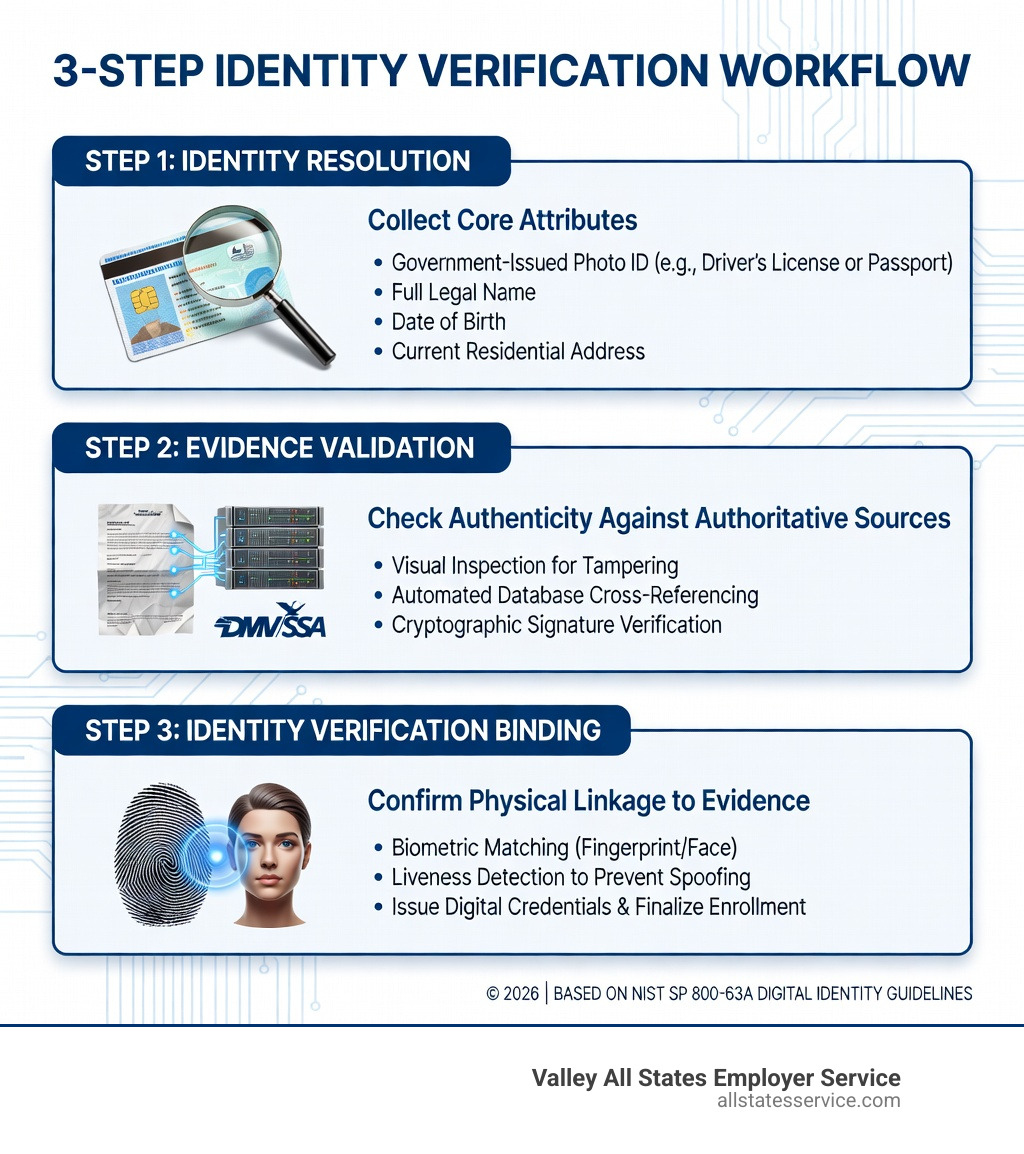
To build a successful identity verification system, we have to follow a logical sequence. You can’t verify a person until you’ve validated their documents, and you can’t validate documents until you’ve resolved who they claim to be.
Step 1: Identity Resolution
The first step is resolution. This is where the applicant makes a “claim” about who they are. We collect what are known as core attributes. According to NIST standards, a government identifier (like an SSN or Passport number) is required. We also typically collect:
- Full legal name (First, Middle, Last)
- Date of birth
- Physical or digital address
The goal here is to distinguish this individual from every other person in a population. If you want to dive deeper into how documents are handled at this stage, check out more info about identity document checks.
Step 2: Evidence Validation
Once we have the documents and attributes, we have to make sure they aren’t fakes. Validation involves checking the evidence against authoritative sources. For example, a driver’s license is checked against the DMV, and a Social Security number is checked against the Social Security Administration (SSA).
Modern systems use automated extraction to pull data from Machine Readable Zones (MRZ) on passports in as little as 0.02 seconds. This speed is vital for keeping users engaged, but the accuracy must remain high. You can find more info about social security identity checks to understand how this specific attribute is validated.
Step 3: Finalizing identity verification system Binding
The final pillar is binding. This is the “moment of truth” where we link the validated evidence to the live person standing in front of the camera (or the counter). If the system confirms the person is real and matches the ID, the identity is “bound” to a credential. This completes the enrollment, allowing the user to access your system securely from that point forward.
| Evidence Strength | Description | Examples |
|---|---|---|
| FAIR | Low resistance to compromise; basic issuance rigor. | Utility bills, non-photo IDs. |
| STRONG | High resistance to compromise; requires physical inspection or cryptographic check. | U.S. Driver’s License, Passport. |
| SUPERIOR | Highest resistance; involves biometric data stored on the document. | Biometric Passports, PIV cards. |
Selecting Evidence and Verification Methods
Choosing the right methods for your identity verification system is a balancing act. You want enough security to stop fraudsters but enough speed to satisfy genuine users. Leading providers like Veriff and Persona have found that most genuine users (over 95%) can be verified on the first try if the methods are intuitive.
Approved Verification Methods
Gone are the days when a simple password or a “secret question” was enough. In fact, NIST now explicitly prohibits Knowledge-Based Verification (KBV) for high-assurance levels because that data is too easily found in data breaches. Instead, we use:
- Biometric Comparison: Comparing a live “selfie” to the photo on a government ID.
- Liveness Detection: Ensuring the person is a live human and not a photo, video, or deepfake. This can be “active” (asking the user to move their head) or “passive” (running background checks on the image quality).
- Confirmation Codes: Sending a code to a verified phone number or physical address to prove “possession” of a communication channel.
For a look at how different companies approach these tools, see more info about leading identity verification providers.
Evidence Strength Requirements
To meet IAL2 or IAL3 standards, you must use STRONG or SUPERIOR evidence.
- STRONG evidence usually involves a photo ID with security features that can be verified visually or through automated scans.
- SUPERIOR evidence includes a biometric chip that can be read via Near Field Communication (NFC), providing a cryptographic guarantee that the document is authentic.
Defeating Modern Threats and Ensuring Compliance
The threat landscape is shifting. Fraudsters are no longer just using stolen IDs; they are using Generative AI to create synthetic identities and deepfakes. A robust identity verification system must be proactive, not just reactive.
Future-Proofing Your identity verification system Against AI
AI-powered fraud is a real concern. Fraud rings now use “face spoofs” that can bypass basic facial recognition. To combat this, modern platforms use multi-layered signals. This includes:
- Behavioral Signals: How the user interacts with the screen.
- Device Fingerprinting: Checking if the device has been used in previous fraud attempts.
- Deepfake Detection: AI models trained specifically to spot the tiny inconsistencies in AI-generated images.
Government agencies are also stepping up. For example, the ID.me IRS Help Site details how they use these technologies to protect taxpayer data while providing a mobile-friendly experience.
Global Compliance Standards
If you operate internationally, your system needs to handle more than just NIST. You may need to comply with:
- KYC/AML: Know Your Customer and Anti-Money Laundering laws for financial services.
- GDPR: Strict data privacy rules in Europe.
- Right to Work: Ensuring employees have the legal right to work in specific countries (like the UK or US).
Balancing Security with User Experience
We’ve all been there: you try to sign up for a service, the ID scan fails three times, and you eventually give up. That’s “onboarding abandonment,” and it kills conversion rates.
Optimizing the Onboarding Flow
The best identity verification system is one that stays out of the way. Providers like Veriff can complete a check in just 6 seconds. To achieve this, we recommend:
- Mobile-Friendly Design: Most users will use their phone camera to scan IDs.
- Localized Languages: Supporting the user’s native tongue reduces errors.
- Pay-per-success Models: Some providers, like iDenfy, only charge for successful verifications, which can save businesses up to 75% on costs.
Privacy and Data Minimization
Security shouldn’t come at the cost of privacy. We follow the principle of data minimization, which means only collecting the PII (Personally Identifiable Information) that is absolutely necessary. Users must give explicit consent for their data to be processed, and they should have access to redress mechanisms if a verification fails or if they want their data deleted.
Frequently Asked Questions about Identity Verification
What is the difference between IAL2 and IAL3?
IAL2 allows for remote verification using strong evidence and biometrics. IAL3 is much stricter, usually requiring a physical, in-person meeting with a trained proofing agent to verify the applicant’s identity with the highest possible certainty.
How do systems detect AI-generated deepfakes?
Modern systems use AI models that look for “liveness” indicators that deepfakes often miss, such as natural skin texture, eye reflections, and the way light interacts with a human face. They also look for “injection” attacks, where a fraudster tries to feed a digital video stream directly into the system instead of using a live camera.
Why is knowledge-based verification (KBV) no longer recommended?
KBV relies on “out of wallet” questions like “What was your first car?” or “Which of these addresses have you lived at?” Because of massive data breaches over the last decade, most of this information is available on the dark web, making it an unreliable way to prove someone’s identity.
Conclusion
Building a secure and efficient workforce starts with a solid identity verification system. Whether you are a small business or a large enterprise, the goals are the same: stop fraud, ensure compliance, and provide a smooth experience for your team.
At Valley All States Employer Service, we specialize in taking the weight off your shoulders. We provide outsourced E-Verify workforce eligibility verification, ensuring your employment compliance is handled by experts. By minimizing errors and reducing the administrative burden, we let you focus on what you do best: growing your business.
Ready to simplify compliance? Explore our complete guide to employment verification services.