
Finding the perfect ID verification system for your needs
Why Choosing the Right ID Verification System Matters for Your Business
A modern ID verification system is software that confirms a person’s identity by checking government-issued documents, biometric data, or personal information against trusted sources, usually in seconds.
Here are the top ID verification platforms worth knowing in 2026:
| Platform | Best For | Key Stat |
|---|---|---|
| Socure Predictive DocV | High-volume, fraud-heavy industries | 98.4% first-try verification rate |
| Veriff | Global onboarding with multilingual support | 95% first-try success, 230+ countries |
| Bureau Identity Verification | Fast global onboarding | Under 10 seconds, 195+ regions |
| FINX IDV | Forensic-grade document checks | 15K+ ID types, 250+ countries |
| PingOne Verify | Enterprise SaaS with privacy focus | PII deleted after 30 minutes |
| iDenfy | Cost-conscious businesses | Save up to 75% on verification costs |
| Cognito Flow | Low-code integration | 20 lines of code, 11,000 document types |
Here’s something that might surprise you: approximately 1 in 3 Australians will be a victim of identity crime at some point in their lives. And in the U.S., more than 29 million adults don’t have a current driver’s license, while over 7 million have no government-issued photo ID at all.
For HR managers, those numbers translate into real risk during hiring and onboarding.
The wrong verification system can slow down your team, block legitimate applicants, or leave your business exposed to fraud. The right one can verify a new hire’s identity in under 10 seconds, flag forged documents automatically, and keep you compliant with E-Verify, KYC, and AML requirements, without adding hours to your team’s workload.
This guide breaks down the leading platforms available right now so you can find the one that fits your business.
Id verification system word roundup:
What is an ID Verification System and How Does It Work?
An id verification system acts as a digital gatekeeper for your business. It bridges the gap between physical identity and the digital world, confirming that the person on the other side of a screen is exactly who they claim to be. This process is essential for compliance, secure hiring, and fraud prevention.
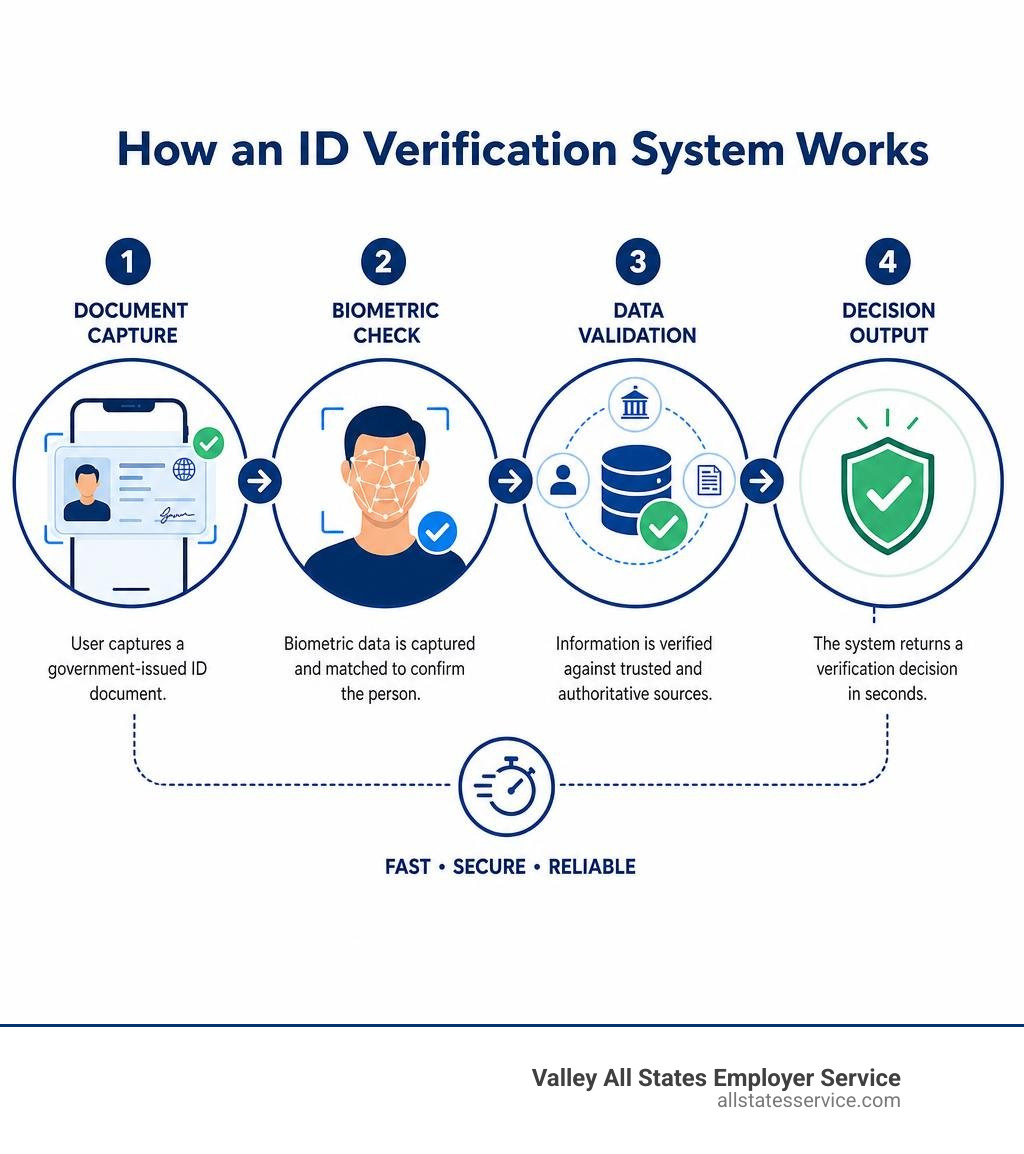
To understand how this technology works, let’s look at the basic steps of a standard digital verification flow:
- Document Capture: The user takes a photo of a government-issued ID, such as a driver’s license, state ID, or passport.
- Data Extraction: The system uses Optical Character Recognition (OCR) to read the text on the document. It instantly extracts key details like name, date of birth, and document number.
- Identity Proofing: The software analyzes security features on the physical card, checking for tampering, altered fonts, or incorrect holograms.
- Biometric Comparison: The user takes a live selfie. The system compares this selfie against the photo on the document to confirm a match.
- Validation and Decision: The system cross-checks the extracted data against authoritative databases and outputs a clear approval or denial.
Implementing these steps successfully requires a reliable setup. To understand how to transition your organization to this technology smoothly, you can read about Your Identity Verification System From Setup To Success for step-by-step guidance.
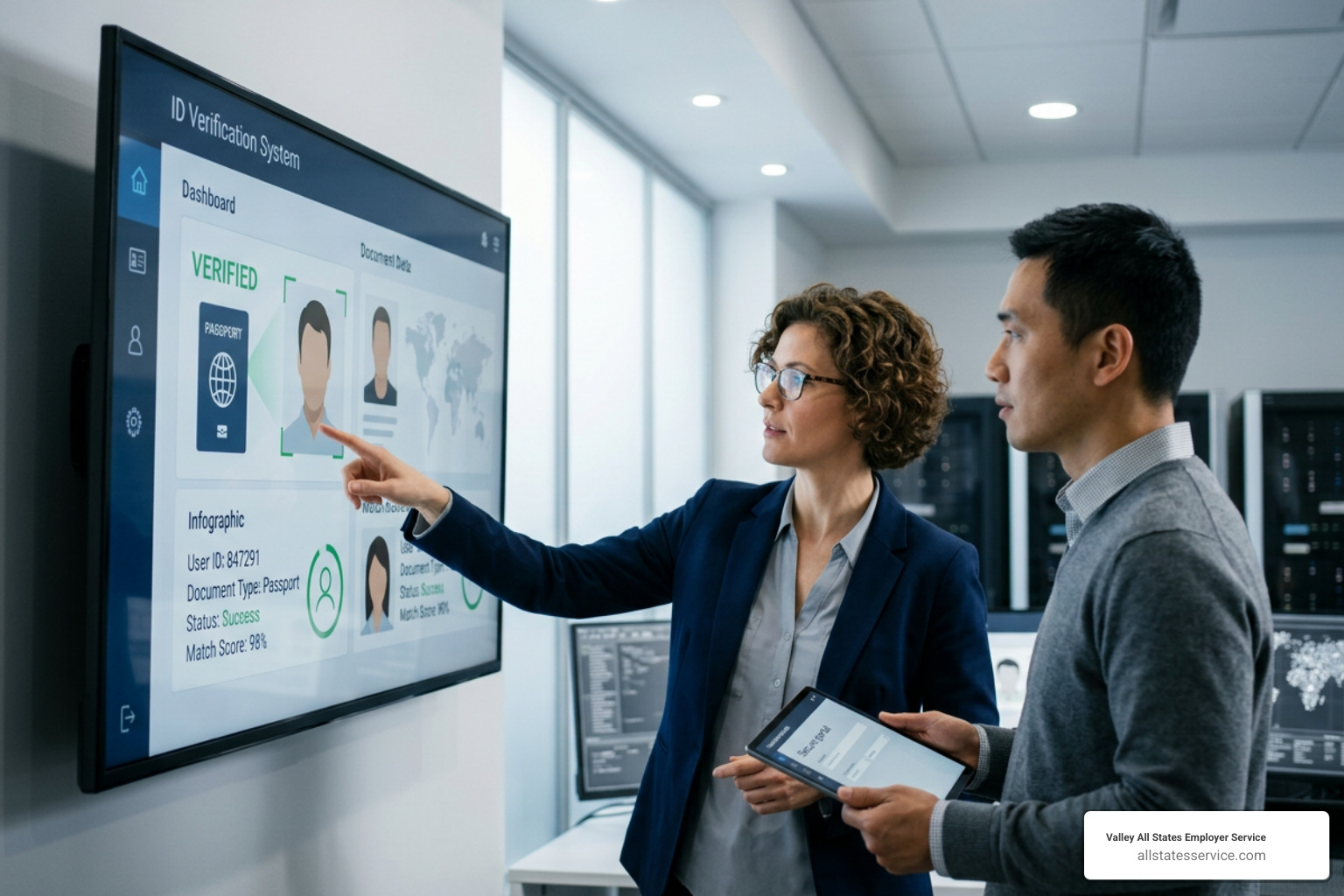
Core Technologies Powering an ID Verification System
Modern systems do not rely on simple visual checks. They use a layered stack of advanced technologies to detect sophisticated fraud attempts:
- Artificial Intelligence and Machine Learning: AI models evaluate hundreds of document features simultaneously. They detect anomalies that are invisible to the human eye, such as microscopic printing errors or digital tampering.
- Biometric Analysis: This technology maps facial landmarks from a selfie and compares them to the ID photo. It ensures that the person holding the ID card is the actual owner.
- Liveness Detection: Liveness detection prevents fraudsters from holding up a printed photo, a video on a tablet, or a 3D mask to the camera. Passive liveness technology can analyze a single frame to confirm a real, three-dimensional human is present, which keeps user friction low.
These technological layers are constantly evolving to counter new threats. For a deeper look into how biometrics keep your business secure, explore The Future Of Id How Biometric Verification Keeps You Secure. Additionally, organizations looking for official background checks can utilize Biometrics Identity: Fingerprint & Background Check Services … to verify physical credentials.
Different Methods of Verifying Identity
Depending on your industry, risk tolerance, and compliance needs, you can use several verification methods:
- Document Upload and Selfie: This is the most common remote method. Users upload their ID card and snap a quick selfie.
- Database Checks: This method verifies personal identifying information, such as a Social Security Number (SSN) or address, against official records without requiring a physical document upload.
- Knowledge-Based Verification (KBV): This method asks users questions based on their credit history or public records. While common, it can be difficult for individuals who lack a deep credit footprint.
- In-Person Verification: Used for high-security public sector programs or when digital options fail, this method involves checking physical documents in person at a trusted location.
Choosing the right approach depends on the specific platform you are using. If you want to see how this works in a consumer-facing scenario, you can check out The Ultimate Guide To The Clearpay Id Verification Every Time.
Key Benefits: Fraud Prevention and Regulatory Compliance
Integrating an automated id verification system into your business workflows brings immediate advantages, particularly in terms of security and legal compliance.

When you automate this process, you protect your business from several key risks:
- Identity Crime Mitigation: Fraudsters frequently use stolen or completely fabricated identities to open accounts or apply for jobs. Automated checks flag these attempts instantly.
- Synthetic Identity Detection: Synthetic fraud involves combining real information, like a stolen SSN, with fake names to create a brand-new credit profile. Advanced identity graphs can spot these disconnected data points.
- Reduced Manual Workload: Instead of having your HR or compliance team manually review blurry photos of driver’s licenses, the system handles the heavy lifting, allowing your staff to focus on complex cases.
If you want to ensure your online verification processes are completely watertight, take a moment to read our Dont Get Fooled Your Guide To Secure Online Identity Verification.
Meeting KYC, KYB, and AML Compliance Standards
For businesses operating in regulated sectors, identity checks are not optional. They are legally required to meet strict compliance frameworks:
- Know Your Customer (KYC): This standard requires businesses to verify the identity of their clients to prevent identity theft, financial fraud, and money laundering.
- Know Your Business (KYB): KYB involves verifying the legal status of corporate entities, including identifying the Ultimate Beneficial Owners (UBOs) to ensure you are not doing business with shell companies.
- Anti-Money Laundering (AML): AML screening checks individuals against global sanctions, Politically Exposed Persons (PEP) lists, and adverse media databases.
In the employment sector, verifying identity is also the foundation of workforce eligibility. Employers must ensure that new hires are legally authorized to work in the United States. To streamline this process and ensure federal compliance, many businesses rely on the E-Verify+ system, which connects the Form I-9 process with electronic database checks.
Balancing Data Security and User Friction in an ID Verification System
While security is critical, adding too many security checks can frustrate users and lead to high drop-off rates. If your onboarding process is too complicated, legitimate users will abandon it.
The best systems solve this issue by using passive liveness detection. Instead of forcing users to blink, turn their heads, or read a script, passive liveness analyzes a single photo silently in the background.
Furthermore, data privacy must be built into the system. High-quality platforms use advanced encryption and automatically delete Personally Identifiable Information (PII) shortly after the check is complete. This protects your business from data breaches and complies with strict privacy regulations.
To learn more about how artificial intelligence is shaping the balance between security and user experience, check out our guide on Beyond The Selfie How Ai Powered Id Verification Secures Your Future.
Top ID Verification System Platforms for 2026
If you are looking to integrate a third-party platform, you have several excellent options. Each platform offers unique strengths tailored to different business needs.
For a comprehensive review of the market, you can read The Best Identity Verification Solutions A Deep Dive Into Leading Providers. Below, we highlight four of the top platforms for 2026.
Socure Predictive DocV
Socure Predictive DocV is an industry leader in automated document verification. It is designed for high-volume businesses that need to stop fraud without slowing down legitimate customers.
- Key Features: It features patented fake ID detection and advanced injection attack prevention to stop deepfakes.
- Performance: The platform delivers an impressive 98.4% first-try verification rate, with a response time of just 0.92 seconds for 95% of transactions.
- Why Choose It: If your business faces sophisticated fraud attacks and needs immediate, highly accurate decisions, this platform is a top choice. Learn more by visiting Socure Predictive DocV.
FINX IDV
FINX IDV specializes in secure, global biometric matching and forensic-grade document authentication.
- Key Features: This platform supports over 15,000 global ID types across 250 countries and territories, localized in 138 languages.
- Performance: It offers a 99% effectiveness rate and reduces onboarding fraud significantly.
- Why Choose It: This system is ideal for international operations that need to verify diverse document types from around the world. You can explore their capabilities at FINX IDV.
Bureau Identity Verification
Bureau offers a highly customizable, AI-powered onboarding and risk orchestration platform.
- Key Features: It supports more than 2,000 document types across 195 regions, evaluating over 30 fraud markers on every document.
- Performance: Bureau can verify users in under 10 seconds using SDKs, APIs, or simple no-code workflows.
- Why Choose It: If you want a flexible system that integrates quickly with your existing tech stack, Bureau is an excellent option. Check out their solution at Bureau Identity Document Verification.
PingOne Verify
PingOne Verify is an enterprise-grade SaaS solution from Ping Identity that prioritizes user privacy and security.
- Key Features: It features facial biometrics, liveness detection, and optional voice verification.
- Privacy Focus: To protect user data, PingOne Verify permanently deletes all PII 30 minutes after the verification is complete, keeping only the metadata.
- Why Choose It: This platform is perfect for security-conscious enterprises that want to minimize their data storage footprint and comply with strict privacy laws. Read more at PingOne Verify.
Frequently Asked Questions
What industries benefit most from digital identity verification?
Any industry that operates online or handles sensitive data benefits from these systems. Financial services, cryptocurrency platforms, and online gambling sites rely on them to meet strict AML and KYC laws. E-commerce businesses use them to reduce credit card chargebacks.
In the HR and employment sector, businesses use identity verification to prevent resume fraud and to comply with federal employment laws during remote onboarding.
How do these systems handle global documents and multiple languages?
Modern verification systems use localized AI engines trained on thousands of document templates from around the world. They use multilingual OCR to extract text from different alphabets, including Cyrillic, Greek, and Arabic.
Many systems also offer localized user interfaces, guiding applicants through the photo-capture process in their native language. If you are a new business trying to navigate these global options, you can read our guide on Choosing The Right Identity Verification Service For Your Startup.
Can identity verification be completed in person?
Yes. While digital verification is fast, it is not accessible to everyone. Some users lack smartphones, reliable internet, or government-issued photo IDs.
To ensure equity and accessibility, public sector programs and some private enterprises offer in-person verification. For example, some government agencies partner with the U.S. Postal Service, allowing users to verify their identities in person at a local post office. You can read about how the federal government handles these hybrid options on Verify my identity.
Conclusion
Finding the perfect id verification system is about balancing security, compliance, and user experience. Whether you need to prevent deepfake fraud with Socure, support global documents with FINX, or protect user privacy with PingOne, there is a specialized tool designed for your specific business needs.
For employers, verifying identity is also the critical first step in employment compliance. Managing Form I-9 requirements and E-Verify checks can create a heavy administrative burden for your HR team, especially when dealing with remote hires or complex document types.
That is where we can help. At Valley All States Employer Service, we provide outsourced E-Verify workforce eligibility verification for employers. Our expert, impartial, and efficient E-Verify processing minimizes errors and reduces the administrative burden on your staff, keeping your business compliant with federal laws.
Ready to simplify your employment compliance and streamline your hiring process? Learn more about our services at Valley All States Employer Service.