
Mastering the Art of Paying 1099 Workers
Why Getting Contractor Payroll Right Is More Important Than Ever
A reliable contractor payroll service is no longer a “nice to have” for businesses working with freelancers and independent contractors. It’s a necessity.
Here’s a quick summary of what a contractor payroll service does:
- Processes payments to 1099 independent contractors
- Automates Form 1099-NEC generation and filing with the IRS
- Collects W-9 forms and manages contractor onboarding
- Tracks payments across multiple contractors, states, or projects
- Keeps your business compliant with federal and state tax rules
The contractor workforce is growing fast. By 2027, an estimated 86.5 million people in the U.S. will be freelancing, making up roughly 51% of the total workforce. That’s a dramatic shift, and it means more businesses are managing 1099 workers than ever before.
But paying contractors isn’t as simple as cutting a check. Unlike W-2 employees, independent contractors handle their own taxes. You don’t withhold income tax, Social Security, or Medicare on their behalf. Instead, you report what you paid them using Form 1099-NEC, and you collect a W-9 before you ever send that first payment.
Get it wrong, and the consequences are real. The average cost of correcting a single payroll error is around $291, and IRS penalties for misclassification or late filings can add up quickly. Small and mid-sized companies already report spending over six hours a month just on payroll processing.
That’s a lot of time and risk for something that can be handled far more efficiently.
Contractor payroll service terms to learn:
What is Contractor Payroll and How Does It Work?

To put it simply, contractor payroll is the process of paying self-employed individuals, freelancers, or subcontractors who perform work for your business. Because these individuals are not classified as employees, the way we pay them is entirely different from the standard payroll runs we use for W-2 staff.
When you run payroll for traditional employees, you calculate gross wages, deduct federal, state, and local taxes, and manage benefits. With independent contractors, you pay the agreed rate in full without any tax withholdings. The contractor is responsible for paying their own self-employment taxes, which cover Social Security and Medicare at a total rate of 15.3%.
To understand how this fits into your broader workforce strategy, you can read The Complete Guide to Employee Payroll Solutions.
To establish a proper contractor payroll workflow, we must follow a few clear steps:
- Collect a completed Form W-9 before any work begins to capture the contractor’s tax identification details.
- Track hours or project milestones using an integrated time-tracking tool or invoice management system.
- Issue payments via direct deposit, check, or payroll cards.
- File Form 1099-NEC at the end of the tax year for any contractor paid $600 or more.
Key Differences Between Employees and Contractors
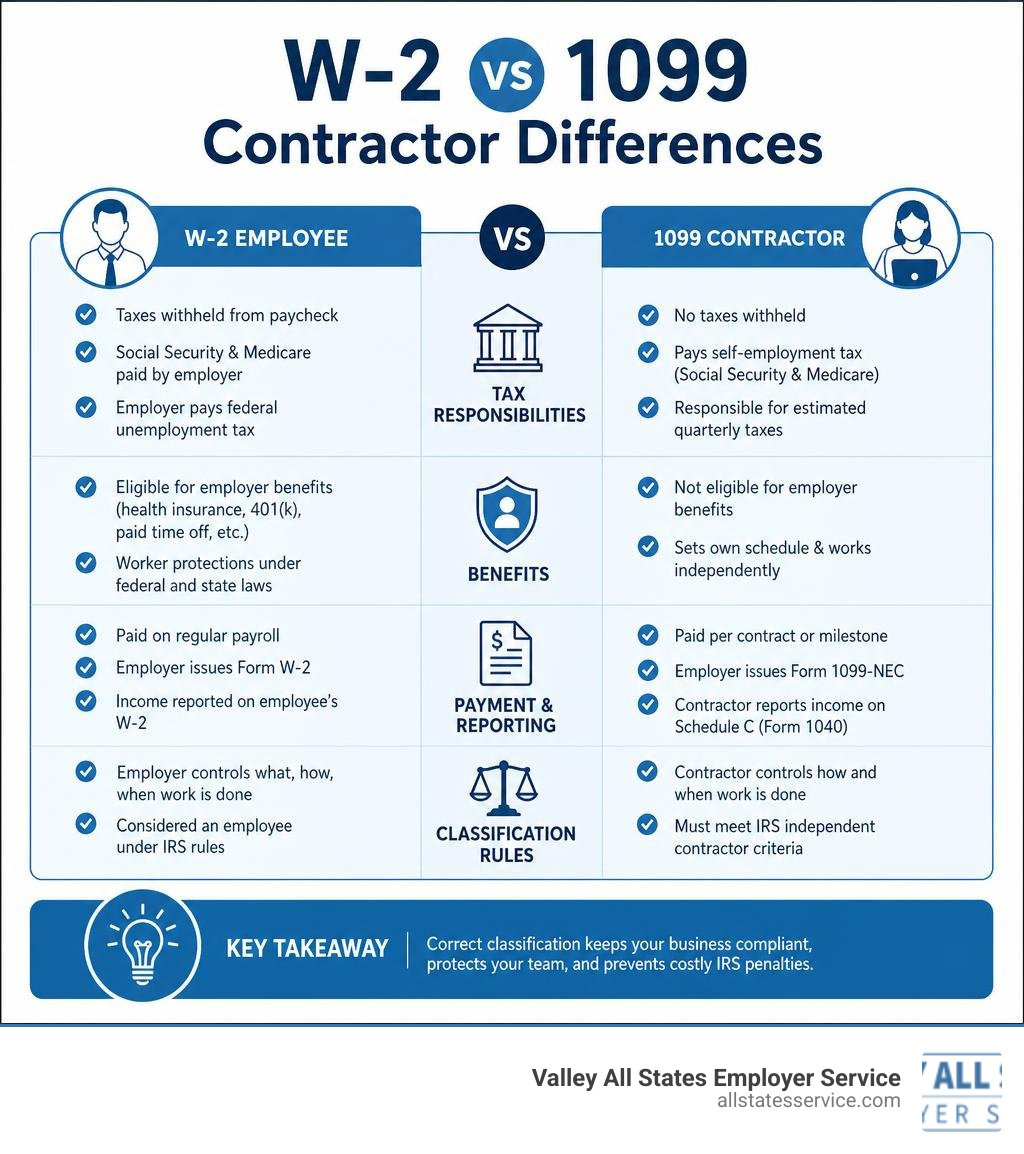
Understanding the divide between employees and contractors is the foundation of compliant workforce management. The IRS looks closely at the level of control a business has over a worker to determine their true classification.
Here are the four primary pillars of this distinction:
- Tax Withholding: For employees, we must withhold income, Social Security, Medicare, and unemployment taxes. For contractors, we make no withholdings, and they handle their own quarterly tax obligations.
- Benefit Eligibility: Employees are typically eligible for company-sponsored health insurance, retirement plans, paid time off, and workers’ compensation coverage. Independent contractors are not eligible for these benefits.
- Behavioral Control: If we dictate exactly how, when, and where the work must be done, the worker is likely an employee. Contractors generally set their own hours, use their own tools, and decide how to accomplish the agreed-upon tasks.
- Financial Control: Employees are usually paid a regular wage and do not realize a business profit or loss. Contractors often submit invoices, negotiate their rates, work with multiple clients simultaneously, and can experience a profit or financial loss on their work.
Risks of In-House Contractor Management
Managing contractor payments manually or through a basic bookkeeping system might seem manageable when you only have one or two freelancers. However, as your business scales, keeping this process in-house presents serious operational and legal risks.
Misclassification is by far the most dangerous risk. Federal agencies and state departments of labor actively audit businesses to catch companies that treat workers like employees but pay them as contractors. If the government finds that you have misclassified your team, you could face massive penalties, including back taxes, unpaid overtime claims, and interest charges.
Beyond the legal threats, the daily administrative burden can quickly overwhelm your back office. Chasing down signed W-9s, manually keying in invoice details, calculating payments across different project rates, and mailing out year-end physical tax forms takes hours of valuable time. Manual data entry also increases the likelihood of payment errors, which can damage your professional relationships with top talent.
If you find yourself buried under a mountain of contractor spreadsheets, it might be time to read Why You Should Outsource Payroll Before You Lose Your Mind.
Choosing the Right Contractor Payroll Service

Finding the right platform or partner to manage your contingent workforce requires looking at your specific business model. Some companies only need a basic software tool to send occasional payments, while others require a fully managed system that acts as an Employer of Record.
Pricing models vary across the industry. Some platforms offer contractor-only plans that charge a low flat monthly fee plus a small per-contractor rate, which is only billed in the months you actually pay them. Other services bundle contractor payments into their standard W-2 payroll packages, which might require a higher base fee.
To understand the financial and time-saving benefits of making this transition, explore Outsourced Payroll Solutions: How US Businesses Can Reclaim Their Time.
Key Features of a Dedicated Contractor Payroll Service
When evaluating your options, look for a platform that automates the tedious parts of contractor management. A modern service should offer:
- Self-Onboarding Portals: Instead of you manually gathering documents, the system invites the contractor to securely upload their bank details and sign their W-9 online.
- Flexible Payment Options: Contractors appreciate fast payment cycles. Look for services that offer direct deposit, same-day ACH, or even prepaid debit cards.
- Time Tracking and Software Integrations: The platform should connect directly with your existing timecards, project management systems, and accounting software to eliminate double data entry.
- Automated Tax Filing: The system must automatically generate, distribute, and file Form 1099-NEC at the end of the year.
To see how these features look in action, you can review the Top Contractor Payroll Software for 1099 Workers | OnPay.
Comparing Top Contractor Payroll Service Providers
To help you find the best fit, we have outlined how the leading platforms compare in terms of pricing, features, and target audiences.
| Provider | Base Price | Per-Contractor Price | Best For | Key Strengths |
|---|---|---|---|---|
| Gusto | $35/month | $6/contractor paid | Small businesses paying a mix of W-2 and 1099 workers | Highly rated for usability, excellent self-onboarding, and automated 1099 filing. |
| Square Payroll | $0/month (contractor-only) | $6/contractor paid | Businesses already using the Square POS ecosystem | No monthly base fee for contractor-only plans, imports timecards directly. |
| QuickBooks Payroll | $15/month (up to 20 contractors) | $2/additional contractor | Businesses using QuickBooks Online for accounting | Seamless accounting integration, next-day direct deposit. |
| OnPay | $40/month | $6/contractor paid | Growing teams wanting flat-rate pricing | Unlimited pay runs, supports onboarding with an ITIN, excellent customer support. |
| ADP (Roll) | Varies by plan | Varies by plan | Mobile-first business owners | Chat-based payroll execution, robust compliance backing from a global leader. |
Tax Compliance and 1099-NEC Filing Requirements
Tax compliance is the main reason businesses partner with a dedicated contractor payroll service. The IRS requires us to report non-employee compensation of $600 or more in a calendar year using Form 1099-NEC.
To remain compliant, we must collect a signed W-9 form from every contractor before we issue their first payment. This form verifies their tax classification, legal name, address, and Social Security Number or Employer Identification Number.
A quality payroll service will securely store these documents and automatically track your total payments to each worker. When January arrives, the system prepares the 1099-NEC forms, sends digital copies to your contractors, and files the required documents with the IRS and state tax agencies.
To learn more about how automated systems handle this process, check out the resources on Payroll for 1099 Contractors | Paychex.
Managing Multi-State and International Payments
As remote work continues to grow, many businesses hire contractors who live in different states or even different countries. This introduces complex local tax laws and state reciprocity agreements.
If your business is based in Maryland, for example, but you hire a contractor in another state, you must ensure that your payment tracking aligns with both federal guidelines and local state reporting requirements. Some states have specific filing thresholds for non-employee compensation that differ from the federal $600 limit.
For businesses working with international talent, the compliance landscape is even more complex. You must collect Form W-8BEN for foreign individuals to certify their non-U.S. tax status. The right payroll platform will help you manage these international documents and handle cross-border payments in local currencies without excessive transfer fees.
To explore how modern software handles these global payment challenges, read the guide on the 11 Best Contractor Payroll Software for US Employers in 2026 – Wise.
Frequently Asked Questions about Contractor Payroll
How do contractor payroll services handle year-end tax filing?
Contractor payroll platforms automate the entire year-end reporting process. Throughout the year, the software tracks every dollar paid to your 1099 workers.
In January, the system automatically generates Form 1099-NEC for any contractor who met the reporting threshold. The platform will deliver a digital copy to the contractor through their secure self-service portal, and it will electronically file the required copies with the IRS and relevant state tax departments.
Can I pay both W-2 employees and 1099 contractors through the same system?
Yes, most modern payroll platforms allow you to manage a blended workforce from a single dashboard. You can run your regular, scheduled payroll for W-2 employees with tax withholdings, and also run separate, unlimited contractor pay runs as invoices are approved.
Keeping both types of workers in one system simplifies your financial reporting and ensures that your worker classifications remain distinct and organized.
What are the penalties for misclassifying a worker?
The penalties for misclassifying an employee as an independent contractor can be severe. If the IRS or state authorities determine that a worker should have been classified as an employee, you may be held liable for:
- Back taxes for federal and state income withholdings
- Unpaid Social Security and Medicare taxes (FICA)
- Unpaid federal and state unemployment taxes (FUTA and SUTA)
- Workers’ compensation back-premiums and unpaid overtime wages
- Substantial interest charges and failure-to-file penalties
Using a dedicated payroll service and establishing clear worker agreements is the best way to protect your business from these costly audits.
Streamlining Your Workforce Operations
Paying your contractors accurately and on time keeps your projects moving forward, but tax reporting is only one piece of the employment compliance puzzle. Before you can safely pay any worker, you must verify that they are legally authorized to work in the United States.
This is where we can help. At Valley All States Employer Service, we specialize in providing outsourced E-Verify workforce eligibility verification for employers. Our team takes the administrative burden off your shoulders, ensuring your hiring processes remain fully compliant with federal regulations while minimizing errors.
By combining an automated payroll system with our expert E-Verify processing, you can create a seamless, risk-free onboarding experience for your entire workforce.
To eliminate administrative headaches and secure your business compliance, Stop the Spreadsheet Madness with a Modern Outsourced Payroll Solution.
Ready to simplify your workforce operations and secure your compliance? Learn more about our payroll outsourcing solutions today.