
Stop the Spreadsheet Madness with a Modern Outsourced Payroll Solution
Why You Should Outsource Payroll Before You Lose Your Mind
An outsourced payroll solution could be the single smartest move your business makes this year. If you’re an HR manager juggling spreadsheets, chasing down timesheets, and lying awake wondering if you filed that quarterly tax form correctly, you’re not alone.
Here’s a quick answer for busy readers:
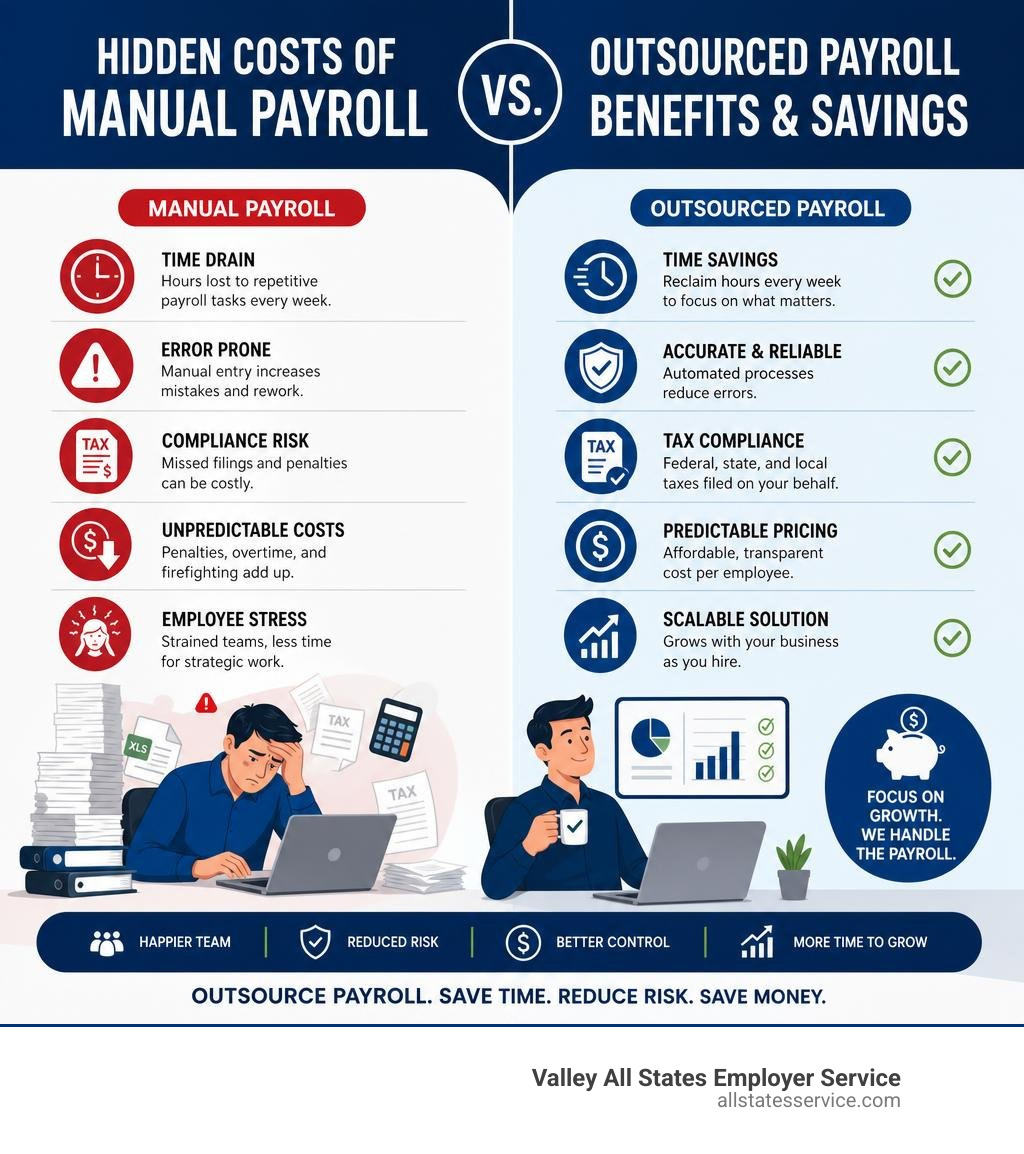
An outsourced payroll solution is a service where a third-party provider handles your payroll processing, tax filing, compliance, and reporting, so your internal team doesn’t have to. Key benefits include:
- Time savings – most businesses reclaim hours of admin work every week
- Fewer errors – automated calculations replace error-prone manual entry
- Tax compliance – providers file federal, state, and local taxes on your behalf
- Cost control – predictable pricing (typically $30-$100 per employee per month)
- Scalability – the service grows as your headcount grows
The numbers tell a hard story. The IRS assessed $26.8 billion in civil penalties on employment tax returns in fiscal year 2024 alone. Meanwhile, 40% of small businesses get fined every year for incorrect payroll tax filings, paying an average of $845 per violation. And if your HR team feels stretched thin, that’s not just a feeling. Research shows 57% of HR professionals are already working beyond capacity, with nearly two-thirds spending 11 or more hours every single week on HR administration tasks.
Something has to give. Payroll doesn’t have to be your team’s problem anymore.
Basic outsourced payroll solution vocab:
The High Cost of Manual Payroll and Spreadsheet Madness

Many businesses start out managing payroll on a simple spreadsheet. It seems harmless at first, but as your team grows, that spreadsheet quickly morphs into a ticking compliance time bomb. Manual entry is slow, tedious, and highly prone to human error. When you are typing in hours, calculating overtime, and trying to track shifting tax codes, one wrong keystroke can cost you thousands of dollars.
The financial stakes are incredibly high. According to the IRS Data Book, the IRS assessed $26.8 billion in civil penalties on employment tax returns in fiscal year 2024 and another $20.2 billion on business tax returns. IRS figures indicate that 40% of small businesses are fined each year for incorrect payroll tax filing, paying an average penalty of $845 per year for late or incorrect filings. These are not just minor slaps on the wrist, they are real financial drains that can damage your bottom line.
Beyond the financial penalties, manual processing takes a massive toll on your people. According to industry data, 57% of HR professionals are already working beyond capacity, leading to higher stress, burnout, and turnover. Nearly two-thirds of respondents in a recent business study said they spend at least 11 hours each week on HR administration.
When your leadership team is stuck in spreadsheet purgatory, they cannot focus on hiring, retention, or growth. That is why choosing an external payroll system is often described as a lifesaver for growing companies.
Why Your Business Needs an Outsourced Payroll Solution

Transitioning to a modern outsourced payroll solution is about reclaiming your time and sanity. By handing the administrative heavy lifting over to specialized experts, you instantly insulate your business from costly errors. You also gain access to enterprise-grade tools that make life easier for your entire team.
The most immediate benefit is time savings. Instead of spending hours cross-checking timesheets and manually calculating local taxes, your team can approve payroll in just a few clicks. This allows your HR and finance staff to redirect their energy toward strategic initiatives that actually generate revenue.
Accuracy and security also get a massive upgrade. Reputable payroll providers use advanced encryption, secure servers, and strict access controls to safeguard sensitive business and employee information. They also undergo regular third-party audits to verify their security practices, giving you peace of mind that your bank details and social security numbers are safe.
Modern solutions also offer excellent scalability and employee self-service. Your team members can log into a mobile app to view their pay stubs, request time off, download W-2s, and manage their direct deposit details. This drastically reduces the number of administrative questions your HR team has to answer every week. If you are looking to keep costs predictable, partnering with affordable payroll services helps you budget effectively with transparent, scalable pricing.
Key Features of a Full-Service Outsourced Payroll Solution
A truly comprehensive outsourced payroll solution does far more than just print checks. It manages the entire lifecycle of payroll and tax compliance. Here is what you should expect from a full-service provider:
- Automated Tax Withholding and Filing: The provider calculates, withholds, and files federal, state, and local taxes, ensuring you never miss a deadline.
- W-2 and 1099 Processing: At the end of the year, the service prepares and distributes tax forms to your employees and independent contractors.
- Garnishment Administration: If an employee has court-ordered wage garnishments, the provider calculates and sends those payments automatically.
- Benefits Integration: Deductions for health insurance, HSA accounts, and 401(k) plans are automatically pulled from employee paychecks.
- Time and Attendance Tracking: Employees can clock in and out directly through the platform, which syncs hours directly to the payroll run.
- PTO Management: Accruals, requests, and approvals for paid time off are handled in one unified dashboard.
In-House vs. Outsourced Payroll: A Direct Comparison
When deciding how to manage your payroll, you generally have to choose between running it in-house with software or completely outsourcing it to a managed service.
Doing it in-house gives you total control, but it also leaves 100% of the compliance liability on your shoulders. If a tax rate changes or an employee is classified incorrectly, your business pays the fine.
With an outsourced payroll solution, you delegate the operational burden and the compliance monitoring to dedicated experts. Many full-service providers even guarantee accuracy, meaning they will pay the penalty if they make a tax filing error.
In terms of cost, in-house software might look cheaper upfront, but it has massive hidden costs in the form of employee labor hours and potential IRS fines. Outsourced services typically use a Per Employee Per Month (PEPM) model, a flat monthly fee, or a per-payroll-run fee. This makes your expenses highly predictable.
| Feature | In-House Payroll Software | Fully Outsourced Payroll Service |
|---|---|---|
| Who Runs It? | Your internal staff | Dedicated payroll specialists |
| Compliance Responsibility | Entirely on your business | Shared or fully managed by the provider |
| Time Commitment | High (hours per week) | Low (minutes per pay cycle) |
| Data Security | Dependent on your local IT setup | Enterprise-grade encryption and audits |
| Year-End Tax Forms | Manual generation and filing | Fully automated W-2 and 1099 processing |
| System Integrations | Often manual or requires custom APIs | Built-in integrations for HR, time, and benefits |
Navigating Compliance, Taxes, and Multi-State Rules
If you employ workers in multiple states, or even just in different counties within Maryland, compliance can quickly become a nightmare. Every local jurisdiction has its own tax rates, filing deadlines, and labor laws. Keeping track of these changes is a full-time job.
For example, employers in Lutherville MD must comply with Maryland state tax requirements alongside federal regulations. If your business hires remote workers in neighboring states, you suddenly have to register with multiple state tax agencies and track varying paid leave mandates.
This is where national payroll services shine. They monitor changing legal requirements and taxation rules across all 50 states, ensuring your payroll remains compliant no matter where your employees live.
Mitigating Risks and Challenges in Payroll Outsourcing
While outsourcing payroll offers incredible benefits, it is not entirely without risk. You must choose your partner carefully to avoid data privacy breaches, partner availability issues, or fragmented data.
To prevent data silos, look for a provider that offers a unified platform. Managing payroll, benefits, and time tracking in separate systems often leads to manual data entry errors and security vulnerabilities.
Before making the switch, read through a trusted guide to national payroll services to understand how to evaluate security standards and service level agreements.
The best way to mitigate transition risk is through parallel run testing. During your onboarding phase, you should run your new payroll system alongside your old system for at least one or two cycles. This allows you to compare the calculations side-by-side and resolve any discrepancies before you officially cut ties with your old process.
How to Choose the Right Outsourced Payroll Solution for Your Team
Selecting the right payroll partner requires looking beyond the price tag. You need to evaluate their technology, customer support, and track record.
A great place to start is by checking the provider’s Net Promoter Score (NPS). While some massive industry giants struggle with customer service and have NPS scores in the single digits, other dedicated payroll providers consistently score around 80, indicating exceptional client satisfaction and responsive support.
You should also look for a partner that can scale with your business. If you plan to expand your team, offer new healthcare plans, or hire out-of-state contractors, your payroll provider must be able to support those changes without forcing you to migrate to a new platform.
For local businesses, partnering with regional experts can provide the personalized, high-touch support your team needs.
Be sure to read through a definitive list of processing firms to compare features, pricing structures, and integration capabilities before making your final decision.
Frequently Asked Questions About Payroll Outsourcing
What is the difference between a PEO and an outsourced payroll service?
A Professional Employer Organization (PEO) operates under a co-employment model. This means the PEO becomes the employer of record for tax and insurance purposes, sharing employment liability with your business and allowing you to access their large-group benefits packages.
An outsourced payroll service, on the other hand, handles your payroll processing, tax filings, and reporting, but you remain the sole employer of record and retain full liability. For a deeper dive into these options, check out The Complete Guide to Employee Payroll Solutions.
How long does it take to transition to an outsourced payroll provider?
Most businesses can successfully transition to a new provider within a few weeks. The timeline depends heavily on how quickly you can gather your historical payroll data, employee tax forms, and bank information.
Once your data is imported, your provider will guide you through a parallel run to test the system before executing a safe cutover. You can learn more about how these digital transitions work by exploring the benefits of a web-based payroll service.
Will I lose control over my business payroll if I outsource?
Not at all. You retain complete decision-making authority over pay rates, schedules, employee classifications, and benefits.
The outsourced provider simply handles the administrative calculations and compliance filings based on the hours and instructions you submit. You will still review and approve every payroll draft before any funds are moved. For accounting firms and businesses looking to optimize this balance, Unlocking Efficiency: The Ultimate Guide to Outsourced Payroll for Accounting Firms offers excellent workflow strategies.
Conclusion
Managing payroll doesn’t have to be a weekly source of stress and administrative burnout. By transitioning from manual spreadsheets to a modern outsourced payroll solution, you can protect your business from costly IRS penalties, reclaim valuable hours for your HR team, and provide a seamless, modern experience for your employees.
While you are modernizing your administrative processes, do not overlook employee onboarding and workforce eligibility. At Valley All States Employer Service, we specialize in providing outsourced E-Verify workforce eligibility verification for employers. Operating across the United States, Maryland, and right here in Lutherville MD, our expert team ensures your E-Verify processing is completely impartial, highly efficient, and fully compliant, minimizing errors and taking the administrative burden off your shoulders.
Ready to reclaim your time and simplify your business compliance? Explore our comprehensive payroll outsourcing solutions and contact our team today to get started.