
The Ultimate Gallery of Completed I-9 Examples
Why Reviewing a Sample Completed I-9 Form Can Save Your Business From Costly Mistakes
A sample completed I-9 form is one of the fastest ways for HR managers to understand exactly what correct, compliant documentation looks like before onboarding a single new hire.
Here’s a quick overview of what a properly completed Form I-9 includes:
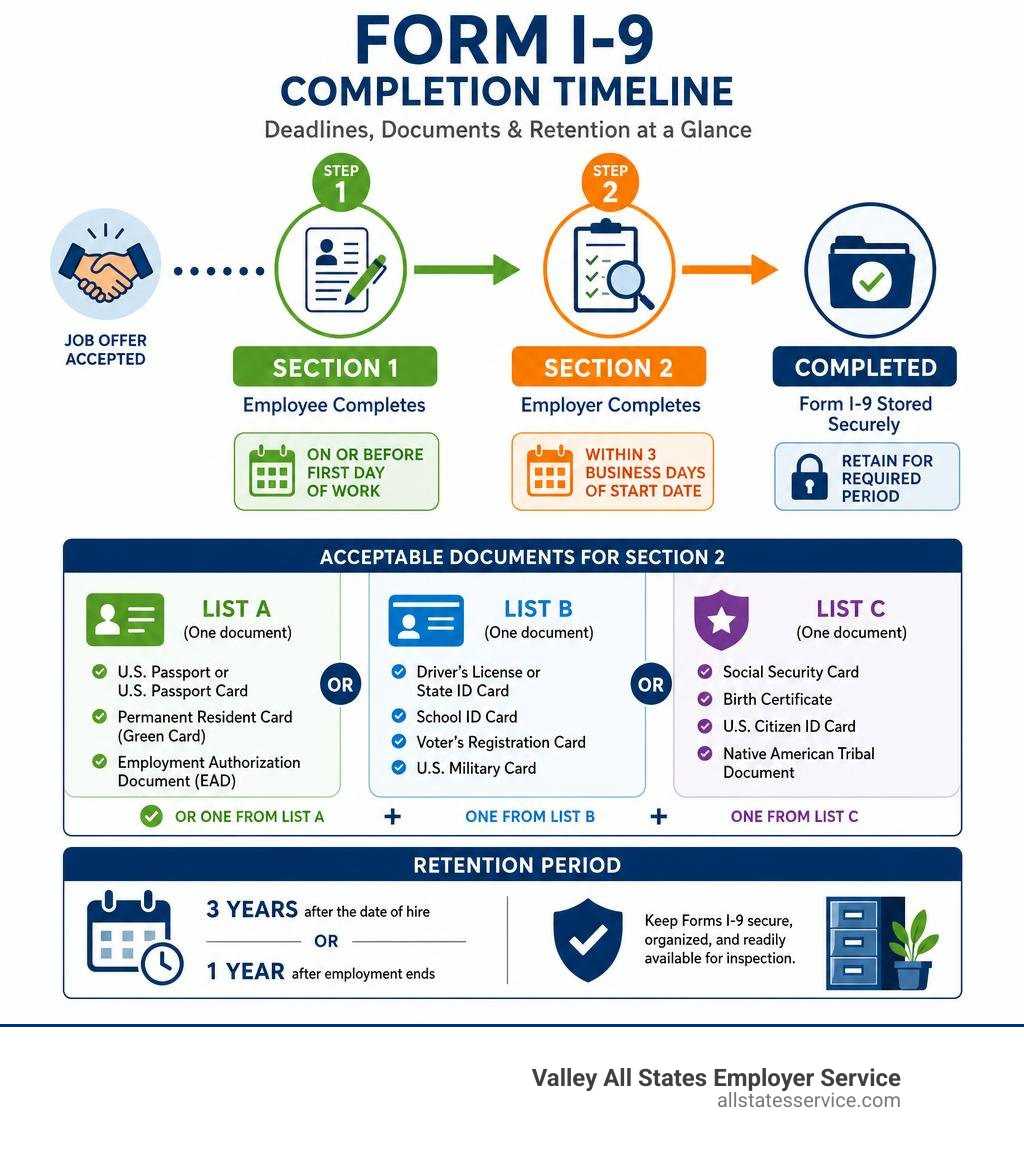
- Section 1 – Filled out by the employee on or before their first day of work (name, address, citizenship status, signature)
- Section 2 – Completed by the employer within 3 business days of the employee’s start date (document review and certification)
- Supplement A – Used only when a preparer or translator helps the employee complete Section 1
- Supplement B – Used for reverification or rehire situations
Every U.S. employer must complete Form I-9 for every person hired after November 6, 1986. That’s not optional. It’s federal law under the Immigration Reform and Control Act.
And yet, even small errors on this form can trigger fines ranging from hundreds to thousands of dollars per form.
The problem isn’t usually that employers don’t care. It’s that the form looks simple but has more moving parts than most people expect. Different employee types, different document combinations, and different deadlines create a lot of room for mistakes.
That’s exactly why looking at real, completed examples is so valuable. Seeing a finished form for a U.S. citizen, a lawful permanent resident, or a noncitizen authorized to work makes the requirements click in a way that reading instructions alone rarely does.
This guide walks you through those examples, section by section.
Simple guide to sample completed i 9 form:
- handbook for employers guidance for completing form i 9
- i9 list b and c
- permanent resident card i9 example
What is Form I-9 and Why is it Required?
The Immigration Reform and Control Act of 1986, often called IRCA, changed the hiring landscape for all U.S. employers. Under this federal law, we are required to verify the identity and employment authorization of every single individual we hire for work in the United States. This mandate applies to U.S. citizens and noncitizens alike.
To comply with this law, employers must use the official Form I-9. Failing to properly complete, sign, or retain this document can expose your business to severe civil and criminal penalties. Immigration and Customs Enforcement audits are common, and simple paperwork errors can quickly add up to massive fines.
Before you begin the verification process with a new hire, it is always a good practice to download a clean copy of the document. You can find one by accessing a Don’t Draw a Blank on Your Blank I-9 Form resource to make sure you are using the most current, unexpired version.
Step-by-Step Guide to a Sample Completed I 9 Form
Completing the Form I-9 is a shared responsibility between the new hire and the employer. The process is governed by strict federal timelines, commonly known as the “one day and three day” rules.
To ensure your business remains compliant, you should reference the Form I-9, Employment Eligibility Verification directly from the USCIS. Having a clear workflow for I-9 Form Completion helps prevent late filings and missing signatures.
Section 1: Employee Information and Attestation
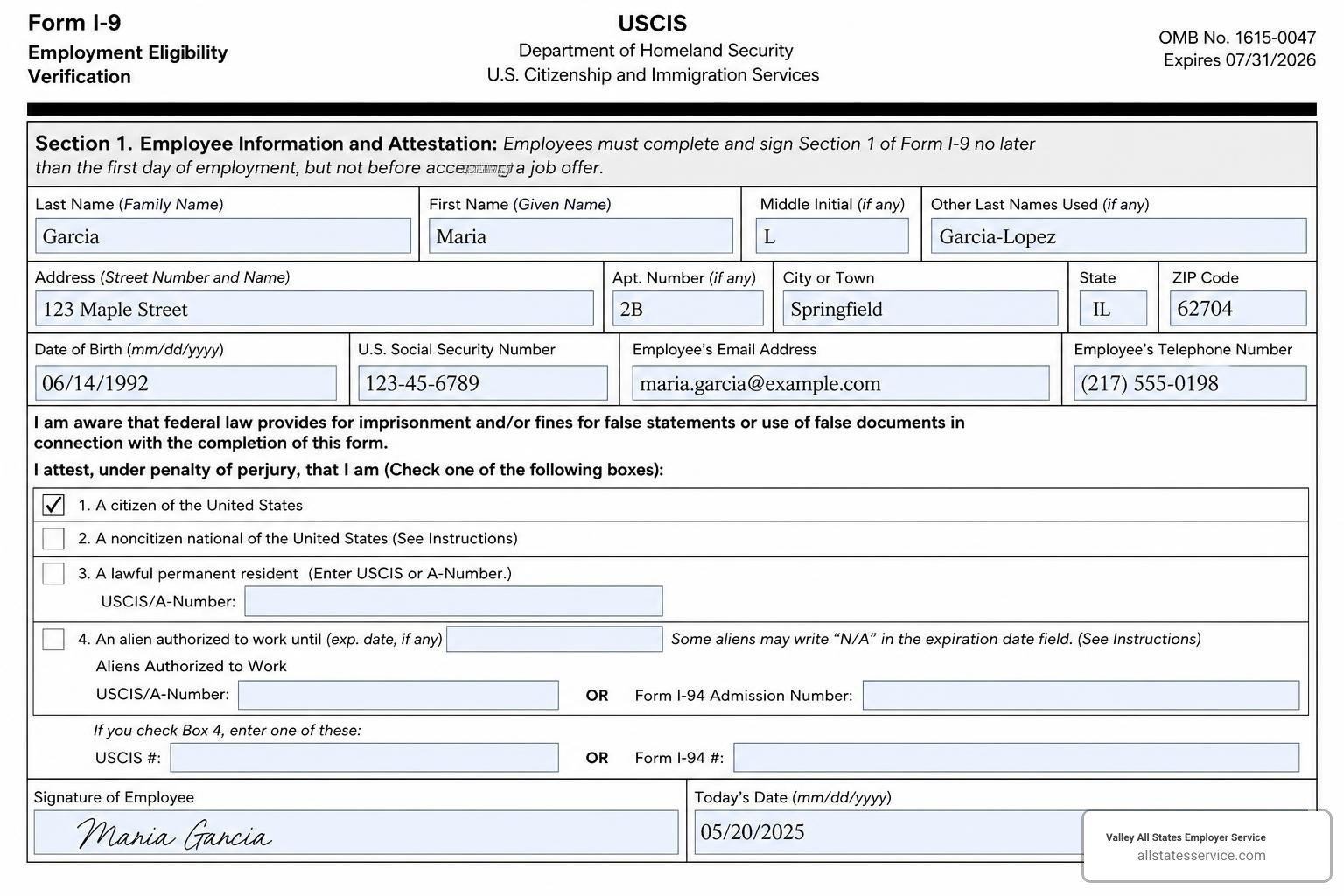
The newly hired employee is solely responsible for completing Section 1. This must be done no later than their very first day of employment, but it can never be completed before the employee has accepted your job offer.
In this section, the employee enters their full legal name, address, date of birth, and citizenship status. While providing a Social Security number is generally voluntary, it is mandatory if your business participates in E-Verify.
If the employee needs assistance, a preparer or translator can help, but they must complete Supplement A, Preparer and/or Translator Certification. To help your team guide new hires through this initial step, you can share our guide on how to Complete Your I-9 Employment Authorization Form Like a Pro.
Section 2: Employer Review and Verification
As the employer, we must complete Section 2 within three business days of the employee’s first day of work for pay. For example, if an employee starts working on a Monday, Section 2 must be finished by Thursday.
During this step, you must physically examine the employee’s original, unexpired documents to confirm their identity and authorization to work. You must record the document title, issuing authority, document number, and expiration date directly on the form.
If you hire remote workers, you can designate an authorized representative to perform the physical document review on your behalf, though your business remains legally liable for any mistakes they make. For a deeper dive into these requirements, read our I-9 Section 2 Complete Guide.
Visual Examples of Completed Forms for Different Employee Types
The documents an employee presents will vary based on their citizenship or immigration status. Employees must be allowed to choose which acceptable documents they want to present from the official list.
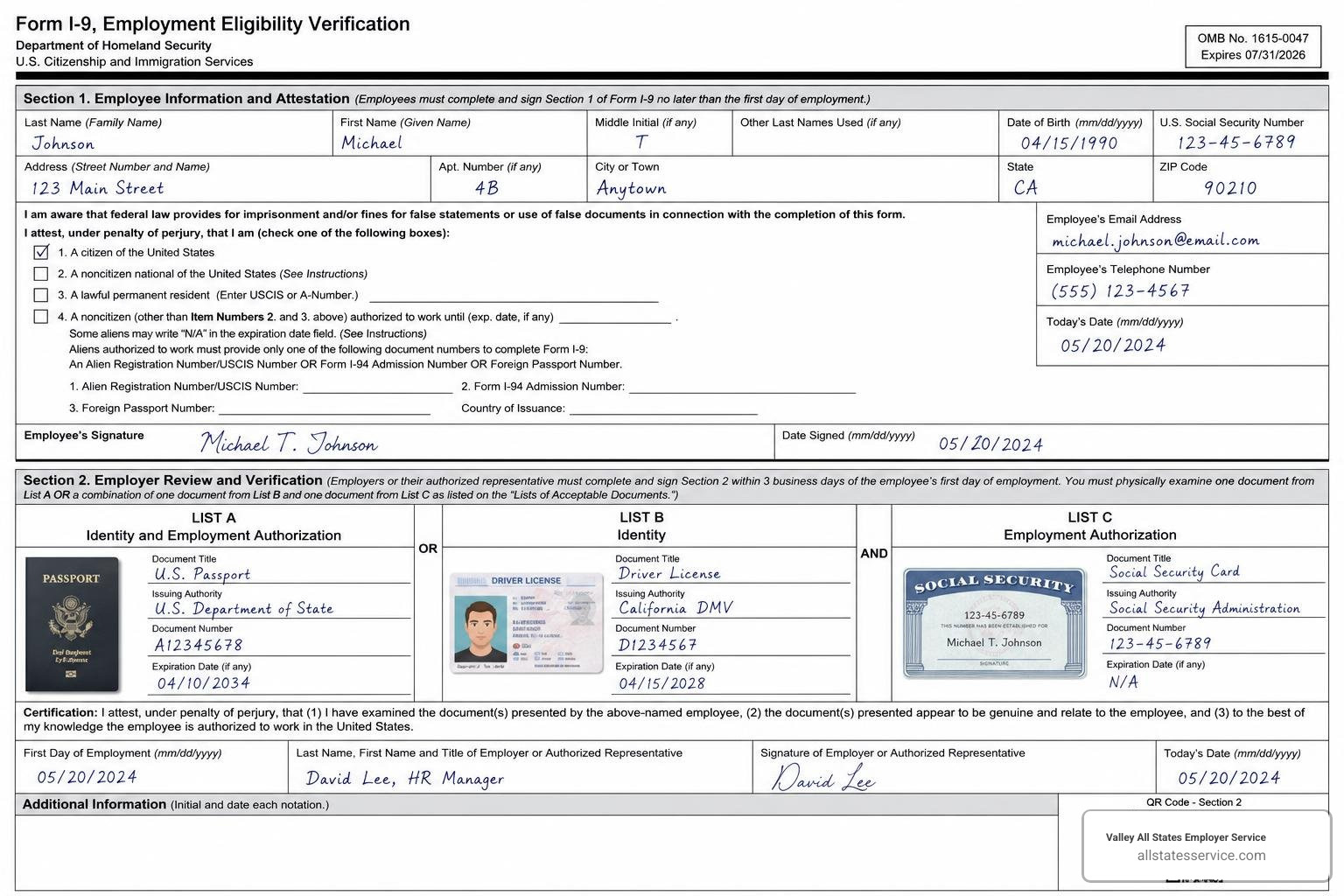
An employee must present either one document from List A, which establishes both identity and work eligibility, or a combination of one document from List B, establishing identity, and one document from List C, establishing work eligibility.
U.S. Citizen Sample Completed I 9 Form
For a U.S. citizen, the verification process is usually straightforward. Many citizens choose to present a U.S. passport, which is a List A document. In this case, you only need to record the passport information in Section 2, leaving the List B and List C columns completely blank.
Alternatively, a U.S. citizen might present a driver’s license for List B and an unrestricted Social Security card for List C. You can see how this combination looks on a completed form by reviewing The Perfect I-9: A Completed I-9 Form Example to Save Your Sanity. For additional academic and institutional examples, you can also look at Examples of Completed Form I-9 for Stanford – Fingate .
Lawful Permanent Resident Sample Completed I 9 Form
A Lawful Permanent Resident will typically present a Permanent Resident Card, also known as Form I-551 or a “green card.” This is a List A document that establishes both identity and employment eligibility.
When recording a Permanent Resident Card, make sure to enter the card number and the expiration date. It is important to note that even though these cards expire, you do not need to perform reverification when they do, as long as the employee’s employment remains continuous. To see this scenario in action, look at our guide to See Exactly What a Completed I-9 Form Looks Like.
Noncitizen Authorized to Work
Noncitizens who are authorized to work in the U.S. present a wider variety of documents. An employee might present an Employment Authorization Document, Form I-766, which is a List A document.
Other noncitizens, such as international students on F-1 visas, will present a foreign passport combined with a Form I-94 arrival record and a Form I-20. For exchange visitors on J-1 visas, they will present a passport, Form I-94, and Form DS-2019. Recording these multi-document combinations requires precision, which is why we created The Ultimate Guide to Completing I-9 Form Examples and Instructions to guide you through the process.
Handling Reverifications, Rehires, and Special Situations
When an employee’s temporary work authorization is about to expire, employers must perform reverification before the expiration date to maintain continuous employment. This process is completed using Supplement B, Reverification and Rehire, which replaces the older Section 3 of the form.
You also use Supplement B if you rehire an employee within three years of the date their original Form I-9 was completed. In this situation, you can inspect their previous documentation to see if they are still authorized to work.
Special rules also apply to minors under the age of 18 and individuals with disabilities who cannot present a standard List B identity document. In these cases, a parent or legal guardian can complete Section 1 on their behalf, and the employer writes “Special Procedures” in the Section 2 document fields. For a complete walkthrough of these unique situations, read our Form I-9 Verification: A Step-by-Step Walkthrough for Employers guide.
Common I-9 Mistakes and Compliance Penalties
Even the most organized HR teams can make mistakes on Form I-9. However, during an Immigration and Customs Enforcement audit, simple oversights can lead to costly civil fines.
| Common Form I-9 Error | Compliance Consequence | How to Avoid It |
|---|---|---|
| Missing employee signature in Section 1 | Considered an incomplete form; subject to fines | Implement a day-one onboarding checklist |
| Accepting expired documents | Invalidates the verification; potential civil penalties | Ensure all documents are unexpired at review |
| Completing Section 2 after 3 business days | Late filing violation | Track hire dates and complete Section 2 on time |
| Requesting specific documents from employees | Document abuse and discrimination risk | Allow employees to choose from the acceptable list |
| Keeping forms longer than the retention window | Unnecessary liability during audits | Purge records securely once the retention period ends |
Using a digital system or partnering with an expert service can help you catch these errors before they become a liability. If you are managing the paperwork yourself, reviewing the rules for Filling Out an I-9 Employer can keep your files in order.
Frequently Asked Questions About Form I-9
Navigating federal compliance can raise a lot of questions. Here are some of the most common questions employers ask about the Form I-9 process.
What are the acceptable receipts and how long are they valid?
In certain situations, an employee can present a receipt instead of an original document. The most common receipt is for a replacement document when the original was lost, stolen, or damaged. This receipt is temporary and is valid for 90 days from the date of hire. By the end of this 90-day window, the employee must present the actual, original replacement document to complete the verification.
Can an employer specify which documents an employee must present?
No, employers cannot specify which documents an employee must present. Doing so is considered document abuse and violates federal anti-discrimination laws. The employee has the absolute right to choose any document from List A, or any combination of documents from List B and List C, as long as they are on the official Lists of Acceptable Documents.
How long must employers retain completed Form I-9 records?
Employers must retain a completed Form I-9 for either three years after the employee’s date of hire, or one year after the date their employment ended, whichever date is later. It is highly recommended to store these forms in a secure location separate from general personnel files to protect employee privacy and simplify the process during an audit.
Conclusion
Managing Form I-9 compliance does not have to be a source of stress for your HR department. By studying a sample completed i 9 form and establishing clear internal workflows, you can protect your business from costly errors and penalties.
At Valley All States Employer Service, we specialize in outsourced workforce eligibility verification, operating out of Lutherville MD to serve employers across Maryland and the United States. We provide expert, impartial, and highly efficient E-Verify processing that takes the administrative burden off your shoulders while keeping your business fully compliant.
Ready to simplify your onboarding and eliminate compliance anxiety? Let us handle the details. Explore our comprehensive I-9 compliance services guide and reach out to our team today to get started.