Mastering HR Compliance E-Verify Without Breaking a Sweat
Why HR Compliance E-Verify Matters More Than Ever in 2026
HR compliance E-Verify is the process of using the federal E-Verify system to confirm that every new hire is legally authorized to work in the United States, and it’s one of the most important steps in your onboarding workflow.
Here’s a quick snapshot of what you need to know:
- What it is: E-Verify is a free, internet-based system run by the U.S. Department of Homeland Security (DHS) and the Social Security Administration (SSA). It checks information from a new hire’s Form I-9 against millions of government records.
- Who must use it: Federal contractors, employers in mandatory states (like Alabama, Arizona, Georgia, Florida, and more), and any employer using remote I-9 verification.
- How fast it works: Results come back in as little as 3 to 5 seconds in most cases.
- Key deadline: You must create an E-Verify case no later than the third business day after the employee starts work for pay.
- What can go wrong: Skipping cases, late submissions, or mishandling mismatches can lead to fines, contract loss, or license suspension.
If you’re an HR manager juggling onboarding, benefits, and a dozen other priorities, keeping up with E-Verify rules can feel overwhelming. The regulations span federal mandates, a patchwork of state laws, strict timelines, and detailed case-handling procedures. One missed step can put your business at real legal risk.
The good news? Once you understand how the system works, compliance becomes a repeatable, manageable process.
This guide walks you through everything, from the basics of Form I-9 and E-Verify integration to handling mismatches and staying current with 2025 and 2026 updates.
Key terms for hr compliance e-verify:
The Essentials of HR Compliance E-Verify and Form I-9
To master hr compliance e-verify, we first have to talk about its inseparable partner: Form I-9. Think of Form I-9 as the foundation and E-Verify as the high-tech inspector that double-checks the work. While Form I-9 has been the standard for identity and work authorization since 1986, E-Verify adds a layer of digital certainty by comparing that data against DHS and SSA records.
When you use E-Verify and I-9 together, you are doing more than just filling out paperwork. You are actively confirming that the person sitting across from you is who they say they are and that they have the legal right to work in the U.S. This process is the gold standard for maintaining a legal workforce. According to the USCIS Handbook for Employers, E-Verify is the best web-based companion to ensure your I-9s are accurate.
Streamlining Your HR Compliance E-Verify Workflow
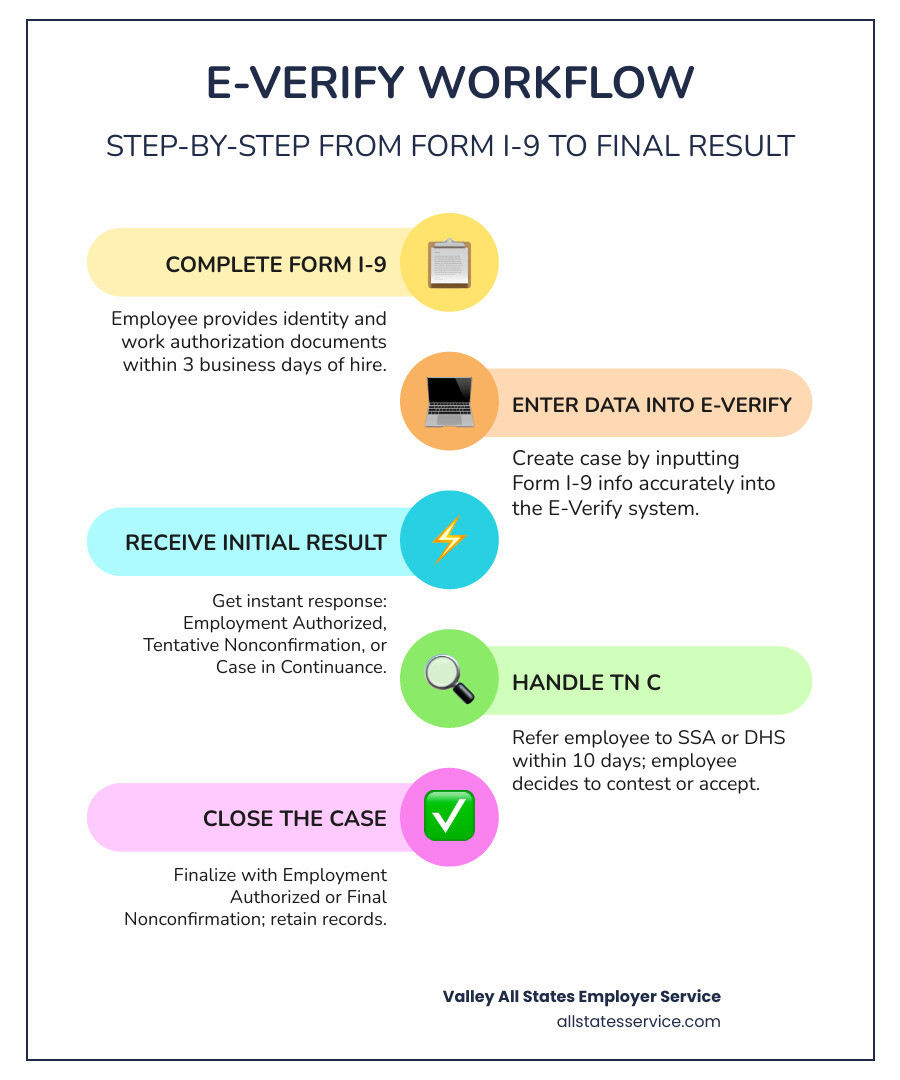
Efficiency is the name of the game in HR. The standard “three-day rule” is the most critical timeline to remember. You must create an E-Verify case no later than the third business day after the employee starts work for pay. If you hire someone on a Monday, you need that case submitted by Thursday.
To make this work without the stress, many businesses look into the E-Verify registration process early. Setting up your account, choosing your access method, and training your staff before the hiring surge begins is vital. Automated systems or integrated HR software can help pull data directly from electronic I-9s into E-Verify, reducing the “fat-finger” typos that lead to unnecessary mismatches.
Avoiding Penalties Through HR Compliance E-Verify Audits
No one likes the word “audit,” but internal reviews are your best friend for E-Verify I-9 compliance. By regularly checking your own records, you can catch missing cases or late submissions before a government inspector does.
If you do find an error, documenting your “good faith efforts” to correct it can go a long way in mitigating fines. Federal and state agencies look more favorably on employers who have a clear policy for record retention and consistent internal audits. The goal isn’t just to pass an inspection, it is to prove you are committed to a compliant, authorized workforce.
Navigating Federal and State Mandates in 2026
As of April 2026, the landscape of E-Verify requirements is a mix of federal rules and a growing list of state-specific mandates. For some, E-Verify is a choice; for others, it is a non-negotiable legal requirement.
If you are a federal contractor, you likely have the “FAR E-Verify clause” in your contracts. This means you must verify all new hires and, in some cases, existing employees assigned to the contract. There are E-Verify essentials every federal contractor should master to avoid losing lucrative government deals.
State laws add another layer of complexity. According to Equifax Workforce Solutions, several states require E-Verify for all or most employers:
- Alabama, Arizona, Mississippi, and South Carolina: These states generally require E-Verify for all employers, regardless of size.
- Georgia and North Carolina: Requirements often depend on the number of employees you have (e.g., 10 or 25+).
- Florida: Mandates apply to public employers and their contractors, with private employers required to use E-Verify or maintain specific document copies.
Keeping track of these geographic shifts is a full-time job. If you operate in multiple states, you have to ensure your onboarding process adapts to the strictest local law.
Managing the Verification Process and Case Results
Once you hit “submit” in the E-Verify portal, the system goes to work. In a perfect world, you get an “Employment Authorized” result in seconds. But what happens when the system needs a closer look?

One of the most important security features is Photo Matching. If an employee presents a U.S. Passport, Passport Card, Permanent Resident Card (Green Card), or Employment Authorization Document, E-Verify will display the photo they have on file. You must compare that digital image to the photo on the actual document the employee provided. It is a simple but powerful way to stop identity fraud.
For a deeper dive into these steps, you can refer to an E-Verify step-by-step user manual to see exactly what buttons to click. You might also see results like “Case in Continuance,” which means the government needs more time to check records, or “Final Nonconfirmation,” which usually means the employee is not authorized to work. You can find more official info on the E-Verify home page.
Handling Mismatches and Employee Rights
A Tentative Nonconfirmation (TNC), or “mismatch,” is not a reason to panic, and it certainly isn’t a reason to fire someone on the spot. A mismatch simply means the information entered didn’t immediately align with government records. It could be a name change, a typo in a Social Security number, or an outdated immigration status.
As an employer, you have specific E-Verify employer responsibilities when a mismatch occurs:
- Notify the employee privately: You must give them the “Further Action Notice” generated by the system.
- Give them a choice: The employee decides whether to contest the result.
- The 10-day window: Employees have 10 federal government working days to take action to resolve the issue with the SSA or DHS.
- No adverse action: You cannot fire, suspend, or delay training for an employee while they are in the process of resolving a TNC.
Treating employees fairly during this process is not just about being nice, it is about staying on the right side of anti-discrimination laws.
Best Practices for Long-Term Compliance Success
Looking ahead through 2026, the E-Verify system continues to evolve. One of the most exciting updates is E-Verify+. This service streamlines the process by allowing employees to create their own accounts and enter their information directly, reducing the administrative burden on your HR team.
We also have to talk about remote work. If you are an E-Verify participant in good standing, you can use the “Alternative Procedure” for remote I-9 verification. This allows you to examine documents over a live video call rather than requiring the employee to travel to your office. It’s a game-changer for distributed teams, but it requires strict adherence to the I-9 E-Verify Guide 2026 standards.
Other best practices for your team:
- Use Login.gov: Enhanced security for your E-Verify account is now the standard.
- Manage Historic Records: Be aware that USCIS periodically deletes old records. For example, cases updated before December 31, 2014, were scheduled for permanent deletion in early 2025. Always download your Historic Records Reports to keep your audit trail intact.
- Ongoing Training: Don’t let your E-Verify knowledge get rusty. Regular E-Verify best practices training for your HR staff ensures everyone knows the latest rules.
Frequently Asked Questions about E-Verify
What is the deadline for creating an E-Verify case?
You must create the case no later than the third business day after the employee starts work for pay. If they start on a Monday, the case must be in the system by the end of the day on Thursday.
Can I use E-Verify to screen job applicants before hiring them?
Absolutely not. Using E-Verify to “pre-screen” applicants is a major violation of the program’s rules and can lead to significant legal penalties for discrimination. You can only use the system after an offer has been accepted and the Form I-9 is completed.
What should I do if an employee receives a Tentative Nonconfirmation?
Provide them with the Further Action Notice immediately and explain their right to contest the finding. Continue to allow them to work while they resolve the mismatch with the SSA or DHS. Do not take any negative action against them during this time.
Mastering Compliance with Expert Support
Keeping your business compliant doesn’t have to be a solo mission. At Valley All States Employer Service, we specialize in taking the weight of hr compliance e-verify off your shoulders. We provide expert, impartial, and efficient E-Verify processing that minimizes errors and ensures you are meeting all federal and state mandates.
By outsourcing your verification needs to us, you can focus on growing your business while we handle the administrative heavy lifting. Whether you are navigating the FAR clause for federal contracts or managing a multi-state workforce, we ensure your verification process is seamless and secure.
Ready to simplify your verification process? Explore our E-Verify employment verification services.