
Choosing Your Payroll Partner The Definitive List of Processing Firms
Why Your Choice of Payroll Partner Matters More Than Ever
Payroll processing firms handle the complex task of calculating wages, managing tax withholdings, and ensuring compliance so you can focus on growing your business. Here are the top categories of providers to consider:
Quick Overview of Leading Payroll Solutions:
- Small Business (1-49 employees): Gusto, QuickBooks Payroll, OnPay
- Midsized Business (50-999 employees): ADP, Paychex, Paylocity
- Large Enterprise (1000+ employees): ADP Workforce Now, Workday
- Full-Service with High NPS: Corporate Payroll Services (NPS ~80 vs. industry average 0-20)
- Best Integration: Rippling, QuickBooks Payroll
Today’s business managers have more on their plate than ever. Between recruiting, onboarding, benefits administration, and compliance, payroll often becomes the task that keeps you up at night.
The stakes are high. One missed tax deadline or miscalculated withholding can trigger penalties that cost thousands. Yet research shows that many employers outsource payroll duties to third-party providers, and for good reason: ADP alone pays 1 in 6 workers in the U.S., serving over 1.1 million clients.
But not all payroll processing firms are created equal. Some excel at serving small startups with simple needs. Others specialize in complex multi-state operations or integrated HR systems. The wrong choice means dealing with poor customer service, tax filing errors, or software that doesn’t talk to your existing systems.
This guide cuts through the noise. We’ll walk you through the different types of third-party arrangements (and what they mean for your liability), compare leading providers across business sizes, and highlight the critical features you can’t afford to overlook. Whether you’re a 5-person startup or a 500-employee enterprise, you’ll find clear answers about which payroll partner fits your needs.
Common payroll processing firms vocab:
- accounting and payroll services for small business
- affordable payroll services
- web based payroll service
Understanding the Role of payroll processing firms
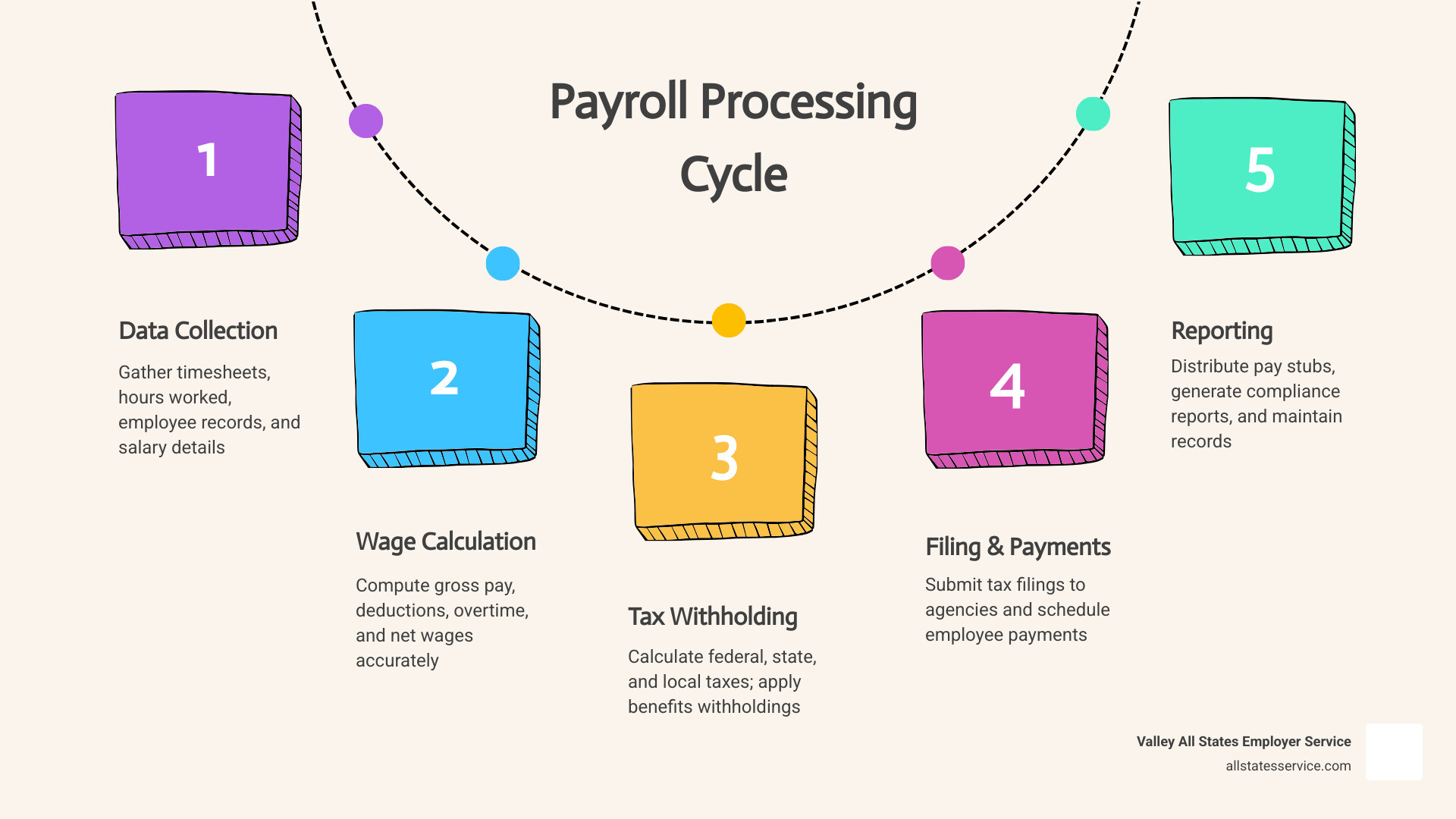
At its core, payroll processing is about making sure your team gets paid correctly and on time. But for a business owner, it is so much more than just cutting checks. It involves navigating a labyrinth of federal, state, and local tax laws, managing garnishments, and tracking paid time off. When we look at why businesses move to affordable payroll services, the primary driver is almost always the desire to shed this administrative weight.
Outsourcing to specialized firms offers a massive boost in time savings. Instead of spending hours every month double-checking spreadsheets and manual tax tables, you can automate the entire cycle. This automation significantly reduces the risk of human error, which is the leading cause of IRS penalties. In fact, many providers offer a 100% error-free guarantee, taking the stress of potential audits off your shoulders.
Beyond just compliance, professional payroll management impacts employee morale. Nothing erodes trust faster than a late or incorrect paycheck. Efficient payroll processing firms provide employee self-service portals and mobile apps, allowing your staff to download their own W-2s and view pay stubs whenever they like. This transparency builds a culture of reliability and professionalism that helps with employee retention.
Different Types of Third-Party Payroll Arrangements
When you decide to outsource, you aren’t just picking a software; you are entering into a specific legal arrangement with the IRS. Understanding these roles is vital because they determine who is on the hook if something goes wrong. The IRS provides clear outsourcing payroll and third-party payers guidance to help employers steer these waters.
Here is a breakdown of the common arrangements:
- Payroll Service Provider (PSP): This is the most common setup for small businesses. The PSP prepares the returns and makes the tax deposits using your Employer Identification Number (EIN). However, the employer remains solely liable for all taxes.
- Reporting Agent (RA): An RA has the authority to sign and file returns on your behalf. They act as a conduit between you and the IRS, often using electronic filing to improve efficiency. Like a PSP, the employer usually retains the primary liability for tax payments.
- Certified Professional Employer Organization (CPEO): This is a more comprehensive partnership. A CPEO can actually take over the federal employment tax liability for wages paid to your employees. While this offers the most protection, it also comes with more complex agreements.
Comparison of Third-Party Payroll Roles
| Feature | Payroll Service Provider (PSP) | Reporting Agent (RA) | CPEO |
|---|---|---|---|
| Who files returns? | Employer or PSP | Reporting Agent | CPEO |
| EIN Used | Employer’s EIN | Employer’s EIN | CPEO’s EIN |
| Tax Liability | Employer | Employer | CPEO (in many cases) |
| IRS Authorization | Not required | Form 8655 | Form 8973 |
It is important to remember that even when you outsource, you are responsible for the accuracy of the data you provide. If a provider fails to make a deposit, the IRS will still look to you for payment unless you are in a specific CPEO arrangement that shifts that liability.
Top-Rated Providers for Every Business Size
Choosing from the sea of payroll processing firms depends heavily on your current headcount and your plans for growth. A tool that works for a solo entrepreneur with one nanny might not scale for a regional manufacturing plant with 300 workers.
Leading payroll processing firms for Small Businesses
Small businesses need simplicity and affordability. You want a system that “just works” without requiring a degree in accounting.
- Gusto: Frequently rated as the #1 software for small businesses, Gusto is loved for its friendly interface and automated tax filings. It handles everything from health insurance to 401(k) syncs, making it a great all-in-one choice.
- QuickBooks Payroll: If you already use QuickBooks for your accounting, this is often the easiest path. The integration is seamless, meaning your payroll data flows directly into your general ledger without manual entry. You can find more tips on choosing the right accounting and payroll services in our small business playbook.
- OnPay: This is a hidden gem for small to medium-sized businesses that want a flat, transparent pricing model. They don’t charge extra for features like multiple pay runs or different pay rates, which can save you a lot of money as you grow.
Scalable payroll processing firms for Midsized and Large Enterprises
As your company grows, your needs shift from “simple” to “scalable.” You might need to manage employees across different states with different withholding rates, like Maryland’s specific requirements or Michigan’s 4.25% withholding rate.
- ADP: With 75 years of experience, ADP is the industry titan. They offer specialized tiers like ADP Workforce Now, which is designed for midsized to large enterprises. They provide deep Human Capital Management (HCM) tools, including talent acquisition and advanced analytics.
- Paychex: Similar to ADP, Paychex offers robust scalability and 24/7 customer support. They are particularly good at handling complex compliance issues and offer a wide range of employee benefits packages.
- Rippling: Rippling is a modern powerhouse that specializes in complexity. It doesn’t just manage payroll; it manages “employee transitions.” When you hire someone, Rippling can set up their payroll, their health insurance, and even their work laptop all in one go.
- Workday: Best suited for very large enterprises (1,000+ employees), Workday provides a unified system for finance, HR, and payroll. It is a high-end solution for companies that need total visibility across global operations.
Critical Features and Integration Capabilities
When evaluating payroll processing firms, look beyond the price tag. The real value lies in the features that eliminate manual work. A web-based payroll service should offer more than just a digital version of a paper check.
Key features to look for include:
- Direct Deposit and Payroll Cards: Most employees expect direct deposit. Offering payroll cards is also a great way to support “unbanked” employees who might not have traditional checking accounts.
- Automated Tax Filing: The provider should calculate, withhold, and pay federal, state, and local taxes. This includes generating W-2s and 1099s at year-end.
- Time and Attendance Tracking: Look for systems that integrate with time clocks or mobile apps. This prevents “buddy punching” and ensures that overtime is calculated accurately according to labor laws.
- Benefits Administration: As you grow, you will want to offer health insurance, 401(k) plans, and HSA accounts. Having these integrated into your payroll system makes deductions automatic and error-free.
- Mobile Access: In our mobile-first world, both employers and employees should be able to manage payroll on the go. Whether it is approving a run from a smartphone or an employee checking their PTO balance, mobile access is no longer optional.
The importance of outsourcing payroll in the cloud cannot be overstated. Cloud-based systems ensure that your data is backed up, secure, and accessible from anywhere, which is crucial for businesses with remote workers or multiple locations.
Frequently Asked Questions about Payroll Services
How do providers handle tax calculations?
Most modern payroll processing firms use proprietary tax engines that are updated in real-time as laws change. When you run payroll, the system automatically calculates the correct federal withholding, Social Security, and Medicare amounts. It also looks at the employee’s location to apply state and local taxes. For example, if you have employees in Maryland, the system will apply the specific Maryland state and county tax rates automatically. The provider then schedules the payment to the appropriate tax agency, ensuring you never miss a deadline.
What responsibilities do employers retain?
Even with the best provider, you are still the captain of the ship. You are responsible for the accuracy of the data entered into the system. If you report that an employee worked 40 hours when they actually worked 50, the provider can’t know that. You also retain the responsibility for employee classification (deciding who is a W-2 employee vs. a 1099 contractor) and for keeping physical records as required by law. Finally, unless you are using a CPEO, you are usually the one the IRS will contact first if there is a discrepancy in tax payments.
Is 24/7 customer support necessary?
It depends on your business. If you run a restaurant and process payroll late on Sunday nights, having 24/7 support might be a lifesaver. For a standard 9-to-5 office, dedicated specialists during business hours might be enough. One way to measure support quality is the Net Promoter Score (NPS). Corporate Payroll Services, for instance, boasts an NPS of about 80, which is significantly higher than many major competitors who often score in the teens. A high NPS generally means you’ll spend less time on hold and more time getting your questions answered.
Final Steps in Selecting Your Provider
Before you sign a contract with any of these payroll processing firms, we recommend doing a “test drive.” Most providers offer a demo or a trial period. Use this time to see how well the software integrates with your existing accounting or timekeeping tools.
At Valley All States Employer Service, we understand that payroll is only one piece of the compliance puzzle. While you are busy getting your team paid, we focus on expert, impartial, and efficient E-Verify workforce eligibility verification. By outsourcing this critical HR task to us, you minimize the risk of administrative errors and ensure your business remains fully compliant with federal employment laws.
Ready to simplify your business operations? Whether you are looking for payroll outsourcing solutions or need help with workforce compliance, the right partnership will give you the peace of mind to focus on what you do best: running your business.
Ready to simplify compliance and streamline your hiring process? Contact our team at Valley All States Employer Service today to learn how our E-Verify solutions can protect your business.