Stay Legal and Stress-Free with These E-Verify Compliance Tips
Why Running a Compliant E-Verify Program Is More Important Than Ever
Running a compliant e-verify program is one of the most important steps your business can take to protect itself during the hiring process. Whether you’re a federal contractor, operate in a state with a mandatory E-Verify law, or simply want to reduce legal risk, getting this right matters.
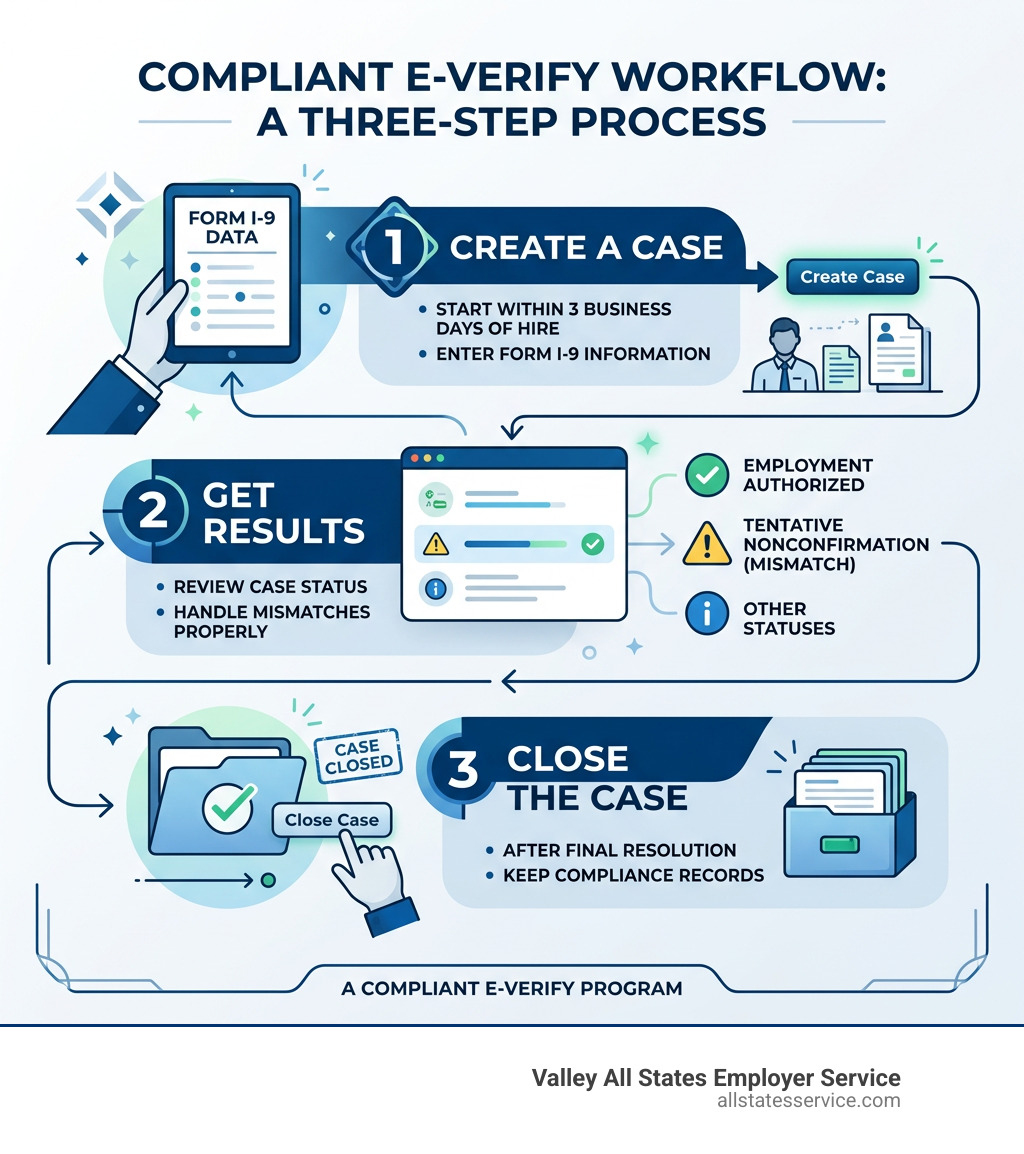
Here’s a quick summary of what a compliant E-Verify program requires:
- Enroll in E-Verify through the official USCIS portal before verifying any employees
- Complete Form I-9 for every new hire before creating an E-Verify case
- Create a case in E-Verify no later than the third business day after the employee starts work
- Review case results and take the appropriate action based on the outcome
- Handle mismatches (Tentative Nonconfirmations) properly, without taking adverse action
- Close every case once a final result is received
The rules around E-Verify have grown more complex in recent years. State mandates are expanding. The federal government introduced E-Verify+. And in early 2025, USCIS permanently deleted older case records, catching some employers off guard.
For a busy HR team, keeping up with all of this is a real challenge. A single misstep, like running E-Verify on some new hires but not others, or taking action against an employee during a mismatch, can expose your business to serious legal consequences.
This guide walks you through everything you need to know to stay fully compliant, from enrollment to case closure, and everything in between.
Discover more about compliant e-verify program:
Understanding the Basics of a Compliant E-Verify Program

At its heart, E-Verify is an internet-based system that allows us to confirm the eligibility of our employees to work in the United States. It is operated by the U.S. Citizenship and Immigration Services (USCIS) in partnership with the Social Security Administration (SSA).
Think of it as a digital bridge between the information an employee provides on their Form I-9 and the records held by the federal government. By comparing these data points, a compliant e-verify program provides a layer of certainty that paper forms alone cannot offer.
If you are curious about the technical roots, you can learn more about what is E-Verify and its role in modern hiring. For those who want the full technical breakdown, the E-Verify User Manual is the ultimate source of truth for administrative procedures.
How the System Works
The process is remarkably fast. When we enter an employee’s information into the portal, the system electronically matches that data against millions of records in the Department of Homeland Security (DHS) and SSA databases.
Within seconds, the system usually returns a result. It confirms the person’s identity and their legal right to work in the U.S., helping us maintain a clean and authorized workforce without the guesswork.
Benefits of Participation
Why should your business join? Beyond staying on the right side of the law, a compliant e-verify program significantly reduces the risk of fraud. It’s much harder for someone to use stolen or fabricated documents when the system is checking those details against federal records in real-time.
Participation also boosts hiring efficiency. Instead of waiting weeks for a manual audit or discovery of an error, we get answers immediately. Understanding E-Verify employer requirements ensures that your onboarding process is both fast and legally sound.
Enrollment and Mandatory Participation Requirements
Enrollment is the first hurdle. To participate, a company must sign a Memorandum of Understanding (MOU), which is a formal agreement between the employer, DHS, and SSA. This document outlines the responsibilities of each party and the rules we must follow to remain compliant.
Before you jump in, it is wise to review the E-Verify state requirements for 2025. While the program began as a voluntary federal initiative, the landscape has shifted dramatically.
Who Must Maintain a Compliant E-Verify Program?
While many businesses choose to use E-Verify voluntarily, others have no choice. Federal contractors and subcontractors with a contract containing the Federal Acquisition Regulation (FAR) E-Verify clause must use the system. This often includes verifying not just new hires, but also existing employees assigned to the contract.
Additionally, many states now mandate E-Verify for all or most employers. For example, states like Arizona and Mississippi have broad requirements, while others focus on public employers or those receiving state incentives. Staying informed on these shifting mandates is essential to see where your business stands.
Finally, if you wish to hire F-1 students for a STEM OPT extension, you must be enrolled. These students are required to work for an E-Verify employer to maintain their legal status.
The Enrollment Process
Enrolling is a one-session task, meaning you cannot save your progress and come back later. We recommend using a desktop computer rather than a mobile device to ensure all forms load correctly.
The system now integrates with Login.gov for enhanced security. You will need your company’s basic information, including your Employer Identification Number (EIN) and the physical locations where you will be performing verifications. Once the MOU is signed, you can designate a program administrator to manage users and cases.
Navigating the Verification Process and Photo Matching
Compliance doesn’t stop at enrollment; it’s a daily commitment. The most important rule to remember is the “three-day rule.” We must create an E-Verify case no later than the third business day after the employee starts work for pay.
The foundation of every case is a properly completed Form I-9. You cannot start the E-Verify process until the I-9 is finished. Staying on top of E-Verify and I-9 compliance is the best way to avoid the “paperwork errors” that often lead to fines during government audits.
Integrating Form I-9 with a Compliant E-Verify Program
There are a few key differences when you use E-Verify compared to the standard I-9 process:
- Social Security Numbers: While optional on a standard I-9, an SSN is mandatory for E-Verify cases.
- List B Documents: If an employee provides a List B document (identity only), it must contain a photograph.
- Remote Verification: As of August 1, 2023, employers in good standing with E-Verify may be eligible to use alternative procedures to examine documents remotely via live video call.
How Photo Matching Works
Photo matching is a specific security feature triggered when an employee presents a U.S. Passport, Passport Card, Permanent Resident Card (Green Card), or an Employment Authorization Document (EAD).
When we enter the document information, the system will display the photo that the government has on file for that document. We then compare the image on the screen to the photo on the physical document the employee provided. This ensures the document is genuine and hasn’t been altered with a different photo.
Handling Mismatches and Employee Rights
Sometimes, the system cannot immediately confirm eligibility. This is called a Tentative Nonconfirmation (TNC), or a “mismatch.” It is important to stay calm and follow the rules when this happens. A TNC does not mean the employee is unauthorized to work; it simply means the data didn’t match government records.
Understanding federal E-Verify rules is vital here. We must notify the employee of the TNC in private as soon as possible. We then provide them with a “Further Action Notice” which explains why the mismatch occurred and what they can do to fix it.
Resolving a Tentative Nonconfirmation
The employee has eight federal working days to contact the appropriate agency (SSA or DHS) to begin resolving the issue. During this time, we cannot take any adverse action against them. That means no firing, no suspension, no delaying training, and no cutting hours because of the TNC.
If the employee chooses to contest the result, we must allow them to continue working while the case is “in continuance.” The USCIS Employee Rights Toolkit is a great resource to share with staff to ensure they understand their protections.
Anti-Discrimination and Adverse Action
The golden rule of a compliant e-verify program is consistency. We must use E-Verify for all new hires, regardless of their citizenship status or national origin. Using the system selectively is a form of discrimination and can lead to investigations by the Immigrant and Employee Rights Section (IER) of the Department of Justice.
Following E-Verify best practices means never using the system to “prescreen” applicants before they accept a job offer. E-Verify is for confirmed hires, not for vetting candidates.
Best Practices and 2025 Compliance Updates
The world of employment compliance never stands still. For 2025, several major updates are worth noting. Illinois, for instance, recently updated its Right to Privacy in the Workplace Act. Even though E-Verify remains voluntary in Illinois, employers there must now follow strict notification and training rules if they choose to use it.
Another major shift is the disposal of old records. Starting in early 2025, USCIS began permanently deleting E-Verify cases that were updated more than ten years ago. We must download “Historic Records Reports” and pair them with our physical Form I-9s to be ready for an audit.
Maintaining a Compliant E-Verify Program for Rehires
What happens when an old employee returns? If we rehire someone within three years of the date their previous Form I-9 was completed, we may be able to use Section 3 of that original form.
However, if the employee’s original E-Verify case resulted in “Employment Authorized,” we generally do not need to create a new case. If we do choose to create a new case for a rehire, we must do it for all rehires to avoid discrimination. Always consult the Handbook for Employers M-274 for the most current guidance on Section 3 updates.
Avoiding Common Errors
Mistakes happen, but in a compliant e-verify program, they can be costly. Common errors include:
- Duplicate Cases: Creating a new case for the same employee within 30 days will trigger an alert.
- Expired Documents: While some documents (like certain EADs) have automatic extensions, generally, we cannot accept expired documents for a new hire.
- Name Mismatches: Ensure the name entered into E-Verify exactly matches what is on the Form I-9 and the government documents.
Using professional E-Verify services can help automate these checks and balances, ensuring you never miss a deadline or a required field.
Frequently Asked Questions
When must I create an E-Verify case?
You must create the case no later than the third business day after the employee’s first day of employment for pay. You can start the process as soon as the job offer is accepted and the Form I-9 is complete, but never before the offer is made.
Can I use E-Verify for existing employees?
Generally, no. E-Verify is for new hires only. The only exception is for federal contractors with the FAR E-Verify clause, who may be required to verify existing staff assigned to a specific federal contract. You can find more details on E-Verify for existing employees here.
What happens if I receive a Final Nonconfirmation?
A Final Nonconfirmation (FNC) means the system could not verify the employee’s work eligibility even after they had a chance to contest. In most cases, we are required to terminate the employee. If we choose to keep them, we must notify DHS, and we may face civil money penalties.
Conclusion
Managing a compliant e-verify program doesn’t have to be a source of stress for your HR department. By following the three-day rule, respecting employee rights during a mismatch, and staying updated on the latest 2025 regulations, you can build a secure and authorized workforce with confidence.
At Valley All States Employer Service, we specialize in taking this administrative burden off your plate. We provide expert, impartial, and efficient E-Verify processing that minimizes errors and keeps your business in total compliance with federal and state laws. Whether you are navigating the new E-Verify+ features or need help with historic records retention, our team is here to help.