
E-Verify State Requirements 2025: Essential Simplified
Your Guide to E-Verify State Requirements and Hiring Compliance
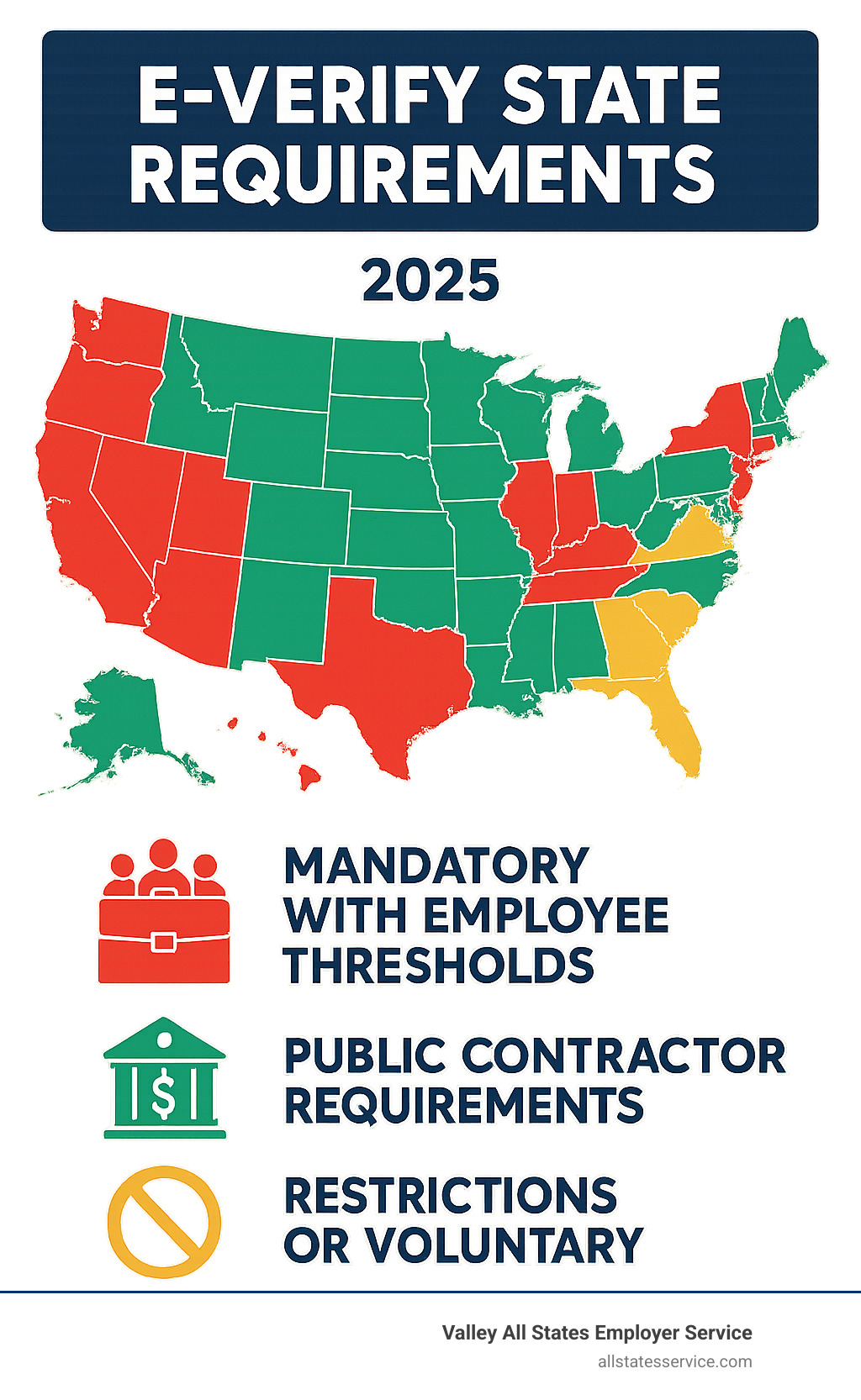
E-Verify state requirements create a complex patchwork of rules that vary dramatically across the United States. While E-Verify remains voluntary at the federal level, 22 states now mandate its use for at least some employers, creating compliance headaches for HR professionals nationwide.
Quick Reference: E-Verify Requirements by State Type
- Mandatory for Most Private Employers (9 states): Alabama, Arizona, Florida, Georgia, Mississippi, North Carolina, South Carolina, Tennessee, Utah
- Required for Public Employers/Contractors Only (11+ states): Idaho, Indiana, Michigan, Minnesota, Missouri, Nebraska, Oklahoma, Pennsylvania, Texas, Virginia, West Virginia
- Voluntary or Restricted: All other states, with California actively restricting E-Verify use
Employee Count Thresholds Vary Widely:
- Georgia: 10+ employees
- Utah: 15+ employees
- Florida/North Carolina: 25+ employees
- Tennessee: 35+ employees
If you’re managing hiring across multiple states, you’re dealing with a maze of different rules, deadlines, and penalties. Some states require E-Verify for all new hires. Others limit it to public contractors with specific contract values. A few states restrict how you can use the system entirely.
The stakes are high too. Non-compliance can result in business license suspension in Arizona and South Carolina, civil penalties exceeding $10,000 in North Carolina, and fines up to $1,000 per violation in Pennsylvania.
Over 1.3 million employers currently use E-Verify, with an average of 2,300 signing up weekly. But navigating the state-by-state requirements doesn’t have to drain your time and energy.
What is E-Verify and How Does It Work?
Before we tackle the maze of E-Verify state requirements, let’s get crystal clear on what E-Verify actually is. Think of it as your digital assistant that checks whether new employees can legally work in the United States.
E-Verify is an internet-based system run by the U.S. Department of Homeland Security (DHS) working hand-in-hand with the Social Security Administration (SSA). It’s designed to make verifying employment eligibility straightforward by cross-checking employee information against government databases.
The beauty of the system lies in its simplicity. When you hire someone new, you’re already required to complete Form I-9 with them. E-Verify simply takes that same information and runs it through federal databases to confirm everything checks out.
Here’s how the process flows:
The employee first completes their Form I-9 with you, providing documents that prove both their identity and work authorization. Only after this paperwork is completely finished do you create an E-Verify case using the E-Verify system. You’ll enter details like their name, date of birth, Social Security number, and citizenship status.
Within seconds, the system compares this Form I-9 data against millions of government records. Most of the time, you’ll get an “Employment Authorized” result, which means everything matches perfectly and you’re good to go.
Sometimes, though, you’ll receive a “Tentative Nonconfirmation” or TNC. Don’t panic. This doesn’t mean your employee can’t work. It simply means there’s a mismatch somewhere that needs clearing up.
When a TNC happens, employee rights kick in immediately. You must give your employee a “Further Action Notice” and allow them eight federal government workdays to contact the appropriate agency and resolve the issue. During this time, you cannot take any negative action against them. No firing, no suspending, no treating them differently.
The results mean different things for your next steps. An “Employment Authorized” status lets you proceed normally. A TNC requires patience and following proper procedures to protect both your business and your employee’s rights.
Understanding this process becomes crucial when you’re dealing with different E-Verify state requirements, since some states mandate this verification while others restrict how you can use it.
E-Verify State Requirements: A State-by-State Breakdown
Trying to figure out E-Verify state requirements can feel like learning a new language where every state speaks a different dialect. While the federal government keeps E-Verify voluntary for most employers, individual states have rolled up their sleeves and created their own rules. The result? A patchwork quilt of requirements that changes depending on where you do business, how many people you employ, and whether you work with government contracts.
The reason for all this variation comes down to state politics and priorities. Some states worry about unauthorized employment and want strict verification. Others focus on protecting worker rights or supporting business flexibility. What’s completely legal in California might land you in hot water in Arizona, and what works fine for a small business in Texas could spell trouble for the same size company in Georgia.
The key differences usually boil down to public versus private employer requirements and employee count thresholds. Some states say “everyone uses E-Verify, period.” Others target only government agencies and their contractors. Many fall somewhere in between, with rules that kick in when you hit a certain number of employees.
Let’s walk through what you need to know, state by state.
States Where E-Verify is Required for Most Private Employers
Nine states have decided that most private employers should use E-Verify, though they don’t all agree on where to draw the line. If you’re doing business in Alabama, you’ve been required to use E-Verify since 2012, regardless of how many people you employ. Even if you’re a one-person operation with employees, you’re in. Arizona took the lead on this back in 2008, requiring all employers to use the system and keep those E-Verify records for three years or one year after an employee leaves, whichever is longer.
Florida just expanded its requirements in July 2024. Now any employer with 25 or more employees must use E-Verify, joining the ranks of states that tie requirements to company size. North Carolina uses that same 25-employee threshold, while Georgia sets the bar lower at 10 employees. If you’re under Georgia’s threshold, you’ll need to sign an affidavit proving you’re exempt.
Mississippi stands out for a unique twist. Not only do all employers need to use E-Verify, but you also have to run your 1099 contractors through the system. That’s pretty rare among state requirements. South Carolina keeps things simple by requiring all employers to use E-Verify as of 2021, no exceptions.
Tennessee gives smaller businesses more breathing room with a 35-employee threshold, while Utah splits the difference at 15 employees. These thresholds matter a lot if you’re growing your team and wondering when compliance requirements will kick in.
If you’re running a smaller operation, these employee count rules can make or break your compliance strategy. Our guide on E-Verify for small businesses breaks down exactly what you need to know as you scale up.
States Requiring E-Verify for Public Employers & Contractors
Many states take a middle-ground approach, focusing their E-Verify requirements on government work and public contracts. The thinking makes sense: if taxpayers are funding the work, the workforce should be verified as legally authorized.
Idaho was an early adopter, requiring E-Verify for public employers and contractors since 2009. Indiana, Oklahoma, and West Virginia follow similar patterns, making sure government agencies and their contractors verify new hires. Texas and Nebraska also focus on state agencies and contractors, with Nebraska extending requirements to businesses receiving certain tax incentives.
Some states get more specific about contract values. Minnesota only requires E-Verify for state contracts over $50,000, while Missouri sets the bar much lower at $5,000 for most state contracts. Virginia combines employee count and contract value, requiring E-Verify for public contractors with 50 or more employees working on contracts worth at least $50,000.
Michigan takes a targeted approach, focusing mainly on transportation department contractors. Pennsylvania gets complicated, with requirements that primarily hit private construction businesses and state contractors working on public projects over $25,000.
If you’re in the contracting world, these rules can get intricate fast. Our resource on E-Verify for contractors explained walks through the specific requirements and helps you avoid costly mistakes.
Unique State Rules and Restrictions
A few states march to their own drummer when it comes to E-Verify, creating special rules that can catch employers off guard.
California takes the most restrictive approach with its AB 622 law. You cannot use E-Verify to pre-screen job applicants, and you absolutely cannot run existing employees through the system unless they’re newly hired. California also prohibits using E-Verify in ways that discriminate based on national origin. Mess this up and you could face fines up to $10,000 per violation. In California, E-Verify is strictly for new hires after they’ve accepted your job offer and completed their Form I-9.
Illinois requires you to notify employees when you’re running them through E-Verify and strictly forbids using the system for pre-screening applicants. If you’re enrolled in E-Verify in Illinois, you need to show you’ve received proper training and posted the required notices.
Colorado offers an interesting case study in changing priorities. The state had an E-Verify mandate for several years but repealed it in 2016. However, state contractors still need to use some form of electronic verification, whether that’s E-Verify or Colorado’s own system.
Don’t forget about city and county rules that can add another layer of complexity. Even if your state doesn’t require E-Verify, local governments might have their own requirements for contractors or certain types of businesses. Some Washington counties, Florida municipalities, and Pennsylvania cities have created their own E-Verify rules on top of state requirements.
The variations show just how complex employment verification has become. For a deeper dive into these differences, check out this analysis of State-by-state E-Verify differences from employment law experts.
Federal Contractors and Special E-Verify State Requirements
When you’re working with federal contracts, the rules around E-Verify state requirements get even more complex. Think of it this way: you’re already juggling state laws, and now federal regulations are adding another layer to your compliance puzzle.
Here’s where things get interesting. The Federal Acquisition Regulation (FAR) E-Verify clause (FAR 52.222-54) doesn’t just suggest that federal contractors use E-Verify. It requires it. This federal mandate has been around since 2007, and it can actually override or add to whatever your state requires.
If your company holds a federal contract with this clause, you’re looking at some unique obligations. Unlike many state laws that focus only on new hires, federal contractors often need to verify both new employees and existing workers who are assigned to the federal contract. Yes, that means going back and running E-Verify checks on current employees who’ll be working on that government project.
The enrollment process itself has its own quirks too. Federal contractors typically need to provide their Unique Entity Identifier (UEI) when setting up E-Verify. This replaced the old DUNS number system, so if you’re still thinking in DUNS terms, it’s time to update your mental filing system.
One aspect that catches many contractors off guard is the subcontractor flow-down requirement. When you’re the prime contractor, that E-Verify obligation doesn’t stop with you. It flows down to your subcontractors too, as long as their portion of the work meets certain criteria. Suddenly, you’re not just managing your own compliance but helping ensure your subs are following the rules too.
This creates a perfect storm of administrative complexity. You’re tracking federal requirements, state mandates, and potentially different rules for different projects all at once. It’s exactly why we put together our detailed guide on E-Verify essentials for federal contractors. The stakes are simply too high to wing it.
For the most current federal requirements straight from the source, the USCIS’s guide for federal contractors provides the official word on what’s expected. But remember, federal requirements work alongside your state obligations, not instead of them. You still need to follow whatever E-Verify state requirements apply in your location while meeting these additional federal standards.
Penalties, Best Practices, and Staying Compliant
Let’s be honest about something: nobody enjoys dealing with compliance paperwork. But when it comes to E-Verify state requirements, the cost of cutting corners can be devastating to your business. We’re talking about penalties that can shut down your operations, not just slap you with a small fine.
Think of compliance as insurance for your business. It requires time and attention upfront, but it protects you from catastrophic losses down the road. States aren’t playing around with these laws, and they’ve designed penalties specifically to get your attention.
The High Cost of Non-Compliance
When states say E-Verify is mandatory, they mean it. The penalties aren’t designed to be a minor inconvenience. They’re crafted to ensure businesses take these requirements seriously, and the consequences can be business-ending.
Business license suspension hits hardest in states like Arizona and South Carolina. Imagine trying to explain to your customers, vendors, and employees that you can’t legally operate because you didn’t follow E-Verify rules. Arizona’s approach was so aggressive that it went all the way to the U.S. Supreme Court, which ultimately upheld the state’s right to impose such severe penalties. The Supreme Court ruling on Arizona’s law sent a clear message that states have real authority here.
Civil penalties in North Carolina can exceed $10,000 per violation. These aren’t one-time fees either. If you’re hiring regularly and not using E-Verify when required, these penalties stack up quickly. A mid-sized company could face six-figure penalties within months.
Per-violation fines vary by state, but they add up fast. Pennsylvania charges between $250 and $1,000 for each contractor violation. If you’re hiring multiple people for a public works project without using E-Verify, you could be looking at thousands in fines for a single project.
Even states that restrict E-Verify use, like California, impose hefty penalties for misuse. Using E-Verify improperly on existing employees or for pre-screening can cost you up to $10,000 per case. This shows that knowing how to use the system correctly is just as important as knowing when to use it.
Debarment from public contracts might be the most devastating long-term consequence. For contractors who rely on government work, losing the ability to bid on future projects can destroy your business model overnight.
Best Practices for E-Verify State Requirements
Getting E-Verify right isn’t just about avoiding penalties. It’s about building a smooth, consistent process that protects both your business and your employees’ rights. The good news is that following best practices makes compliance much easier.
Timing is everything with E-Verify. You can only use the system after someone accepts a job offer and completes their Form I-9. Never use it to screen job applicants. This isn’t just a best practice, it’s the law in many states and can lead to discrimination claims if you get it wrong.
Consistency protects you from discrimination accusations. If you’re required to use E-Verify, or if you choose to use it voluntarily, you must run every new hire through the system. Picking and choosing which employees to verify is a recipe for legal trouble.
Handling Tentative Nonconfirmations (TNCs) properly is crucial. When an employee gets a TNC, you must notify them immediately, provide the required paperwork, and give them the full time period to resolve the issue with the Social Security Administration or Department of Homeland Security. Taking any negative action based solely on a TNC is illegal and can result in significant penalties.
Transparency builds trust with your employees. Explain why you’re using E-Verify, what the process involves, and what their rights are. Most employees appreciate knowing what to expect, and it reduces anxiety about the verification process.
Documentation saves businesses during audits. Keep detailed records of every E-Verify case, including Form I-9 submissions, case confirmation numbers, and any TNC resolution documents. These records prove you’re following proper procedures and can protect you if questions arise later.
Training your team prevents costly mistakes. Make sure everyone involved in hiring understands when and how to use E-Verify. A single mistake, like using the system for pre-screening, can trigger penalties and legal issues.
For more detailed guidance on implementing these practices, our comprehensive E-Verify best practices guide walks you through each step of building a compliant process.
How to Stay Up-to-Date on E-Verify State Requirements
E-Verify state requirements change more often than you might expect. New laws pass, existing rules get modified, and court decisions can shift how requirements are interpreted. Staying current isn’t optional if you want to maintain compliance.
Government sources give you the most reliable information. The official E-Verify homepage provides current maps showing state requirements and detailed explanations of obligations. Your state’s Department of Labor website is equally important for understanding local nuances and recent changes.
Legal counsel becomes essential for complex situations. If you operate in multiple states, have federal contracts, or deal with unique hiring scenarios, employment law attorneys who specialize in immigration compliance can provide invaluable guidance. They can also help you interpret gray areas where state and federal requirements might conflict.
Industry newsletters and HR publications can alert you to changes before they take effect. Many employment law firms and HR organizations offer free updates on regulatory changes. Subscribing to a few reliable sources helps you stay ahead of new requirements rather than scrambling to catch up after they’re already in place.
The key is building these check-ins into your regular business routine. Don’t wait until you’re facing a compliance issue to start paying attention to regulatory changes. A few minutes each month reviewing updates can save you thousands in penalties and administrative headaches.
Streamlining E-Verify for Multi-State Employers
Picture this: you’re managing hiring for offices in Georgia (where you need E-Verify for 10+ employees), Florida (25+ employees), and California (where you actually can’t use E-Verify on existing workers). If this scenario sounds familiar, you know exactly how challenging E-Verify state requirements can be for multi-state employers.
The administrative headaches are real. Your HR team spends countless hours researching different state rules instead of focusing on strategic initiatives. With so many varying requirements, the risk of missing a crucial detail or misapplying a rule skyrockets. And let’s be honest, trying to standardize your onboarding process across locations with completely different E-Verify rules feels nearly impossible.
Integrating with your HRIS can be a game-changer here. Modern Human Resources Information Systems can automatically transfer employee data directly to E-Verify, eliminating those tedious manual entries that lead to errors. They also centralize all your records, storing E-Verify case results, Form I-9s, and related documentation in one secure location. When audit time comes around, you’ll thank yourself for this organization. Plus, compliance dashboards give you real-time insights into your E-Verify status across all locations, flagging potential issues before they become problems.
But here’s where things get really interesting: using an E-Verify Employer Agent can take the entire burden off your shoulders. An Employer Agent is essentially your E-Verify expert who handles the whole verification process on your behalf. Think of them as your compliance partner who stays current on all federal and state requirements while you focus on running your business.
The benefits are substantial. These agents live and breathe E-Verify regulations, so they know exactly what Georgia requires versus what Florida mandates versus what California restricts. They provide consistent, accurate processing regardless of which state your new hire is in, dramatically reducing your error risk. Most importantly, they free up your HR team to do what they do best instead of wrestling with compliance paperwork.
At Valley All States Employer Service, we operate as an E-Verify Employer Agent, providing centralized compliance solutions for businesses exactly like yours. We handle the complex state-by-state requirements so you don’t have to become an expert in every jurisdiction where you operate. Our approach is straightforward: expert, impartial, and efficient E-Verify processing that minimizes both errors and the stress that comes with multi-state compliance.
Ready to simplify your multi-state E-Verify challenges? Learn more about How an E-Verify Employer Agent can help streamline your entire process.
Simplify E-Verify State Requirements for Your Business
We’ve walked through the maze of E-Verify state requirements together, and if your head is spinning a little, you’re not alone. From Alabama’s requirement for all employers to California’s strict restrictions on how you can use the system, the patchwork of state laws creates a compliance challenge that would give even the most seasoned HR professional a headache.
The reality is stark: nine states require E-Verify for most private employers, eleven more mandate it for public contractors, and the rest have their own unique twists. Employee thresholds jump from 10 in Georgia to 35 in Tennessee. Penalties range from business license suspension to fines exceeding $10,000. It’s enough to make you want to hide under your desk.
But here’s the thing about having a clear, consistent E-Verify process: it’s not just about dodging those scary penalties we talked about. It’s about creating a hiring system that actually works for your business instead of against it. When you’re constantly worried about whether you’re following the right rules in the right state, you’re not focusing on what you do best.
Think about it this way. Every minute your HR team spends researching whether Florida’s 25-employee threshold applies to your newest location is a minute they’re not spending on strategic hiring, employee development, or any of the dozen other priorities on their plate. The stress of potentially making a costly mistake can paralyze even the most competent teams.
This is exactly where expert support transforms everything. Imagine knowing that someone who lives and breathes E-Verify state requirements is handling the complex stuff while you focus on growing your business. No more late-night Google searches about Tennessee’s latest rule changes. No more second-guessing whether you’re handling that TNC correctly.
At Valley All States Employer Service, we’ve made it our mission to take this burden off your shoulders entirely. We steer the intricate legal landscape so you don’t have to. Whether you’re dealing with a single state’s requirements or juggling compliance across multiple locations, our E-Verify outsourcing expertise means you get accurate, compliant employment eligibility verification without the administrative headaches.
Your business deserves to operate with confidence, knowing that your E-Verify compliance is rock-solid no matter which state you’re hiring in.
Ready to simplify your E-Verify process? Learn more about our E-Verify Outsourcing services.