Why Every Compliant E-Verify Employer Needs to Get This Right
Being a compliant e-verify employer means more than just signing up for a federal program. It means running every new hire through a system that checks their work authorization against real government records, on time, every time, without cutting corners.
Here’s a quick snapshot of what compliance looks like:
- Enroll in E-Verify at e-verify.gov and sign the Memorandum of Understanding (MOU)
- Complete Form I-9 for every new hire before creating an E-Verify case
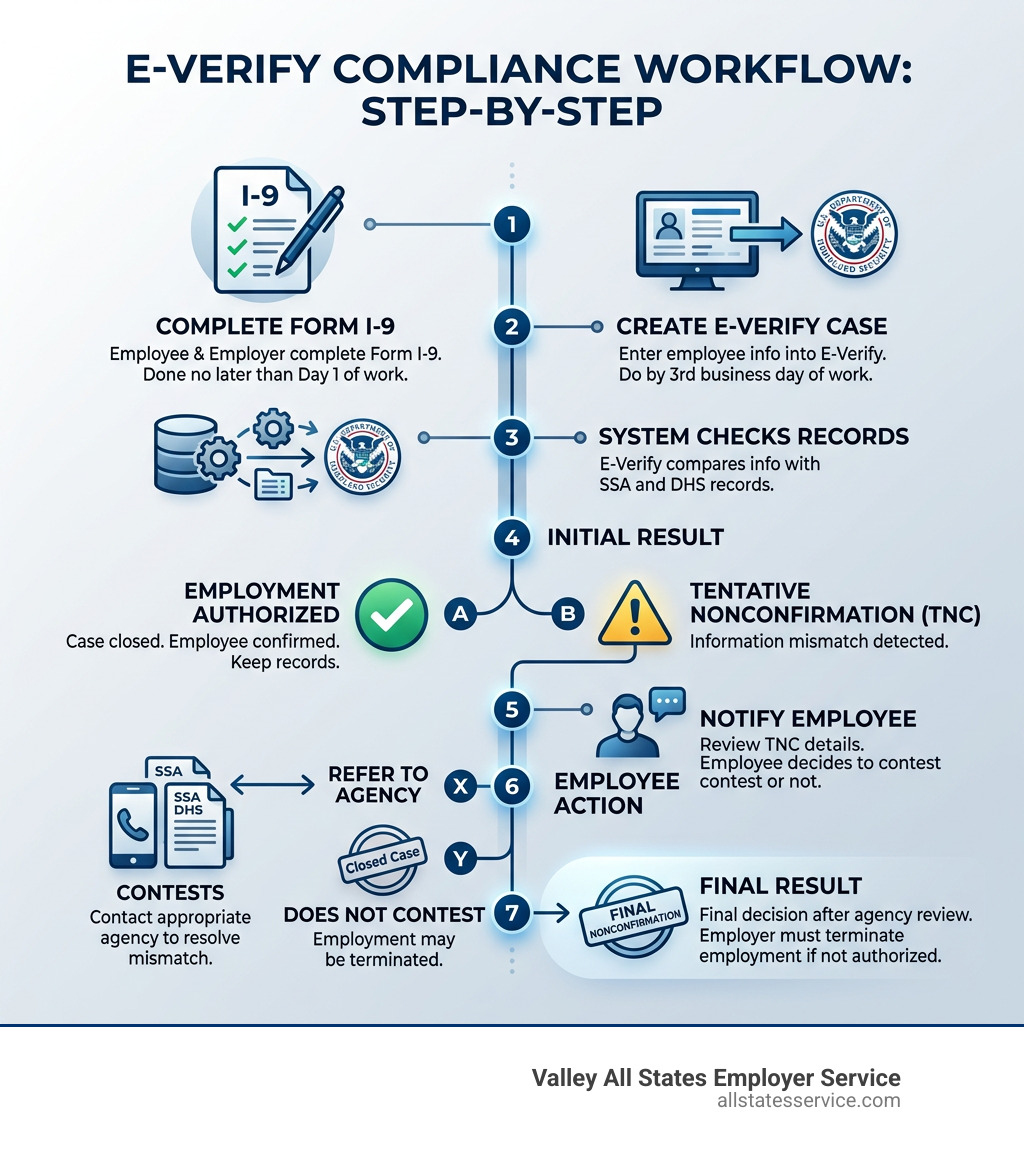
- Create a case no later than the third business day after the employee starts work for pay
- Respond correctly to results: Employment Authorized, Tentative Nonconfirmation (TNC), or Final Nonconfirmation
- Never use E-Verify to prescreen applicants or selectively verify certain employees
- Follow state rules since 23 states now require E-Verify for some or all employers
Over one million employers across the U.S. already use E-Verify. And with enforcement increasing and state mandates expanding in 2025, the stakes for getting it wrong have never been higher.
Whether you’re a federal contractor who must comply under the FAR clause, an employer in a state with a mandate, or a business that wants to hire with confidence, this guide walks you through everything you need to know.
Understanding the Role of a Compliant E-Verify Employer
To understand what it means to be a compliant e-verify employer, we first need to look at what the system actually does. E-Verify is a web-based system that allows us to confirm the eligibility of our employees to work in the United States. It works by electronically matching the information provided by an employee on their Form I-9 against records available to the Social Security Administration (SSA) and the Department of Homeland Security (DHS).
While the Form I-9 has been the standard for identity and employment authorization since 1986, E-Verify adds a modern layer of security. It provides real-time confirmation that the documents presented are valid and belong to the person presenting them. This helps us maintain a legal workforce and protects us from the risks associated with unauthorized employment.
Using this system is more than just a data entry task. It is a commitment to E-Verify and I-9 integration that ensures every person on our payroll has the legal right to be there. By matching data against millions of federal records, we can hire with confidence knowing that our team is fully authorized to work.
How E-Verify Complements Form I-9
It is a common misconception that E-Verify replaces the Form I-9. In reality, the two work hand-in-hand. You cannot have one without the other. Every compliant e-verify employer must first complete the Form I-9 process.
In Section 1, the employee provides their personal details, including their Social Security Number (SSN). While providing an SSN is technically voluntary on a standard Form I-9, it is mandatory for any employer using E-Verify. In Section 2, we examine the employee’s original documents to verify their identity and work authorization.
Once the Form I-9 is complete, we use that information to create a case in E-Verify. This “secondary verification” step is what separates a standard employer from a compliant e-verify employer. If the system finds a mismatch, it triggers a process that allows the employee to resolve the issue with the government, ensuring that no one is unfairly denied work due to a simple clerical error in a federal database.
Enrollment and Mandates for Modern Businesses
Getting started with E-Verify is a straightforward process, but it requires gathering specific details about your business before you sit down at the computer. Think of it like prep work for a big project, if you have everything ready, the actual execution is a breeze.

To enroll, you will need your Federal Employer Identification Number (EIN), your North American Industry Classification System (NAICS) code, and a list of all hiring sites where you will be using the system. You also need to designate a Program Administrator who will manage the account and a Signatory who has the legal authority to bind the company to the E-Verify Memorandum of Understanding (MOU).
Requirements for the Compliant E-Verify Employer
While E-Verify is voluntary for many businesses, it is mandatory for others. The most common group required to use it are federal contractors. If your business has a contract that includes the Federal Acquisition Regulation (FAR) E-Verify clause, you are legally obligated to use the system. This often includes verifying not just new hires, but also existing employees assigned to the contract.
State laws also play a major role. Currently, 23 states have some form of E-Verify mandate. For example, states like Arizona, Mississippi, and South Carolina require almost all employers to use the system. Other states may only require it for public employers or businesses that hold public contracts. Staying compliant means knowing the specific rules for every state where you have “hiring sites.”
Steps to Successful Enrollment
When you are ready to join the over one million businesses using the system, follow the official enrollment checklist. One important thing to remember: the enrollment session cannot be saved. You must complete the entire process in one sitting, so make sure you have your EIN and E-Verify employer responsibilities understood before you begin.
If you are a federal contractor, you will also need your Unique Entity Identifier (UEI). Once you have entered your company information and signed the MOU, you will gain access to the portal. From there, you can add users and start verifying your workforce. It is a simple process that sets the foundation for your status as a compliant e-verify employer.
Managing the Verification Workflow and Results
The core of being a compliant e-verify employer is the “3-day rule.” This means you must create an E-Verify case for each newly hired employee no later than the third business day after they start work for pay. If you hire someone on a Monday, you must have their case submitted by Thursday.
| E-Verify Result | What It Means | Required Action |
|---|---|---|
| Employment Authorized | Information matched government records. | Close the case and record the case number. |
| Tentative Nonconfirmation (TNC) | Information did not immediately match records. | Notify the employee privately and allow them to contest. |
| Final Nonconfirmation | The government cannot confirm work eligibility. | Usually results in termination of employment. |
When verifying new and existing employees, accuracy is everything. Ensure the name, date of birth, and SSN exactly match what the employee wrote on their Form I-9. Even a small typo can trigger a TNC, which creates extra work for everyone involved.
Handling Results as a Compliant E-Verify Employer
Most cases return an “Employment Authorized” result within seconds. However, if you receive a Tentative Nonconfirmation (TNC), you must handle it with care. A TNC does not mean the employee is unauthorized to work; it simply means there is a data mismatch that needs to be cleared up.
As a compliant e-verify employer, you must:
- Print the Further Action Notice and discuss it with the employee in private.
- Ask the employee if they want to contest the result.
- If they contest, provide them with the Referral Date Confirmation, which gives them eight federal business days to contact the SSA or DHS.
- Never take adverse action, such as cutting hours or firing the employee, while they are in the process of resolving a TNC.
Remote Verification and E-Verify Plus
The world of work has changed, and the government has updated its rules to keep up. As of August 1, 2023, employers who are enrolled in E-Verify and in good standing have the option to use “alternative procedures” for remote document examination. Instead of seeing the documents in person, you can examine them via a live video interaction.
There is also a new service called E-Verify+ that streamlines the process even further. This allows the employee to enter their own Form I-9 information and upload their documents directly into the system. The data is then transmitted to the employer for final review. This reduces data entry errors and makes the entire workflow much faster for distributed teams.
Staying Ahead of Compliance and 2025 Updates
Compliance is not a “set it and forget it” task. The rules change, and as a compliant e-verify employer, you need to stay informed. For example, starting January 6, 2025, USCIS will begin permanently deleting E-Verify cases that were updated before December 31, 2014. If you need those records for your files, you must download the Historic Records Report before the deadline.
State-level changes are also frequent. Illinois, for instance, has updated its Right to Privacy in the Workplace Act for 2025. Even though E-Verify is voluntary in Illinois, the new law adds strict requirements for how employers notify employees about discrepancies and prohibits retaliation. This is a perfect example of why you must look at both federal and state regulations.
Best Practices for a Compliant E-Verify Employer
To keep your account in good standing and avoid the dreaded “desk review” or site visit from USCIS, follow these best practices:
- Consistent Training: Ensure anyone handling your I-9s and E-Verify cases has completed the latest tutorials.
- Self-Assessments: Use the official self-assessment guides to audit your own files before the government does it for you.
- Avoid Discrimination: Never use E-Verify to screen applicants before they are hired. Only use it after an offer has been accepted and the Form I-9 is complete.
- Check Your Partners: If you use a staffing agency, make sure they are also a compliant e-verify employer. You can be held liable if your contractors are not following the rules.
Frequently Asked Questions
What happens if E-Verify is down? Sometimes the system goes offline, such as during a government shutdown. During these times, the “3-day rule” is suspended. Once the system is back online, you usually have a short grace period to enter any cases that were delayed. Always document the reason for the delay in your files.
Can I use E-Verify for pre-screening? Absolutely not. Using E-Verify to check a candidate’s status before you hire them is a violation of the MOU and can lead to charges of discrimination from the Department of Justice.
What are the penalties for non-compliance? Failure to use E-Verify when required can lead to the loss of government contracts, hefty fines, and in some states, the suspension of your business license. Additionally, it can trigger an audit from Immigration and Customs Enforcement (ICE).
Conclusion
Navigating employment eligibility doesn’t have to be a headache. While the requirements for a compliant e-verify employer are strict, they are designed to protect your business and your employees. By following the 3-day rule, handling TNCs fairly, and staying updated on 2025 changes, you can build a workforce that is both legal and productive.
At Valley All States Employer Service, we specialize in taking this administrative burden off your plate. We provide outsourced E-Verify verification that is expert, impartial, and incredibly efficient. Our team handles the data entry, monitors for results, and ensures that your business remains in full compliance with both federal and state laws.
By minimizing errors and streamlining the verification process, we help you focus on what you do best: growing your business. Ready to simplify your verification process? Let us help you stay compliant while you build your team.