
Your Handbook for Employers Guidance for Completing Form I-9
Why Every U.S. Employer Needs to Know the Handbook for Employers Guidance for Completing Form I-9
The handbook for employers guidance for completing form i 9 is the official USCIS resource (called the M-274) that tells employers exactly how to verify every new hire’s identity and work authorization. Here’s the short version of what you need to know:
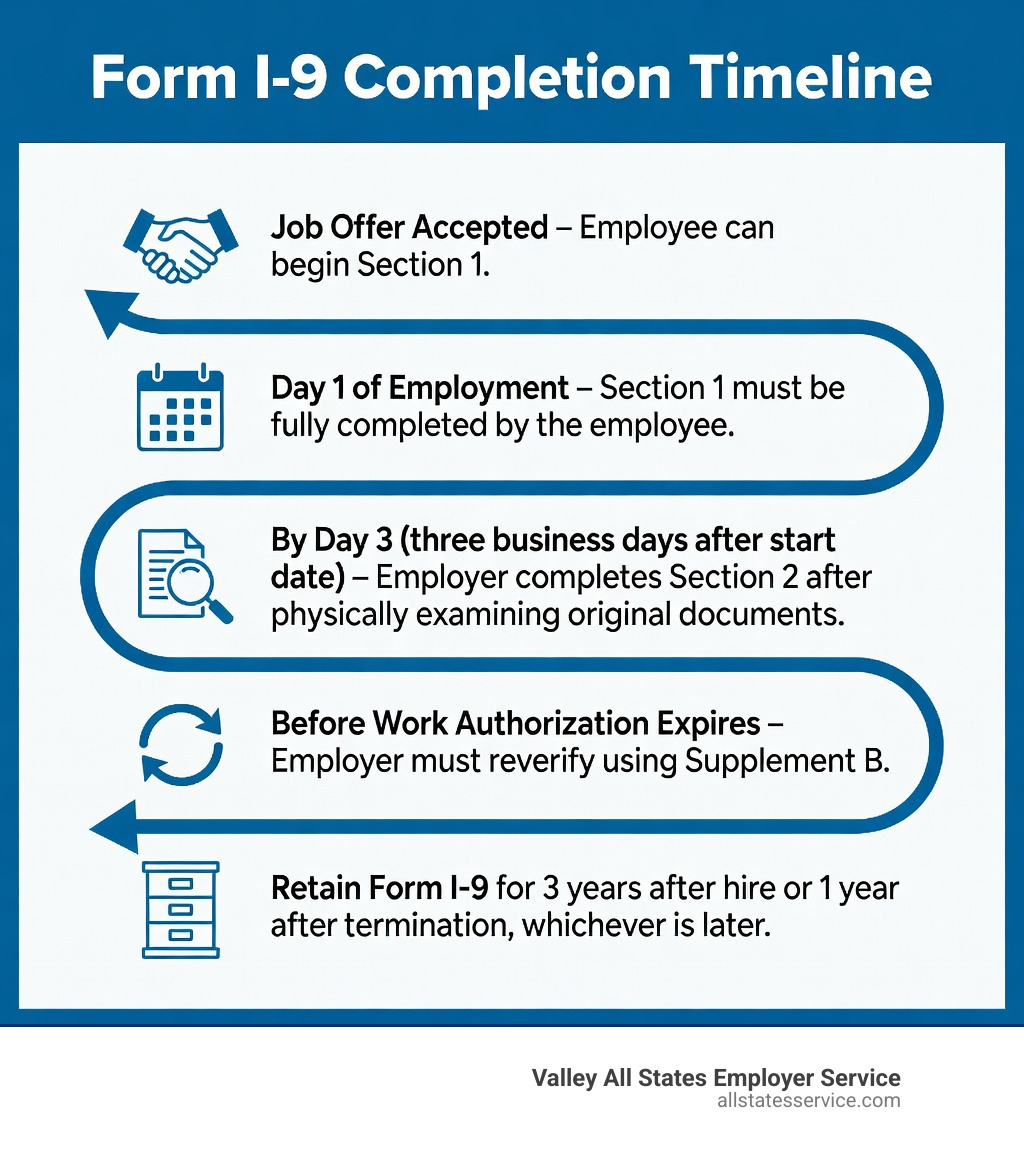
Quick Reference: Form I-9 Basics
| What | Who | When |
|---|---|---|
| Employee completes Section 1 | The new hire | On or before their first day of work |
| Employer completes Section 2 | You or your authorized rep | Within 3 business days of start date |
| Reverify expiring work authorization | Employer, using Supplement B | Before the authorization expires |
| Retain the completed form | Employer | 3 years after hire or 1 year after termination, whichever is later |
Back in 1986, Congress passed the Immigration Reform and Control Act (IRCA), which made it illegal for employers to knowingly hire workers who aren’t authorized to work in the U.S. That law created Form I-9 and the employer verification system we still use today.
Every new hire must complete this process, including U.S. citizens. There are no exceptions for most paid employees hired after November 6, 1986.
If you’re an HR manager juggling onboarding, payroll, and a dozen other priorities, getting this wrong isn’t just a paperwork headache. Violations can mean serious civil penalties. That’s exactly why understanding the M-274 handbook matters, and why we’ve broken it down for you here. You can also start with what an I-9 actually is if you need the fundamentals first.
Understanding the Handbook for Employers Guidance for Completing Form I-9
When we talk about the handbook for employers guidance for completing form i 9, we are referring to the M-274. Think of this as the “I-9 Bible.” It is published by U.S. Citizenship and Immigration Services (USCIS) and is updated periodically to reflect changes in immigration law and document types. We always recommend using the online version of the Table of Contents because a printed copy becomes outdated the moment a new regulation drops.
The primary goal of this manual is to help us navigate employer sanctions. Under the law, we are responsible for ensuring our workforce is legally eligible to work. If we fail to follow the steps in the handbook, we could face fines ranging from a few hundred to several thousand dollars per individual. Proper I-9 training for employers is the best way to stay in the clear.
Key Updates in the Handbook for Employers Guidance for Completing Form I-9
The most recent major revision occurred in July 2023, and it brought some big changes. One of the most exciting updates is the permanent option for remote document examination. If you are enrolled in E-Verify and in good standing, you may be eligible to examine documents via a live video call instead of in person.
Another critical update involves the 540-day automatic extension for certain Employment Authorization Documents (EADs). Between May 4, 2022, and September 30, 2025, some noncitizens who have a pending renewal application are eligible for a much longer extension than the standard 180 days. This is designed to help workers stay on the job while USCIS deals with processing backlogs. Keeping up with these changes through the Immigrant and Employee Rights Section (IER) ensures we don’t accidentally discriminate against workers who have these valid extensions.
Step-by-Step Instructions for Section 1 and Section 2
Completing Form I-9 is a two-step dance between the employee and the employer. Section 1 is the employee’s responsibility. They must provide their full legal name, any other names used (like a maiden name), their address, date of birth, and Social Security number (though providing the SSN is optional unless you use E-Verify).
The employee must also attest to their citizenship or immigration status. This must be done no later than their first day of work for pay. If a new hire starts on Monday morning, Section 1 needs to be finished by Monday evening at the latest.
Section 2 is where we come in. As the employer, we must review the documents the employee provides and record the information on the form. The “three business day rule” is the golden rule here. If the employee starts on a Monday, you must complete Section 2 by Thursday. To make sure you’re doing this right, check out our I-9 Section 2 complete guide.
| Requirement | Section 1 (Employee) | Section 2 (Employer) |
|---|---|---|
| Who Completes It? | The New Hire | The Employer or Authorized Rep |
| Deadline | No later than the 1st day of work | Within 3 business days of the 1st day |
| What is Verified? | Personal info and legal status attestation | Identity and work authorization documents |
| Document Review | None required | Must examine original documents |
Completing Section 2 with the Handbook for Employers Guidance for Completing Form I-9
When we fill out Section 2, we have to physically examine original documents. Photocopies are not allowed, with the only exception being a certified copy of a birth certificate. We need to look at the documents and decide if they reasonably appear to be genuine and relate to the person standing in front of us.
If you use an authorized representative, such as a notary public or a remote manager, you are still legally liable for any mistakes they make. They don’t need to use a notary seal, they just need to fill out the form correctly. If you are using the new DHS-authorized alternative for remote verification, make sure to check the box in Section 2 indicating that you used an alternative procedure. For more specifics, see our I-9 Section 2 requirements complete guide.
Mastering the Lists of Acceptable Documents
The handbook for employers guidance for completing form i 9 provides three lists of documents. It is vital that we let the employee choose which documents to present. We cannot tell them, “Bring me your passport,” as that could be considered document abuse or discrimination.
- List A: These documents prove both identity and work authorization (e.g., U.S. Passport or Permanent Resident Card).
- List B: These prove identity only (e.g., Driver’s license or School ID).
- List C: These prove work authorization only (e.g., Social Security card or Birth certificate).
If an employee doesn’t have a List A document, they must provide one document from List B and one from List C. For a deep dive into what counts, visit our guide to acceptable documents.
One tricky area is the “receipt rule.” If an employee’s document was lost, stolen, or damaged, they can present a receipt showing they applied for a replacement. This receipt is valid for 90 days. After that, they must show the actual replacement document. Following I-9 best practices means keeping a calendar alert for these 90-day deadlines so we don’t miss them.
Managing Special Cases and Automatic Extensions
Not every hire is straightforward. Some noncitizens have automatic extensions of their work authorization. For example, F-1 students on STEM OPT may be eligible for a 180-day extension if they have a renewal pending. There is also the “Cap-Gap” extension, which allows students transitioning from an F-1 visa to an H-1B visa to continue working while their petition is processed.
Refugees and asylees also have special rules. A refugee’s I-94 arrival record with a refugee admission stamp can act as a temporary List A document for 90 days. After that, they need to present either an EAD or a combination of List B and List C documents. You can find more details on these scenarios in our I-9 document requirements guide.
What about minors or people with disabilities? If a minor under 18 cannot produce a List B identity document, a parent or legal guardian can sign Section 1 on their behalf. In Section 2, the employer would write “Individual under age 18” in the document title area. Similar rules apply to employees with disabilities who are placed through special programs.
When a worker’s authorization is about to expire, we use Supplement B (formerly Section 3) for reverification. We must do this before the current authorization expires to avoid a gap in legal employment. We never reverify U.S. citizens or Lawful Permanent Residents who presented a “green card” (Form I-551).
Retention Rules and E-Verify Integration
Once the paperwork is done, we can’t just toss it in a drawer and forget it. We must retain Form I-9 for every current employee. Once an employee leaves, we keep the form for either three years after their hire date or one year after their termination date, whichever is later.
Whether you store these in a physical filing cabinet or an electronic system, they must be secure and accessible for a government audit within three business days. Electronic systems must have an audit trail that shows who accessed or changed a record and when. Our I-9 compliance solutions guide explains how to set up these systems to meet DHS standards.
Many of us also use E-Verify, which is a web-based system that compares I-9 info to government records. E-Verify is a great “companion” to the I-9, but it doesn’t replace it. If E-Verify returns a “Tentative Nonconfirmation” (mismatch), we cannot fire or take adverse action against the employee while they contest the mismatch. It simply means the records don’t align yet, not necessarily that they aren’t authorized to work.
Frequently Asked Questions about the Handbook for Employers Guidance for Completing Form I-9
When must I complete Section 2 if an employee starts on Monday?
If an employee’s first day of work for pay is Monday, you must complete Section 2 by the end of the day on Thursday. If the job is only for two days, you must complete Section 2 on the very first day of work.
Can I specify which documents an employee should bring?
No. This is one of the most common mistakes. You must provide the Lists of Acceptable Documents to the employee and let them choose which ones to present. Forcing a specific document, like a passport, can lead to discrimination charges from the Department of Justice.
Do I need to complete a new Form I-9 for a rehire?
If you rehire an employee within three years of the date their previous Form I-9 was completed, you can either complete a new form or use Supplement B to update the existing one. If it has been more than three years, you must start a fresh Form I-9.
Summary of Compliance Steps
Staying compliant with the handbook for employers guidance for completing form i 9 doesn’t have to be a nightmare. By following the timelines, allowing employees to choose their documents, and keeping organized records, you can protect your business from costly penalties.
At Valley All States Employer Service, we specialize in taking this burden off your shoulders. We provide expert, impartial, and efficient E-Verify workforce eligibility verification. Our goal is to minimize errors and reduce the administrative heavy lifting for your HR team. If you want to ensure your onboarding process is bulletproof, check out our Form I-9 ultimate guide or contact us today to learn how we can streamline your compliance.
Ready to simplify your hiring process? Let us handle the details so you can focus on growing your team.