
Why Understanding I-9 Valid Documents Matters for Every Employer
I-9 valid documents are the specific forms of ID and work authorization every new hire in the U.S. must present. As an employer, understanding which documents are acceptable is crucial for avoiding costly compliance mistakes. Penalties for violations can range from hundreds to tens of thousands of dollars, and Immigration and Customs Enforcement (ICE) conducts thousands of I-9 audits annually.
Quick Answer: The Three Document Lists
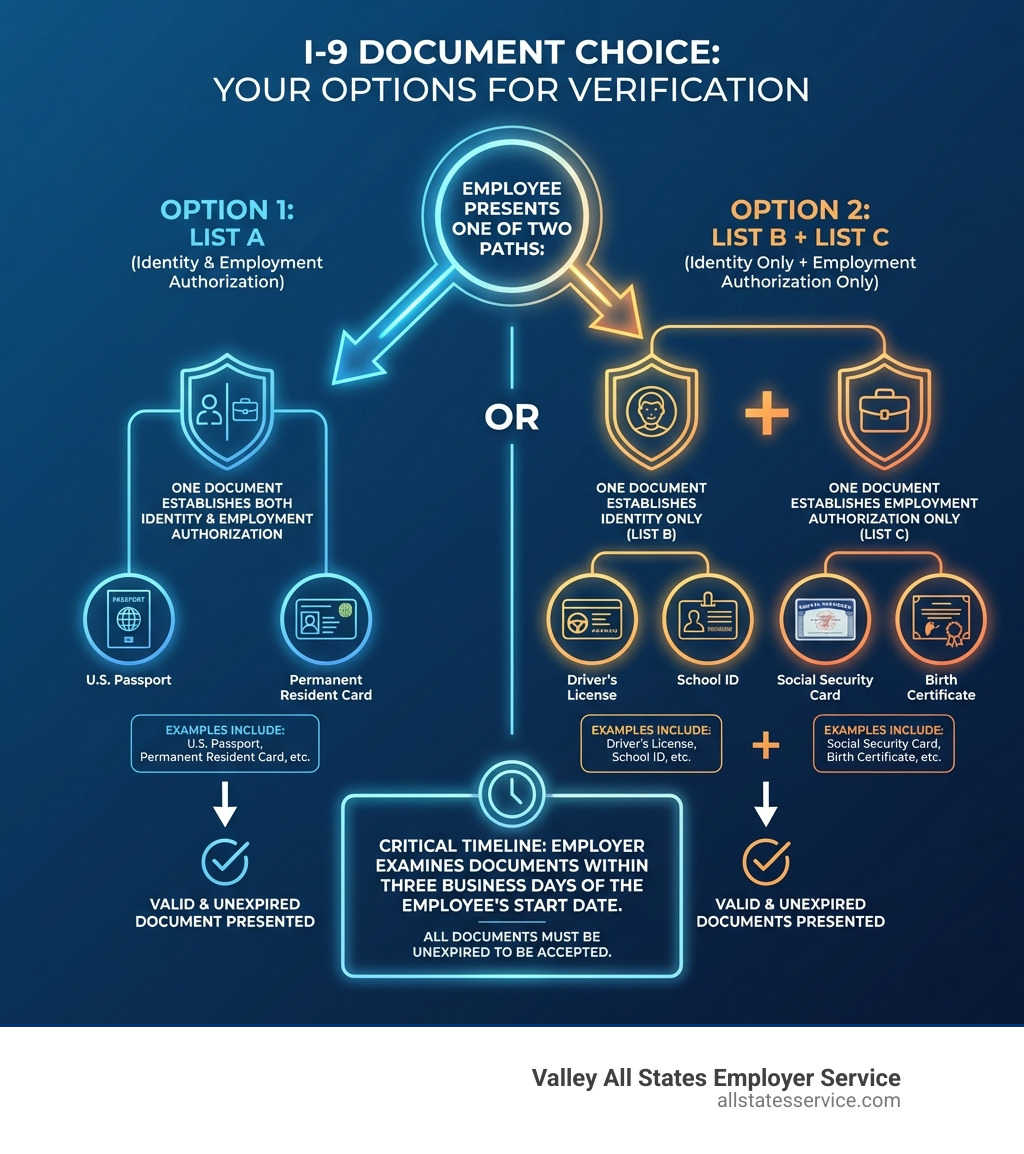
Employees must present one of the following options:
- List A: One document that proves both identity and employment authorization (like a U.S. Passport).
- List B + List C: One document that proves identity (like a Driver’s License) AND one that proves employment authorization (like a Social Security Card).
Common List A Documents:
- U.S. Passport or U.S. Passport Card
- Permanent Resident Card (Green Card)
- Employment Authorization Document with photo
Common List B Documents (Identity):
- State-issued Driver’s License
- Government-issued ID card with photo
- U.S. Military ID
Common List C Documents (Work Authorization):
- Unrestricted Social Security Card
- U.S. Birth Certificate
- Certification of Birth Abroad
All documents must be unexpired and appear genuine. Since 1986, federal law has required employers to verify every new hire’s identity and work authorization via Form I-9. While the form seems simple, mistakes like accepting a restricted Social Security card can lead to major penalties. The good news is that once you understand the three-list system, I-9 compliance becomes manageable.
Explore more about i 9 valid documents:
Understanding Form I-9 and the Three Document Lists
Form I-9, the Employment Eligibility Verification Form, is a U.S. Citizenship and Immigration Services (USCIS) document used to verify the identity and employment authorization of every new hire. For employers, completing this form correctly is a legal obligation with significant financial penalties for non-compliance. For employees, it’s how they affirm their legal right to work.
The core of the I-9 process is the “three-list system.” Employees can present one document from List A, or a combination of one document from List B and one from List C. The choice is entirely up to the employee; employers cannot specify which documents to provide, as this could be discriminatory.
Understanding this system is key to smooth onboarding. To learn more about the broader context, check out our I-9 Compliance Guide 2025. For a general overview, see our guide on What is an I-9?.
What is the Difference Between List A and a List B & C Combination?
The distinction is simple once you understand the purpose of each list.
List A documents are the all-in-one solution, establishing both identity and employment authorization. If an employee presents a valid List A document, no other documents are needed for verification.
List B + C documents fulfill the two requirements separately:
- List B documents establish only identity. These are typically government-issued photo IDs.
- List C documents establish only employment authorization.
Both options are equally valid. The employee chooses which valid documents to present, and the employer must accept them.
Key Timelines for Form I-9 Completion
Timeliness is crucial in the I-9 process. Missed deadlines are a common and costly mistake.
First, the employee must complete Section 1 of Form I-9 no later than their first day of employment. This should be done after accepting the job offer but before starting work for pay.
Next, the employer or an authorized representative must complete Section 2 of Form I-9 within three business days of the employee’s first day. During this time, you must physically examine the employee’s original documents. For example, if an employee starts on a Monday, you have until Thursday to complete Section 2. Missing this deadline is a paperwork violation.
This strict timeline highlights the need for a streamlined onboarding process. For more details on new hire paperwork, visit our guide on New Hire Paperwork I-9.
A Deep Dive into the Lists of I 9 Valid Documents
Let’s look more closely at the specific i 9 valid documents in each list so you can feel confident during hiring. A simple rule guides everything: all documents must be unexpired, and they must look reasonably genuine and clearly belong to the person who presents them.
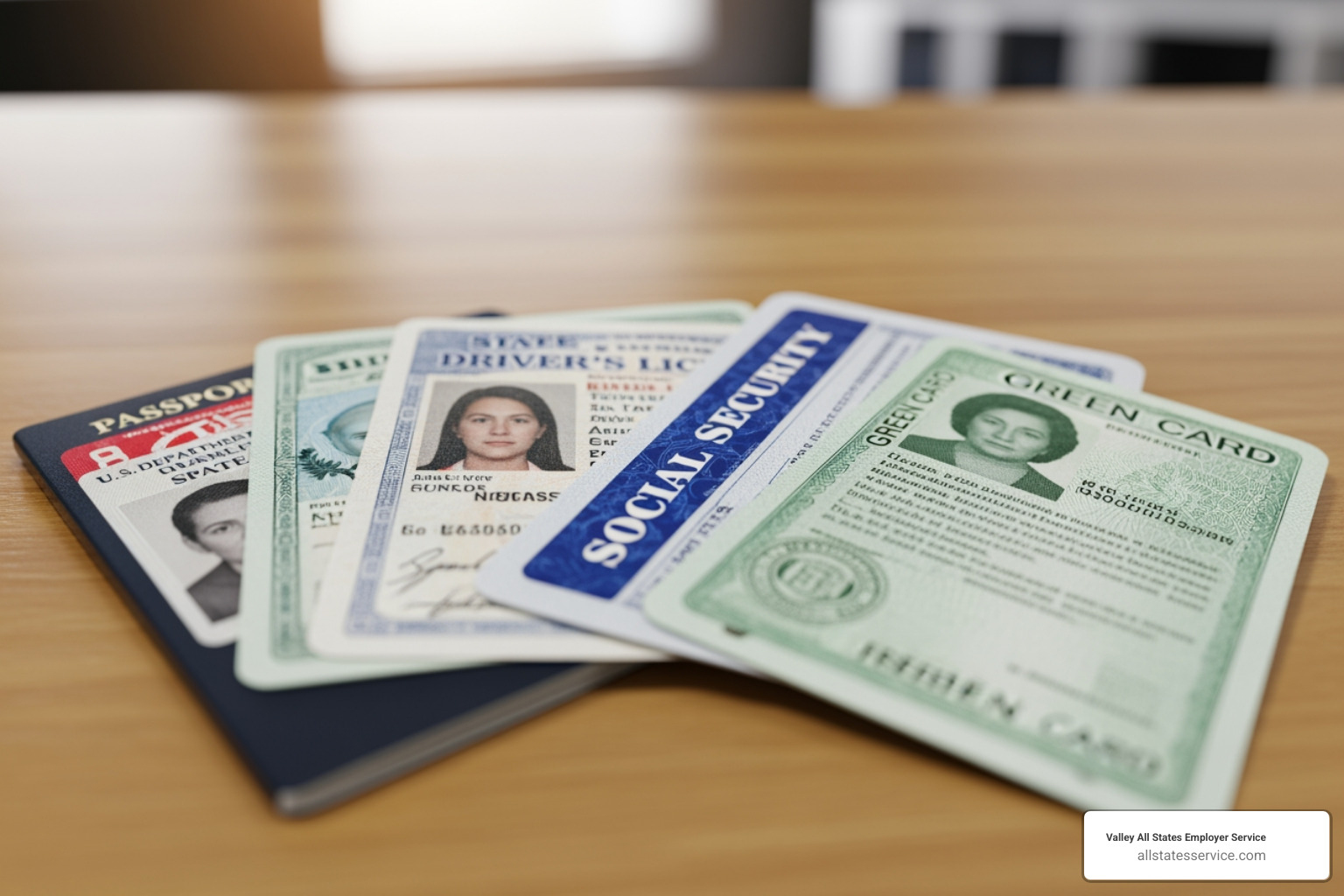
The USCIS offers detailed, plain-language guidance, and you can always check the official U.S. Citizenship and Immigration Services Examples of Acceptable Form I-9 Documents for the most current list of i 9 valid documents. For a more practical, employer-focused breakdown, our I-9 Document Requirements Complete Guide walks through real-world scenarios and common issues.
List A: Documents That Establish Both Identity and Employment Authorization
These documents cover both identity and work authorization in a single item. If an employee presents a valid List A document, you do not need anything else.
- U.S. Passport or U.S. Passport Card: Confirms both U.S. citizenship and identity.
- Permanent Resident Card (Form I-551): Commonly called a “Green Card,” it shows lawful permanent resident status and work authorization. If you need step-by-step help, see our guide on Filling Out I9 with Permanent Resident Card.
- Foreign passport with a temporary I-551 stamp or notation: Acceptable for individuals waiting for their physical Green Card.
- Employment Authorization Document (EAD) (Form I-766): A photo card from USCIS that grants employment authorization to certain non-citizens.
- Foreign passport with Form I-94/I-94A: The I-94 or I-94A must show the same name as the passport, along with the worker’s nonimmigrant status and work authorization. This is common for people in employment-based visa categories, such as H-1B or L-1.
- Passport from the Federated States of Micronesia (FSM) or the Republic of the Marshall Islands (RMI): Must be accompanied by a Form I-94/I-94A that shows admission under the Compact of Free Association.
List B: Documents That Establish Identity
When an employee chooses the List B plus List C route, they need one document from List B to prove identity. These are usually government-issued documents with a photo or other strong identifiers.
Common List B i 9 valid documents include:
- Driver’s license or ID card issued by a U.S. state or outlying possession
- ID card issued by federal, state, or local government agencies
- School ID card with a photograph
- U.S. Military card or draft record
- Military dependent’s ID card
- U.S. Coast Guard Merchant Mariner Card
- Native American tribal document
- Voter’s registration card
- Canadian driver’s license
Each of these satisfies the identity requirement, but you still need a List C document to confirm work authorization.
List C: The List of I 9 Valid Documents for Employment Authorization
List C documents are paired with List B documents. Together, they show who the employee is and that the person is allowed to work in the United States.
Common List C i 9 valid documents include:
- U.S. Social Security Account Number card: The card must be unrestricted. Cards with notes such as “NOT VALID FOR EMPLOYMENT” or “VALID FOR WORK ONLY WITH DHS AUTHORIZATION” are not acceptable. A laminated card is also generally not acceptable.
- Certification of Birth Abroad (Form FS-545 or DS-1350) or a Consular Report of Birth Abroad (Form FS-240)
- Original or certified copy of a birth certificate issued by a U.S. state, county, or municipal authority with an official seal. Puerto Rico birth certificates issued before July 1, 2010, are not valid for I-9.
- Native American tribal document
- U.S. Citizen ID Card (Form I-197)
- Employment authorization document issued by the Department of Homeland Security (DHS)
These documents do not prove identity on their own, so you always need to see them alongside a List B document.
Special Cases: Receipts and Minors
The I-9 process recognizes that not every worker will have their original documents ready on day one. In some narrow situations, receipts can be used temporarily.
Acceptable Receipts
In limited cases, an employee may present a receipt instead of the actual document if the original was lost, stolen, or damaged. The key points are:
- The receipt is valid for 90 days from the hire date.
- The employee must present the replacement original document within that 90-day window.
- Receipts are not acceptable for the first-time issuance of work authorization, such as a brand-new EAD.
For more detail on which receipts qualify as i 9 valid documents, see the USCIS guidance on More on acceptable receipts.
Employees Under 18 Years Old
Some minors will not have a standard List B photo ID. In those situations, they can use alternative identity documents, such as:
- School record or report card
- Clinic, doctor, or hospital record
- Day-care or nursery school record
Even when a minor uses one of these alternatives for identity, the worker still needs a List C document to prove employment authorization. Keeping these options in mind helps you stay compliant without turning away eligible younger workers.
Employer Responsibilities and Best Practices for I-9 Compliance
Your role in the I-9 process extends beyond collecting documents. It involves careful examination, adhering to timelines, and upholding non-discrimination principles.

When an employee presents their i 9 valid documents, you must examine them to ensure they appear genuine and relate to the individual. A critical part of this responsibility is anti-discrimination. You cannot request specific documents or refuse a document that appears genuine and is on the official lists. The employee has the right to choose which documents to present.
Implementing robust best practices is key to avoiding penalties. For a comprehensive overview, explore our I-9 Best Practices Complete Guide and our I-9 Employer Compliance Guide.
Document Retention and Corrections
Proper retention and correction of Form I-9 are essential.
Retention Rule: You must retain a completed Form I-9 for three years after the date of hire, or for one year after employment ends, whichever is later. These forms should be stored securely and separately from general personnel files.
Correcting Errors: If you find an error on a Form I-9:
- Draw a single line through the incorrect information.
- Enter the correct information.
- Initial and date the correction.
Never use white-out or erase the original entry. The goal is a clear audit trail. For detailed guidance, refer to the USCIS handbook on How to properly date and initial corrections. Regularly auditing your I-9s can help catch issues proactively, and our Internal I-9 Audit Complete Guide can help.
Navigating Remote Hires and E-Verify
I-9 verification for remote employees has new flexibilities. The August 1, 2023, version of Form I-9 includes a checkbox for remote document examination. If you are enrolled in E-Verify, you can use an alternative procedure that allows for document examination via live video. If you are not enrolled in E-Verify, you must still designate an authorized representative to perform a physical, in-person inspection of the documents.
E-Verify is an internet-based system that allows employers to electronically confirm the employment eligibility of new hires by comparing Form I-9 information with government records. While Form I-9 is mandatory for all employers, E-Verify is voluntary for most but can streamline verification, especially for remote hires. To understand the relationship between these systems, our E-Verify vs I-9 Guide is a great resource. For remote verification specifics, see our I-9 Verification Process for Remote Employees and the official E-Verify Handbook for Employers.
The High Cost of Non-Compliance: I-9 Penalties
Improperly completing Form I-9 requirements carries significant financial and legal risks. The government takes employment eligibility verification seriously, and penalties for non-compliance can be steep.
Here are the potential consequences:
- Paperwork Violations: Technical errors, like a missing signature, can result in fines from $288 to $2,861 per violation.
- Knowingly Hiring Unauthorized Workers: This is a much more serious offense with escalating penalties:
- First offense: Fines from $716 to $5,724 per worker.
- Second offense: Fines from $5,524 to $14,308 per worker.
- Subsequent offenses: Fines from $8,586 to $28,619 per worker.
- E-Verify Penalties: Failing to follow E-Verify procedures can lead to fines of $973 to $1,942 per violation.
- Criminal Penalties: In severe cases involving a pattern of violations or fraud, criminal penalties may apply, including imprisonment.
An I-9 audit by ICE can be triggered by various factors, and the fines can be devastating. Proactive compliance and understanding i 9 valid documents are your best defense. Learn more about I-9 Compliance Penalties and what to expect during an ICE I-9 Audit.
Frequently Asked Questions about I 9 Valid Documents
Here are straightforward answers to common questions about i 9 valid documents and the Form I-9 process.
What triggers an I-9 audit?
I-9 audits, carried out by Immigration and Customs Enforcement (ICE), can start for several different reasons, including:
- Complaints from current or former employees
- Tips or leads from other agencies or sources
- Targeted reviews of industries that have a history of higher violation rates
- Random selection as part of wider enforcement efforts
Being ready with accurate, organized I-9 forms and properly reviewed i 9 valid documents is the best way to handle any potential audit.
Does a 1099 independent contractor need to fill out a Form I-9?
No. Form I-9 only applies to employees who are on your payroll. Independent contractors, who typically receive a 1099, do not complete Form I-9.
That said, misclassifying a worker as an independent contractor when they function as an employee can lead to serious tax, wage, and compliance problems. If you use contractors heavily, it is smart to review your classification practices and learn how E-Verify fits into that picture through our E-Verify 1099 Contractors Complete Guide.
Are there any documents that are explicitly not acceptable for Form I-9?
Yes. Even if a document looks official, it may not count as an i 9 valid document. Common examples that are not acceptable include:
- Expired documents, with very few exceptions
- Laminated Social Security cards, which can raise questions about alteration
- Restricted Social Security cards, such as those printed with “NOT VALID FOR EMPLOYMENT” or “VALID FOR WORK ONLY WITH DHS AUTHORIZATION”
- Hospital birth certificates, because the I-9 rules require a state or county certificate with an official seal
- Photocopies of documents, unless it is an original certified copy of a birth certificate
When in doubt, compare what you are seeing with the official lists of i 9 valid documents from USCIS or use internal resources like Valley All States Employer Service to help your team stay compliant.
Conclusion
Navigating i 9 valid documents is a manageable and essential part of hiring once you understand the rules. By focusing on compliance, you protect your business and your workforce.
The key takeaways are clear:
- Employee’s Choice: Employees can present one document from List A or a combination of one from List B and one from List C.
- Employer’s Responsibility: You must examine documents to ensure they appear genuine, relate to the employee, and are unexpired, without discriminating.
- Timeliness: Completing Section 2 within three business days is non-negotiable.
- Compliance is Key: The penalties for non-compliance are severe, making accuracy critical.
- Adaptability: For remote hires, understanding the alternative verification procedure through E-Verify is crucial.
Staying current with I-9 rules is an ongoing commitment. At Valley All States Employer Service, we provide expert E-Verify and compliance assistance to minimize errors and administrative burdens. We believe robust employment eligibility verification is a best practice that protects every organization.
For a deeper dive, refer to our I-9 Acceptable Documents Ultimate Guide. Ready to simplify your compliance? Contact our team today!