
Filling out i9 with permanent resident card Top 1
Why Understanding Your Permanent Resident Card is Critical for I-9 Success
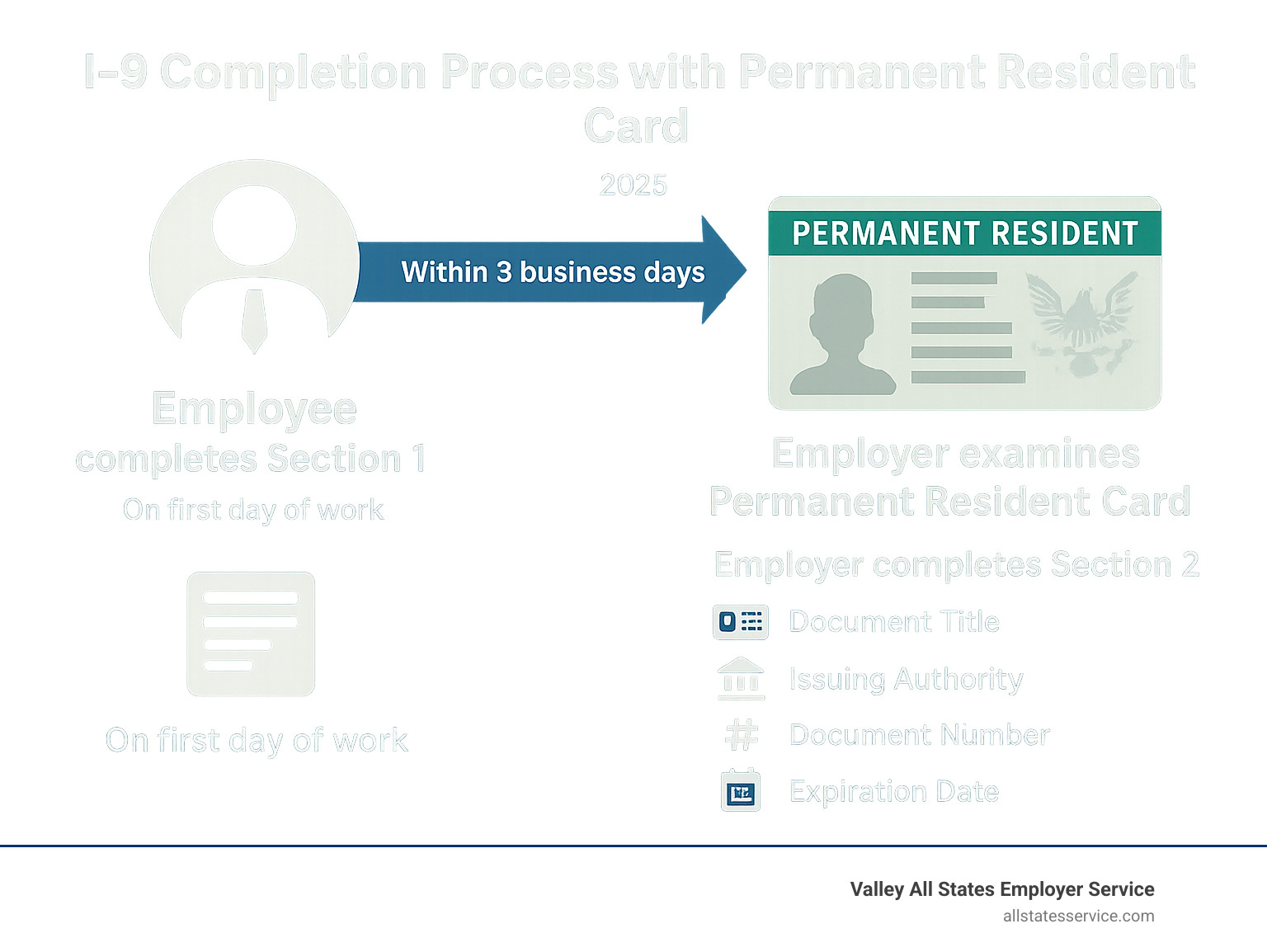
Filling out I-9 with permanent resident card requires knowing specific details about your employee’s document and following precise steps. Here’s what you need to know right away:
Quick Steps for I-9 with Permanent Resident Card:
- Employee completes Section 1 – marks “Lawful Permanent Resident” and enters A-Number
- Employer examines the card – verify it appears genuine and relates to the employee
- Record in Section 2 – Document Title: “Permanent Resident Card”, Issuing Authority: “USCIS”
- Enter the Document Number – typically 3 letters + 10-11 numbers (different from A-Number)
- Enter expiration date – no reverification needed for standard 10-year cards
As one government source explains: “Form I-9 is used for verifying the identity and employment authorization of individuals hired for employment in the United States.” The Permanent Resident Card (Form I-551) serves as a List A document, meaning it proves both identity and work authorization in one step.
But here’s where many HR managers get tripped up. There are different versions of permanent resident cards, temporary documents that look similar, and specific rules about when reverification is required. Get it wrong, and you could face compliance penalties or discrimination claims.
The good news? Once you understand the basics, processing permanent resident cards becomes straightforward. Most standard cards don’t require reverification, making them simpler than many other work authorization documents.
Understanding Your Permanent Resident Card (Form I-551)
Let’s start with the basics. When someone shows you a Permanent Resident Card, you’re looking at Form I-551, better known as a Green Card. This little piece of plastic is pure gold for I-9 processing because it’s what we call a List A document. That means it proves both identity and work authorization in one go.
Think of it as the Swiss Army knife of employment eligibility documents. While other employees might need to present two separate documents (like a driver’s license plus a Social Security card), filling out I-9 with permanent resident card requires just this single document. Pretty convenient, right?
The card shows that USCIS has granted someone Lawful Permanent Resident (LPR) status in the United States. For employers, this translates to a straightforward verification process. The USCIS Handbook For Employer: 7.1 Lawful Permanent Residents (LPR) provides the official guidance, and if you’re still getting familiar with the whole process, our guide on What is an I-9? covers the fundamentals.
Card Versions and Key Information
Here’s where things get interesting. Not all Permanent Resident Cards look the same. Over the years, USCIS has updated the design several times, and understanding these different versions can save you from second-guessing yourself during document review.
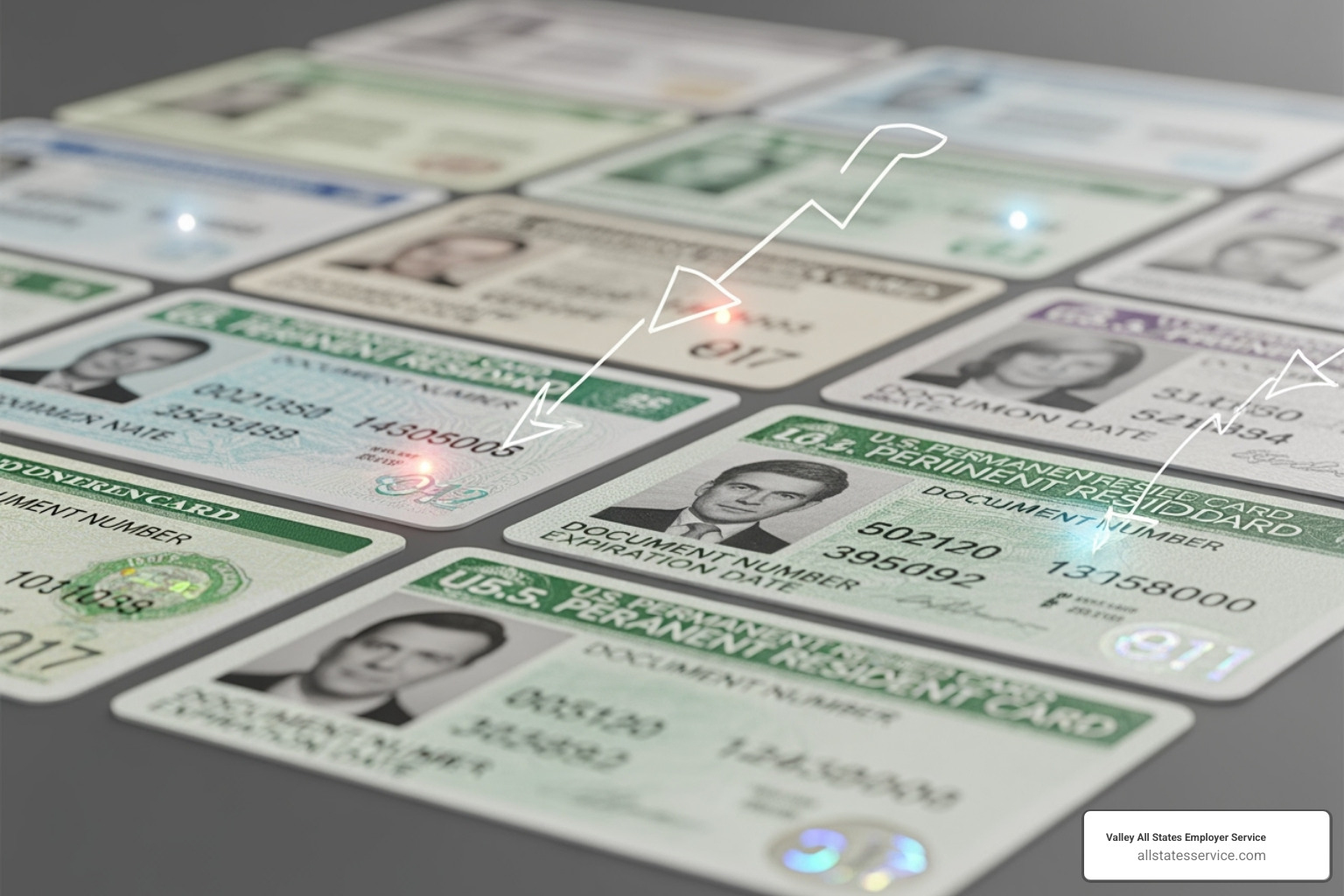
Most cards you’ll encounter fall into three main categories. Standard 10-year cards are the most common, issued to permanent residents for a decade of validity. These are your bread-and-butter documents that require no reverification when they expire.
Then there are 2-year conditional resident cards. These go to people who got their permanent residence through marriage or certain investment programs. The “conditional” part means they need to prove their status is legitimate before getting the standard 10-year version.
Now here’s something that surprises many HR professionals: older cards without expiration dates are still perfectly valid. Some Alien Registration Receipt Cards issued between January 1977 and August 1989 never expire. Yes, you read that right. A card from the 1980s with no expiration date is still a valid List A document today.
When examining any version, you’ll need to locate two crucial pieces of information: the Document Number and the USCIS Number (A-Number). The Document Number typically appears as three letters followed by 10 or 11 numbers, while the A-Number is the person’s unique identification number in the USCIS system.
The Difference Between the A-Number and the Document Number
This distinction trips up even experienced HR professionals, so don’t feel bad if it seems confusing at first. Both numbers appear on the same card, but they serve completely different purposes on Form I-9.
The A-Number (USCIS Number) identifies the person in government records. It’s usually 7 to 9 digits long and goes in Section 1 of Form I-9, which the employee fills out. Think of it as the person’s unique ID in the immigration system.
The Document Number (Card Number) identifies the specific card itself. This longer number, typically three letters plus 10 or 11 digits, goes in Section 2 of Form I-9, which you as the employer complete. It’s like the card’s serial number.
| Feature | A-Number (USCIS Number) | Document Number (Card Number) |
|---|---|---|
| Purpose on I-9 | Employee’s immigration record (Section 1) | Specific document presented (Section 2) |
| Format | 7 to 9 digits (e.g., A12345678) | 3 letters + 10-11 numbers (e.g., LIN12345678901) |
| Location | Front of card, labeled “A#” or “USCIS#” | Front or back, often near bottom or side |
Getting these numbers in the right sections isn’t just about following rules. It’s about creating an accurate record that protects both you and your employee. Mix them up, and you might face compliance headaches down the road.
A Step-by-Step Guide to Filling Out I-9 with a Permanent Resident Card
Getting the Form I-9 right isn’t complicated, but it does require attention to detail. Think of it as a two-person dance where the employee leads in Section 1, and you follow with Section 2. When filling out I-9 with permanent resident card, both parties have specific responsibilities that must be completed within strict timelines.
For broader guidance on this process, our comprehensive I-9 Form Completion resource covers all document types. Here, we’ll walk through exactly what happens when your new hire presents that green card.
For the Employee: Completing Section 1
Your employee has a straightforward but critical job on their first day of work. They need to complete Section 1 honestly and accurately, and this attestation carries legal weight.
The lawful permanent resident status selection comes first. Your employee will check the box indicating “A lawful permanent resident” rather than the citizen or work authorization options. This choice determines what happens in the rest of the process.
Next comes the USCIS Number entry, which is that 7- to 9-digit A-Number we discussed earlier. Your employee should look at their Permanent Resident Card and carefully copy this number into the designated field. Small mistakes here can cause big headaches later, so accuracy matters.
The signature and date complete Section 1. Your employee is certifying under penalty of perjury that everything they’ve provided is true and correct. As their employer, you can clarify instructions or point out obvious errors, but you cannot fill out this section for them.
This all happens on or before the first day of employment. No exceptions, no extensions.
For the Employer: Completing Section 2 with a Standard Card
Now it’s your turn, and you have up to three business days from their first day of work to complete Section 2. This is where you’ll examine that Permanent Resident Card and record its details.
Document examination comes first, and you’re not expected to be a forensics expert. Look at the card with reasonable care. Does it appear genuine? Does the photo match the person standing in front of you? Are there obvious signs of tampering or alteration? You’re making a good-faith determination, not conducting a criminal investigation.
Recording the document information follows a specific pattern. Under “List A Documents,” you’ll enter “Permanent Resident Card” as the document title. The issuing authority is always “USCIS” regardless of which version of the card you’re looking at.
The document number entry is where many people get confused, but it’s simpler than it seems. Find that string of characters that typically looks like three letters followed by 10 or 11 numbers. This is different from the A-Number the employee used in Section 1. Copy it exactly as it appears.
The expiration date goes in next, transcribed directly from the card. Even if the card expires next month, you record what you see.
Here’s the beautiful part about standard Permanent Resident Cards: no reverification is typically required. Unlike work authorization documents that expire and require follow-up, most green cards represent permanent status. The card itself might expire, but the person’s right to work doesn’t.
After you’ve completed all the fields, sign and date Section 2. You’re certifying that you examined the document and that it reasonably appears to relate to the person who presented it.
If your company uses E-Verify, this information from Section 2 gets submitted to create the employee’s case. The integration between Form I-9 and E-Verify is seamless when done correctly. Learn more about this connection in our guide to E-Verify and I-9.
Handling Complex Scenarios: Temporary and Expired Documents
Not every permanent resident walks through your door with a pristine, current card. Sometimes you’ll encounter situations that make you pause and wonder, “Is this acceptable?” These complex scenarios involving temporary or expired documents require extra attention because they often trigger reverification requirements. Get these wrong, and you could face significant I-9 Compliance Penalties.
The good news? Once you understand the patterns, these situations become much more manageable.
Expired Permanent Resident Card with a Form I-797 Receipt
Picture this: your new employee presents a permanent resident card that expired last month, along with an official-looking government receipt. Before you panic, know that this combination might be perfectly acceptable for filling out I-9 with permanent resident card documentation.
When a lawful permanent resident applies to renew their card or remove conditions on their residence, USCIS often extends the validity of their expired card through a Form I-797 Notice of Action. This receipt acts like a temporary bridge until their new card arrives.

Here’s where it gets interesting. Different types of I-797 receipts create different scenarios:
For standard renewals (Form I-90 applications or naturalization applications), the I-797 receipt automatically extends the expired card’s validity. You can accept this combination as a List A document. Record the document title as “Permanent Resident Card (Form I-551)” and use the expiration date from the I-797 receipt. Keep a copy of that receipt with your I-9 and note the extension in the “Additional Information” section. The best part? No reverification needed for the permanent resident status itself.
For conditional residents removing conditions (Forms I-751 or I-829), things work differently. The expired conditional card plus I-797 receipt becomes a List C document, meaning it only proves work authorization. Your employee will also need to present a List B document like a driver’s license for identity verification. Record this as “Form I-797, Notice of Action, indicating extension of a conditional Permanent Resident Card” and mark your calendar for reverification before the extension expires.
Temporary I-551 Documents: ADIT Stamps and MRIVs
Sometimes permanent residents find themselves in the U.S. without their physical card. Maybe they’re returning from travel and their card was lost, or they’re new residents waiting for their card to arrive. In these cases, they might present temporary I-551 evidence.
ADIT stamps are your most common temporary document. These special stamps appear either on a Form I-94 with a photograph or directly in a foreign passport. Think of them as USCIS saying, “This person is definitely a permanent resident, we just haven’t gotten them their card yet.”
When you see an ADIT stamp, record it as “Form I-94 with temporary I-551 stamp and photograph” or “Foreign passport with temporary I-551 stamp.” The issuing authority is always “USCIS” or “USDHS.” These stamps typically last one year from issuance, though some have specific expiration dates printed right on them.
Machine-Readable Immigrant Visas (MRIVs) work similarly. These appear in foreign passports with a printed notation stating they serve as temporary I-551 evidence. They’re usually valid for one year from the date of U.S. admission.
Here’s the catch with all temporary documents: reverification is required. Unlike standard permanent resident cards, these temporary proofs expire, and you’ll need to complete Supplement B when they do. The employee should have received their actual card by then.
The key to managing these complex scenarios is understanding that permanent resident status itself doesn’t expire, but the documents proving that status sometimes do. Keep track of those expiration dates, and you’ll stay compliant while supporting your employees through their documentation transitions.
Reverification and Employer Compliance
Staying compliant with Form I-9 requirements isn’t a “set it and forget it” process. It requires ongoing attention, especially when it comes to understanding reverification rules. The good news? Filling out I-9 with permanent resident card scenarios are often simpler than other document types when it comes to ongoing compliance.
Regular I-9 Self-Audit practices can help you catch and correct errors before they become costly problems. If your company uses E-Verify, understanding how reverification interacts with the system becomes even more important. Our E-Verify and I-9 Compliance guide covers these connections in detail.
When (and When Not) to Reverify a Lawful Permanent Resident
Here’s where many employers get confused, but the rules are actually quite straightforward once you understand the logic behind them.
Standard 10-year cards present the simplest scenario. You do not need to reverify employment authorization for an employee who originally presented a valid 10-year Permanent Resident Card. Even when that card expires, the person’s lawful permanent resident status doesn’t expire with it. Think of the card like a driver’s license. When your license expires, you’re still the same person who knows how to drive. Similarly, when a Permanent Resident Card expires, the person is still a lawful permanent resident.
Conditional 2-year cards follow the same principle. If a conditional permanent resident presented their 2-year card during initial hiring and has been working for you continuously, you don’t need to reverify when the card expires. Their LPR status remains valid as long as they’ve filed their petition to remove conditions on time.
The situation changes with temporary evidence. When an employee initially presented temporary I-551 documents (like an ADIT stamp, MRIV, or an expired card with certain I-797 receipts), reverification is required before that temporary evidence expires. These documents were always meant to be temporary placeholders until the employee received their actual Permanent Resident Card.
The key insight is this: permanent status doesn’t expire, but temporary proof of that status does. This distinction drives all reverification decisions for LPRs.
Avoiding Discrimination: Your Legal Obligations
Employment verification laws include strong anti-discrimination protections, and understanding these rules protects both your company and your employees.
Document abuse is one of the most common compliance mistakes. You cannot demand that an employee show you their Permanent Resident Card specifically, even if you know they have one. Employees have the right to choose which acceptable documents to present from the Lists of Acceptable Documents. Similarly, you cannot refuse a document that reasonably appears genuine and relates to the employee presenting it.
Another critical point: you cannot refuse to hire someone or treat them differently because their documentation has a future expiration date. This directly applies to Permanent Resident Cards. The card’s expiration date doesn’t mean the person’s work authorization expires.
Employees who feel they’ve experienced discrimination during the I-9 process have resources available. For issues related to national origin, immigration, or citizenship status discrimination, they can visit IER’s website. For discrimination based on other protected characteristics like race, color, or religion, they can visit the EEOC website.
Your best practices for non-discriminatory I-9 compliance should include treating all employees consistently, accepting any valid document combination from the acceptable lists, and never requesting more documentation than required. Most importantly, a Permanent Resident Card’s expiration date has nothing to do with the person’s ongoing employment authorization.
These principles aren’t just about avoiding legal trouble. They create a fair, welcoming workplace where all employees feel respected during the verification process.
Frequently Asked Questions about Filling Out I-9 with a Permanent Resident Card
Let’s be honest – even after reading all the rules and guidelines, real-world scenarios can still throw us curveballs when filling out I-9 with permanent resident card. Here are the questions we hear most often from HR professionals just like you.
My employee’s Permanent Resident Card expires in two months. Should I reverify them?
This question comes up constantly, and the answer might surprise you: absolutely not. You should not reverify them, and here’s why this matters so much.
Here’s the key insight that trips up many employers: a Permanent Resident Card’s expiration date has nothing to do with the person’s immigration status. Think of it like a driver’s license. When your license expires, you’re still the same person who knows how to drive. The card is just the proof, not the permission itself.
The employee’s lawful permanent resident status is exactly that – permanent. The card is simply a document that serves as evidence of that status. When it expires, they’re still authorized to work. They just need to renew their card for convenience and identification purposes.
Refusing to continue employing someone because their documentation has a future expiration date actually constitutes illegal discrimination. The anti-discrimination rules are crystal clear on this point, and it’s a mistake that can lead to serious legal trouble.
What if the employee presents a receipt for a lost, stolen, or damaged Permanent Resident Card?
Life happens. Cards get lost, wallets get stolen, and sometimes important documents get damaged. Fortunately, the “receipt rule” covers exactly this situation, and it’s more straightforward than you might think.
When an employee presents a receipt for a replacement Permanent Resident Card, you can accept this as a temporary List A receipt. The process works like this: the receipt is valid for 90 days from the date of hire, or if you’re doing reverification, from the date their previous employment authorization expired.
In Section 2, you’ll record the document title as something like “Receipt for Permanent Resident Card,” note the receipt number if it’s available, and enter that 90-day expiration date. Then comes the important part – within that 90-day window, the employee must present their actual replacement card. When they do, you’ll update Section 2 with the new card’s details.
It’s a temporary solution that keeps everyone compliant while the employee waits for their replacement document to arrive.
How does E-Verify handle temporary I-551 documents?
E-Verify adds another layer to consider when temporary I-551 documents are involved, but don’t worry – the system is designed to handle these situations smoothly.
When an employee presents something like the arrival portion of Form I-94 with a temporary Form I-551 ADIT stamp and photograph, you’re generally required to create the E-Verify case by the third business day after hiring. The key is selecting the right document type in the system.
When you’re entering the document information into E-Verify, you’ll select the appropriate document type for the temporary I-551, such as “Temporary I-551 Document (ADIT Stamp).” The system knows how to handle these temporary documents and will process them accordingly.
If E-Verify returns a “Mismatch” – and this can happen more frequently with temporary documents – don’t panic. Simply follow the instructions E-Verify provides to help your employee resolve the issue. The system will guide you through the process step by step.
For detailed guidance on this process, the E-Verify manual has a specific section on E-Verify with ADIT that walks through handling receipts and temporary documents. If you want to dive deeper into E-Verify compliance overall, our comprehensive I-9 E-Verify Compliance Guide covers everything you need to know.
The bottom line? These temporary documents require a bit more attention and follow-up, but they’re completely manageable when you understand the process.
Conclusion
Successfully filling out I-9 with permanent resident card doesn’t have to be complicated once you understand the fundamentals. Throughout this guide, we’ve walked through everything from identifying the different versions of Permanent Resident Cards to mastering the crucial difference between A-Numbers and Document Numbers.
The beauty of working with Permanent Resident Cards lies in their simplicity as List A documents. They prove both identity and work authorization in one step, which streamlines your verification process considerably. But as we’ve seen, the devil is in the details, especially when dealing with temporary documents or extension receipts.
Here’s what matters most: accuracy is everything. Whether you’re recording document numbers, tracking expiration dates, or determining when reverification is needed, small mistakes can lead to big compliance headaches. Most standard 10-year Permanent Resident Cards don’t require reverification, but temporary I-551 documents always do.
The good news? You don’t have to steer these waters alone. At Valley All States Employer Service, we’ve built our reputation on helping employers just like you master the intricacies of workforce eligibility verification. Our team understands that behind every form is a real person starting a new job, and behind every employer is a business trying to do the right thing.
We know how overwhelming compliance can feel, especially when regulations seem to change faster than you can keep up. That’s exactly why we focus on providing expert, impartial, and efficient E-Verify processing services. We take the guesswork out of the equation, minimize your administrative burden, and help you sleep better knowing your I-9s are handled correctly.
Ready to turn your compliance concerns into confidence? Streamline your workforce eligibility verification with Valley All States Employer Service and find what peace of mind feels like.