
Don’t Get Denied: Every Document You Need for Your I-9
Why the List of Acceptable I-9 Documents Matters for Every Hire You Make
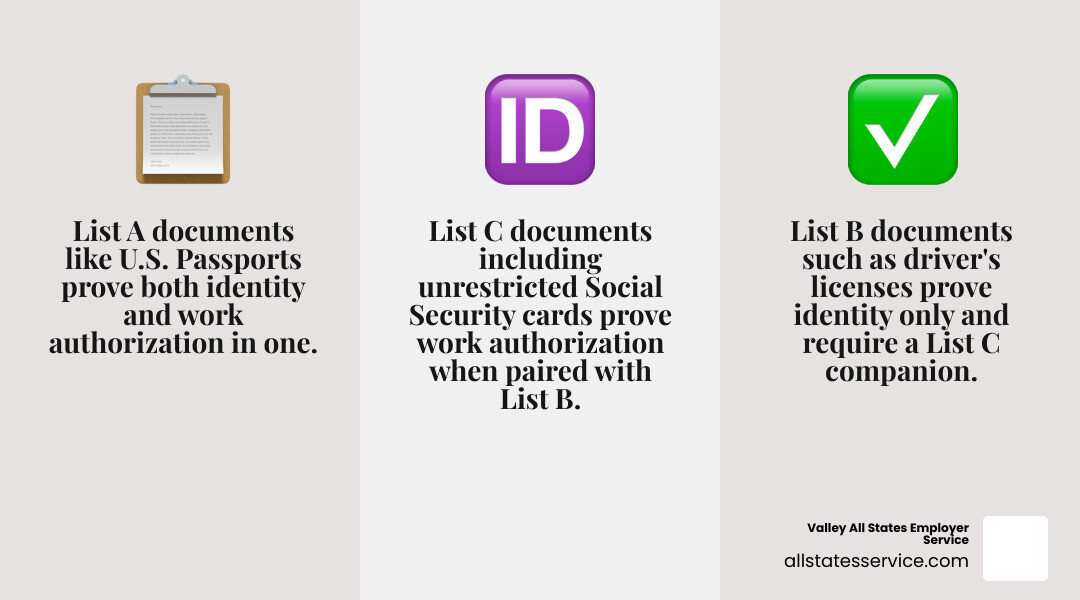
The list of acceptable I-9 documents falls into three categories, and every new hire must present at least one document from that list before they can legally start work in the U.S.:
| List | What It Proves | Examples | |
|---|---|---|---|
| List A | Identity and work authorization (one document does both) | U.S. Passport, Permanent Resident Card (I-551), Employment Authorization Document (I-766) | |
| List B | Identity only (must be paired with a List C document) | Driver’s license, State ID card, School ID with photo | |
| ** | List C** | Work authorization only (must be paired with a List B document) | Unrestricted Social Security card, U.S. birth certificate |
The rule is simple: an employee presents either one List A document, or one List B document plus one List C document. All documents with expiration dates must be unexpired.
Every employer in the United States is required to verify that new employees are legally allowed to work. That verification happens on Form I-9, and getting it wrong can mean serious fines.
But here’s where many HR teams run into trouble: the form looks straightforward, yet the rules around which documents qualify are surprisingly specific. A Social Security card with the wrong notation is invalid. An Employment Authorization Document is List A, not List C. And for minors or employees with lost documents, entirely different rules apply.
This guide walks you through every document category, the rules that govern them, and the mistakes that can quietly put your business at risk.
List of acceptable I-9 documents further reading:
Understanding the List of Acceptable I-9 Documents
Form I-9 is the cornerstone of employment eligibility in the United States. Since November 1986, federal law has required every employer to verify the identity and work authorization of every person they hire. Whether you are hiring a CEO or a seasonal intern, the process remains the same. We must ensure that every individual is legally permitted to work in the U.S. to avoid hefty penalties and maintain a compliant workforce.
The list of acceptable I-9 documents is determined by U.S. Citizenship and Immigration Services (USCIS). These documents serve two main purposes: proving who the person is (identity) and proving they have the legal right to be paid for work in this country (employment authorization). If you want to dive deeper into the basics, check out this I 9 Eligibility Documents Guide.
As of April 2026, the current version of Form I-9 must be used for all new hires. The process is split into two main sections. In Section 1, the employee provides their personal information and attests to their citizenship or immigration status. This must be done no later than the first day of employment. In Section 2, we, as the employer, must physically examine the documents the employee chooses to present and record the document information.
List A: Documents That Prove Identity and Work Authorization
List A documents are often called the “gold standard” of the list of acceptable I-9 documents. Why? Because a single document from this list satisfies both the identity and the work authorization requirements. If an employee shows you a valid List A document, you cannot ask for anything else.
The most common List A documents include:
- U.S. Passport or U.S. Passport Card: These are the most frequent documents we see.
- Permanent Resident Card (Form I-551): Also known as a “Green Card.” USCIS redesigns these every few years to prevent fraud, but older versions are still valid until they expire.
- Employment Authorization Document (Form I-766): This is a photo ID card issued to non-citizens who have temporary permission to work.
- Foreign Passport with an I-94 Form: For certain non-immigrants authorized to work for a specific employer, the passport must be unexpired and accompanied by Form I-94 showing the same name and a valid endorsement of the individual’s non-immigrant status.
It is vital to remember the unexpired requirement. With very few exceptions involving automatic extensions, every document on the list of acceptable I-9 documents that has an expiration date must be current. If you need a more granular look at these heavy-hitters, read our Cracking The Code Understanding I 9 List A Documents guide. You can also view the official Form I-9 Acceptable Documents – USCIS page for visual examples of what these look like.
List B and List C: Combining Your Identification Paperwork
If an employee does not have a List A document, they must provide a combination of one document from List B and one from List C.
List B: Proving Identity
List B documents establish identity only. For employers participating in E-Verify, List B documents must contain a photo. Common examples include:
- Driver’s license or ID card issued by a state or outlying possession of the U.S.
- ID card issued by federal, state, or local government agencies.
- School ID card with a photograph.
- Voter’s registration card.
- U.S. Military card or draft record.
- Military dependent’s ID card.
- U.S. Coast Guard Merchant Mariner Card.
- Native American tribal document.
- Driver’s license issued by a Canadian government authority.
List C: Proving Employment Authorization
List C documents prove the employee is authorized to work but do not prove who they are. Common examples include:
- Social Security Account Number card: This must be unrestricted. If the card says “NOT VALID FOR EMPLOYMENT” or “VALID FOR WORK ONLY WITH DHS AUTHORIZATION,” it is not an acceptable List C document.
- Certification of Birth Abroad: Issued by the Department of State (Forms FS-545, DS-1350, or FS-240).
- Original or certified copy of a birth certificate: Issued by a state, county, municipal authority, or territory of the U.S. bearing an official seal.
- Native American tribal document.
- U.S. Citizen ID Card (Form I-197).
- Identification Card for Use of Resident Citizen in the United States (Form I-179).
When an employee brings a combination, we must ensure both documents appear genuine and relate to the person standing in front of us. For more help on this part of the form, see our I 9 Section 2 Acceptable Documents Guide.
Critical Rules for a Valid List of Acceptable I-9 Documents
Verification isn’t just about looking at a card, it is about following a strict federal protocol. The most important rule is that we must examine original documents. Photocopies are never acceptable, with the single exception of a certified copy of a birth certificate.
Physical examination is the standard rule. We must hold the document, look at both sides, and ensure it “reasonably appears to be genuine” and relates to the employee. However, since the pandemic, DHS has introduced alternative procedures for remote verification. Only employers in good standing who are enrolled in E-Verify may use these remote “live video” procedures to examine documents, provided they follow specific steps like retaining copies of all documents examined.
Deadlines and Expiration Dates for Your List of Acceptable I-9 Documents
Timing is everything. Section 1 must be finished by the employee’s first day of work for pay. Section 2 must be completed by the employer within three business days of the first day of employment. If a hire starts on a Monday, we must have Section 2 finished by Thursday.
Expired documents are generally a “no-go.” If a document has expired, it is no longer on the list of acceptable I-9 documents. However, there are exceptions for automatic extensions. For example, some Employment Authorization Documents (EADs) are automatically extended by USCIS via a Federal Register notice. In these cases, the “expired” card, when presented with the extension notice, is considered unexpired. For a full breakdown of these tricky scenarios, consult our Expired I 9 Documents Complete Guide.
Handling Receipts and Minors in the List of Acceptable I-9 Documents
What happens if an employee’s wallet was stolen and they don’t have their original Social Security card? They can present a receipt for the application of a replacement document. This receipt is valid for 90 days. By the end of that period, the employee must show us the actual replacement document. A receipt for a new document application (not a replacement for a lost/stolen one) is usually not acceptable.
For minors under the age of 18 who cannot produce a standard List B identity document (like a driver’s license or school ID), there are special “minor” rules. They may use:
- School record or report card.
- Clinic, doctor, or hospital record.
- Day-care or nursery school record.
If they still cannot produce these, a parent or legal guardian can complete the identity section in a specific way on the form. We are also committed to providing disability accommodations if an employee cannot produce standard documents due to a disability. For more on the verification process, see Verifying I 9 Documents.
Common Mistakes and Employer Compliance Requirements
One of the biggest mistakes we see is overdocumentation. If an employee provides a valid U.S. Passport (List A), and the employer says, “Great, now let me see your Social Security card just in case,” that employer has committed a compliance error. You must accept the documents the employee chooses to present as long as they are on the list of acceptable I-9 documents. Asking for more can be viewed as document discrimination.
Another common pitfall is failing to follow retention rules. We must keep a completed Form I-9 for either three years after the date of hire or one year after employment is terminated, whichever is later. Keeping these forms organized and separate from general personnel files is a best practice.
When an employee’s work authorization expires, we must perform reverification before the expiration date. This is done using Supplement B (formerly Section 3) of the Form I-9. You can find official guidance on this in the Form I-9, Employment Eligibility Verification instructions. To ensure you aren’t missing any steps, check our Everything You Need To Know About I 9 Documentation Verification resource.
Frequently Asked Questions about I-9 Documentation
Can I use a photocopy of my birth certificate?
No. You must present the original document. The only exception is a certified copy of a birth certificate issued by a state, county, municipal authority, or territory of the United States that bears an official seal. A standard “Xerox” copy you made at home will be rejected.
What if my Social Security card has employment restrictions?
If your Social Security card says “NOT VALID FOR EMPLOYMENT” or “VALID FOR WORK ONLY WITH DHS AUTHORIZATION,” it cannot be used as a List C document. In this case, you would need to provide a different List C document (like a birth certificate) or a List A document (like a passport).
Can my employer tell me which documents to bring?
Absolutely not. While an employer must provide you with the list of acceptable I-9 documents so you know your options, they cannot tell you which ones to pick. For example, they cannot insist on a passport if you prefer to show a driver’s license and Social Security card. This is to prevent discrimination based on citizenship status or national origin.
Ensuring Compliance with Valley All States Employer Service
Navigating the list of acceptable I-9 documents can feel like walking through a legal minefield. Between expiration dates, receipt rules, and the nuances of E-Verify, the administrative burden on your HR team can be massive. One small mistake, like accepting a restricted Social Security card, can lead to significant fines during an audit.
That is where Valley All States Employer Service comes in. We provide outsourced E-Verify workforce eligibility verification to help employers stay compliant without the stress. Our expert team acts as an impartial, efficient extension of your HR department, processing E-Verify checks and minimizing errors. By letting us handle the technical side of verification, you can focus on what matters most: growing your business and supporting your new hires.
Ready to simplify your onboarding and protect your company from compliance risks? Explore our I 9 Compliance Services Complete Guide to see how we can help you streamline your process today.
Ready to simplify compliance? Contact our team today.