
Why Employer Service I-9 Compliance Can Make or Break Your Hiring Process
Employer service I-9 compliance is the process of verifying every new hire’s identity and work authorization using Form I-9, as required by federal law for all U.S. employers.
Here’s a quick overview of what it involves:
- Who it applies to: Every U.S. employer that recruits, refers for a fee, or hires individuals for work in the United States
- What’s required: Complete Form I-9 for every new hire, regardless of citizenship status
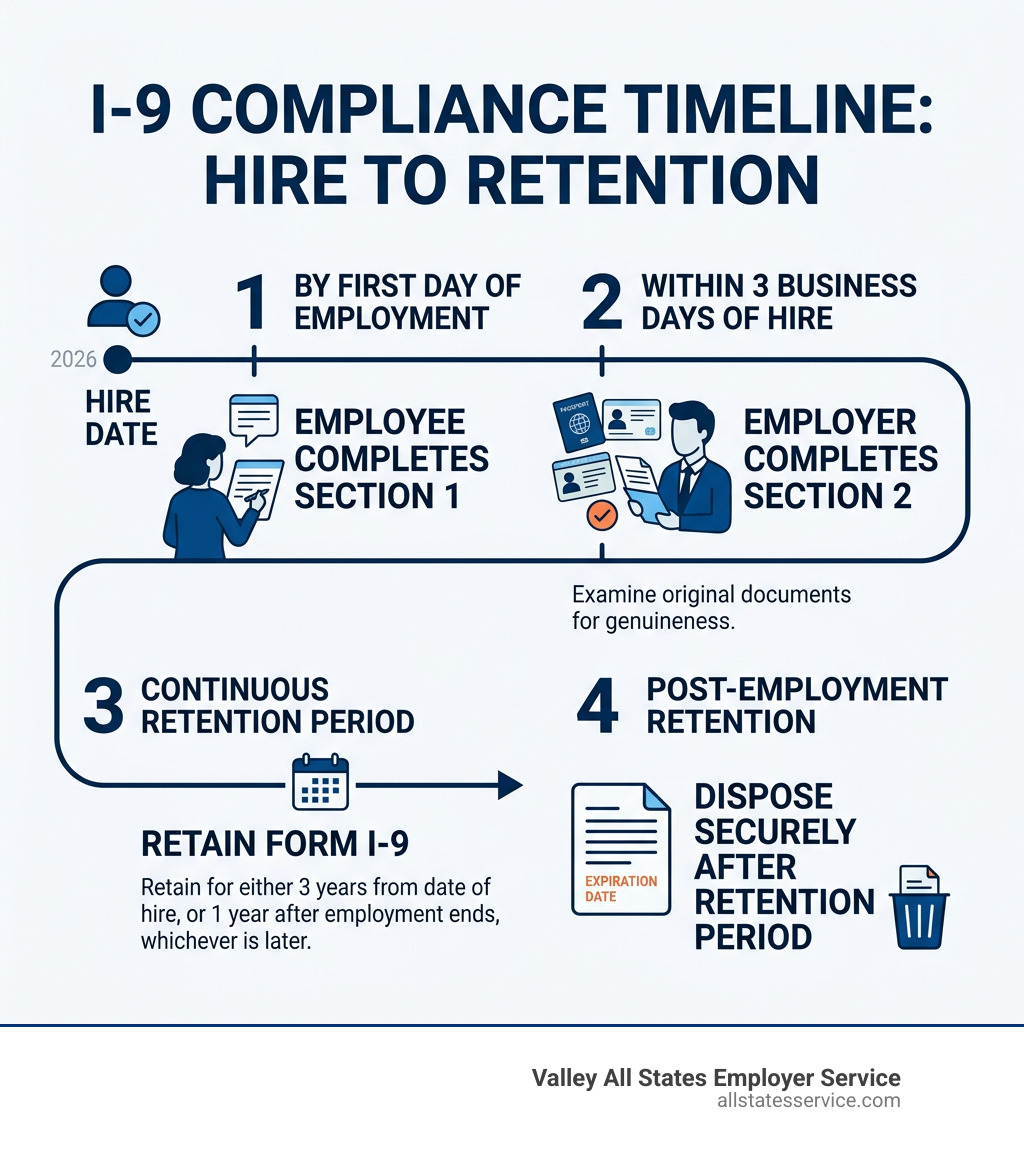
- When it must happen: Section 1 on or before the first day of work; Section 2 within 3 business days of hire
- Who manages it: U.S. Citizenship and Immigration Services (USCIS), with enforcement by ICE’s Homeland Security Investigations (HSI)
- What’s at stake: Civil penalties, audits, and potential debarment from federal contracts for non-compliance
If you’re an HR manager juggling onboarding, benefits, payroll, and everything else, Form I-9 can feel like one more thing that’s easy to get wrong and expensive to fix.
And the stakes are real. Since the Immigration Reform and Control Act (IRCA) was signed into law in 1986, every U.S. employer has been legally required to verify the employment eligibility of every person they hire. That’s not a suggestion. It’s a federal mandate.
The problem is that I-9 rules are more complicated than they look. There are strict deadlines, specific acceptable documents, reverification requirements, remote inspection rules, and audit procedures, all of which carry fines that are adjusted upward every year for inflation.
Getting it wrong isn’t just a paperwork headache. It can cost your business thousands of dollars per violation.
That’s exactly why many mid-sized businesses are turning to employer services that specialize in I-9 compliance, to reduce errors, stay current with changing rules, and take the burden off their hiring teams.
Understanding the Basics of Employer Service I-9 Compliance

At its core, employer service I-9 compliance is about one thing: making sure everyone working for you has the legal right to do so. This is managed by U.S. Citizenship and Immigration Services, and the rules haven’t stopped evolving since 1986.
The Form I-9, Employment Eligibility Verification is the tool the government uses to enforce these rules. It is a four-part document that includes the main form, a list of acceptable documents, and two supplements for specialized situations. While it might look like a simple two-page form, the instructions alone are dozens of pages long. If you are wondering what is an I-9 form, think of it as your primary defense against federal audits and hiring penalties.
Who Must Complete Form I-9
The law is very clear: if you hire someone for work in the United States, you must complete a Form I-9. This applies to:
- All new hires, including U.S. citizens and non-citizens.
- Recruiters and referrers for a fee (in certain industries).
- Agricultural employers.
There are very few exceptions. For example, you don’t need an I-9 for independent contractors or people hired on or before November 6, 1986, who have been continuously employed. But for almost everyone else, the paperwork is mandatory.
Timelines for Section 1 and Section 2
Timing is everything in I-9s. If you miss a deadline by even one day, it’s considered a “substantive violation” during an ICE audit.
- Section 1: The employee must complete this section on or before their first day of work for pay. They provide their personal details and attest to their citizenship or immigration status.
- Section 2: You, the employer, must complete this within three business days of the hire date. If an employee starts on Monday, you must finish Section 2 by Thursday.
Many businesses use authorized representatives to handle this, especially for remote hires. An authorized representative can be anyone you designate, but be careful, you are still legally liable for any mistakes they make.
Acceptable Documents and Remote Verification Rules
When it comes to proving someone can work, not just any ID will do. The government provides three lists of acceptable I-9 documents.
- List A: Documents that prove both identity and work authorization (like a U.S. Passport or Permanent Resident Card).
- List B: Documents that prove identity only (like a Driver’s License).
- List C: Documents that prove work authorization only (like a Social Security card or birth certificate).
Employees must present either one document from List A OR a combination of one document from List B and one from List C. As an employer, you must examine the original documents to ensure they appear genuine and relate to the person standing in front of you. You can find more details in the E-Verify Handbook for Employers.
The Shift to Remote Document Examination
For years, the law required a “physical, in-person” inspection of documents. However, a major shift occurred in August 2023. The Department of Homeland Security (DHS) issued a final rule allowing certain employers to use “alternative procedures” for remote I-9 compliance.
To use this remote option, you must be an E-Verify participant in good standing. You must conduct a live video interaction with the employee while they show you their documents, and you must retain clear copies of those documents. This has been a game-changer for companies with a distributed workforce, but it requires strict adherence to the new digital standards.
Handling Receipts and Expiring Authorization
What happens when a document is lost or about to expire? I-9 form updates are often necessary.
- Receipts: In some cases, like a lost or stolen document, an employee can present a receipt for a replacement. This is usually valid for 90 days.
- Reverification: If an employee has a temporary work authorization (like an EAD), you must reverify them before it expires using Supplement B.
- The 240-Day Rule: For certain visa holders (like H-1B), if you file an extension on time, they may be authorized to continue working for up to 240 days while the petition is pending.
Managing Audits and Avoiding Costly ICE Penalties
An ICE audit usually begins with a Notice of Inspection (NOI). When you receive an NOI, you typically have just three business days to produce all your I-9 forms and supporting payroll data. This is where employer service I-9 compliance proves its worth.
ICE looks for two types of errors: technical failures and substantive violations.
| Feature | Technical/Procedural Failures | Substantive Violations |
|---|---|---|
| Examples | Missing an address, forgetting to date the form | Missing signatures, missing I-9s, hiring unauthorized workers |
| Correction | You get 10 business days to fix these after notice | Cannot be “fixed” to avoid fines |
| Penalty Risk | Low if corrected quickly | High; leads to immediate fines |
Missing a single signature might seem small, but if you have a high percentage of errors, those fines add up fast. You can learn more about the financial impact in our I-9 audit penalties guide.
Best Practices for Employer Service I-9 Compliance Audits
We always recommend conducting a self-audit at least once a year. When doing this, you must be careful not to violate anti-discrimination laws.
- Use Neutral Criteria: Don’t just audit employees who “look” like they might be non-citizens. Audit everyone or a random sample.
- Correct Properly: If you find an error, don’t use white-out. Cross out the wrong info, enter the correct info, and initial and date the change.
- No Backdating: Never, ever backdate a form. If a form was missing, complete it now with the current date and attach an explanation.
Leveraging Technology for Employer Service I-9 Compliance
Modern electronic I-9 solutions are designed to stop errors before they happen. These systems won’t let an employee submit Section 1 if a field is blank, and they provide automated alerts when a work authorization is about to expire.
Furthermore, the government is piloting “E-Verify NextGen,” which will allow employees to create a secure account to share their information directly with the government, further reducing the administrative burden on your HR team.
Frequently Asked Questions about I-9 Requirements
Navigating the sea of paperwork can raise a lot of questions. Here are the most common ones we hear from business owners.
How long must I retain Form I-9 records?
The “3-1 Rule” is your golden guide for I-9 record keeping. You must keep the Form I-9 for:
- Three years after the date of hire, OR
- One year after the date employment ends, whichever is later.
If you keep forms longer than necessary, you are actually increasing your liability during an audit. Once the retention period is over, securely destroy them.
What are the fines for non-compliance?
Fines for employer service I-9 compliance violations are adjusted annually for inflation. Currently, paperwork violations can range from hundreds to thousands of dollars per form. If ICE finds you “knowingly hired” an unauthorized worker, the fines can jump to over $20,000 per individual for repeat offenders.
Fines are calculated based on a matrix that considers the size of your business, your “good faith” effort to comply, the seriousness of the violation, and whether you have a history of previous issues.
Can I use E-Verify for my entire existing workforce?
Generally, no. E-Verify is intended for new hires only. You cannot use it to “screen” your current employees unless you are a federal contractor with a specific FAR (Federal Acquisition Regulation) clause in your contract. For most businesses, E-Verify and I-9 only come together during the onboarding of a new team member.
Why Outsourcing is the Smart Move
At Valley All States Employer Service, we know that you didn’t start your business to become an expert in immigration paperwork. The rules are dense, the deadlines are unforgiving, and the penalties can be devastating for a growing company.
We provide outsourced E-Verify and workforce eligibility verification that takes the guesswork out of the process. Our team acts as an impartial, expert partner to ensure your forms are completed correctly, your documents are verified properly, and your business stays on the right side of the law.
By utilizing our I-9 compliance services, you can stop worrying about the “I-9 grind” and get back to what you do best: running your business and supporting your team.
Ready to simplify compliance? Contact our team today to learn how we can protect your business and streamline your hiring process.