
Finding an HR Services Provider That Won’t Break the Bank
Why Choosing the Right HR Services Provider Can Make or Break Your Business
An HR services provider can be the difference between a business that runs smoothly and one that’s constantly putting out fires. Whether you’re drowning in payroll paperwork, worried about compliance, or struggling to keep up with onboarding, the right partner handles it all so you don’t have to.
Here’s a quick look at the top HR outsourcing options to help you compare:
| Provider Type | Best For | Typical Cost | Key Feature |
|---|---|---|---|
| PEO | Small to midsize businesses | $8-$210 PEPM | Co-employment, bundled benefits |
| Full HRO | Growing businesses | 4%-8% of payroll | Full HR department outsourcing |
| Fractional/Consulting HR | Startups, project needs | Varies | Senior expertise, part-time |
| HR Software | Tech-forward teams | $12-$29 PEPM | Self-service automation |
| Local/Specialized (e.g., Valley All States) | Compliance-focused businesses | Custom quotes | Personalized, high-touch service |
Most businesses can reduce administrative costs by at least 25% by outsourcing HR, and some see up to a 35% drop in admin overhead each year.
But cost savings are only part of the story.
Think about the last time a compliance change caught you off guard, an I-9 error slipped through, or a new hire’s onboarding felt chaotic. These aren’t just inconveniences. They’re risks that can cost your business real money and real talent.
The HR outsourcing market has grown significantly because businesses of all sizes have figured out that expert help doesn’t have to mean expensive help. From solo HR consultants to large national platforms, there are more options than ever, and more ways to get it wrong if you’re not sure what to look for.
This guide breaks down the best HR services providers available right now, what they cost, and how to find the one that actually fits your business.
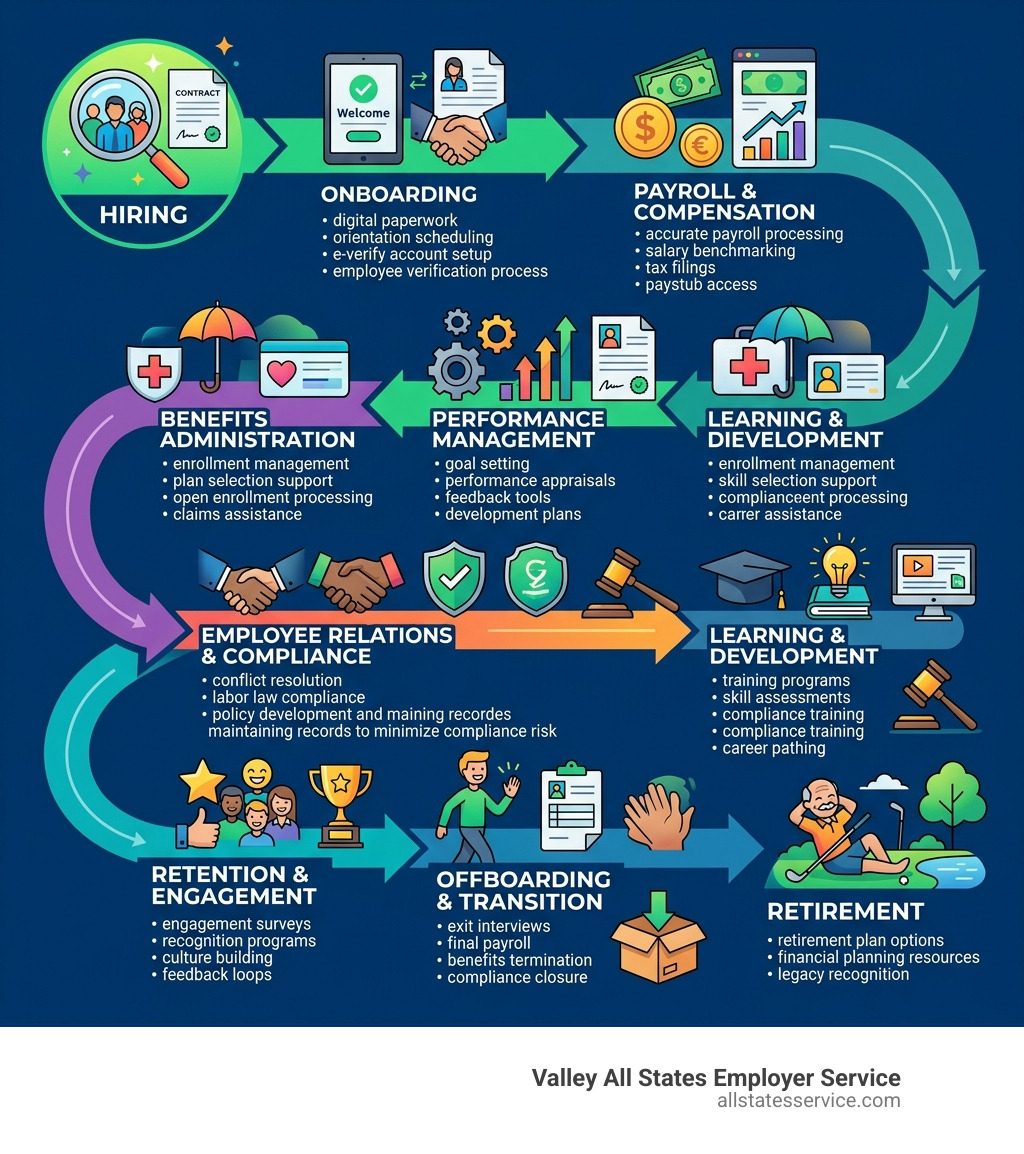
HR services provider vocab explained:
Finding the Right HR Services Provider for Your Business Size

Choosing an HR services provider isn’t a one size fits all decision. What works for a tech startup in Lutherville MD with ten employees won’t work for a manufacturing plant with three hundred workers. You need to look at company size, industry expertise, and actual client satisfaction scores like the Net Promoter Score (NPS) to see if a provider actually keeps their promises.
For instance, national players support over 3 million employees, offering massive scale. On the other hand, specialized firms might offer a 5/5 rating from dozens of reviews because they provide a personal touch that big corporations sometimes miss. If you want to dive deep into how these partnerships work, check out our HR Outsourcing Solutions Ultimate Guide. You can also review the Society for Human Resource Management for broader context on HR standards and best practices.
What to Look for in a Comprehensive HR Partner
When we evaluate a provider, we look for three things: experience, breadth, and commitment. Has the company been around for thirty years, or did they just launch a sleek app last Tuesday? You want a partner that has seen it all, from complex employee disputes to sudden shifts in federal labor laws.
A comprehensive partner should handle the “big four” of HR: payroll, benefits administration, compliance, and recruiting. If they only do payroll, they aren’t really an HR services provider, they’re just a check processor.
Tailoring Solutions to Your Business and Industry
Scalability is the name of the game in 2026. Your HR needs today will look very different after you hire your next twenty people. The best providers offer tiered services that grow with you.
Industry expertise is just as vital. A medical center has vastly different compliance needs compared to a fashion brand or a construction firm. Providers often specialize in specific verticals, ensuring they understand the unique risks and regulations of your field.
The Value of Integrated Technology and High-Touch Service
We live in a world of apps, so your HR platform should be seamless. You want a system where payroll, time tracking, and benefits all talk to each other. However, technology shouldn’t replace the human element.
The most successful businesses find a balance between high-tech software and high-touch service. You want the efficiency of a cloud platform but the ability to call a dedicated expert when a sensitive employee issue arises. This “personal touch” is often what separates the top-rated providers from the ones that leave you sitting on hold for forty minutes.
Understanding the Different Types of HR Support
Before you sign a contract, you need to know exactly what kind of relationship you’re entering. The world of Outsourced HR Services is divided into a few main categories.
Professional Employer Organizations (PEO)
A PEO operates on a co-employment model. This means the PEO becomes the employer of record for tax and insurance purposes, while you maintain daily control over your staff.
Why do businesses do this? It allows small companies to access “enterprise-level” benefits like high-end health insurance and 401k plans at lower rates. PEOs also share legal liability with you, which is a huge weight off your shoulders. Look for IRS-certified PEOs to ensure they meet the highest standards of financial reporting.
Managed HR and Fractional Consulting
If co-employment sounds a bit too involved for you, Managed HR (often called HRO) or fractional consulting might be the better fit. In this model, you remain the sole employer. You simply hire an outside firm to manage specific tasks like payroll or compliance.
Fractional HR is perfect for businesses that need senior-level expertise but can’t justify a $150,000 salary for a full-time HR Director. You get a seasoned pro for a few hours a week or on a project basis. This is a highly scalable way to get expert help without the overhead. You can learn more about these models in our guide on Human Resources Outsourcing.
How Much Does HR Outsourcing Cost in 2026?
Let’s talk numbers. The cost of an HR services provider usually boils down to how much work you’re handing over. While prices vary, outsourcing is almost always cheaper than hiring a full-time HR person, which can save you at least 25% in total costs.
Common Pricing Models Explained
Most providers use one of three models:
- Per Employee Per Month (PEPM): This is the most common for software and PEOs. You might pay anywhere from $8 for basic software to $210 for a full-service PEO.
- Percentage of Payroll: Some HROs charge a flat 4% to 8% of your total pretax monthly earnings.
- Flat Monthly Fees: Common for fractional consultants or specialized compliance services.
Don’t forget to ask about implementation fees, which cover the initial setup of your software and data migration.
Calculating Your Return on Investment
The ROI of HR outsourcing isn’t just about the monthly fee. It’s about the 35% reduction in administrative costs that many businesses see within the first year.
Think about the “soft costs” too. How much is your time worth? If you’re spending ten hours a week on payroll and insurance forms, that’s forty hours a month you aren’t spending on growing your business. Outsourcing buys that time back while reducing the risk of expensive litigation or compliance fines.
Maximizing Efficiency and Compliance
Compliance is the scariest part of being an employer. Between federal mandates and state-specific rules, it’s easy to miss a detail that leads to a massive fine. Using a specialized HR Compliance Guide 2026 is a great start, but having a partner to execute it is better.
Ensuring Workforce Eligibility with E-Verify
This is where we come in. At Valley All States Employer Service, we specialize in one of the most critical parts of the hiring process: E-Verify workforce eligibility verification.
While a general HR services provider might offer a broad range of tasks, we provide expert, impartial, and efficient E-Verify processing. Our goal is to minimize errors and take the administrative burden off your plate entirely. We ensure that every new hire is verified correctly the first time, protecting you from the heavy fines associated with I-9 and E-Verify mistakes. For a deeper look at why this matters, see our Human Resources BPO Ultimate Guide.
Navigating State-Specific Regulations
If you operate in Maryland, you have to stay on top of local laws. But if you have remote employees in Nevada or Connecticut, things get even more complicated.
For example, Connecticut has been a leader in sexual harassment prevention training since 1992 and recently increased its minimum wage to $15.69 per hour. Nevada has its own unique labor laws regarding leave and overtime. A national HR services provider or a specialized partner helps you navigate these different rules so you don’t have to become a legal expert in fifty different states.
Frequently Asked Questions about HR Outsourcing
Can small businesses afford an HR services provider?
Absolutely. In fact, small businesses often see the highest ROI because they don’t have the budget for a full-time HR department. Scalable options like fractional HR or “à la carte” services allow you to pay only for what you need.
What is the difference between a PEO and an HRO?
The main difference is the employment relationship. In a PEO, you enter a co-employment agreement where the PEO handles taxes and benefits under their own ID. In an HRO (Human Resources Outsourcing) model, you remain the sole employer and the provider simply acts as your administrative arm.
How does outsourcing improve employee retention?
Professional HR support leads to better onboarding, clearer handbooks, and more competitive benefits packages. When employees feel that their payroll is accurate and their benefits are well-managed, they are much more likely to stay with the company long-term.
Final Thoughts on Selecting Your Partner
Finding the right HR services provider is about building a long-term partnership that supports your strategic growth. Whether you need a massive PEO or a specialized compliance partner, the goal is to free yourself from the “administrative weeds” so you can focus on your people.
The best partner is one that scales with you, protects you from risk, and treats your employees with the same care you do. If you’re looking to tighten up your compliance and ensure your workforce is fully eligible, we’re here to help.
Ready to simplify your workforce eligibility? Explore our E-Verify services today.