
Expired I-9 documents: Avoid 2025 Fines
When and Why is I-9 Reverification Required?
When it comes to expired I-9 documents, employers often feel lost. There are clear rules you need to follow. Missteps can lead to big problems. Here’s what you need to know quickly:
- Initial Verification: For new hires, employers generally cannot accept documents that are already expired.
- Reverification: If an employee’s temporary work authorization has an expiration date, you must reverify their eligibility before that date passes.
- Exceptions: Some documents that appear expired are still valid. This includes certain automatically extended Employment Authorization Documents (EADs), Temporary Protected Status (TPS) documents, or when an employee provides a valid receipt for a replacement document.
- Consequences: Failing to properly manage expired documents can result in significant fines and legal issues for your business.
Navigating the rules for employee eligibility can feel like a maze, especially with all the nuances around expiring documents. As an HR manager, you’re tasked with keeping your company compliant. But figuring out when to act on an expiration date – and what to accept – can be confusing. This guide will cut through the clutter. We’ll show you exactly how to handle expired I-9 documents to avoid common mistakes and keep your business safe from penalties. Let’s make I-9 compliance clear and simple.
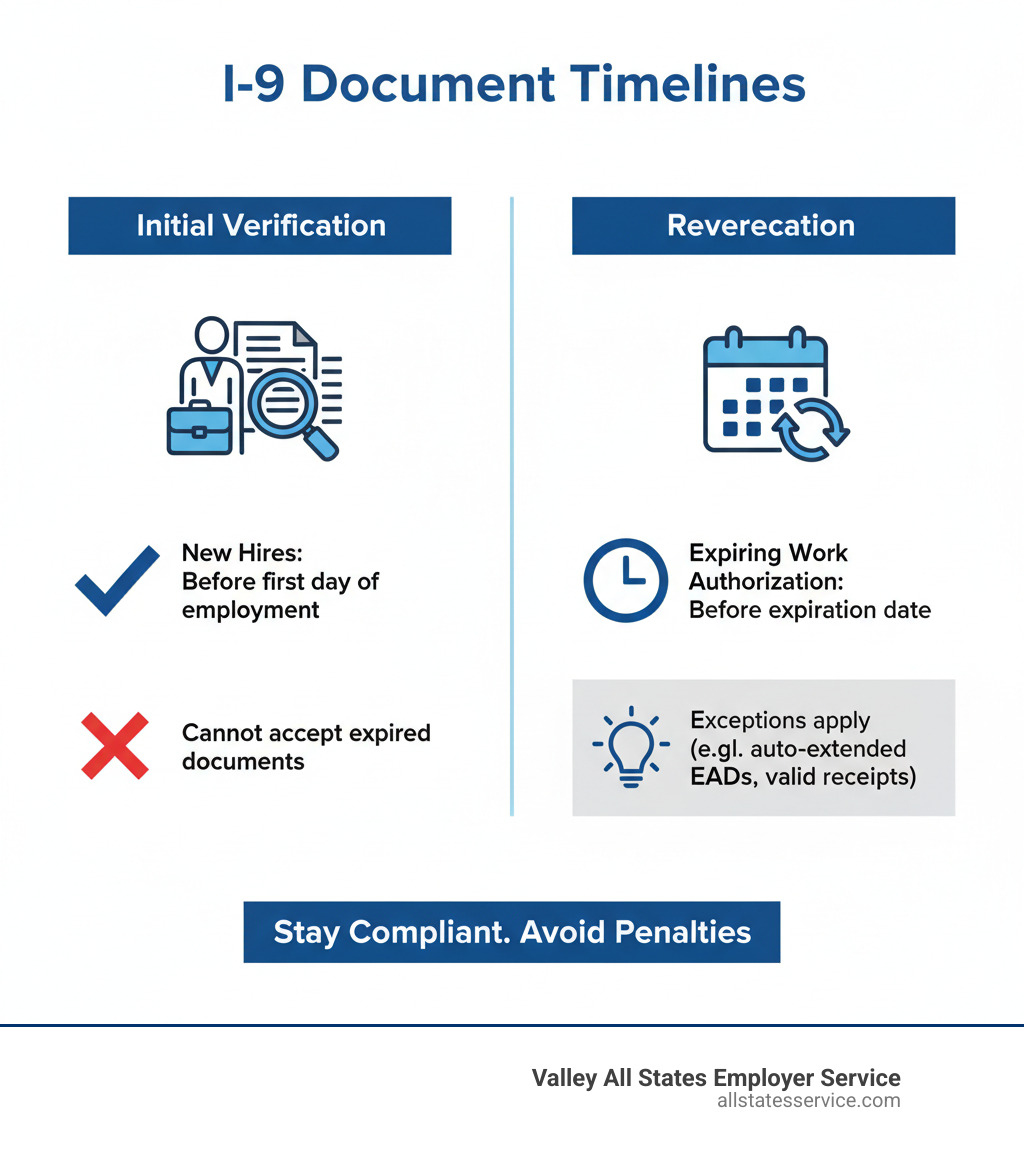
As employers, we have a crucial responsibility to ensure our workforce is authorized to work in the United States. This responsibility doesn’t end after the initial Form I-9 verification. Sometimes, an employee’s work authorization has a limited lifespan. This is where reverification comes into play.
We are required to reverify an employee’s I-9 documents no later than the date their employment authorization expires. This is a non-negotiable deadline. Think of it like a driver’s license renewal, but for an employee’s right to work. It’s critical to track these dates carefully. We recommend putting a system in place to remind employees at least 90 days before reverification is due. This gives them ample time to gather the necessary documentation and ensures continuous authorization.
When it’s time to reverify, we use Supplement B, Reverification and Rehire (formerly Section 3) of Form I-9. This section is specifically designed to update employment authorization information for current employees. If an employee’s authorization has expired, or is about to, they must present new, unexpired documents to prove they are still eligible to work. Without this proof, we cannot legally continue their employment. You can learn more about managing this process effectively with our guide on I-9 Record Keeping. We also offer insights into specific scenarios like I-9 Process for Rehires.
Situations That Do NOT Require Reverification
While reverification is essential in many cases, it’s equally important to know when it’s not required. Attempting to reverify when unnecessary can lead to claims of discrimination, which we certainly want to avoid.
Here are the key situations where we should NOT reverify an employee’s documents:
- U.S. Citizens and Noncitizen Nationals: The employment authorization for these individuals does not expire. Once we’ve verified their eligibility, no further action is needed.
- Lawful Permanent Residents (Green Card Holders): An employee who presented a Permanent Resident Card (Form I-551) for initial verification does not need reverification, even if the card itself has an expiration date. Their lawful permanent resident status does not expire.
- Expired List B Documents: List B documents, like a driver’s license or state ID card, establish identity only. We never reverify these documents when they expire because they do not relate to employment authorization. We are concerned with the authorization to work, not the validity of their identity document after initial verification.
Understanding these distinctions is crucial for compliance. For more detailed information, SHRM provides valuable resources like their article on When are employers required to reverify or update I-9 documents?.
Handling Expired I-9 Documents: Initial vs. Reverification
The rules around expired I-9 documents differ significantly depending on whether we’re talking about initial verification for a new hire or reverification for an existing employee. It’s a common area of confusion, so let’s clarify.
When we’re verifying a new employee for the first time, the expectation is straightforward. Employees must present unexpired documents from the Lists of Acceptable Documents. These lists include List A documents (which prove both identity and work authorization), or a combination of List B documents (for identity) and List C documents (for work authorization). We physically examine these original documents to ensure they appear genuine and relate to the person presenting them.
Reverification works a bit differently. When an existing employee’s work authorization is expiring, they need to present a document that shows their current employment authorization. This can be any document from List A or List C. For example, an unrestricted Social Security card is perfectly acceptable for reverification, as long as it doesn’t have a notation like “NOT VALID FOR EMPLOYMENT.” If an employee brings us a restricted Social Security card, we need to ask for a different document from List A or C instead. For a comprehensive overview of acceptable documents, check out our guides on Documents for I-9 and I-9 Section 2 Acceptable Documents.
Can an employer accept expired I-9 documents for initial verification?
The short answer is no. When hiring a new employee, we generally cannot accept expired I-9 documents for initial verification. The USCIS Form I-9 instructions are clear: employees should present unexpired documents when completing their I-9. This is a fundamental rule that keeps everyone on the right side of compliance.
Here’s where it gets a little nuanced. There’s a common misconception that documents must be unexpired on the employee’s very first day of work. That’s not quite right. What actually matters is that the documents are unexpired when we physically examine them and complete Section 2 of the Form I-9. This typically happens within three business days of the employee’s start date. So if a document is valid when we verify it but expires a few days later, that’s usually acceptable for U.S. citizens and lawful permanent residents, whose work authorization doesn’t expire. However, for employees whose work authorization is tied to a specific expiration date, their document needs to cover the intended period of employment.
It’s worth noting that there is one exception to this rule for certain military personnel, as outlined in the official Form I-9 instructions. Beyond that, we need to be careful. Rejecting a valid, unexpired document or demanding specific documents can lead to discrimination claims, which is the last thing any employer wants.
What happens if an employee’s employment authorization document expires?
If an employee’s employment authorization document expires and they don’t provide proof of continued authorization, we face a serious situation. Put simply, we cannot legally continue to employ that individual. It’s not a pleasant conversation to have, but it’s a reality we must steer carefully to stay compliant.
When we know an employee’s work authorization is expiring (and our proactive tracking system should give us plenty of advance notice), we need to inform them that they must present new, unexpired documentation. If the employee fails to provide new evidence of employment authorization by the expiration date, their employment must end. There’s no wiggle room here. We can’t make exceptions or look the other way, no matter how valuable the employee is to our team. This is a core requirement of federal law.
To record the new authorization properly, we use Supplement B of Form I-9. This involves documenting the new document’s title, number, and expiration date, then signing and dating the update. This process keeps our records current and ensures we’re only employing individuals who are authorized to work. Both the employee and employer share responsibility here. The employee needs to be proactive about renewing their authorization, and we need to track the dates and complete reverification on time. For a complete understanding of this entire process, our Employment Eligibility Verification Complete Guide offers detailed information to help you steer these situations with confidence.
Navigating Exceptions and Special Scenarios
Here’s where I-9 compliance gets interesting. While we’ve established that we generally need unexpired documents, there are important exceptions you need to know about. Some documents that look expired on their face are actually still valid. Missing these exceptions could mean turning away an authorized worker, which opens the door to discrimination claims. Nobody wants that.
These special scenarios typically involve automatic extensions. USCIS grants these extensions for certain Employment Authorization Documents (EADs), Temporary Protected Status (TPS) documents, and even some Permanent Resident Cards. The rules can shift, sometimes without much warning. That’s why staying current is so important. Our I-9 Form Updates page keeps you in the loop when changes happen. We also have specific guidance on Filling Out I9 With Permanent Resident Card to help you handle these trickier situations with confidence.
Are there exceptions for unexpired documents during reverification?
Yes, and this is where many employers get tripped up with expired I-9 documents. In specific, limited situations, you can actually accept a document that appears expired for reverification purposes. Understanding these exceptions isn’t just helpful, avoid accidentally discriminating against someone who has every right to work.
The most common exception involves automatic EAD extensions. When foreign nationals in certain eligibility categories file their renewal application on time, USCIS may automatically extend their current EAD. The employee can show you their expired EAD along with a Form I-797C, Notice of Action, proving they filed the renewal application on time and for the same qualifying category. Together, these two pieces of paper count as an unexpired List A document. It sounds counterintuitive, but it’s perfectly legitimate.
Temporary Protected Status (TPS) extensions work a bit differently. The Department of Homeland Security can automatically extend TPS-related EADs through a Federal Register notice. If an employee hands you an expired TPS EAD, you’ll need to check the relevant Federal Register notice to confirm the extension date. Yes, it’s an extra step, but it’s worth it to keep both you and your employee protected.
Then there are Permanent Resident Card extensions. Sometimes a card that looks expired is actually still valid because USCIS issued an extension. This might come as a Form I-797, Notice of Action, showing the extension, or even as a sticker directly on the card itself. Occasionally, a receipt notice for a Form I-90 (the application to replace a Permanent Resident Card) also indicates continued validity.
The key with all these exceptions is verifying the specific conditions and category codes that qualify. The Section 5.1 of the M-274 Handbook for Employers is your best friend here. It’s the most reliable, up-to-date source for navigating these complex rules.
What if an employee presents a receipt for a lost or stolen document?
Life happens. Documents get lost, stolen, or damaged. When that happens to an employee’s work authorization document, there’s a solution that keeps everyone moving forward. It’s called the “Receipt Rule,” and it applies to both initial verification and reverification.
If an employee presents a receipt showing they’ve applied for a replacement List A, List B, or List C document, you can temporarily accept it. The receipt is valid for 90 days, giving the employee time to receive their actual replacement document.
Here’s how you handle it in practice. In Section 2 or Supplement B of the Form I-9, record the document title (something like “receipt for Employment Authorization Document”). In the document number field, write “receipt.” Then, in the expiration date field, note the last day that receipt is valid, which is 90 days from the date the employee provided it.
During those 90 days, it’s your responsibility to track the deadline and remind the employee to bring in the actual replacement document. When they do, you’ll cross out the word “receipt” and any related information, record the real document’s details, and initial and date the change.
This temporary acceptance is a lifeline for employees who need to keep working while they wait for replacement documents. It’s one of those provisions that shows the system has some flexibility built in. For more details on handling receipts and other document scenarios, our I-9 Document Requirements Complete Guide breaks it all down.
Compliance Risks: Penalties, E-Verify, and Document Review
Navigating Form I-9 compliance is more than just checking boxes; it’s about protecting your business. Mismanaging expired I-9 documents or overlooking crucial verification steps can lead to serious consequences, including hefty penalties, legal troubles, and even harm to your company’s good name. We understand these responsibilities are significant, and we’re here to help you manage them with confidence.
Your commitment to being accurate and diligent when verifying I-9s is super important. This means understanding potential document abuse and ensuring the documents an employee presents are truly authentic. As an employer, you’re responsible for looking at the documents and accepting them if they look genuine and match the person presenting them. If a document doesn’t meet this standard, you must not accept it. Instead, you’ll need to ask for other acceptable documents. This careful approach helps protect you from both unknowingly hiring unauthorized individuals and facing claims of discrimination. For a closer look at how to avoid these common pitfalls, our I-9 Audit Penalties Complete Guide and I-9 Document Review resources are excellent places to start. And if you use E-Verify, understanding how it handles document expiration adds another vital layer to your compliance efforts. You can learn more about this in our I-9 E-Verify Ultimate Guide.
What are the consequences of accepting expired I-9 documents or failing to reverify?
The consequences for employers who don’t properly handle expired I-9 documents or skip reverification can be quite severe. Immigration and Customs Enforcement (ICE) regularly conducts audits, and any violations can result in significant fines and other legal issues. We’re talking about much more than a minor inconvenience.
Consider these potential penalties: You could face civil penalties, with fines for incomplete or incorrect I-9 forms, or for not reverifying, ranging from hundreds to thousands of dollars per form. These costs can quickly add up, especially if there are many mistakes. If your business is found to have treated employees unfairly, perhaps by refusing valid documents or asking for too many documents (which is called document abuse), you might have to pay back pay to affected employees. You could also face other remedies, like mandatory training or monitoring by the Department of Justice, which provides helpful information on discriminatory practices. In very serious cases, like knowingly hiring or continuing to employ unauthorized individuals, employers could even face criminal penalties. Plus, your company might be debarred from getting government contracts. Clearly, compliance isn’t just a good idea; it’s a legal requirement. Carefully managing your I-9 forms, including diligent reverification, is your best defense against these big risks.
How does E-Verify interact with document expiration?
E-Verify is a fantastic tool for confirming if someone can work legally, but it has specific rules about document expiration. This is another area where expired I-9 documents can cause a bit of a headache if you’re not careful.
Generally, E-Verify expects you to enter documents that are not expired into the system. If you try to create an E-Verify case using information from an expired document (unless it’s one of those special exceptions for automatic extensions), the system will likely give you an error message. This means you won’t be able to move forward with the case until the employee provides acceptable, unexpired documents, and you update the Form I-9 accordingly.
What if an employee gives you a receipt for a lost or stolen document? You can’t create an E-Verify case immediately in that situation. You’ll need to wait until the employee brings in the actual replacement document. When this happens, and you can’t submit the E-Verify case within the usual three business days, you’ll select “Other” as the reason for delay in E-Verify and simply note “Receipt provided. Awaiting actual document.” Our I-9 E-Verify Compliance guide offers more details on navigating these scenarios. And remember, Valley All States Employer Service specializes in outsourced E-Verify workforce eligibility verification, helping employers like you handle these complexities efficiently and accurately.
Frequently Asked Questions about I-9 Document Expiration
We know that even with all the guidance, specific questions often arise. Here are some of the most common questions we hear about expired I-9 documents, answered in plain language.
Should I reverify an employee’s expired driver’s license?
No, absolutely not. This is one of the most frequent misunderstandings we see, and it’s an important one to clear up. A driver’s license is a List B document, which means it only establishes identity. It has nothing to do with employment authorization. Think of it this way: a driver’s license tells us who someone is, not whether they’re allowed to work in the United States.
Reverification is only required when a document that proves employment authorization (from List A or List C) has an expiration date. Once we’ve verified an employee’s identity with their driver’s license or any other List B document during initial hiring, we’re done with that document. We don’t need to follow up when it expires. Asking for a new one could actually open us up to discrimination claims, so it’s best to leave expired List B documents alone.
What’s the difference between an expired document and expired work authorization?
This is a crucial distinction that trips up a lot of employers! An expired document simply means the physical card or paper has passed its validity date. Expired work authorization means the legal right for someone to work in the U.S. has actually ended. These aren’t always the same thing.
Here’s where it gets interesting: U.S. citizens and lawful permanent residents never lose their work authorization. Their right to work doesn’t expire, even if their physical green card does. So if a lawful permanent resident’s green card shows an expiration date, we don’t need to reverify them. Their authorization to work continues indefinitely.
For non-citizens with temporary work authorization, though, the situation is different. Their work authorization is typically tied directly to the expiration date on their document, like an Employment Authorization Document (EAD). When that document expires, their work authorization expires too, unless an automatic extension applies. Understanding this difference helps us avoid unnecessary reverification and potential discrimination claims. It also ensures we don’t accidentally keep someone on the payroll when their authorization has genuinely ended.
Can I fire an employee if they don’t provide a new document on the expiration date?
This is a delicate situation that requires careful handling. If an employee’s temporary employment authorization expires and they fail to provide acceptable, unexpired documentation proving continued work authorization by that date, we cannot legally continue their employment. It’s not about “firing” them in the traditional sense. It’s about complying with federal law that prohibits employing individuals who aren’t authorized to work in the United States.
We must cease their employment until they can present valid, unexpired proof of their right to work. This can feel harsh, but it’s the law. The employee has a responsibility to maintain their work authorization and provide timely documentation. We have a responsibility not to employ anyone without proper authorization.
This is why proactive tracking is so important. We should be reminding employees well before their authorization expires, giving them plenty of time to renew their documents. Clear communication throughout the process helps avoid surprises and maintains a positive relationship with the employee. If you’re ever unsure about how to handle these situations, consulting with legal counsel or working with a compliance expert like Valley All States Employer Service can help you steer these sensitive scenarios while staying on the right side of the law.
Conclusion: Stay Compliant with Proactive I-9 Management
Phew! We’ve covered a lot about expired I-9 documents and how vital it is to get things right. By now, you know that keeping a close eye on expiration dates, understanding when to reverify (and when not to!), and recognizing those tricky exceptions are all key. It’s not just about paperwork; it’s about making sure your business stays compliant, fair, and safe from penalties.
Think of proactive management as your best friend in I-9 compliance. When you set up good tracking systems and send out timely reminders, you’re avoiding so many common pitfalls. This approach helps ensure that all your initial verifications and reverifications happen smoothly and correctly, saving you headaches down the line.
Navigating these detailed rules can honestly feel like a whole job in itself, right? That’s exactly where Valley All States Employer Service steps in. We’re here to simplify I-9 compliance for you. Our team offers expert, impartial, and super efficient E-Verify processing. We aim to cut down on your administrative burden and minimize errors, helping employers like you across the United States.
Want to dive even deeper into making sure your I-9 process is rock-solid? Check out our I-9 Compliance Services Complete Guide. And for all the nitty-gritty details on document requirements, our I-9 Section 2 Complete Guide is a fantastic resource.
Ready to make your I-9 and E-Verify processes simple and ensure you’re always compliant? Contact our friendly team today!