
Don’t Forget Your Papers
What I-9 Documentation Is Needed for New Hires?
Understanding the I-9 documentation needed for every new hire is one of the most important compliance steps your business will take. Here’s the short answer:
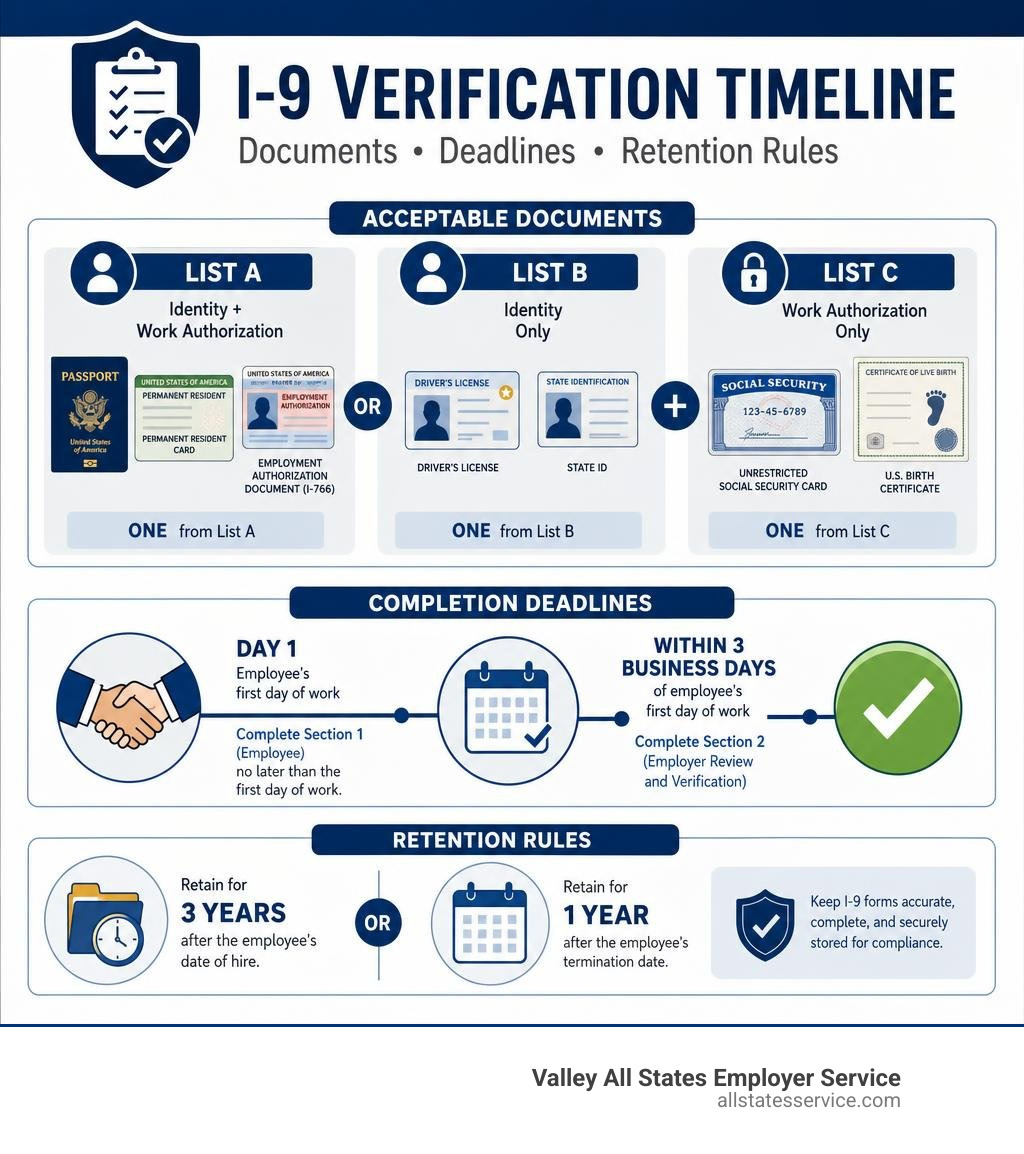
Employees must present either:
- One document from List A (proves both identity and work authorization), OR
- One document from List B (proves identity) + one document from List C (proves work authorization)
Most common examples:
| List | What It Proves | Common Examples |
|---|---|---|
| List A | Identity + Work Authorization | U.S. Passport, Permanent Resident Card, Employment Authorization Document (I-766) |
| List B | Identity Only | Driver’s license, state ID, military card |
| List C | Work Authorization Only | Unrestricted Social Security card, U.S. birth certificate |
All documents must be unexpired and original (no photocopies, with limited exceptions).
Every U.S. employer has been required to verify new employees’ identity and work authorization since the Immigration Reform and Control Act passed in 1986. That verification happens through Form I-9, and getting it wrong can cost you anywhere from $272 to $2,701 per violation for a first offense, with steeper fines for repeat mistakes.
For a busy HR team, the pressure is real. You’re onboarding fast, juggling paperwork, and the last thing you need is an ICE audit revealing a stack of incorrectly completed forms. The good news is that once you know exactly which documents are acceptable and how the process works, I-9 compliance becomes much more manageable.
This guide walks you through everything: the three document lists, key deadlines, how to handle edge cases, and how to avoid the most common mistakes employers make.
Know your i9 documentation needed terms:
- handbook for employers guidance for completing form i 9
- i9 list b and c
- permanent resident card i9 example
What is Form I-9 and Why is it Required?
At its core, Form I-9 is a federal requirement designed to ensure a legal workforce in the United States. Since the passage of the Immigration Reform and Control Act of 1986, every single employer must verify the employment eligibility of every individual they hire, regardless of whether that person is a citizen or a non-citizen.
This verification process is managed by U.S. Citizenship and Immigration Services, which is a branch of the Department of Homeland Security. When you hire someone, you are legally obligated to examine their documents to confirm they are who they say they are and that they have the legal right to work in the country.
If you fail to properly complete or retain these forms, your business can face substantial civil fines. Currently, in June 2026, those fines range from $272 to $2,701 per form for basic paperwork errors on a first offense. If a government agency audits your records and finds systemic issues, those numbers multiply quickly.
Completing the form is not just a standard onboarding chore, it is a vital legal shield for your organization. For a detailed breakdown of the basics, you can check out the official Employment Eligibility Verification | USCIS portal or read our guide on What I-9 Documents Do I Need? to get a head start.
The Three Lists of I-9 Documentation Needed
To make the verification process structured, the government divides all acceptable verification items into three distinct lists. Understanding how these lists interact is the key to maintaining compliance and avoiding onboarding delays.
The main rule of thumb is simple. An employee must present either one document from List A, or a combination of one document from List B and one document from List C. You can never accept two List B documents or two List C documents. They must pair up perfectly to establish both who the person is and their legal authorization to work.
Let us look at how these documents are categorized so you know exactly what to look for when a new hire sits down at the onboarding table. For an in-depth reference, explore our I-9 Eligibility Documents Guide.
List A: Documents that Establish Identity and Employment Authorization
List A documents are the gold standard of onboarding. If an employee hands you a valid document from this list, your job in Section 2 is almost done. These documents prove both identity and work eligibility all by themselves, meaning the employee does not need to show you anything else.
The most common List A documents include:
- A U.S. Passport or U.S. Passport Card
- A Permanent Resident Card, also known as Form I-551 or a green card
- An Employment Authorization Document that contains a photograph, known as Form I-766
- A foreign passport with a temporary I-551 stamp
- A foreign passport with a Form I-94 arrival and departure record endorsing the alien’s non-immigrant status
It is worth noting that USCIS redesigns green cards and Employment Authorization Documents every three to five years to prevent counterfeiting. Older designs remain completely valid until their expiration date, so do not panic if a card looks slightly different from the latest version issued by the government. For a complete list of these dual-purpose papers, read Don’t Get Denied: Every Document You Need for Your I-9.
List B: Documents that Establish Identity Only
When an employee does not have a List A document, they must go the combination route. The first half of this combination is a List B document, which establishes identity only.
For most of your new hires, this will be a state-issued driver’s license or a state identification card with a photograph. Other acceptable List B documents include:
- A school ID card with a photograph
- A voter registration card
- A U.S. military card or draft record
- A military dependent’s ID card
- A Native American tribal document
If you are hiring minors under the age of 18 who cannot present one of the standard identity documents listed above, they can present school report cards, clinic or doctor records, or daycare records. To learn more about these identity-focused forms, take a look at our article on Everything You Need to Know About Acceptable Forms for I-9.
List C: Documents that Establish Employment Authorization Only
The second half of the document combination is List C, which proves the employee has the legal right to work in the United States. A List C document must always be paired with a List B document to satisfy the federal requirements.
The most common List C documents are:
- An unrestricted Social Security account number card
- An original or certified copy of a birth certificate issued by a state, county, municipal authority, or outlying possession of the U.S. bearing an official seal
- A Certification of Report of Birth issued by the Department of State
- A Native American tribal document
- An employment authorization document issued by the Department of Homeland Security
Pay close attention to Social Security cards. To be acceptable under List C, the card must be unrestricted. If the card says “NOT VALID FOR EMPLOYMENT”, “VALID FOR WORK ONLY WITH INS AUTHORIZATION”, or “VALID FOR WORK ONLY WITH DHS AUTHORIZATION”, it is restricted and cannot be accepted as a List C document.
Additionally, keep in mind that Puerto Rico birth certificates issued before July 1, 2010, are not acceptable due to older security vulnerabilities. For more help identifying valid work authorization papers, check out our I-9 Acceptable Documents Ultimate Guide.
Rules, Deadlines, and Remote Verification
Now that you know what the i9 documentation needed looks like, let us talk about the rules of engagement. Verifying documents is not just about checking boxes, it requires following strict federal timelines and administrative procedures.
When an employee brings you their documents, you must inspect the original items. Photocopies are not acceptable, with the sole exception of a certified copy of a birth certificate.
You must check that the documents are unexpired, though documents extended by the issuing authority, such as those extended via Form I-797 or Federal Register notices, are considered legally unexpired. To review the official list of rules, you can read the Form I-9 Acceptable Documents | USCIS page.
Avoiding Discrimination in Document Selection
One of the easiest ways for an employer to get into legal trouble with the Department of Justice is by telling an employee which documents to bring. This practice is known as “steering” and is a form of discrimination.
The law is clear: the choice of which acceptable documents to present belongs entirely to the employee. If a new hire wants to show you a U.S. passport, you cannot demand a driver’s license and Social Security card instead.
If they show you a valid green card, you cannot ask them to show you a state ID. Your role is simply to provide the list of acceptable documents, let them choose what to bring, and verify what they present. To protect your business from discrimination claims, read The A-Z of Valid I-9 Documents: Don’t Get Caught Off Guard.
Handling Expired Documents and Temporary Receipts
What happens if a new hire shows up for their first day but their driver’s license was lost or stolen last week? This is where the receipt rule comes into play.
Employers can accept a temporary replacement receipt in lieu of an original document under specific circumstances:
- The Receipt for a Replacement Document: If an employee’s document was lost, stolen, or damaged, they can present a receipt showing they applied for a replacement. This receipt is valid for 90 days, after which they must present the actual replacement document.
- The arrival portion of Form I-94: This can act as a temporary receipt for a List A document in certain refugee cases.
A receipt for a new document application, such as applying for a passport for the first time, is not acceptable. The receipt must be for a replacement of a lost, stolen, or damaged document. Learn more about managing these temporary situations in Don’t Get Denied: A Guide to I-9 Verification Documents.
Deadlines for Completing Sections 1 and 2
Timing is everything when it comes to federal compliance. The government enforces strict deadlines for both sections of the form:
- Section 1 (Employee Information and Attestation): The employee must complete and sign Section 1 no later than their first day of work for pay. They can complete it as soon as they accept a formal job offer, but never before.
- Section 2 (Employer Review and Verification): You, the employer, must physically examine the documents and complete Section 2 within three business days of the employee’s first day of work. For example, if an employee starts on Monday, you must complete Section 2 by Thursday.
If you hire someone for a project lasting less than three business days, Section 2 must be completed no later than their very first day of employment. To stay on top of these strict timelines, read our guide on Documents for I-9.
Remote Hiring and Alternative Document Examination
The rise of remote work has changed how we hire, but it has not changed our legal obligations. Historically, employers had to physically examine documents in the hands-on presence of the employee.
Today, eligible employers who are enrolled in good standing with E-Verify can use a DHS-authorized alternative procedure to examine documents remotely. Under this procedure, the employer conducts a live video interaction with the employee to inspect the documents, matches them against photocopies sent by the worker, and checks the designated remote verification box on Form I-9.
If you are not enrolled in E-Verify, you must still physically inspect documents in person, which often means hiring an authorized representative to perform the inspection on your behalf. To learn how to handle remote verifications correctly, read the I-9 Section 2 Acceptable Documents Guide.
Best Practices for Storing and Auditing I-9 Forms
Once the forms are filled out, where do they go? Storing them correctly is just as important as filling them out.
We highly recommend storing all completed Form I-9 records in a secure location separate from standard employee personnel files. This prevents internal HR staff from seeing sensitive personal information, such as citizenship status or age, during routine file reviews, which could lead to claims of bias.
You must retain a completed form for three years after the date of hire, or one year after employment is terminated, whichever date is later. Conducting regular internal audits of your stored forms can help you catch missing signatures or expired documents before a government agency does. For details on proper physical and digital storage, read I-9 Section 2 Acceptable Documents.
Compliance Pitfalls and FAQs
Even with the best intentions, employers frequently stumble over technicalities. Knowing where others fail can help you keep your business safe from costly penalties.

When ICE conducts an audit, they look for pattern errors, missing fields, and outdated form usage. If you need to reference the official form and its layout, you can download the Form I-9, Employment Eligibility Verification directly from the USCIS website.
Common Mistakes with I-9 Documentation Needed
The most frequent mistakes we see during compliance reviews involve over-documentation and form editions.
Many employers believe that collecting more documents makes them safer. In reality, asking for a passport and a driver’s license when the passport alone was sufficient is a compliance violation. Only record what is necessary to satisfy the List A or List B + List C requirement.
Another common pitfall is using outdated forms. You must use the correct edition of the form to remain compliant. Currently, the active version is the 01/20/25 edition, which features an expiration date of 05/31/2027 in the top right corner. Using an older, expired version of the form during onboarding is an automatic violation during an audit.
Frequently Asked Questions About I-9 Documentation Needed
Q: Can I accept a photocopy of a document if the employee promises to bring the original later?
A: No. You must inspect the original document within three business days of their start date. The only exception is a certified copy of a birth certificate.
Q: What should I do if an employee’s work authorization document is about to expire?
A: You must perform a reverification before the document expires. Have the employee present an updated List A or List C document, and record the new details in Supplement B of the form. You should never reverify expired identity documents from List B.
Q: Are older designs of green cards still valid for onboarding?
A: Yes. USCIS redesigns cards every three to five years to combat fraud, but older designs remain valid until the expiration date printed on the card.
Q: Can I accept a Social Security card that has work restrictions printed on it?
A: No. If a Social Security card contains notations like “VALID FOR WORK ONLY WITH DHS AUTHORIZATION”, it is not an acceptable List C document. The employee must provide an unrestricted card or a different List C document, such as a birth certificate.
Streamlining Your Onboarding Compliance
Staying compliant with federal employment laws does not have to be a source of stress for your business. Between managing document lists, tracking strict three-day deadlines, and keeping up with remote verification rules, compliance can quickly consume your HR team’s valuable time.
That is where we come in. At Valley All States Employer Service, we provide outsourced E-Verify workforce eligibility verification for employers. Our expert, impartial, and highly efficient E-Verify processing minimizes administrative burdens and helps you eliminate costly errors.
Whether you are onboarding in-office or managing a growing remote team, we help you navigate the complexities of federal compliance with confidence.
Ready to simplify your onboarding and protect your business from audit penalties? Learn more about how we can help by exploring our I-9 Compliance Services Complete Guide.