
Everything You Need to Know About Acceptable Forms for I-9
Why Knowing the Acceptable Forms for I-9 Can Save Your Business from Costly Mistakes
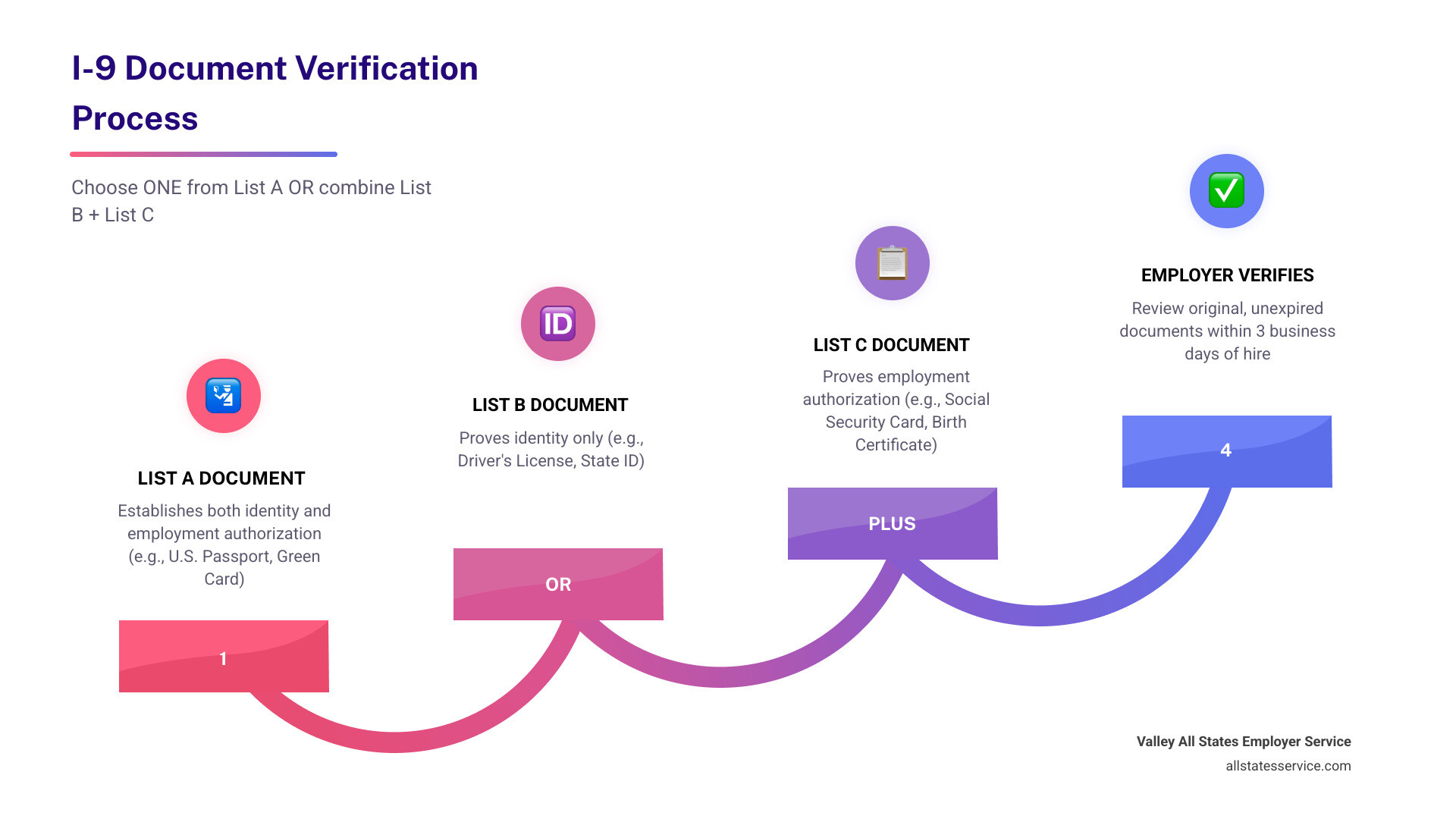
The acceptable forms for I-9 verification fall into three official lists, and every U.S. employer must know them. Here’s a quick breakdown:
Employees must present EITHER:
- One document from List A (proves both identity AND work authorization), OR
- One document from List B (proves identity) PLUS one document from List C (proves work authorization)
Most common examples:
| List | Document Examples |
|---|---|
| List A | U.S. Passport, Permanent Resident Card (I-551), Employment Authorization Document (I-766) |
| List B | Driver’s license, State ID card, Military ID |
| List C | Unrestricted Social Security card, U.S. birth certificate |
All documents must be unexpired and original (no photocopies).
If you manage hiring at a mid-sized business, Form I-9 compliance is one of those things that looks simple on the surface but has real consequences when done wrong. Fines, audits, and discrimination claims can all stem from mistakes in the document verification process.
Form I-9 is required by federal law for every new hire in the United States. It verifies that your employee is who they say they are and is legally authorized to work. The form itself has been around since 1986, and the rules around which documents qualify haven’t always been easy to follow.
The good news? Once you understand the three-list structure, the process becomes much more manageable.
This guide walks you through every document category, the rules that apply, and what your HR team needs to do to stay fully compliant.
Acceptable forms for i 9 helpful reading:
Understanding the Three Lists of Acceptable Forms for I-9
When a new team member joins your company, they are faced with a choice. They don’t just hand over any ID they have in their wallet. They must choose from the official Form I-9 Acceptable Documents provided by USCIS. As an employer, your role is to ensure they have access to these lists so they can make an informed decision.
One of the most important rules we emphasize to our clients is that the employee chooses which documents to present. You cannot tell a new hire, “Bring me your passport,” or “I need to see your driver’s license and Social Security card.” Doing so can actually lead to a discrimination claim. Your job is to provide the list and let them pick the combination that works for them.
Every document presented must be an original. The only exception to this rule is a certified copy of a birth certificate. Beyond that, no photocopies or digital images on a phone are allowed for the physical inspection process. We always recommend checking out our ultimate guide to I-9 documents if you want a deeper dive into the nuances of document handling.

List A: Documents That Establish Identity and Employment Authorization
List A documents are the “all-in-one” winners of the I-9 world. If an employee shows you one of these, they have satisfied both the identity and the work authorization requirements in one go. You won’t need to ask for anything else.
The most common List A document is the U.S. Passport or Passport Card. Whether it is a shiny new one or a well-traveled one, as long as it is unexpired, it is golden. Other heavy hitters in this category include:
- Permanent Resident Card (Form I-551): Also known as a Green Card. USCIS redesigns these every few years to prevent fraud, but older versions remain valid until the expiration date listed on the card.
- Employment Authorization Document (Form I-766): Often called an EAD, this is a card issued to people with temporary permission to work in the U.S.
- Foreign Passport with I-94: For certain nonimmigrant aliens authorized to work for a specific employer, a foreign passport combined with Form I-94 or I-94A serves as a List A document.
When you are cracking the code on List A documents, keep in mind that “unexpired” is the keyword. If a document has an expiration date, it must be current on the day the employee starts work.
Combining List B and List C Documents
If an employee doesn’t have a List A document, or simply prefers not to use one, they must go the “combination route.” This involves picking one item from List B to prove who they are, and one item from List C to prove they are allowed to work here.
Think of it as a two-key system. One key unlocks their identity, and the other unlocks their authorization. You need both keys to open the door to legal employment. Again, the choice of which two documents to pair up belongs entirely to the employee. We see many people default to a driver’s license and a Social Security card, but that is just one of many possible pairings. For a full look at how these work together, see our guide on navigating I-9 requirements.
List B: Acceptable Forms for I-9 Identity Verification
List B is all about identity. These documents tell you that the person standing in front of you is indeed the person named on the form. For most adults, this is a state-issued driver’s license or an ID card. These must contain a photograph or at least identifying information like name, date of birth, gender, height, eye color, and address.
Other acceptable List B documents include:
- School ID card with a photograph.
- Voter’s registration card.
- U.S. Military card or draft record.
- Military dependent’s ID card.
- U.S. Coast Guard Merchant Mariner Card.
- Native American tribal document.
- Driver’s license issued by a Canadian government authority.
There are special rules for minors under the age of 18 who might not have a driver’s license or school ID. In these cases, they can use school records, report cards, clinic or doctor records, or even day-care or nursery school records. If you are ever unsure about a specific ID, the E-Verify Handbook for Employers M-274 is an excellent resource for visual examples.
List C: Acceptable Forms for I-9 Employment Authorization
Once identity is settled, we need to talk about the right to work. List C documents prove that the individual is legally permitted to accept employment in the United States.
The most frequent List C document is an unrestricted Social Security card. However, pay close attention here. If the card says “NOT VALID FOR EMPLOYMENT” or “VALID FOR WORK ONLY WITH INS/DHS AUTHORIZATION,” it is not an acceptable List C document. Those restrictions mean the person needs a different document to prove their current status.
Other List C options include:
- A Birth Certificate: This must be an original or certified copy issued by a state, county, municipal authority, or outlying possession of the U.S., bearing an official seal.
- Consular Report of Birth Abroad: Forms FS-240, FS-545, or DS-1350.
- Native American tribal document.
- U.S. Citizen ID Card (Form I-197).
- Identification Card for Use of Resident Citizen in the United States (Form I-179).
- Employment authorization document issued by the Department of Homeland Security.
When verifying I-9 documents, List C is strictly about the legal right to work, not about who the person is.
Rules for Expiration, Receipts, and Special Circumstances
The “unexpired” rule is the bedrock of I-9 compliance. If a document has reached its expiration date, it is no longer valid for the I-9 process. However, immigration is full of extensions. Sometimes, USCIS will issue a Form I-797 (Notice of Action) that extends the validity of a Permanent Resident Card or an EAD. In these cases, the document is considered unexpired for I-9 purposes.
What happens if an employee loses their wallet the day before they start? This is where the “Receipt Rule” comes in. An employee can present a receipt showing they have applied for a replacement document that was lost, stolen, or damaged.
| Document Type | Validity Period | Notes |
|---|---|---|
| Original Document | Until expiration date | Must be unexpired |
| Receipt for Lost/Stolen/Damaged Doc | 90 Days | Employee must show replacement by day 90 |
| I-94 with Refugee Stamp | 90 Days | Serves as a receipt for List A |
| I-551 Stamp on Passport/I-94 | 1 Year | Valid until the expiration date listed |
This 90-day window is a hard deadline. By the end of those 90 days, the employee must bring in the actual replacement document. If they don’t, you technically have to take them off the payroll until they can provide valid documentation. For more detailed help on this, our I-9 section 2 document guide covers these scenarios in depth.
Employer Compliance and Best Practices
Compliance isn’t just about what documents you look at, it is about when you look at them. There are two critical deadlines you must hit:
- Section 1: The employee must complete this no later than their first day of work for pay. They can do it as soon as they accept the job offer, but never before.
- Section 2: You, the employer, must complete this within three business days of the employee’s first day of work. If they start on a Monday, you must have Section 2 finished by Thursday.
Retention is another area where businesses often stumble. You don’t just throw these forms in a drawer and forget them. You must keep a Form I-9 for every current employee. Once an employee leaves, you must keep their form for either three years after their date of hire or one year after the date employment ended, whichever is later.
If you are a business that uses E-Verify, you have an extra layer of responsibility. E-Verify requires that any List B document presented must contain a photograph. It also requires the employee to provide their Social Security number in Section 1, which is otherwise optional on the paper Form I-9.
For rehires, things get a bit easier. If you rehire someone within three years of the date their original I-9 was completed, you can often use Supplement B (formerly Section 3) to update their information rather than starting a whole new form. This is also where you handle reverification for employees whose work authorization has expired.
Frequently Asked Questions about I-9 Documents
Can I accept a photocopy of a document?
No. With the very specific exception of a certified copy of a birth certificate, you must examine the original document. Photocopies are too easy to alter, and the law requires you to physically examine the original to ensure it reasonably appears to be genuine and relates to the person presenting it.
What if an employee’s document is expired?
You cannot accept it. Even if it is a driver’s license that expired yesterday, it is not a valid form for the I-9. The only exception is if the document has been automatically extended by the issuing authority (like certain EAD extensions mentioned in the M-274 handbook).
Who chooses which documents to present?
The employee always chooses. As an employer, you must present the Lists of Acceptable Documents to the employee and let them decide whether to provide one document from List A or a combination from List B and List C. Telling them which one to bring is a violation of anti-discrimination laws.
Final Thoughts on Maintaining Compliance
Managing the acceptable forms for i 9 verification doesn’t have to be a source of stress for your HR department. By following the three-list structure and respecting the deadlines, you can build a solid compliance foundation.
At Valley All States Employer Service, we know that mid-sized businesses have enough on their plates without worrying about the minutiae of E-Verify and I-9 audits. We provide outsourced workforce eligibility verification that takes the guesswork out of the process. Our goal is to minimize your administrative burden and eliminate the errors that lead to costly fines.
Whether you are dealing with remote hires or high-volume onboarding, having an expert partner ensures your files are always audit-ready. Ready to simplify compliance? Explore our I-9 compliance services and let us help you protect your business while you focus on growth.