
Don’t Draw a Blank on Your Blank I-9 Form
Every U.S. Employer Needs a Blank I-9: Here’s What to Know First
A blank i 9 is the official USCIS Form I-9, used to verify that every new hire in the United States is legally authorized to work. You can download the current version directly from USCIS:
Download the official blank Form I-9 (PDF) from USCIS
Here’s a quick snapshot of what you need to know:
- Current edition: 01/20/25, expiring 05/31/2027
- Who needs one: Every employer in the U.S., for every new hire, including citizens and non-citizens
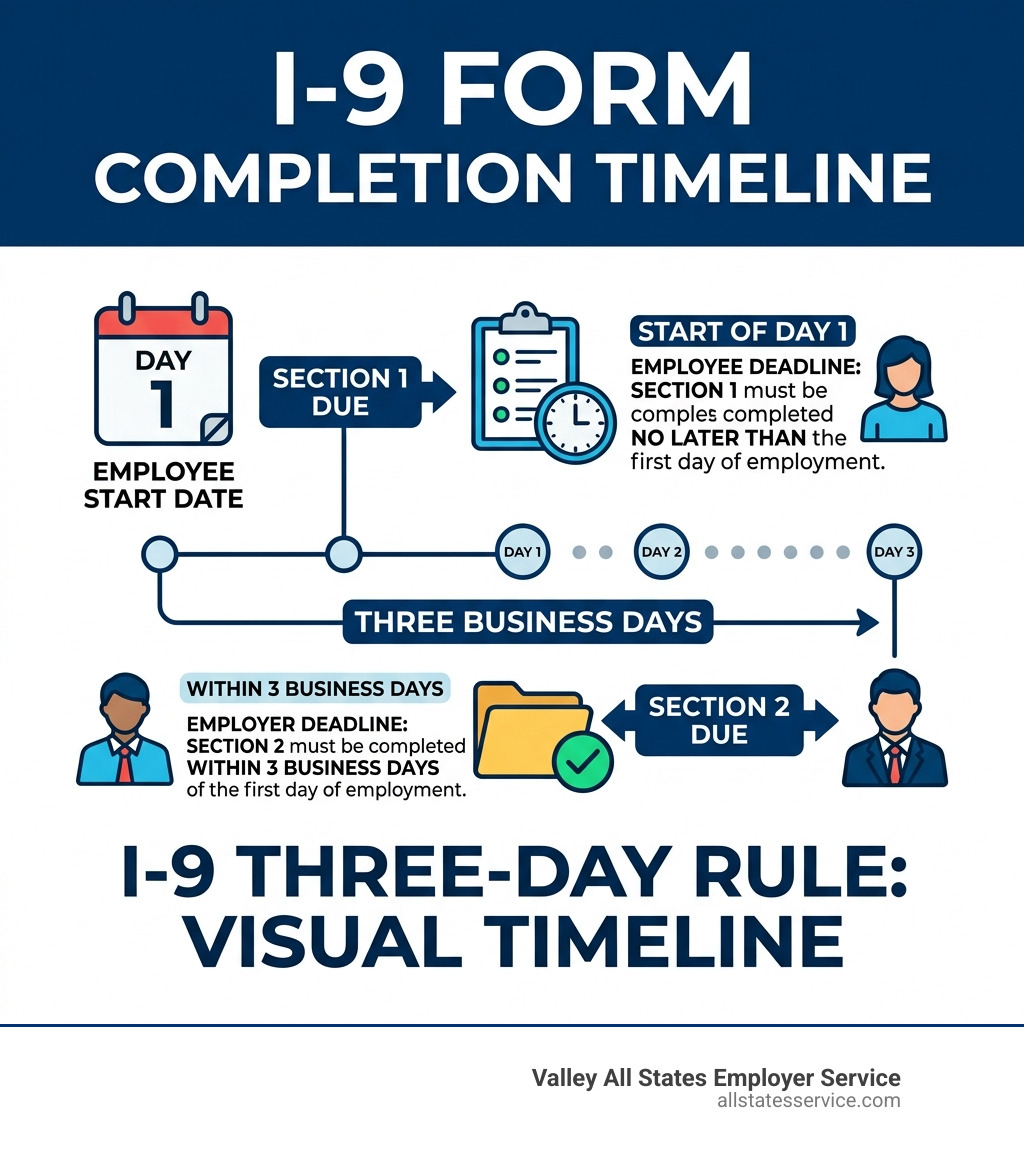
- Employee deadline: Section 1 must be completed no later than the employee’s first day of work
- Employer deadline: Section 2 must be completed within three business days of the employee’s first day
- Where to file it: Nowhere, you keep it on file and make it available for government inspection if requested
- How long to keep it: Three years after the date of hire, or one year after employment ends, whichever is later
Federal law has required Form I-9 for every U.S. hire since November 6, 1986. The form is managed by U.S. Citizenship and Immigration Services (USCIS), and employers are personally liable for errors or missing forms.
That’s a lot of pressure on your HR team, especially when you’re juggling onboarding, benefits, and a dozen other priorities.
The good news? Once you understand the form’s structure and deadlines, compliance becomes much more manageable. This guide walks you through everything, from downloading the right version to avoiding the mistakes that trigger audits.
Similar topics to blank i 9:
Navigating the Blank I-9 Form for 2026 Compliance

As of April 2026, staying compliant means more than just having a stack of papers in a drawer. The Department of Homeland Security (DHS) and USCIS frequently update the form to reflect changes in immigration law and technology. Using an outdated blank i 9 can lead to technical violations during an audit, even if your employees are perfectly authorized to work.
The current version of the form, which features an edition date of 01/20/25, is the gold standard for your hiring process. This edition introduced several streamlined features, such as moving the preparer/translator certification and the reverification sections to separate supplements. Understanding What Is I 9 Form requirements is the first step in protecting your business from hefty civil fines.
Where to Download a Valid Blank I-9
When you are looking for a blank i 9, it is vital to go straight to the source. Third-party sites often host old versions that might have expired years ago. We always recommend visiting the official USCIS Form I-9 page.
The official PDF is a “smart” form, meaning it has fillable fields that can help prevent some common errors. However, keep in mind that even if you fill it out on a screen, the version provided by USCIS typically requires a manual signature unless you are using a specialized electronic I-9 system that meets specific DHS standards. If you are on the go, the form is accessible via mobile devices, but you will need a PDF reader compatible with Adobe’s features to use the fillable functions correctly. For more on staying current, check out our guide on I 9 Form Updates.
Who Must Complete a Blank I-9 and When
The law is very clear: every single person hired for employment in the United States after November 6, 1986, must complete a Form I-9. This includes U.S. citizens, non-citizen nationals, lawful permanent residents, and aliens authorized to work. There are no exceptions for “small businesses” or “short-term” hires. If they are on your payroll, they need an I-9.
The timing is just as strict. I 9 Form Completion follows a two-step dance:
- Section 1: The employee must complete this no later than their first day of work for pay. They can actually complete it any time after they have accepted your job offer, but never before.
- Section 2: You, the employer, must complete this within three business days of the employee’s first day of employment.
If a hire starts on a Monday, you have until Thursday to get Section 2 signed and sealed. Missing this window is one of the most common ways companies find themselves in hot water during an ICE inspection.
Key Deadlines and Section Breakdowns
To avoid “drawing a blank” when you look at the blank i 9, let’s break down the four main components of the modern form. Each part has a specific owner and a specific purpose.
- Section 1: Employee Information and Attestation. This is the employee’s responsibility. They provide their personal details and swear under penalty of perjury that they are authorized to work in the U.S.
- Section 2: Employer Review and Verification. This is your territory. You must examine the employee’s original documents to ensure they are genuine and relate to the person standing in front of you. You’ll record the document titles, issuing authorities, and expiration dates here. Filling Out An I 9 Employer requires a keen eye for detail.
- Supplement A: Preparer and/or Translator Certification. If your employee needs help reading or filling out the form, the person assisting them must complete this supplement. This is no longer part of the main page, keeping the primary form cleaner.
- Supplement B: Reverification and Rehire. Formerly known as Section 3, this is used when an employee’s work authorization expires or when you rehire someone who previously filled out an I-9 for your company within the last three years.
Common Mistakes When Filling Out a Blank I-9
Even with a blank i 9 in hand, it is easy to trip up. We see the same errors over and over again. One big one is missing signatures or dates. If the employee signs but forgets to date the form, it is technically incomplete.
Another frequent pitfall is accepting expired documents. With very few exceptions (like certain documents extended by the issuing authority), every document presented must be unexpired. We also see “over-documentation,” where an employer asks for more documents than required. If an employee provides a U.S. Passport (a List A document), you cannot ask for a Social Security card. Doing so could be seen as discriminatory. For a visual aid on what a “perfect” form looks like, take a look at The Perfect I 9 A Completed I 9 Form Example To Save Your Sanity.
Acceptable Documents: Lists A, B, and C
The back of the blank i 9 contains the “Lists of Acceptable Documents.” This is the only list you should use to verify identity and work eligibility. Employees must be allowed to choose which documents they want to present from these lists.
- List A: These documents prove both identity and employment authorization. Examples include a U.S. Passport, Permanent Resident Card (Green Card), or an Employment Authorization Document (EAD). If an employee brings one of these, you are done!
- List B: These prove identity only. Common examples are a driver’s license or a school ID card. If an employee provides a List B document, they must also provide a List C document.
- List C: These prove employment authorization only. The most common is an unrestricted Social Security card or a birth certificate.
You must see the original documents. Photocopies are not acceptable, except for certified copies of birth certificates. For a deeper dive into who needs which form, visit Completing Form I-9 | USCIS.
Remote Verification and Alternative Procedures
In the modern workplace, you might hire someone who lives states away. How do you verify their documents? Traditionally, you had to designate an “authorized representative” to meet the person and look at the physical documents.
However, DHS now allows an alternative procedure for employers in good standing who are enrolled in E-Verify. This allows for a remote examination of documents via a live video interaction. To use this, you must:
- Be enrolled in and using E-Verify for that hiring site.
- Examine copies of the documents (front and back) sent by the employee.
- Conduct a live video call where the employee holds up the original documents.
- Check the box on the Form I-9 indicating you used an alternative procedure.
This has been a lifesaver for remote-first companies. If you are looking for a walkthrough of this process, Mastering The I 9 Verification Form Step By Step covers the nuances of remote compliance.
Storage, Retention, and Avoiding Costly Penalties
Once the blank i 9 is filled out, your job isn’t over. You must store these forms securely. You can keep them in paper files, on microfilm, or electronically. The key is that they must be retrievable within three business days if the government comes knocking for an inspection.
The retention rule is often confusing. You must keep the form for:
- Three years after the date of hire, OR
- One year after the date employment is terminated, whichever date is later.
Failing to produce these forms or having significant errors can lead to civil fines that range from a few hundred to several thousand dollars per form. Beyond the money, there are anti-discrimination rules to follow. You cannot treat people differently based on their citizenship status or national origin during the I-9 process. For a comprehensive look at the risks, our Form I 9 Ultimate Guide is an essential resource for any business owner.
Frequently Asked Questions about Form I-9
Can I use a Spanish version of the blank I-9?
In most of the United States, including Maryland, the Spanish version of the blank i 9 is for use as a translation aid only. The version you actually fill out and keep on file must be the English version. The only exception is for employers in Puerto Rico, who are permitted to use the Spanish version as their official record.
What happens if I find an error on a previously completed form?
Don’t panic and don’t use white-out! If you find an error, the best practice is to draw a line through the incorrect information, enter the correct data, and then initial and date the change. If the error is massive, you may need to complete a new form and attach it to the old one with a brief memo explaining why the new form was created. This creates a clear audit trail for inspectors.
When is Supplement B required for rehires?
Supplement B is your go-to for “re-verification.” If you rehire an employee within three years of the date their original Form I-9 was completed, you can often use Supplement B instead of starting a whole new blank i 9. You can also use it to record a name change or to update work authorization if the employee’s original document (like an EAD) has expired.
Conclusion
Managing employment eligibility doesn’t have to be a headache. While the blank i 9 might look like just another piece of government paperwork, it is a vital document for protecting your business and ensuring a legal workforce. By staying on top of deadlines, examining original documents carefully, and following retention rules, you can navigate the hiring process with confidence.
At Valley All States Employer Service, we specialize in taking the weight off your shoulders. We provide outsourced E-Verify workforce eligibility verification for employers across the United States, including those in Lutherville, MD. Our expert team ensures your processing is impartial, efficient, and error-free, minimizing the administrative burden on your HR staff.
Ready to simplify your compliance and stop worrying about audits? Explore our I-9 Compliance Services Complete Guide or contact our team today to see how we can streamline your onboarding process.