
Filling out an I-9 employer: 3 Steps to Success
Why Employer I-9 Completion is Critical for Your Business
Filling out an I-9 employer section correctly is more than just a legal requirement. It’s your first line of defense against costly penalties and compliance issues. Every U.S. employer must complete Form I-9 for each new hire to verify their identity and work authorization, as mandated by federal law since 1986.
Quick Answer for Employer I-9 Completion:
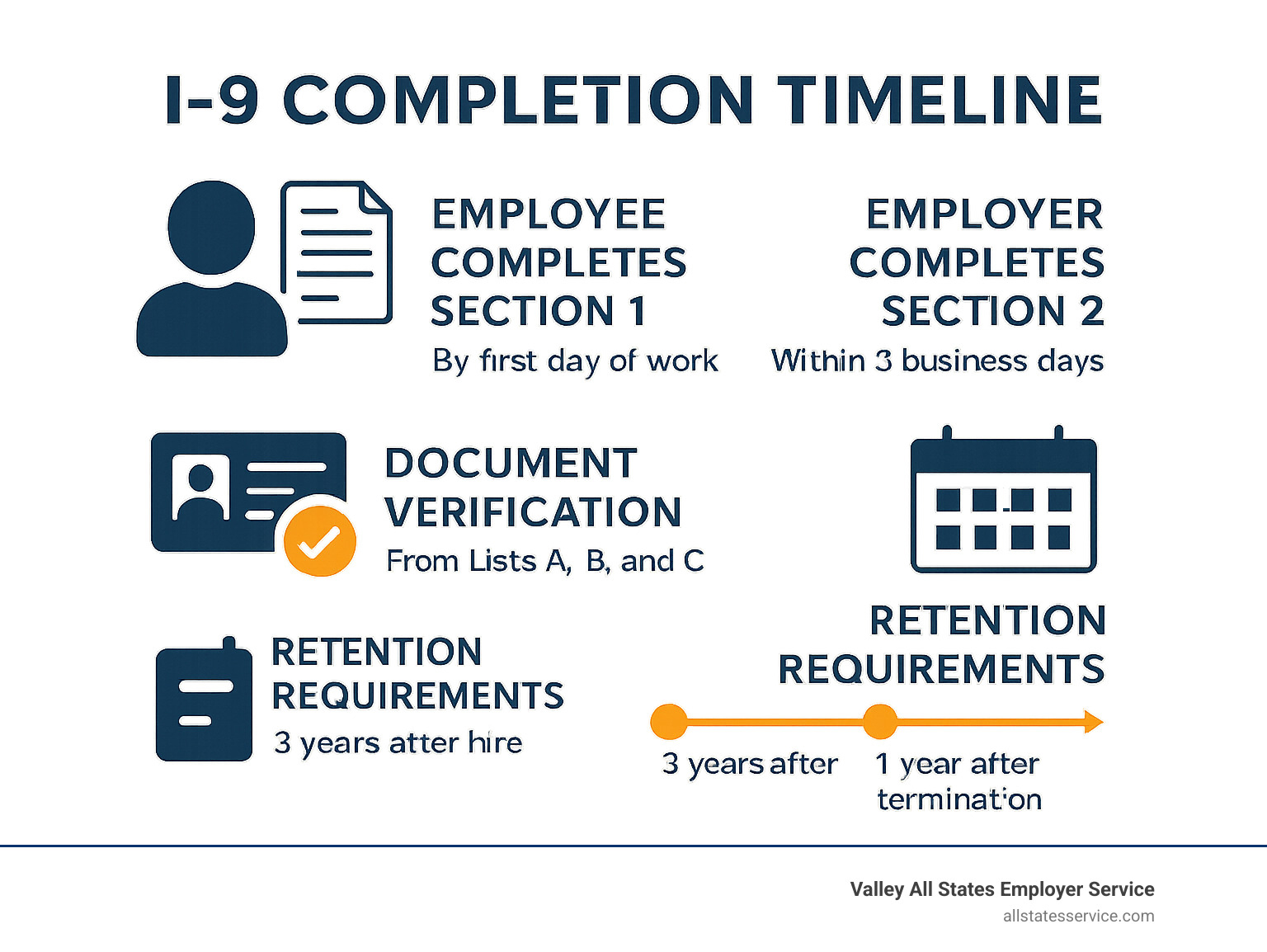
- Employee completes Section 1 – No later than first day of employment
- Employer completes Section 2 – Within 3 business days of employee’s start date
- Document verification – Physically examine acceptable documents from Lists A, B, or C
- Record retention – Keep forms for 3 years after hire OR 1 year after termination (whichever is longer)
- Sign and date – Employer must certify document examination under penalty of perjury
Form I-9, officially called Employment Eligibility Verification, serves a simple but crucial purpose: ensuring every person you hire is legally authorized to work in the United States. The Immigration Reform and Control Act of 1986 made this verification mandatory for all employers, regardless of company size.
Here’s what makes I-9 completion so critical for your HR operations. Failure to properly complete, retain, or produce Form I-9 during an audit can result in civil fines ranging from hundreds to thousands of dollars per form. With busy hiring schedules and complex documentation requirements, even small errors can quickly add up to significant penalties.
The process involves two main sections: your employee handles their personal information and work authorization attestation in Section 1, while you as the employer verify their identity and employment eligibility in Section 2. You have exactly three business days after your employee’s first day to complete your portion of the verification process.
Don’t worry. While the requirements are strict, the process becomes straightforward once you understand the key steps and timing requirements.
A Step-by-Step Guide to Filling Out an I-9 for an Employer
Filling out an I-9 employer section doesn’t have to be overwhelming once you know the process. Think of it like following a recipe. Get the ingredients right, follow the steps in order, and you’ll have success every time.
The key is using the most current version of Form I-9. USCIS updates this form periodically, so always grab the latest version from their website. Using an outdated form is like trying to steer with an old map. You might end up somewhere you don’t want to be, like facing penalties during an audit.
For employers new to this process, our guide on What is an I-9? covers the fundamentals in detail.
Step 1: Ensuring the Employee Completes Section 1 Correctly
Your new hire takes the first swing at Form I-9 by completing Section 1, called “Employee Information and Attestation.” This is entirely their responsibility, and timing matters here. They must complete this section no later than their first day of employment, but never before accepting your job offer.
Section 1 asks for the basics: full legal name, address, date of birth, and Social Security number (when applicable). The employee also needs to check a box indicating their citizenship or immigration status. This is more than just paperwork, as they’re making a legal attestation about their work authorization.
Sometimes employees need help due to language barriers or disabilities. That’s perfectly fine. If someone assists them, that helper must complete the “Preparer and/or Translator Certification” section. This creates a clear paper trail and ensures accountability.
Your role here is straightforward but important. Review Section 1 for completeness before moving to your part. Check that all required fields are filled out and the employee has signed and dated their attestation. You can provide employee instructions to help them steer the process, but remember, you cannot tell them which specific documents to bring for verification.
Step 2: The Employer’s Guide to Filling Out an I-9 Employer Section (Section 2)
Now it’s your turn to complete Section 2, the “Employer or Authorized Representative Review and Verification.” This is where you examine your employee’s documents and verify their identity and work authorization.
The clock starts ticking on your employee’s first day of work. You have exactly three business days from that first day to complete Section 2. If someone’s employment lasts less than three days, you must finish this section by their first day. Missing this deadline isn’t like being fashionably late to a party. It can result in serious penalties.
Document examination traditionally happened in person, but times have changed. If you participate in E-Verify, you can now use Remote I-9 Verification procedures. This allows document examination via video call, which has been a game-changer for remote hiring.
You don’t have to handle Section 2 personally. An authorized representative can complete it for you. Think of them as your designated document examiner. This could be anyone from your HR team, a supervisor, or even a notary public for remote employees. Just remember, you’re still responsible for any mistakes they make, so choose someone reliable. Many companies use professional services for this step to ensure accuracy.
When completing Section 2, you need to:
Examine original documents that appear genuine and belong to the person presenting them. Record document details including title, issuing authority, document number, and expiration date in the appropriate fields. Enter the employee’s first day of employment in the designated space. Sign and date the certification under penalty of perjury, confirming you’ve examined the documents and believe the employee is authorized to work.
Step 3: Understanding Acceptable Documents (Lists A, B, and C)
Here’s where many employers get confused, but it’s actually quite logical once you understand the system. The Form I-9 includes a “Lists of Acceptable Documents” page that breaks documents into three categories.
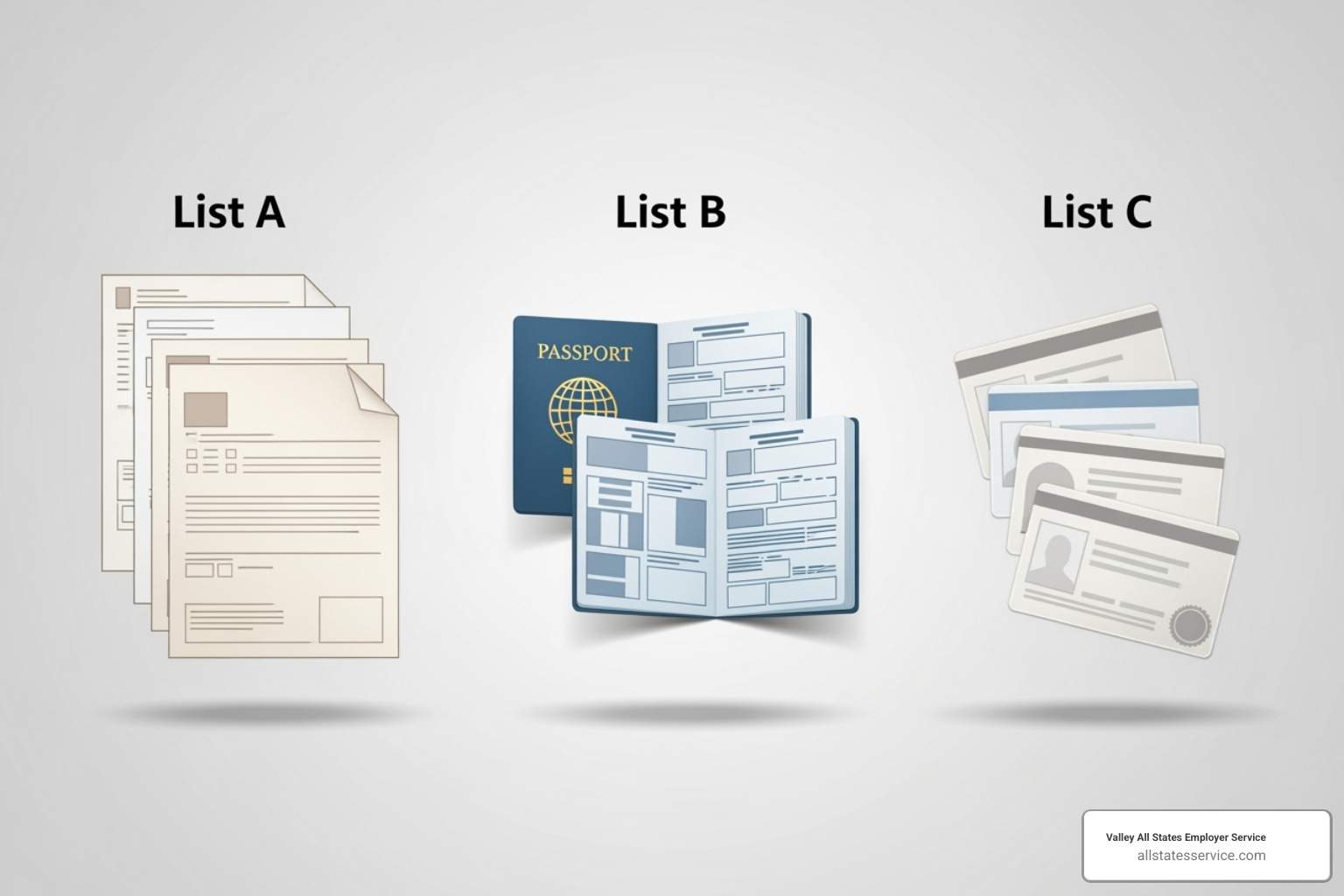
Think of it like a menu with different combination options. List A documents are the “combo meals.” They establish both identity and work authorization with just one document. Common List A documents include U.S. passports, permanent resident cards (green cards), and employment authorization documents with photos.
List B documents prove identity only, while List C documents prove work authorization only. If an employee doesn’t have a List A document, they need to present one from List B and one from List C, like ordering items separately instead of getting the combo.
List B documents include driver’s licenses, school ID cards with photos, voter registration cards, and military cards. For employees under 18 who can’t present these, school records or medical records work too.
List C documents focus on work authorization and include unrestricted Social Security cards, U.S. birth certificates, and certain Native American tribal documents. The key word here is “unrestricted.” Social Security cards that say “not valid for employment” don’t count.
Here’s the most important rule: you cannot specify which documents an employee must present. The choice is entirely theirs. It’s like telling someone they can order anything from the menu, then insisting they choose the fish. That’s discrimination, and it can land you in legal trouble.
The complete USCIS Acceptable Documents list gets updated periodically, so bookmark that page for reference. When in doubt, check the official source rather than relying on memory or outdated information.
Managing I-9 Compliance: Retention, Corrections, and Reverification
Think you’re done once you’ve completed that Form I-9? Not quite! Filling out an I-9 employer section is just the beginning of your compliance journey. The real challenge lies in maintaining ongoing compliance through proper record-keeping, knowing how to fix mistakes when they happen, and understanding when you need to reverify employees.
Here’s the truth: most I-9 violations don’t happen during the initial completion process. They occur months or years later when employers haven’t kept proper records, made corrections incorrectly, or missed reverification deadlines. Regular I-9 Self Audit practices can save you from costly surprises during an official government inspection.
I-9 Retention and Storage Rules
Let’s talk about the “3-year/1-year” rule because this trips up more employers than you’d think. You must keep each completed Form I-9 for three years after the date of hire OR one year after employment ends, whichever is later.
Here’s how this works in practice: if someone works for you for five years, you’ll keep their I-9 for six total years (five years of employment plus one additional year). But if they only work for six months, you still keep it for the full three years from their hire date.
The good news is you have flexibility in how you store these forms. You can go old-school with physical filing cabinets or accept the digital age with electronic storage systems. If you choose electronic storage, your system needs to meet specific DHS requirements for security, integrity, and accessibility. Many businesses find that digital solutions for I-9 Record Keeping actually make compliance easier and more organized.
Keep your I-9 forms separate from regular personnel files. This isn’t just a best practice, it’s smart strategy. When government agencies like DHS, the Department of Justice, or the Department of Labor come knocking for an audit, you can quickly produce the requested forms without exposing other confidential employee information.
Correcting Errors and Making Updates
Nobody’s perfect, and mistakes on I-9 forms happen more often than you’d expect. The key is knowing how to fix them properly. Simply crossing things out, using white-out, or scribbling over errors can actually make things worse during an audit.
For Section 1 corrections, your employee takes the lead. They should draw a single line through the incorrect information, write the correct details nearby, then initial and date the change. If there are major errors or missing information, sometimes it’s cleaner to have them complete a fresh Form I-9, attach it to the original, and include a brief explanation.
When you need to correct Section 2 or Supplement B, follow the same approach. Draw one line through the mistake, add the correct information, then initial and date your correction. If you forgot to fill in something originally, just add it to the appropriate field with your initials and the date.
The USCIS guidance on correcting Form I-9 provides detailed instructions for tricky situations. One common question: what happens when an employee legally changes their name? They’re not required to update their I-9, but if they want to, they handle it as a Section 1 correction. You don’t need to make any changes in Section 2.
Reverification and Rehiring (Supplement B)
Some employees will need reverification, and this is where Supplement B comes into play. You must reverify when an employee’s work authorization document expires or by the expiration date they noted in Section 1, whichever comes first. This typically applies to employees who presented Employment Authorization Documents (EADs) or other temporary work permits.
Here’s a relief: you generally don’t need to reverify U.S. citizens, noncitizen nationals, or lawful permanent residents who showed you a Green Card during their initial verification.
When reverification time comes, use Supplement B of the current Form I-9. The employee presents any acceptable List A or List C document showing their continued work authorization. You examine the document, record the information in Supplement B, and sign and date it.
Rehiring gets interesting when it happens within three years of the original I-9 completion. If their work authorization is still valid, you can simply complete Supplement B rather than starting from scratch. If their authorization expired, you’ll need to reverify using Supplement B. Our detailed guide on the I-9 Process for Rehires walks you through these scenarios step by step.
The bottom line? Ongoing I-9 compliance requires attention to detail and good systems. Whether you’re tracking expiration dates, storing forms properly, or making corrections, consistency and accuracy will protect your business from penalties and audit headaches.
Common I-9 Questions and How to Avoid Costly Penalties
When you’re filling out an I-9 employer section, questions naturally arise. We’ve heard them all over the years, and honestly, most employers face the same puzzles. The good news? Once you understand the answers, avoiding those expensive penalties becomes much more manageable. For a detailed breakdown of what these penalties actually cost, check out our comprehensive guide on I-9 Compliance Penalties.
Let’s tackle the most common concerns that keep HR professionals up at night.
What are the consequences of incorrect I-9 completion?
Here’s the reality that might surprise you: the government doesn’t mess around when it comes to I-9 compliance. Even honest mistakes can cost your business significantly.
Civil fines represent the most frequent penalty employers face. These aren’t small slaps on the wrist either. The government distinguishes between “paperwork” violations (think missing signatures, wrong dates, or incomplete fields) and more serious “substantive” violations (like knowingly hiring unauthorized workers or skipping the I-9 process entirely). Fines typically range from hundreds to thousands of dollars per form, and they escalate quickly for repeat offenders.
The math gets scary fast. Imagine finding during an audit that 20 of your I-9 forms have minor errors. Even at the lower end of the penalty scale, you could be looking at substantial unexpected expenses.
Criminal penalties come into play when violations become patterns or when employers knowingly hire unauthorized individuals. These consequences include hefty fines and potential imprisonment. While less common than civil penalties, they represent the most serious end of the enforcement spectrum.
Beyond the immediate financial impact, compliance issues create audit risks that can disrupt your entire operation. Once you’re on the government’s radar, expect increased scrutiny that often uncovers additional problems. The USCIS penalties for non-compliance make it clear that accuracy isn’t optional.
The importance of getting it right the first time cannot be overstated. Every field matters, every signature counts, and every date needs to be correct.
How is Form I-9 different from Form W-9?
This confusion comes up constantly, and for good reason. Both forms have similar names and deal with worker verification, but they serve completely different purposes for entirely different types of workers.
Form I-9 exists for your W-2 employees. These are the people on your regular payroll who receive benefits and have taxes withheld. Its sole purpose is verifying that these individuals can legally work in the United States. You’ll examine their identity documents, confirm their work authorization, and maintain these records as required by immigration law.
Form W-9 serves your independent contractors, freelancers, and vendors. These are the 1099 workers who aren’t technically employees. This form collects their taxpayer identification number so you can report payments to the IRS accurately. It’s purely about tax compliance, not work authorization.
Think of it this way: I-9 asks “Can this person legally work here?” while W-9 asks “How do I report payments to this contractor for tax purposes?” The legal foundations differ too. I-9 stems from immigration law (the Immigration Reform and Control Act of 1986), while W-9 comes from tax regulations (the Internal Revenue Code).
You’ll likely use both forms in your business, but never for the same person in the same working relationship. An employee gets an I-9, a contractor gets a W-9, and mixing them up creates compliance headaches.
Can I use an authorized representative for filling out an I-9 employer section?
Absolutely, and many smart employers take advantage of this option. An authorized representative can complete and sign Section 2 on your behalf, which proves especially valuable for multi-location businesses or remote hiring situations.
Your authorized representative can be practically anyone you trust to handle this responsibility. Personnel officers, supervisors, agents, or even notary publics all qualify. The key word here is “trust” because while they’re doing the work, you remain fully liable for any mistakes they make.
This liability aspect deserves emphasis. If your authorized representative makes an error, uses poor judgment, or fails to follow proper procedures, the penalties and consequences land squarely on your business. Choose someone who understands I-9 requirements thoroughly and takes accuracy seriously.
For remote employees, authorized representatives often provide the only practical solution for meeting the physical document examination requirement. Many businesses find that professional Third-Party I-9 Verification services offer the perfect middle ground. You get expert processing that minimizes errors and administrative burden while maintaining full compliance with federal requirements.
The beauty of working with experienced verification professionals is that they handle hundreds of I-9 forms and stay current with every regulatory change. It’s like having a specialized I-9 expert on your team without the overhead of training and maintaining that expertise in-house.
Streamlining Compliance with E-Verify and Remote Verification
In our increasingly digital world, the process of filling out an I-9 employer section has also evolved. Technology offers powerful tools to improve accuracy and efficiency, particularly through E-Verify and new remote verification procedures.

E-Verify is an internet-based system operated by the Department of Homeland Security (DHS) in partnership with the Social Security Administration (SSA). It allows employers to electronically confirm the employment eligibility of their newly hired employees by comparing the information from Form I-9 against government records.
While E-Verify does not replace the Form I-9, it certainly improves it. Employers still must complete Form I-9 for each new hire, but then they use E-Verify to cross-reference the data. This provides an additional layer of verification. Our article on E-Verify and I-9 digs deeper into their synergistic relationship.
The benefits of E-Verify include:
- Increased Accuracy: It helps identify discrepancies in employment authorization information quickly.
- Reduced Fraud: It makes it harder for unauthorized workers to gain employment.
- Efficiency: It provides rapid results, often within seconds.
While E-Verify is voluntary for most employers, it is mandatory for some, particularly federal contractors. Certain states and local jurisdictions also require its use for public agencies or even private employers.
The landscape for remote verification has also seen recent changes. The DHS has authorized an “alternative procedure” for E-Verify participants that allows for the remote examination of Form I-9 documents. This means that instead of a physical in-person inspection, employers using E-Verify can conduct document reviews over a live video call, provided certain conditions are met. This is a game-changer for businesses with a remote workforce. You can find more information on this at USCIS I-9 Remote Verification.
This flexibility, however, doesn’t negate the need for diligence. Employers must still ensure the documents appear genuine and relate to the employee. Leveraging robust digital solutions and expert services can help you steer these advanced verification methods with confidence.
Mastering Your I-9 Obligations
Getting comfortable with filling out an I-9 employer section might feel overwhelming at first, but you’ve now got the roadmap to steer it successfully. Think of it like learning to drive. Once you understand the rules and practice the process, it becomes second nature.
The truth is, mastering I-9 compliance isn’t just about checking boxes. It’s about protecting your business from penalties that can reach thousands of dollars per form and ensuring you’re treating every new hire fairly and legally. When you get the basics right, like accurate completion, timely processing, and proper record-keeping, you’re building a solid foundation for your entire HR operation.
Remember the key principles we’ve covered: your employee handles Section 1 by their first day, you complete Section 2 within three business days, and you keep those forms safe for years to come.
Here’s what really matters for your business: consistency and attention to detail. Every I-9 form you complete correctly is one less compliance headache down the road. Every document you examine thoroughly is protection against future audits. Every record you store properly is peace of mind that you’re ready for whatever comes next.
At Valley All States Employer Service, we’ve seen how much time and stress proper I-9 management can save businesses. Our team specializes in taking the guesswork out of workforce eligibility verification, so you can focus on growing your company instead of worrying about compliance paperwork.
Ready to streamline your I-9 process and ensure every form is handled with expert care? Learn more about Workforce Eligibility Verification and find how we can simplify compliance for your business.