
Everything You Need to Know About How Long Background Checks Take for a Job
How Long Do Background Checks Take for a Job? Here’s What to Expect
How long do background checks take for a job is one of the most common questions HR managers ask when a great candidate is waiting on the other side of the hiring process. The short answer: most employment background checks take 1 to 5 business days, though the exact timeline depends on what’s being checked and how the search is conducted.
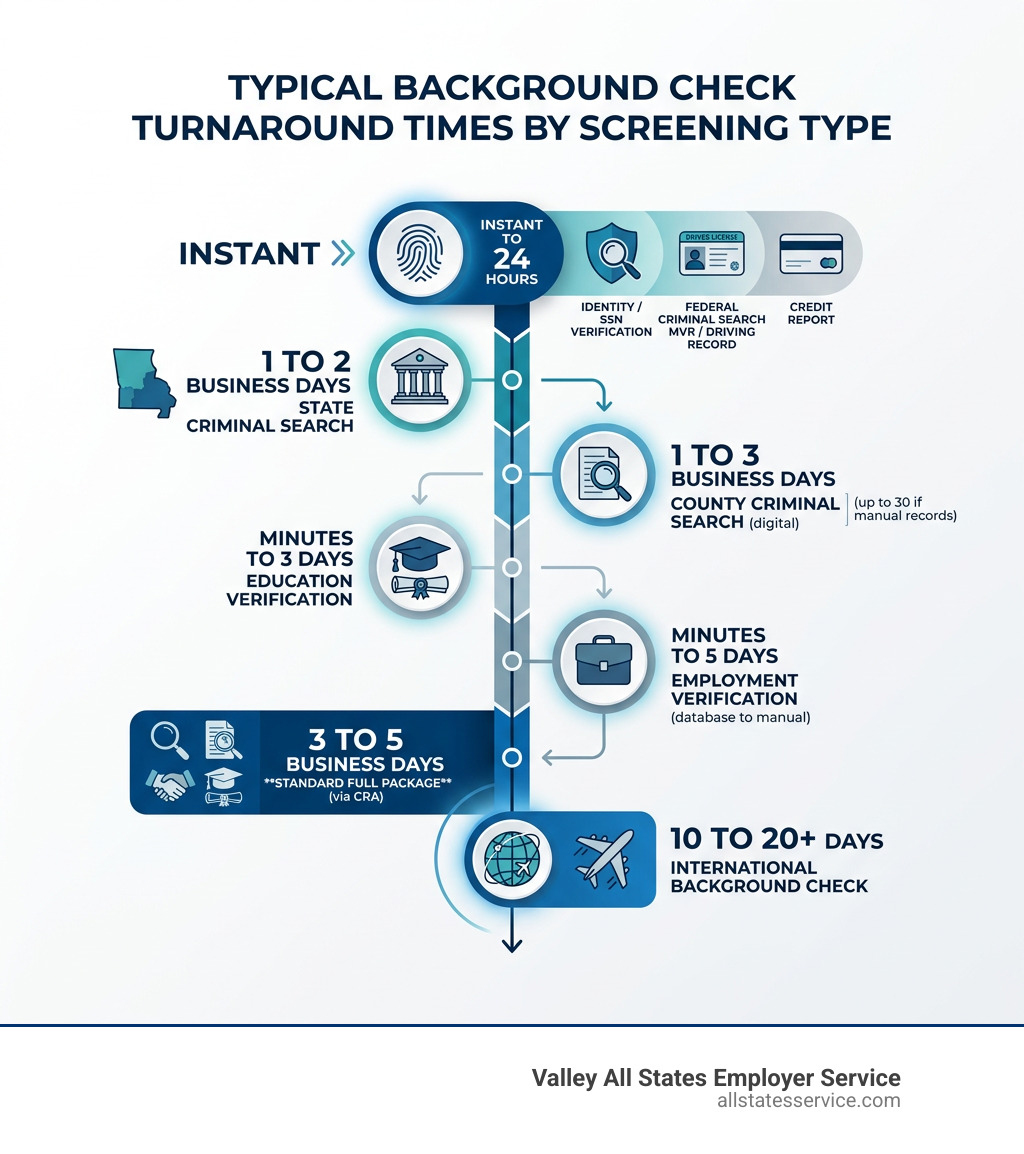
Here’s a quick breakdown of typical turnaround times:
| Screening Type | Typical Turnaround |
|---|---|
| Identity / SSN Verification | Instant to 24 hours |
| Federal Criminal Search | About 1 business day |
| State Criminal Search | 1 to 2 business days |
| County Criminal Search | 1 to 3 business days (up to 30 if manual) |
| Employment Verification | Minutes (database) to 5 days (manual) |
| Education Verification | Minutes (database) to 3 days |
| MVR / Driving Record | Minutes to 24 hours |
| Credit Report | Instant to 24 hours |
| International Background Check | 10 to 20+ business days |
| Standard Full Package (via CRA) | 3 to 5 business days |
The range is wide, and that’s by design. A quick identity check can return results in seconds. A county criminal court search in a jurisdiction with paper-only records? That could stretch to weeks.
For busy HR teams managing tight hiring timelines, that uncertainty can be stressful. Knowing what drives the clock, and what can slow it down, puts you back in control.
Average Turnaround Times for Employment Screening
When we talk about the average wait time, we are usually looking at a window of 3 to 5 business days. This is the industry standard for a comprehensive package conducted through a Consumer Reporting Agency (CRA). While some individual pieces of the puzzle move faster than others, the total time accounts for the coordination of multiple data sources.
The efficiency of a CRA is a major factor here. Professional screening services use automated systems to ping national databases, which can return some results almost instantly. However, the 94% of employers who use background checks know that “instant” does not always mean “thorough.” A truly reliable report often requires a mix of high-speed digital searches and more time-consuming manual verifications.
If you are curious about why the clock starts and stops at different intervals, you can find more info about pre-employment timing to help set better expectations with your hiring team. Most standard checks are completed within that 1 to 3 business day sweet spot, but if your candidate has a complex history, you should prepare for the longer end of the 5-day average.
How Long Do Background Checks Take for Job Roles by Type?

The scope of your search is the biggest lever you can pull to change the timeline. A basic identity check is worlds away from a deep-dive executive screening. The more layers you add, the more potential there is for a “hiccup” in record accessibility.
For instance, verifying a Social Security Number is often a simple database match that takes seconds. On the other hand, verifying a professional license might require a human being to call a state board and wait for a return message. We recommend checking out our pre-employment-background-checks-guide to see how different screening layers fit into your specific industry requirements.
Criminal Record Search Timelines for a Job
Criminal searches are the backbone of most screenings, and they usually take 1 to 3 business days. Federal criminal searches are surprisingly fast, often wrapping up in about one day because they search the 94 U.S. federal judicial districts through centralized electronic systems.
State-level databases usually add another day or two. The real wildcard is the county court search. While many counties have digitized their records, some still require a court clerk to manually pull a physical file. This manual process can turn a 48-hour wait into a 30-day marathon.
We also have to consider the “John Smith” problem. If your candidate has a very common name, the screening team must perform additional due diligence to ensure they aren’t attributing someone else’s record to your applicant. Throughout this process, employers must remain compliant with the Summary of Rights under the FCRA, which protects candidates from inaccurate reporting.
Verifying Employment and Education History for a Job
Verifying where someone worked or went to school is often the most manual part of the process. If a candidate’s records are stored in large databases like The Work Number or the National Student Clearinghouse, verification can happen in minutes. These systems compile data from millions of employers and thousands of academic institutions.
However, if the records aren’t in a database, a researcher has to contact the HR department or the school registrar directly. This is where we see the 2 to 5 business day window. Delays are common during school holiday closures or when a former employer is slow to return a call. For a deeper look at how we handle these hurdles, see our guide on pre-employment-work-history-verification.
MVR and Credit Report Durations
If the job involves driving or handling finances, you will likely need a Motor Vehicle Record (MVR) or a credit report. These are among the fastest checks available.
- MVRs: Most motor vehicle services offer instant digital access to driving records, meaning results arrive in minutes or within 24 hours. If a state requires a certified copy via mail, however, it can take weeks.
- Credit Reports: These are governed by the Fair and Accurate Credit Transactions Act and are typically delivered instantly or within one business day.
Why Some Background Checks Take Longer Than Others
Sometimes, a background check feels like it has fallen into a black hole. Usually, there is a logical reason for the delay. One of the most common reasons is international history. If a candidate lived, worked, or studied abroad, the process changes completely.
International checks can take anywhere from 5 to 20 business days. Every country has its own privacy laws, and many foreign authorities still rely on manual archives and physical mail. If you want to understand the mechanics behind these delays, you might enjoy cracking-the-code-how-pre-employment-background-checks-really-work.
Other factors that stretch the timeline include:
- Aliases and Nicknames: If a candidate has used multiple names, the search must be run for each one to be thorough.
- Seasonal Spikes: During high-volume hiring seasons (like the holidays or early summer for grads), courts and universities get backlogged.
- Incomplete Information: If a candidate forgets to list a previous address or provides the wrong phone number for a past boss, the researcher has to stop and ask for clarification.
Strategies to Accelerate the Screening Process
As an employer, you don’t have to just sit and wait. There are proactive steps we can take to keep things moving. The goal is to eliminate “dead air” time where the request is just sitting in an inbox.
One of the best moves is using a candidate portal for digital authorization. Under the FCRA, you must have written consent before running a check. If you send a paper form, it might take days to get back. A digital portal allows the candidate to sign on their phone and immediately upload any required documents.
Working with experienced pre-employment-background-check-companies also helps because they have established relationships with data providers and courts. Furthermore, integrating e-verify-background-checks into your workflow ensures that identity and work eligibility are handled swiftly and accurately from the start.
Frequently Asked Questions About Background Check Timelines
Can I start a new job while the background check is still pending?
This depends entirely on your company policy and the industry. In many corporate roles, an employer might issue a “conditional job offer.” This allows you to start training or orientation while the final report is processing.
However, in highly regulated fields like healthcare, childcare, or finance, state laws often prohibit a candidate from starting until the full report is cleared. It is always best to check your specific background-check-pre-employment-screening policy to see what is allowed.
Do weekends and holidays affect how long the process takes?
Yes, they definitely do. It is important to remember that background check timelines are almost always measured in business days. If you submit a request on Friday afternoon, the “clock” doesn’t really start until Monday morning.
Courts, government offices, and universities are usually closed on weekends and federal holidays. If a court is closed for a local holiday or a snow day, that will add a direct delay to any manual criminal searches in that jurisdiction.
How long do international background checks take compared to domestic ones?
While a domestic U.S. check is often done in 3 days, international checks average 10 to 15 business days. This is due to the need for communication with foreign authorities, potential translation requirements, and the varying levels of digitization in other countries. Some regions, like parts of Europe or Asia, have very strict privacy laws that require specific, localized release forms which can take time to process.
Conclusion
Understanding how long do background checks take for job candidates is about more than just a calendar date. It is about managing the human element of hiring. At Valley All States Employer Service, we know that every day a position stays open is a day of lost productivity.
Our focus is on providing outsourced E-Verify workforce eligibility verification that is expert, impartial, and efficient. We help you navigate the complex world of employment compliance while minimizing the administrative burden on your HR team. By combining our specialized E-Verify processing with a clear understanding of screening timelines, you can hire with confidence and speed.
Ready to streamline your hiring and ensure your workforce is fully compliant? Learn more in our employment background check online guide 2026 or contact our team today to see how we can simplify your verification process.