
Why Pre-Employment Background Check Timing Matters to Your Hiring Success
Pre employment background check time typically ranges from 2-5 business days for standard screening packages, though individual components can vary dramatically from minutes to several weeks depending on the type of verification required.
Here’s what you need to know about background check durations:
Standard Timeline Breakdown:
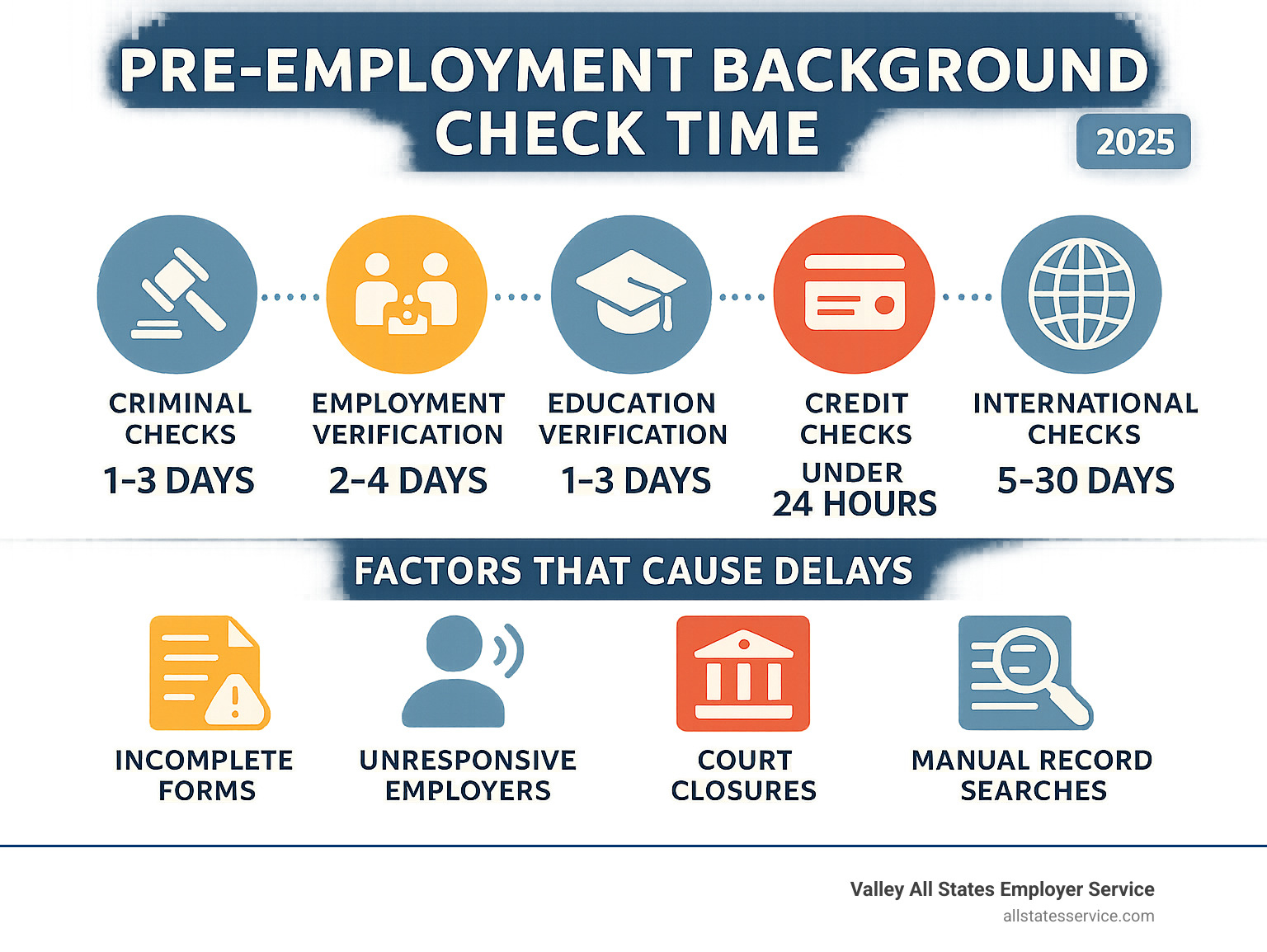
- Criminal background checks: 1-3 business days
- Employment verification: 2-4 business days
- Education verification: 1-3 business days
- Credit checks: Less than 24 hours
- Motor vehicle records: Minutes to 2 days
- International checks: 5-30 business days
Industry Average: Most background screening companies report 3-5 business days as their standard turnaround time when working with a consumer reporting agency (CRA).
If you’re an HR manager juggling multiple open positions, understanding these timelines isn’t just helpful, it’s critical for managing candidate expectations and keeping your hiring pipeline moving smoothly. According to Sterling’s research, 71% of job seekers considered dropping out of their most recent hiring experience because the process took too long and felt too complicated.
The reality is that background checks involve multiple moving parts. There’s no single “CSI-style” database that contains all the information employers need. Instead, screening companies must contact individual courts, schools, and former employers, each with their own response times and processes.
What Exactly Happens in a Pre-Employment Background Check?
Let’s clear up a common misconception right away: a pre-employment background check isn’t one magical search through some giant database. Instead, it’s more like assembling a puzzle, where each piece comes from a different source and takes its own sweet time to arrive.
The pre employment background check time varies so much because each component involves reaching out to different organizations, courts, and databases.
Here’s what typically happens behind the scenes:
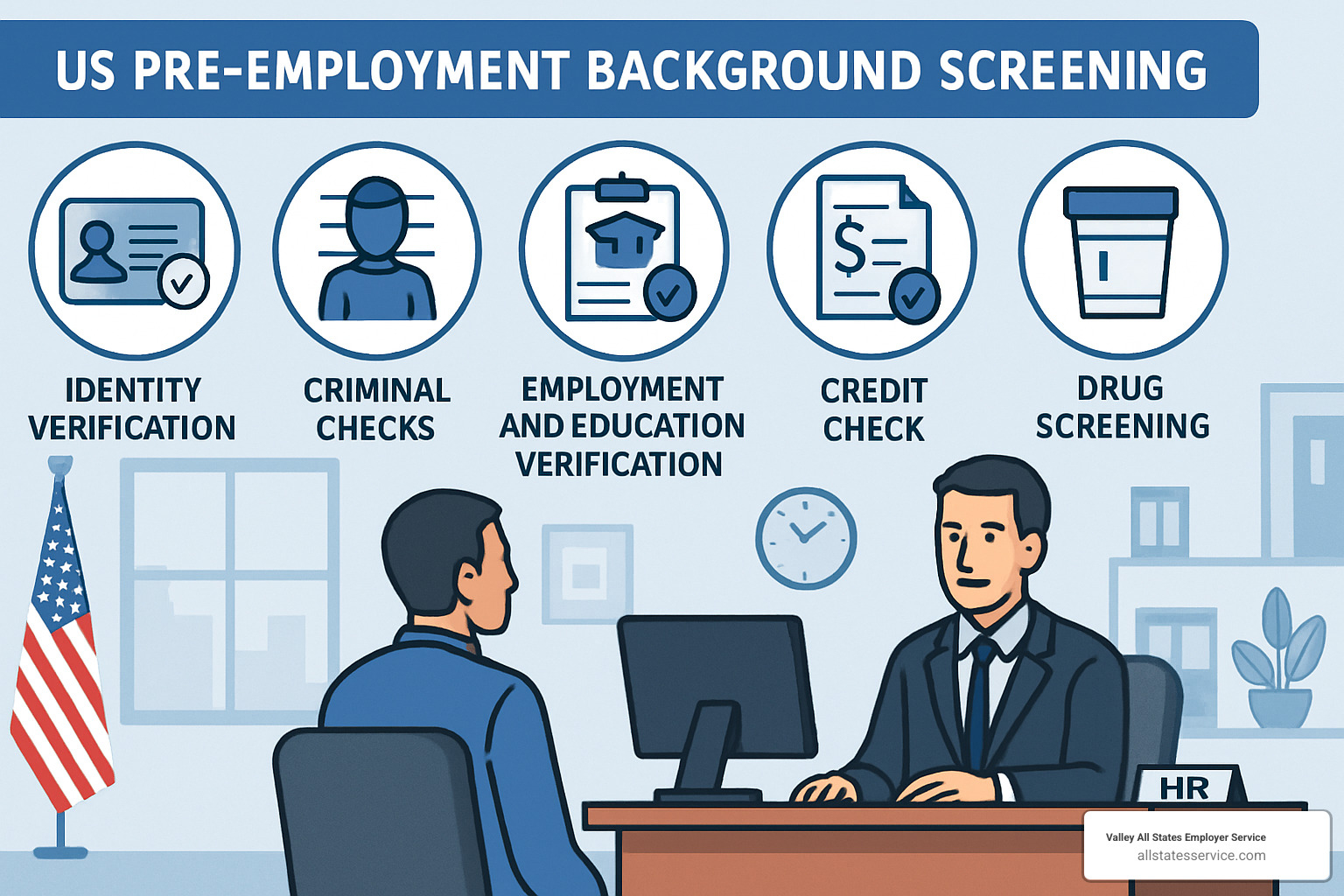
Identity verification kicks things off and usually wraps up in about 90 seconds when done digitally. This ensures the person sitting in your interview chair is actually who they claim to be and helps pre-populate accurate information for other checks.
Employment history verification is where your screening company becomes a detective, contacting previous employers to confirm job titles, employment dates, and sometimes salary details. Most verifications take 2-4 business days, but international companies or closed businesses might require 1-2 weeks.
Education verification follows a similar pattern. Schools get contacted to confirm degrees, graduation dates, and academic credentials. Most educational institutions respond within 1-3 days, though summer breaks or holiday periods can extend this timeline.
Criminal record searches are the most complex part. The United States has over 3,240 counties, and there’s no centralized criminal database. Your screening company has to check individual court systems across county, state, federal, and sometimes international jurisdictions.
Credit history reports are the speed demons of background checks, typically completing within 24 hours thanks to digitized financial records.
Motor vehicle records show an interesting split. Digital records can return results in minutes, while certified reports requested through traditional mail can take weeks.
Drug screening often runs alongside background checks. Rapid on-site tests give results in about 10 minutes, while lab-based testing takes 1-3 days.
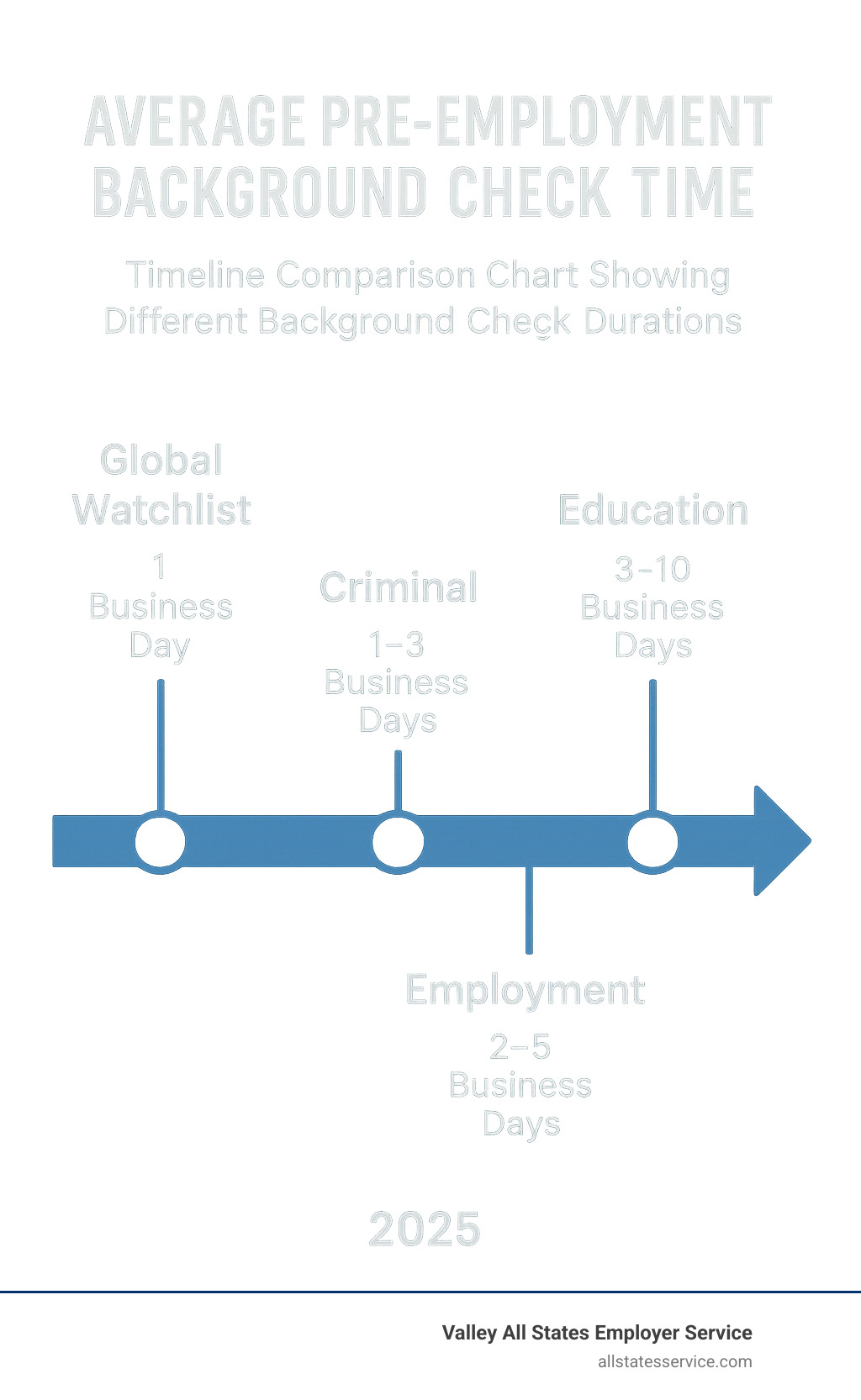
Global watchlist searches check candidates against terrorist and sanctions lists, typically completing within one business day.
Key Components & Why Employers Use Them
Fraud prevention has become increasingly important as resume embellishment reaches epidemic levels. Some candidates fabricate entire positions, claim degrees they never earned, or inflate job titles beyond recognition.
Workplace safety considerations drive criminal background checks. This becomes especially crucial for positions involving vulnerable populations, financial responsibilities, or access to sensitive information.
Regulatory compliance often removes the choice entirely. Healthcare workers, childcare providers, financial services employees, and transportation professionals face legal requirements for specific types of background screening.
The cost of bad hires provides clear justification for thorough screening. Research shows that problematic employees cost approximately 30% of their position’s annual salary in productivity losses, training costs, and potential legal issues.
Average Pre Employment Background Check Time (The Numbers You Came For)
You’ve submitted your application, interviewed well, and now you’re waiting. Let’s cut through the uncertainty with real numbers from the industry.
Pre employment background check time typically falls between 2-5 business days for most standard screening packages. A basic package checking criminal history and employment might wrap up in 2-3 days, while comprehensive screening for financial services roles could stretch to a full week or more.
Domestic checks move much faster than international counterparts. If all your history is U.S.-based, you’re looking at that standard 2-5 day window. International history adds another 5-15 business days due to different systems, privacy laws, and cooperation levels.
Database searches happen almost instantly, while manual verification adds days or weeks when someone needs to physically call employers, visit courthouses, or dig through paper records.
Role-specific requirements create the biggest timeline variations. Entry-level retail might only need basic criminal and identity verification, while bank executive roles require credit checks, professional license verification, and deeper employment history.
Government positions live in their own universe. Security clearances can take 4-8 months for standard levels, with top-secret clearances sometimes stretching over a year.
Typical Timeline by Check Type
Criminal background checks usually complete within 1-3 business days when courts have digital systems. International criminal checks can take 3-30 business days depending on the country.
Employment verification typically takes 2-4 business days. Large companies with dedicated HR departments respond within 2-3 days, while small businesses might take a full week. International employment adds another week.
Education verification generally wraps up in 1-3 business days for most institutions. International schools can require several weeks, especially with language barriers or closed institutions requiring manual research.
Credit checks complete in less than 24 hours thanks to highly digitized financial records.
Motor vehicle records vary dramatically. Digital state databases provide instant results, while certified reports by mail take 2-3 weeks.
International checks require 5-30 business days depending on the country, privacy laws, government cooperation, and local bureaucracy.
Government & High-Clearance Roles: When Weeks Feel Like Months
Government positions operate on completely different timelines. While standard pre employment background check time runs 2-5 days, government roles often require 30 days or more.
Security clearance levels have their own expectations. Confidential and Secret clearances typically take 4-8 weeks, Top Secret clearances average 4-8 months, and Top Secret with Special Access Programs can stretch over a year.
These extended timelines exist because government investigations include extensive interviews with references, neighbors, and colleagues, plus analysis of financial history, international travel verification, and sometimes polygraph examinations.
What Delays or Speeds Up Results?
Several factors can either speed up or slow down your pre employment background check time. Some are within your control, while others feel like waiting for the stars to align.
Complete and accurate forms make the biggest difference. Wrong phone numbers for previous employers can turn a three-day process into a three-week ordeal. Missing middle names, incorrect dates, or outdated contact information create major delays.
Aliases and name variations create common stumbling blocks. If you’ve used nicknames professionally, maiden names, or any spelling variations, screening companies need to know about all of them.
Court access limitations present frustrating delays. With over 3,240 counties and no centralized criminal database, some jurisdictions still require physical courthouse visits and paper record searches.
Holiday closures and weather events can halt everything. Courts, schools, and government offices don’t operate 24/7, and unexpected events can shut down record access for days.
Previous employers and schools that don’t respond promptly create major bottlenecks. Some companies have dedicated verification departments responding within 24 hours, while others take weeks to return simple phone calls.
The difference between manual versus digital record access is like comparing a horse and buggy to a sports car. Digitized records return results almost instantly, while manual searches take days or weeks.
When candidates dispute findings, everything stops while screening companies reinvestigate, adding 5-10 business days while additional documentation is gathered.

Candidate-Controlled Factors
Candidates have more influence over background check speed than they realize.
Accurate data submission means double-checking everything before submitting. Verify employment dates against old pay stubs, ensure phone numbers are current, and confirm email addresses are spelled correctly.
Prompt signature and consent keeps things moving. Background checks cannot begin until proper consent is provided.
Many screening companies offer proactive document upload through candidate portals. Instead of waiting for employer contact, you can upload pay stubs, tax records, or transcripts directly.
Providing complete address history helps screening companies target the right jurisdictions for criminal searches. Missing addresses result in incomplete searches requiring additional time to correct.
Provider & Court-Controlled Factors: Out of Your Hands
County court runner availability affects timing in jurisdictions requiring manual research. Busy court systems create backlogs unrelated to your specific case.
Record digitization levels vary wildly. Older records or organizations without modernized databases require manual research, inherently taking longer than automated searches.
Volume spikes during peak hiring seasons slow processing times across all services, regardless of individual candidate preparation.
International record cooperation presents unique challenges with varying cooperation levels and processing standards creating unpredictable timelines.
How Employers & Candidates Can Cut the Waiting Game Short
Both employers and candidates have more control over pre employment background check time than they might think. The secret lies in understanding that modern background screening can turn what once took weeks into days when everyone works with the system.
Automation and technology tools have revolutionized screening. Digital identity verification can pre-populate candidate information in 90 seconds, eliminating data entry errors that cause delays.
Concurrent processing makes enormous differences. Instead of waiting for criminal checks to finish before starting employment verification, smart providers run multiple checks simultaneously, cutting total turnaround time nearly in half.
Real-time communication keeps everyone informed without constant phone calls. Modern candidate portals provide live updates so applicants know exactly where their screening stands.
At Valley All States Employer Service, clear candidate communication transforms the entire experience. When people understand what’s happening, they provide complete information upfront and respond quickly to follow-up requests. Our I-9 Verification Assistance services work hand-in-hand with background screening to create seamless onboarding without guesswork.

Action Plan for Candidates
You have more power over your pre employment background check time than you realize.
Verify your resume accuracy before submitting applications. Cross-check every employment date, job title, and company name against actual records. Small discrepancies can add days while verification teams sort out confusion.
Prepare your supporting documents like pay stubs, tax records, and transcripts before the background check begins. When screening companies need additional proof, you can upload it immediately.
List every name variation you’ve ever used. Your maiden name, college nicknames, shortened middle names. Screening companies need to search all possible combinations.
Monitor your email and phone closely. Background check companies often need quick clarification. Responding within hours instead of days keeps your screening moving at full speed.
Action Plan for Hiring Teams
Smart hiring teams know that upfront planning dramatically reduces pre employment background check time while improving candidate experience.
E-Verify integration creates powerful efficiency gains when combined with background screening. Our E-Verify services help streamline this integration, turning multiple separate steps into one smooth workflow.
Batch submissions work like buying in bulk. When hiring multiple candidates, submitting background checks together often improves processing efficiency and reduces per-check turnaround times.
Clear consent forms prevent confusion that slows everything down. Well-designed forms explaining exactly what information candidates need eliminate back-and-forth emails that add days.
Standardized screening packages eliminate over-screening that unnecessarily extends timelines. Develop role-specific packages that include exactly what you need for adequate risk management.
Know Your Rights: Errors, Disputes, and Adverse Action
If you’re going through the background check process, understanding your legal rights can make the difference between a smooth hiring experience and a frustrating ordeal.
The Fair Credit Reporting Act (FCRA) serves as your primary protection. This federal law requires employers to provide clear written disclosure that a background check will be conducted and obtain your written consent before starting any investigation.
When potential issues arise, employers can’t simply pull your job offer without warning. If they’re considering adverse action based on background check results, federal law requires a pre-adverse action notice with a copy of the report and summary of your rights, creating an opportunity to address problems before final decisions.
The dispute process exists for these situations. When you challenge background check information, screening companies have up to 30 days to investigate, though most legitimate disputes get resolved within 5-10 business days with solid supporting documentation. This timeline gets added to your overall pre employment background check time, but it’s worth ensuring accuracy.
You have the right to request a free copy of your background check report, particularly if adverse action is taken. The EEOC guidance on adverse action provides comprehensive details about employer obligations and your rights.
Fixing Mistakes Without Losing the Job Offer
Finding errors in your background check doesn’t mean losing your dream job. Most employers understand that mistakes happen and prefer waiting for accurate information rather than making decisions based on incorrect data.
Speed matters when disputing errors. Contact the screening company immediately to request reinvestigation. Don’t wait and hope problems resolve themselves.
Documentation is your best friend. Court records showing case dismissals, employment letters confirming job details, official transcripts, or government documents that contradict incorrect information help screening companies resolve disputes quickly.
Keep your potential employer informed throughout the dispute process. Simple emails explaining that you’ve identified errors and are working with the screening company demonstrate transparency and professionalism.
Follow up appropriately without becoming a nuisance. Most legitimate disputes with proper documentation get resolved within a week, so patience combined with professional persistence usually yields the best results.
Frequently Asked Questions about Pre-Employment Background Check Time
How do I know if I passed?
You might never get a direct “congratulations, you passed!” message. Most employers simply move forward with job offers or start date information when everything checks out. Pre employment background check time ends quietly when there’s nothing problematic to discuss.
However, if something comes up that might affect employment, employers are legally required to provide written notice and give you a copy of the background check report before making final decisions.
Want to know for sure? You can request a copy of your background check report directly from the screening company, showing exactly what information was shared with your potential employer.
Why is my background check still “pending” after a week?
Delays beyond typical timelines are often just part of the process, not red flags about your candidacy.
International verifications are the biggest culprit for extended timelines, easily taking two to three weeks or longer depending on countries involved.
Unresponsive employers or schools create common bottlenecks. While some institutions respond quickly, others take time getting back to screening companies.
Court backlogs can slow things down, especially for criminal record searches. Some jurisdictions are still catching up from pandemic-related closures.
If your check has been pending over a week, it’s reasonable to follow up with your hiring manager or the background check company for a status update.
Can I start work before every check is finished?
This depends on your specific employer and role type. Some companies let new hires begin work while certain components are processing, especially for positions with lower security requirements.
However, certain roles almost always require complete clearance before starting. Working with vulnerable populations, financial responsibilities, access to sensitive information, or security clearances typically means waiting for complete results.
Ask your hiring manager directly about their policy rather than making assumptions. Some employers have flexible policies allowing restricted starts until all checks complete, while others maintain strict no-exceptions policies.
Conclusion
When you’re waiting to hear back about a job offer, understanding pre employment background check time can save you from unnecessary stress and help you plan your next career move with confidence. The typical 3-5 business day timeline isn’t set in stone, but it gives you a realistic baseline for most standard screening packages.
The truth is, background checks are a bit like cooking a complex meal. Some ingredients (like credit checks) come together quickly, while others (like international employment verification) need more time to simmer. The final result depends on having all the right information from the start and avoiding common delays that can stretch the process unnecessarily.
Preparation makes all the difference. Whether you’re a candidate double-checking your resume dates or an HR manager streamlining your screening process, small upfront investments in accuracy and organization pay huge dividends in faster turnaround times.
For employers juggling multiple open positions, partnering with experienced compliance professionals can transform background screening from a bottleneck into a smooth part of your hiring workflow. The goal isn’t just completing checks quickly, but doing them right the first time while maintaining full regulatory compliance.
At Valley All States Employer Service, we’ve seen how the right processes and expertise can dramatically reduce hiring delays. Our team specializes in the compliance details that keep your hiring pipeline flowing smoothly, from E-Verify processing to comprehensive employment verification.
The best background check process is one you barely notice because it works seamlessly in the background while you focus on finding great candidates and making strong hiring decisions. Our Employee Onboarding Compliance services integrate naturally with background screening to create exactly that kind of smooth experience.
Ready to eliminate background check delays and streamline your entire compliance process? Our team understands the nuances of employment verification and can help you build a hiring system that works as efficiently as your business demands. Contact us today to find how much simpler compliant hiring can be.