
Why Employee Eligibility Verification List A Matters for Your Business
If you are trying to make sense of employee eligibility verification List A requirements, you are not alone. Many HR teams find Form I-9 rules confusing, especially when they are busy hiring and onboarding.
Employee eligibility verification list a documents are the simplest way to prove both identity and work authorization on Form I-9. These documents let new hires complete the verification process with a single piece of documentation, rather than needing two separate forms.
Here is what you need to know about List A documents:
- List A documents prove both identity and work authorization in one step.
- Most common examples: U.S. Passport, Permanent Resident Card (Green Card), Employment Authorization Document (EAD).
- All List A documents must be unexpired (with specific exceptions for certain automatic extensions).
- Employees can choose to present either one List A document or one List B (identity) plus one List C (work authorization) document.
- Employers cannot specify which documents an employee must present.
Within three business days of the date employment begins, you or your authorized representative must complete Section 2 of Form I-9 by examining original, acceptable documentation. The U.S. Department of Homeland Security requires that employees present evidence of identity and employment eligibility to their employer within this timeframe.
Getting this right matters. If you fail to properly complete Form I-9, you risk violating section 274A of the Immigration and Nationality Act and may face civil money penalties. Yet many HR managers struggle with the complexity of acceptable documents, recent card redesigns, and automatic extensions that can make an expired looking document actually valid.
This guide breaks down everything you need to know about List A documents, from the most common U.S. Passport to special cases like foreign passports with I-551 stamps or Form I-94 notations. For more context, you can also read our related articles on employer i 9 verification, filling out an i 9 employer, and the federal employment eligibility verification form i 9.
First Things First: What is Form I-9?
Form I-9, Employment Eligibility Verification, is a required document for every employer in the United States. Its primary purpose is to verify the identity and employment authorization of individuals hired for employment in the U.S. This federal requirement helps ensure that all employees, whether U.S. citizens or foreign nationals, are legally authorized to work.
Both employers and employees have clear responsibilities when it comes to Form I-9. Employees must attest to their employment authorization in Section 1 and present acceptable documents from employee eligibility verification List A or the other lists. Employers then examine these documents and record the information in Section 2, confirming that the documents appear genuine and relate to the person presenting them. This process must be completed within three business days of the employee’s first day of employment. If an employee is hired for less than three business days, the form must be completed no later than their first day.
Once completed, employers must retain Form I-9 for a specific period, either three years after the date of hire or one year after employment is terminated, whichever is later. Employers must also make these forms available for inspection if requested by authorized U.S. government officials from the Department of Homeland Security (DHS), Department of Labor (DOL), or Department of Justice (DOJ). Failing to properly complete and retain Form I-9 can lead to significant civil money penalties, so careful compliance is essential. For comprehensive guidance, the Handbook for Employers M-274 is an invaluable resource.
Understanding the Document Lists
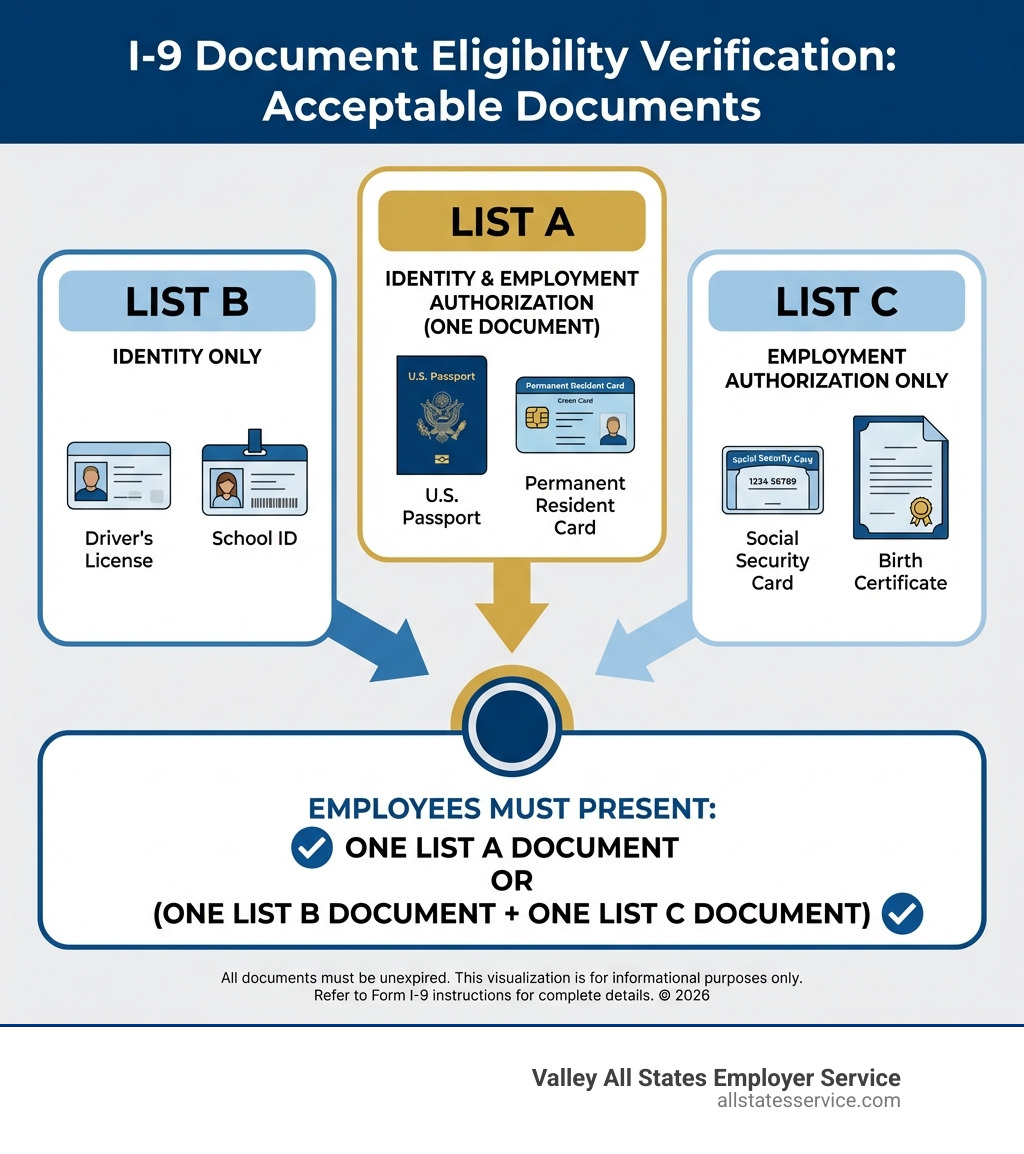
The heart of Form I-9 verification lies in its three lists of acceptable documents, List A, List B, and List C. These lists categorize the types of documents an employee can present to prove their eligibility to work in the U.S.
- List A documents are the superstars of verification because they establish both identity and employment authorization with a single document. This simplifies the process for both the employee and the employer.
- List B documents establish only identity. If an employee chooses to present a List B document, they must also present a List C document.
- List C documents establish only employment authorization. Similarly, if an employee presents a List C document, they must also provide a List B document to prove their identity.
The employee has the right to choose which documents they present, as long as they meet the requirements of either one List A document or one document from List B and one document from List C. Employers cannot dictate which specific documents an employee must provide, and they cannot request more documents than are legally required. This protects employees from discrimination and supports a fair verification process.
The Complete Employee Eligibility Verification List A
Now let us dive into the specifics of employee eligibility verification list a documents. These documents prove both who an employee is and that they are legally allowed to work in the United States. When an employee presents one of these, no other documents are needed.
It is crucial that all List A documents are unexpired, unless specifically noted otherwise, for example certain documents with automatic extensions. When we examine these documents, we look for genuineness and make sure they appear to belong to the person presenting them. It is a visual inspection, not an investigative one, so we do not try to become document experts. We also avoid over documentation, which means asking for more documents than necessary.
U.S. Passport or U.S. Passport Card
The U.S. Passport, whether the traditional book or the more compact passport card, is one of the most straightforward and commonly accepted List A documents. It clearly establishes both the employee’s identity and their U.S. citizenship, which grants them employment authorization.
When reviewing a U.S. Passport, we check for key security features, the employee’s photo, and the expiration date. An unexpired U.S. Passport is a strong List A document that simplifies the I-9 process.
Permanent Resident Card (Form I-551)

Often called a Green Card, the Permanent Resident Card (Form I-551) is another key employee eligibility verification list a document. This card proves an individual’s status as a lawful permanent resident, which grants both identity and permanent work authorization in the U.S.
The U.S. Citizenship and Immigration Services (USCIS) periodically redesigns these cards to improve security and reduce fraud. For instance, USCIS began issuing its most recent redesign of the Permanent Resident Card on January 30, 2023. Older designs remain valid until their expiration date. Employers must accept a Permanent Resident Card as long as it is unexpired, regardless of its design, unless the card has been officially replaced. In some cases, certain conditions can automatically extend the validity of an expired card, so staying informed about these details is important.
Employment Authorization Document (Form I-766)
The Employment Authorization Document, or EAD (Form I-766), is issued to foreign nationals who have temporary authorization to work in the United States. This card, which typically includes a photograph, serves as both proof of identity and employment authorization for the period specified on the card.
Like the Permanent Resident Card, EADs are also redesigned from time to time. USCIS began issuing its most recent redesign of the EAD card on January 30, 2023, and older versions are still valid until their stated expiration date. When reviewing an EAD, employers should carefully check the expiration date to make sure the employee’s authorization is current. Some EADs, particularly for individuals with Temporary Protected Status (TPS) or certain pending applications, may have automatic extensions of their validity. Employers need to understand these rules so they do not mistakenly reject a valid document.
Foreign Passport with I-551 Stamp or Form I-94 for Employee Eligibility Verification List A
This category involves more nuance, because it often applies to foreign nationals with specific immigration statuses. A foreign passport can sometimes function as an employee eligibility verification list a document when it is combined with certain endorsements or accompanying forms.
- Foreign Passport with a Temporary I-551 Stamp: Some foreign passports contain a temporary I-551 stamp or a printed notation on a machine readable immigrant visa. This acts as temporary evidence of lawful permanent resident status and employment authorization. These cases often require reverification once the permanent Green Card is issued.
- Foreign Passport with Form I-94 or I-94A and Work Endorsement: For individuals temporarily authorized to work in specific categories, a foreign passport presented with a Form I-94, Arrival or Departure Record, or Form I-94A can be a valid List A combination. The I-94 must show the individual’s nonimmigrant status and, importantly, indicate that this status permits employment with a specific employer. F-1 and M-1 students can fall into this category under certain conditions.
USCIS automated Form I-94 at airports and seaports in April 2013, so travelers no longer automatically receive a paper copy. Employees can usually access their I-94 information online.
Special Considerations for F-1 and M-1 Students
For F-1 academic students and M-1 vocational students, verifying employment eligibility can be complex. On campus employment for F-1 students is generally permitted up to 20 hours a week when school is in session, and it can increase to full time during breaks. For this, they might use their foreign passport and Form I-94 with an endorsement like “F-1 D/S” (duration of status), along with their Form I-20, Certificate of Eligibility for Nonimmigrant Student Status, which is issued by their Designated School Official.
For off campus work, such as Curricular Practical Training, CPT, or Optional Practical Training, OPT, an Employment Authorization Document, EAD, Form I-766, is usually required. The EAD itself is a List A document. For F-1 STEM OPT Extension, employers must also be enrolled in E-Verify and implement a formal training plan, Form I-983.
The Cap Gap Provision
A particularly important provision for F-1 students is the cap gap extension. If an H-1B petition is timely filed on behalf of an F-1 student on OPT, their F-1 status and OPT employment authorization may be automatically extended. This extension bridges the gap between the expiration of their OPT and the start date of their H-1B status, usually October 1, and it allows them to continue working.
Verification for cap gap usually involves the foreign passport, Form I-94, and a Form I-797C, Notice of Action, that shows the H-1B petition was filed. Employers will need to reverify employment authorization once the H-1B is approved or rejected.
M-1 students have stricter employment rules. They may only accept employment after completing their course of study, and only if it is part of a practical training program, for a maximum of six months. Like F-1 students on OPT, they must obtain an EAD before starting employment. Dependents of M-1 students, M-2 status, are not eligible for employment authorization.
What If an Employee Does Not Have a List A Document?
It is common for an employee to start work without a List A document. The law provides a flexible alternative. They can present one document from List B, to prove identity, and one document from List C, to prove employment authorization. Think of it as putting two puzzle pieces together to complete the picture of their eligibility.
| Document List | Purpose | Examples |
|---|---|---|
| List A | Establishes both Identity & Work Authorization | U.S. Passport, Permanent Resident Card, EAD |
| List B | Establishes Identity Only | Driver’s License, State ID Card, School ID |
| List C | Establishes Work Authorization Only | Social Security Card (unrestricted), Birth Certificate, DHS EAD (specific) |
Common List B Documents That Establish Identity
List B documents are used to confirm who the employee is. These documents must contain a photograph or enough identifying information such as name, date of birth, sex, height, eye color, and address. They must also be unexpired.
Common examples include:
- Driver’s license or ID card issued by any U.S. state
- ID card issued by federal, state, or local government agencies
- School ID card with a photograph
- U.S. military card or draft record
- Military dependent’s ID card
- U.S. Coast Guard Merchant Mariner Card
- Native American tribal document
- Driver’s license issued by a Canadian government authority
For employees under 18 years of age who may not have standard identity documents, special options apply. School records, report cards, clinic records, or doctor or hospital records can serve as List B documents and help establish identity.
Common List C Documents for Employee Eligibility Verification List A’s Alternative
When an employee provides a List B document, they also need a List C document to confirm their employment authorization. These documents prove that they are legally allowed to work in the U.S.
Popular List C documents include:
- U.S. Social Security Account Number card: This is a very common List C document, but it comes with an important rule. It must be an unrestricted card. Employers cannot accept cards that state “NOT VALID FOR EMPLOYMENT,” “VALID FOR WORK ONLY WITH INS AUTHORIZATION,” or “VALID FOR WORK ONLY WITH DHS AUTHORIZATION.” Also, the card should not be laminated if it was issued after 1982.
- Certification of report of birth issued by the Department of State, Form FS-545, Form DS-1350, or Form FS-240
- Original or certified copy of a birth certificate issued by a U.S. state, county, municipal authority, or territory, bearing an official seal. Puerto Rico birth certificates issued before July 1, 2010, are generally not acceptable.
- Native American tribal document
- U.S. Citizen ID Card (Form I-197)
- Identification Card for Use of Resident Citizen in the United States (Form I-179)
- Employment authorization document issued by DHS (other than those on List A), for example an unexpired Form I-94 with an asylee or refugee stamp, or a Form I-571 Refugee Travel Document.
Used correctly, these List B and List C options give you a complete alternative to employee eligibility verification List A documents, while still keeping your I-9 process compliant.
Navigating Common I-9 Problems and Best Practices
Even with clear guidelines, I-9 compliance can be challenging. Common mistakes include accepting expired documents, failing to complete sections on time, or asking for too many documents. The goal is to reduce these errors and keep your process simple and consistent.
What about receipts for lost, stolen, or damaged documents?
Documents can be lost, stolen, or damaged. To keep the hiring process moving, there is a temporary solution for Form I-9 verification, receipts. An employee can present an acceptable receipt instead of a document from List A, B, or C.
Here is the important part, the employee must present the actual replacement document within 90 days of the date of hire. For example, if an employee presents a receipt for a lost Green Card, a List A document, they have 90 days to provide the actual Green Card. There are also specific receipts for lawful permanent residents, such as Form I-94 with a temporary I-551 stamp and a photograph, and for refugees, such as Form I-94 with an RE notation or a refugee stamp, that can be accepted as List A documents. Employers should carefully record these receipts on Form I-9 and track the 90 day period to make sure they follow up on time.
How does E-Verify relate to the I-9 process?
E-Verify is an online system that works along with Form I-9. While Form I-9 is the required paperwork, E-Verify takes the information from Form I-9 and electronically compares it against records from the Social Security Administration and the U.S. Department of Homeland Security. This process helps confirm that an employee is authorized to work in the United States.
For many employers, E-Verify is voluntary. For some federal contractors and subcontractors, E-Verify is a mandatory requirement for employees working on covered federal contracts. Using E-Verify can help reduce errors and support a legally authorized workforce, which gives employers more confidence in their hiring practices. You can find more information about the E-Verify system on the E-Verify program information website.
Can we examine documents remotely?
Traditionally, employers or their authorized representatives were required to physically examine an employee’s original documents in the employee’s physical presence. This physical presence rule was the standard for I-9 completion.
DHS has now implemented an alternative procedure for remote document examination. This option is available to employers who participate in E-Verify and are in good standing. If you are an E-Verify participant, you may be allowed to examine an employee’s documents remotely by using live video interaction, as long as you follow the DHS conditions.
This flexibility, which was expanded during the COVID 19 pandemic, has become a permanent option for qualified E-Verify employers. It makes employee eligibility verification list a review and other document checks more adaptable to remote and hybrid hiring environments while still staying within federal rules.
Simplify Your I-9 and E-Verify Compliance
Managing Form I-9 and E-Verify on top of daily HR work can easily become overwhelming. The detailed rules around employee eligibility verification list a documents, automatic extensions, receipts, and reverification make it hard to stay confident that every file is correct.
Valley All States Employer Service focuses on outsourced E-Verify workforce eligibility verification for employers across the United States, including Maryland and the Lutherville area. Our team handles the process with expert, impartial, and efficient review, which helps you:
- Reduce administrative burden on HR and hiring managers
- Lower the risk of I-9 and E-Verify errors
- Stay aligned with current federal guidance and document changes
- Keep onboarding smooth for new employees
We stay current with I-9 and E-Verify rules so you do not have to. Whether your employees use List A documents or a combination of List B and List C, we help keep your verification process organized and consistent.
Ready to make I-9 and E-Verify simpler for your business and avoid costly mistakes? Learn more about workforce eligibility verification with Valley All States Employer Service today.