
Pre Employment Security Screening and the Art of Not Panicking
Why Pre Employment Security Checks Are the First Line of Defense in Smart Hiring
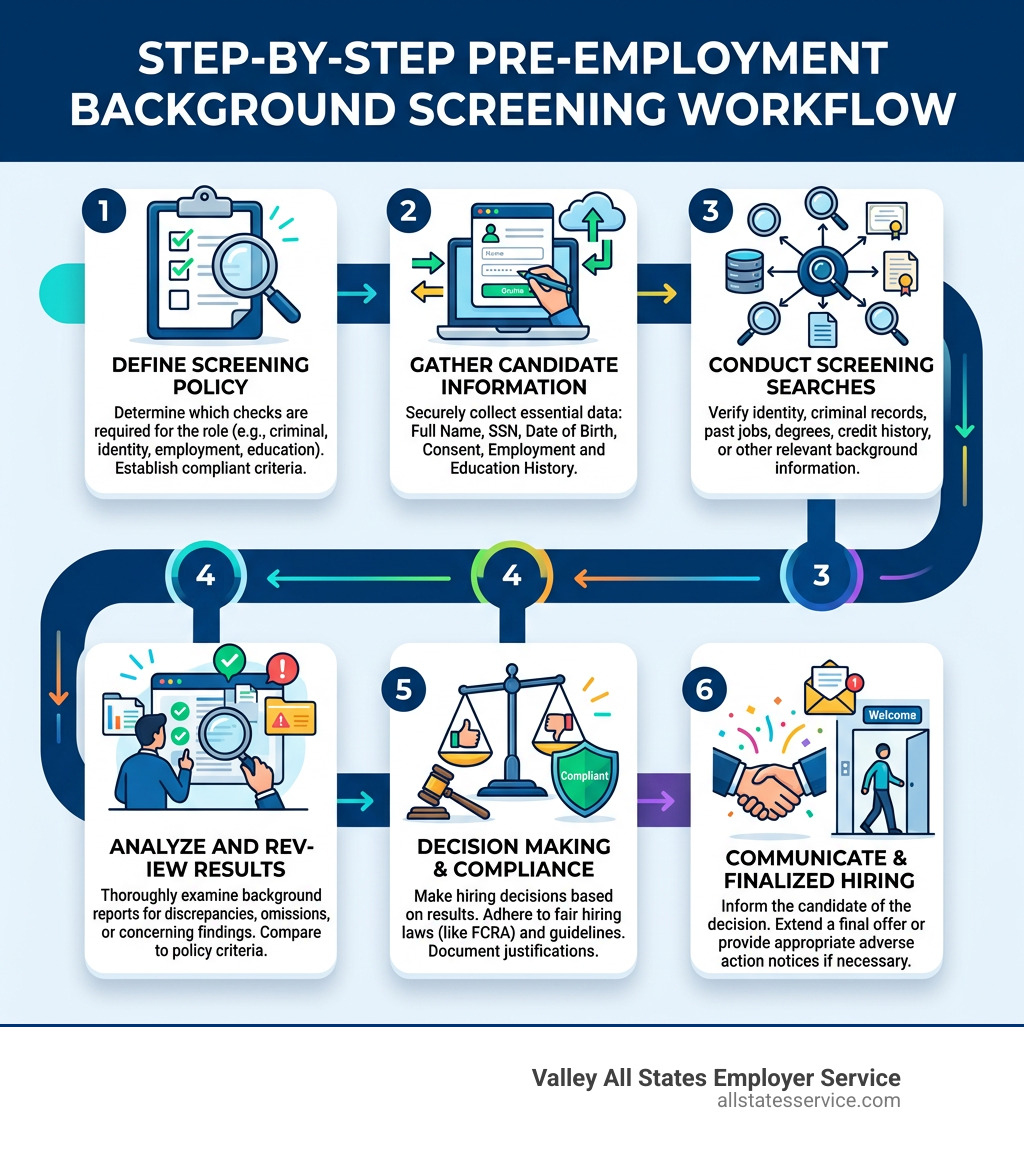
A pre employment security check is the process of verifying a job candidate’s identity, criminal history, employment record, education, and other relevant background information before making a hiring decision.
Here’s a quick breakdown of what’s typically involved:
| Check Type | What It Reveals |
|---|---|
| Criminal history | Convictions, sex offender status, federal records |
| Identity verification | Confirms the person is who they claim to be |
| Employment verification | Past job titles, dates, and reasons for leaving |
| Education verification | Degrees, certifications, and institutions attended |
| Credit check | Financial responsibility (for relevant roles) |
| Drug screening | Substance use, especially for safety-sensitive jobs |
| Right to work / E-Verify | Legal authorization to work in the US |
Most basic checks take 1 to 3 business days. Comprehensive checks can take several days to a few weeks, depending on the depth of the search and how quickly third parties respond.
Here’s the reality: hiring feels stressful enough without worrying about whether the person across the desk is being straight with you. But the data says you should worry, at least a little.
75% of HR managers have caught a candidate lying on a resume. Drug test positivity rates hit their highest level since 2004, with 4.2% of applicants testing positive on urine screens. And employee theft cases averaged over $1,200 per incident in 2020, a number that keeps climbing.
That’s not meant to scare you. It’s meant to show why a structured, compliant screening process isn’t just a formality. It’s one of the smartest investments a hiring team can make.
The good news? Once you understand how pre-employment screening actually works, it stops feeling like a legal minefield and starts feeling like a straightforward part of your hiring workflow.
Pre employment security check terms at a glance:
- hospital pre employment background check
- pre employment background investigation
- what do pre employment background checks look for
What is a Pre Employment Security Check and Why Does it Matter?
At its core, a pre employment security check is about risk mitigation. We aren’t just looking for “bad” people, we are looking for the right fit while protecting our current team and assets. When we authenticate a candidate, we are ensuring that the person joining our culture actually possesses the skills and history they claim to have.
The statistics are eye-opening. According to a report by CNBC, 75% of HR managers have discovered lies on resumes. These aren’t always small embellishments either. They can range from fake degrees to entirely fabricated job histories. Without a proper pre-employment-background-checks-guide, your company is essentially hiring based on fiction.
Safety is another major driver. An annual report from Quest Diagnostics found that 4.2% of applicants tested positive for drugs on urine screens, the highest rate since 2004. In roles involving heavy machinery or driving, this isn’t just a HR issue, it’s a life-and-death safety concern. By performing these checks, we create a safer environment for everyone involved.
The High Cost of Skipping the Vetting Process
If you think background checks are expensive, try skipping them. The financial fallout from a bad hire can be staggering. In the retail sector, for instance, employee theft cases were valued at $1,219.61 per case in 2020. That is a nearly 4% increase from the previous year, showing that internal shrinkage is a growing problem.
Beyond the direct loss of cash or inventory, there is the threat of workplace violence and the subsequent damage to your brand reputation. A single high-profile incident involving an unvetted employee can lead to lawsuits and a loss of customer trust that takes years to rebuild. Utilizing a background-check-pre-employment-screening process is a proactive way to shield your business from these avoidable disasters.
Common Types of Screening and What They Reveal
What exactly does a pre employment security check dig up? It’s more than just a quick Google search. A professional screening covers several critical layers of a person’s history.
Criminal history is often the first thing people think of. With an estimated 77 million Americans possessing reportable criminal records, it is a significant factor in the hiring landscape. These checks can include county, state, and federal searches, as well as a look at the sex offender registry.
Education and employment verification are equally vital. We’ve all heard stories of people claiming Ivy League degrees they never earned. Professional screening services contact institutions directly to confirm dates of attendance and degrees conferred. Similarly, pre-employment-work-history-verification ensures that a candidate’s “five years of management experience” wasn’t actually two years as an entry-level clerk.

The Role of a Pre Employment Security Check in Specialized Industries
In certain sectors, the stakes for a pre employment security check are even higher. For healthcare providers, checking the OIG exclusions list is mandatory. The U.S. Department of Health & Human Services Office of Inspector General maintains this list of individuals barred from working in healthcare due to crimes like fraud or patient abuse. Hiring someone on this list can result in massive fines.
If your business deals with government contracting, you’ll likely need to use the System for Award Management (SAM). This system allows agencies and contractors to verify that the businesses or individuals they are dealing with aren’t suspended or debarred from federal work.
Aviation and transportation also have strict requirements. From pilot background checks to MVR (Motor Vehicle Record) reports for truck drivers, these industries rely on screening to maintain public safety. Whether you’re moving cargo or patients, our from-application-to-admission-your-guide-to-hospital-background-checks can help you navigate these industry-specific hurdles.
Global Differences in a Pre Employment Security Check
If you are hiring across borders, the rules change significantly. In the UK, for example, employers often use the Disclosure and Barring Service. You can Check someone’s criminal record as an employer via DBS checks, which range from “Basic” to “Enhanced with Barred Lists” depending on the role’s sensitivity.
In the United States, the primary governing law is the Fair Credit Reporting Act (FCRA). Meanwhile, in Europe, the General Data Protection Regulation (GDPR) places strict limits on how personal data is collected and stored.
| Region | Primary Regulation | Key Focus |
|---|---|---|
| United States | FCRA / EEOC | Consumer rights and anti-discrimination |
| United Kingdom | DBS / Right to Work | Criminal history and immigration status |
| European Union | GDPR | Data privacy and “Right to be Forgotten” |
Navigating the Legal Maze of Compliance
Conducting a pre employment security check isn’t a “do whatever you want” situation. There are strict federal and state laws designed to protect candidates from unfair treatment. The Fair Credit Reporting Act (FCRA) is the big one. It requires you to provide a clear, standalone disclosure to the candidate and obtain their written consent before you run a check.
Then there are the EEOC guidelines. The Equal Employment Opportunity Commission is very clear: you cannot use background information to discriminate. Under Title VII of the Civil Rights Act of 1964, it is illegal to treat candidates differently based on race, national origin, or religion.
For example, it’s illegal to discriminate by subjecting only certain ethnic groups to heightened security checks. If you run a background check on one person for a specific role, you should run it on everyone for that role. Consistency is your best defense against a discrimination claim. For more on how to stay compliant, check out our guide on cracking-the-code-how-pre-employment-background-checks-really-work.
Managing the Adverse Action Process for a Pre Employment Security Check
If a pre employment security check comes back with negative information and you decide not to hire the candidate, you must follow the “Adverse Action” process. This isn’t optional, it is a legal requirement under the FCRA.
First, you must send a “Pre-Adverse Action Notice.” This includes a copy of the background report and the FCRA Summary of Rights. This gives the candidate a chance to review the findings and dispute any inaccuracies. Usually, a period of five business days is considered reasonable for a response.
If you still decide to move forward with the rejection after that period, you send the “Final Adverse Action Notice.” This document informs them of the final decision and provides contact information for the screening agency. Using a professional background-verification-company can help automate this process, ensuring you never miss a step.
The Modern Edge: AI and Technology in Screening
The world of screening is changing fast. In 2025 and 2026, AI legislation is becoming a major topic. States like Illinois and Colorado are already requiring transparency and bias audits for AI tools used in hiring.
The CFPB rules are also tightening. The Consumer Financial Protection Bureau recently issued warnings about using AI to “score” candidates without proper disclosure. While AI can speed up the process, we believe it should be used to assist human decision-makers, not replace them.
Technology is also making it easier to verify candidates’ identities through biometric scanning and blockchain-based systems. This is especially helpful for remote hiring, where identity fraud is on the rise. If you need to scale your hiring quickly, fast-workforce-screening through automated platforms is the way to go.
Frequently Asked Questions
How long does a pre-employment background check usually take?
We get this question a lot. Turnaround times vary depending on what you’re looking for. A basic Social Security Number (SSN) trace or an E-Verify check can often be completed within minutes or a single business day.
However, more comprehensive searches involving county courthouses or international records can take longer. If a courthouse is closed or requires a manual search by a clerk, you might be looking at several days or even a couple of weeks. You can read more about timelines in our pre-employment-background-check-time guide.
What can cause a candidate to fail a security check?
“Failing” is a bit of a misnomer, as every employer has different standards. However, common red flags include:
- Serious criminal convictions related to the job duties.
- Falsified degrees or certifications (remember, 75% of HR managers have caught these!).
- Significant gaps in employment that can’t be explained.
- A poor credit history for roles involving financial management.
When should a job offer be withdrawn based on findings?
You shouldn’t have a “one strike and you’re out” policy for everything. The EEOC’s guidance suggests an “individual assessment.”
Consider the nature of the offense, how much time has passed, and how relevant it is to the job. A ten-year-old misdemeanor for a candidate applying for a warehouse role might not be a dealbreaker, whereas a recent fraud conviction for an accounting role likely would be. It always comes down to business necessity and the specific nature of the role.
Choosing the Right Partner for Your Business
At Valley All States Employer Service, we specialize in taking the headache out of workforce eligibility. We provide outsourced E-Verify verification, ensuring your team is legally authorized to work in the U.S. while you focus on growing your business.
Our expert, impartial, and efficient processing minimizes the administrative burden on your HR team. We know the ins and outs of employment compliance, especially for businesses in Maryland and across the United States. Whether you need an employment-background-check-online-guide-2026 or a partner for fast-workforce-screening, we are here to help.
Ready to simplify your compliance and hire with confidence? Contact our team today to learn how we can streamline your vetting process.