
Why Healthcare Screening is Non-Negotiable
A hospital pre employment background check is a screening process that verifies a candidate’s criminal history, credentials, and employment history, while also checking for healthcare-specific sanctions before they are hired.
Key Components of a Hospital Pre-Employment Background Check:
- Criminal History Search – National, state, and county-level checks
- Identity Verification – Social Security number trace and identity confirmation
- Professional License Verification – Confirms active, valid credentials
- Healthcare Sanctions Check – OIG LEIE, GSA, and state exclusion lists
- Drug Screening – Pre-employment substance abuse testing
- Employment & Education Verification – Confirms past work history and degrees
- Sex Offender Registry Search – National and state-level checks
- National Practitioner Data Bank (NPDB) – For licensed practitioners only
Healthcare is built on trust. In an environment where patient well-being is paramount, a thorough background check isn’t a formality, it’s a critical safeguard. Healthcare workers have direct access to vulnerable patients, handle powerful medications, and make life-or-death decisions. One bad hire can shatter patient safety, damage your facility’s reputation, and create devastating legal liability.
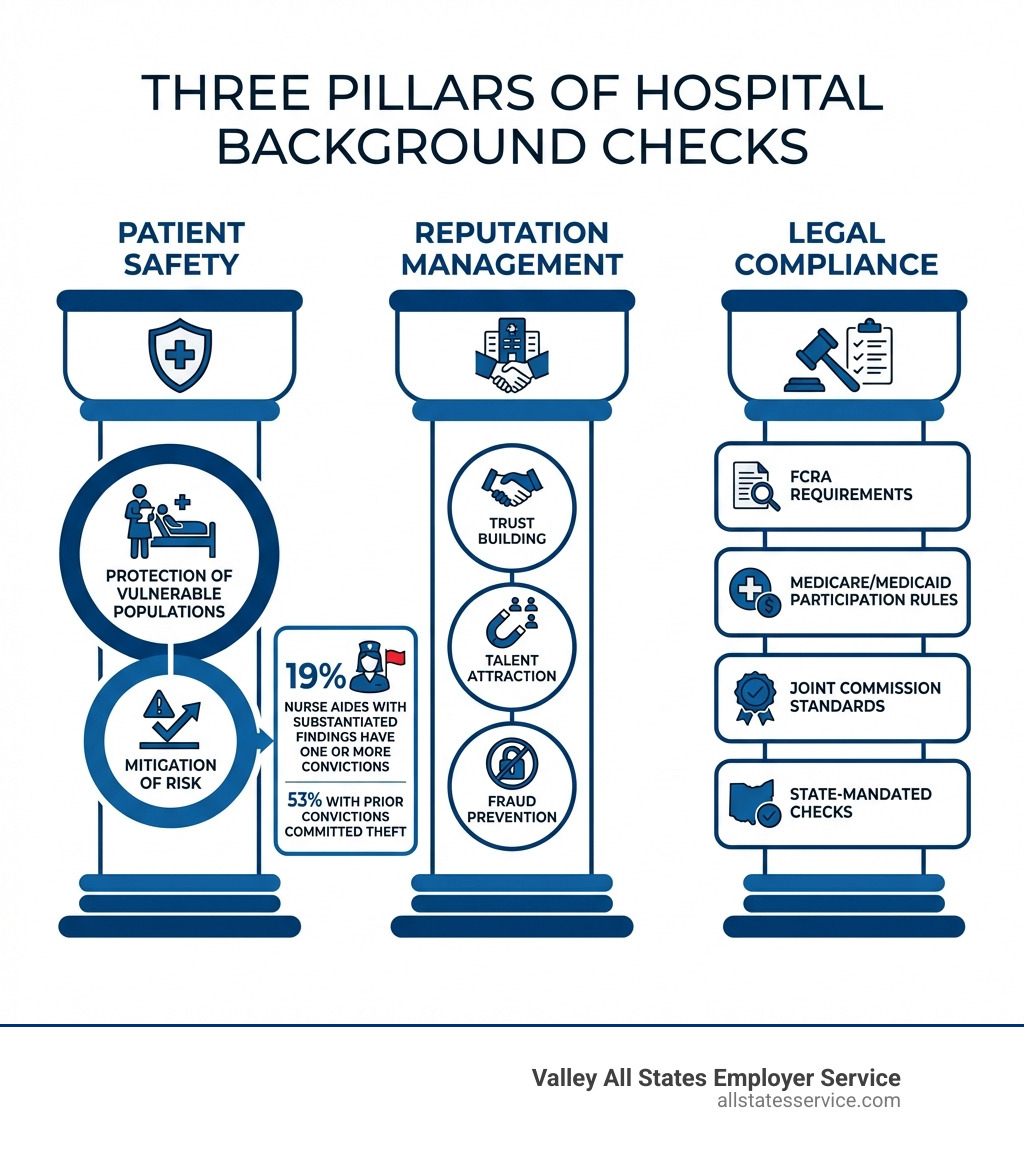
The data backs this up. Research shows that 19% of nurse’s aides with substantiated findings of employee theft, abuse, or neglect had one or more convictions on their records. Of those, 53% had committed theft offenses, and those with substantiated abuse or neglect were over three times likelier to have prior convictions for crimes against persons.
Add to that the reality that 10-12% of physicians working in the U.S. have a substance abuse disorder, and the picture becomes clear. Rigorous screening isn’t optional, it’s essential.
Hospital background checks go far beyond a simple criminal records search. They involve specialized healthcare sanctions databases, professional license verifications, and compliance with a complex web of regulations. This guide breaks down everything you need to know about hospital pre-employment background checks, from essential components to the regulatory landscape.
The Primary Purpose: Protecting Vulnerable Patients
At its core, every hospital pre employment background check is about patient safety. Healthcare professionals are entrusted with direct care, medications, and private health information. This immense responsibility means there is no room for error when hiring. A comprehensive background check identifies individuals who might pose a threat through a history of violence, theft, abuse, or professional misconduct.
Consider the stark reality revealed by studies: 19% of nurse’s aides with substantiated findings of employee theft, abuse, or neglect had one or more convictions on their records. A deeper dive showed that 53% of those nurse’s aides had prior convictions for theft offenses. Furthermore, those with substantiated abuse or neglect were a little more than three times likelier to have prior convictions for crimes against persons. These numbers underscore the direct link between past behavior and potential risks. You can explore the full study by the U.S. Department of Health and Human Services Office of the Inspector General (DHHS OIG) here: A study on nurse’s aides with prior convictions.
Beyond criminal history, substance abuse is another critical concern. A landmark study estimated that 10-12% of physicians working in the U.S. have a substance abuse disorder. This statistic highlights the importance of drug screening to ensure providers are fit to deliver care. Learn more about this issue: Data on physician substance abuse disorders.
Maintaining Your Hospital’s Reputation and Integrity
Beyond patient safety, a hospital’s reputation is its lifeline. Public trust is hard-earned and easily lost. News of a single negligent hire can spread rapidly, causing irreparable damage.
A strong, consistent hospital pre employment background check process signals to the community that your organization prioritizes safety and integrity. This commitment builds public confidence and helps attract top talent, as ethical professionals want to work for institutions with high standards.
Robust background checks are also essential for preventing internal theft and fraud. By identifying individuals with a history of financial crimes, you can reduce the risk of such incidents, protecting both your assets and your patients’ privacy.
What a Comprehensive Hospital Pre-Employment Background Check Includes
A standard background check won’t cut it for the healthcare industry. A comprehensive screening is a multi-layered investigation designed to verify a candidate’s history, credentials, and suitability for a role with patient access.

Essential Screening Components
A comprehensive hospital pre employment background check includes a suite of services custom to the healthcare sector’s unique demands. Here are the essential components:
- Criminal History Search: This foundational search scours national, state, and county databases for felony and misdemeanor convictions, focusing on offenses like abuse, neglect, or fraud that are critical in patient care roles.
- Identity Verification: This confirms a candidate is who they claim to be, typically through a Social Security Number (SSN) trace to verify identity, past addresses, and aliases. It’s a crucial first step against fraud.
- Employment Verification: We confirm a candidate’s previous employment history, including dates, job titles, and sometimes reasons for leaving, to validate their experience.
- Education Verification: Verifying academic degrees and certifications ensures that candidates possess the qualifications claimed on their application.
- Professional License Verification: For any licensed professional, verifying the active status, disciplinary actions, and validity of their license is non-negotiable. This protects against individuals practicing with expired or revoked credentials.
- Drug Screening: Given the access to controlled substances and the critical nature of patient care, pre-employment drug testing is a standard and often mandated component.
Specialized Healthcare Searches
Beyond the essentials, the healthcare industry demands specialized searches to address its unique regulatory landscape. These are crucial for any hospital pre employment background check:
- Healthcare Sanctions: This check looks for actions taken against professionals by licensing boards or government agencies for violations or fraud. It is critical to ensure a candidate has not been penalized for behavior that could jeopardize patient care. You can find more information on What are healthcare exclusions?
- OIG LEIE Search: The Office of Inspector General (OIG) maintains a List of Excluded Individuals and Entities (LEIE). People on this list are prohibited from participating in federal healthcare programs like Medicare. Hiring someone on the LEIE can lead to significant penalties.
- System for Award Management (SAM) Database: This federal database lists parties excluded from receiving federal contracts and assistance. It’s an important check for any organization receiving federal funds. Access the database here: System for Award Management (SAM) database.
- GSA List: Similar to SAM, the General Services Administration (GSA) lists parties debarred from doing business with the federal government.
- National Practitioner Data Bank (NPDB): For licensed practitioners, the NPDB contains reports of medical malpractice payments and adverse actions, helping hospitals identify practitioners with a history of misconduct.
- Sex Offender Registry Search: A national sex offender registry search is a standard and critical component to protect vulnerable patient populations. You can access the National Sex Offender Public Website here: National Sex Offender Public Website.
What is a Level 2 background check in healthcare?
In healthcare, a “Level 2 background check” typically refers to a comprehensive, often fingerprint-based criminal history check that is more rigorous than a standard name-based check.
One system associated with Level 2 checks is FACIS® (Fraud and Abuse Control Information System), which searches various sources for exclusions, sanctions, or disciplinary actions. FACIS® has different screening levels (1, 1M, 2, and 3), each searching a broader range of federal and state sources.
Fingerprint-based checks are a key feature of many Level 2 requirements, especially for roles with direct contact with vulnerable populations. These checks are submitted to state and federal agencies, like the FBI, for a more definitive criminal history search. For example, some states, like Maryland, have specific processes for these checks. You can find details on Maryland’s background check process.
Disqualifying offenses for Level 2 checks are broad and target crimes that make an individual unsuitable for healthcare. These can include aggravated assault, child abuse, kidnapping, and various forms of fraud or neglect. The specific list of disqualifying offenses varies by state and role, but the intent is always to protect patients.
Navigating the Complex Web of Regulations
Hospitals don’t operate in a vacuum. A web of federal, state, and accrediting body rules dictates who you can hire and how you must screen them. Navigating these laws is key to avoiding costly fines and legal trouble.

Federal and State Law Requirements
The regulatory landscape for a hospital pre employment background check is intricate, requiring attention to federal and state mandates.
At the federal level, the Fair Credit Reporting Act (FCRA) is paramount when using a third-party for background checks. The FCRA dictates how you must obtain consent, what can be reported, and how to handle adverse action if you don’t hire someone based on the report. Understanding these obligations is critical. You can learn more about Your rights under the FCRA.
Federal regulations also tie directly to funding. For instance, as a condition of participation in Medicare and Medicaid, hospices must conduct criminal background checks on all employees that have direct patient contact or access to patient records. This is outlined in federal regulations: Hospice employee background check regulations.
State-mandated checks also play a significant role. Many states have their own requirements for healthcare background checks, which may dictate the scope of criminal searches or the use of fingerprinting.
Finally, “Ban the Box” laws, which restrict when employers can ask about criminal history, are increasingly common. These laws add a layer of complexity, requiring careful timing of background checks to ensure compliance while still protecting patients.
The Role of Accrediting Bodies like The Joint Commission
Accrediting bodies like The Joint Commission also shape hospital pre employment background check practices. While The Joint Commission doesn’t issue a blanket mandate for all checks, its standards require organizations to comply with applicable laws and have clear internal policies.
Their stance is that staff, students, and volunteers working in the same capacity as staff must have criminal background checks when required by law, regulation, and the organization’s own policy. If a state law requires checks, The Joint Commission will survey for compliance.
In cases where state law is silent on criminal background checks, your organization can develop its own policy, and The Joint Commission will evaluate your compliance against that documented policy. Regardless, all criminal background checks must be documented. You can dig into The Joint Commission’s specific guidance here: The Joint Commission’s stance on criminal background checks.
How far back does a hospital pre-employment background check go?
How far back a hospital pre employment background check looks depends on the type of check, relevant laws, and the position’s salary.
Under the federal Fair Credit Reporting Act (FCRA), there are lookback period limitations. For most non-conviction information, like arrests not leading to conviction, the FCRA limits reporting to seven years. Bankruptcies can be reported for up to ten years.
However, a crucial exception exists: criminal convictions can often be reported indefinitely, depending on state laws. Additionally, the FCRA’s seven-year lookback limits may not apply if the role’s expected salary is $75,000 or higher, allowing for a more extensive review.
For healthcare-specific checks like sanctions and exclusions, lookback periods vary. Mandatory exclusions on the OIG list remain for five or ten years, and can even be permanent after multiple offenses.
State laws can also impose their own lookback periods, which may be more or less restrictive than federal guidelines. It’s essential to consult legal counsel to ensure your practices comply with all applicable regulations.
The Screening Process: Timelines and Disqualifiers
Once you’ve initiated a check, what happens next? Understanding the timeline, potential delays, and what might disqualify a candidate helps manage expectations for both HR teams and applicants.
How Long Do Healthcare Background Checks Take?
The time it takes to complete a hospital pre employment background check can range from hours to weeks, depending on the scope of the search and other external factors.
Automated systems have dramatically sped up the process, with data showing 90 percent of candidates complete screening within 4 hours. This efficiency is key to attracting top talent in a competitive market.
However, several factors can influence the turnaround time:
- Types of Searches: Comprehensive searches, like manual court record retrievals, naturally take longer.
- Court Delays: Local court closures, staff shortages, or backlogs can significantly delay criminal history checks.
- Candidate Responsiveness: The speed at which a candidate provides necessary information impacts the timeline.
- Third-Party Verifications: Delays can occur if previous employers or schools are slow to respond to verification requests.
Partnering with a specialized screening provider often leads to quicker results, as they have the technology to steer these complexities efficiently.
Common Disqualifiers in Healthcare Screening
A hospital pre employment background check identifies red flags that could compromise patient safety or organizational integrity. While specific disqualifiers vary by role and state, some common issues can make an applicant unsuitable for a healthcare role:
- Relevant Criminal Convictions: Felony or misdemeanor convictions related to fraud, abuse, neglect, theft, violence, or drug offenses are frequently disqualifying.
- Sanctions and Exclusions: Appearing on federal or state exclusion lists, such as the OIG List of Excluded Individuals/Entities, is a major disqualifier, as it makes their employment a compliance risk.
- Lying on an Application: Any significant misrepresentation concerning qualifications, employment history, or criminal background can lead to immediate disqualification.
- Failed Drug Test: A positive pre-employment drug screening for illegal substances is almost always a disqualifying factor.
- Professional License Issues: An inactive, suspended, or revoked professional license for a role that requires one is an obvious disqualifier.
- Do HIPAA Violations Appear on Checks? Minor HIPAA violations typically do not appear on a standard background check. However, if a violation results in disciplinary action, legal penalties, or is reported to law enforcement and the U.S. Department of Health and Human Services (HHS), it can show up. For example, a HIPAA violation that also violates the Social Security Act could lead to a criminal conviction that would appear on a check.
Building a Robust Hospital Background Check Policy
A clear, consistent, and compliant policy is your best defense. It ensures fairness, reduces liability, and streamlines your hiring process. Here’s what every hospital’s policy should include.
Key Elements of a Compliant Policy
Developing a comprehensive hospital pre employment background check policy is about creating a fair, consistent, and defensible hiring process. Here are the key elements every policy should include:
- Identify Positions Requiring Checks: Define which roles require checks based on job duties, patient access, access to sensitive data, and regulatory mandates.
- Define Search Types for Different Roles: Specify the types of checks (e.g., criminal history, OIG exclusion, license verification) that will be performed for each position.
- Outline Disclosure and Authorization Steps: Detail the process for informing applicants that a check will be conducted and obtaining their written consent, a critical FCRA requirement.
- Detail the Adverse Action Process: Lay out the steps for handling derogatory information, including providing a pre-adverse action notice, a copy of the report, and a summary of FCRA rights before a final decision.
- Include a Strong Drug Testing Policy: Outline your pre-employment and post-employment drug testing procedures, including substances screened for and consequences of a failed test.
- Plan for Ongoing Monitoring: A robust policy should include provisions for ongoing monitoring or periodic re-screening, especially for roles with direct patient contact.
Why Screening Doesn’t Stop at ‘You’re Hired’
The initial hospital pre employment background check is a snapshot in time. A person’s record can change after they are hired, which is why screening should be an ongoing process for continuous patient safety and compliance.
Ongoing monitoring ensures your workforce remains trustworthy and eligible. This can take several forms:
- Continuous Screening: Some systems offer continuous monitoring, alerting employers to new arrests or changes in license status in near real-time. The FBI’s Rap Back system, for instance, provides agencies with notifications of subsequent criminal activity. This allows for proactive intervention. Learn more about the Rap Back system: FBI’s Rap Back system for real-time updates.
- Annual Re-screening: Many healthcare organizations implement policies for annual or biennial re-screening, particularly for checks against exclusion lists (like the OIG LEIE) and professional license verification. The HHS Office of Inspector General (OIG) recommends checking the OIG Exclusion List periodically after hiring. Read their advisory bulletin here: HHS OIG recommendations for ongoing checks.
- Random Drug Testing: For certain positions, random drug testing programs can be implemented as part of a commitment to a drug-free workplace.
Implementing a policy for repeating background checks, even when not strictly mandated, is a best practice in healthcare. Ongoing vigilance is your best defense against potential risks, ensuring your employees continue to meet the high standards required for patient care.
Streamlining Your Hiring for a Safer Tomorrow
A compliant hospital pre employment background check is a complex but essential task. It requires understanding legal requirements, specialized databases, and a commitment to patient safety. A robust policy and an expert partner help protect your patients, reputation, and organization.
At Valley All States Employer Service, we understand the unique challenges healthcare organizations face in hiring. We provide outsourced E-Verify workforce eligibility verification for employers, operating in the employment compliance and HR services industry. Our unique selling point is expert, impartial, and efficient E-Verify processing, minimizing errors and administrative burden for clients.
We help organizations streamline their compliance needs, ensuring every hire meets the highest standards of eligibility and trustworthiness. Our team is well-versed in the specific federal and Maryland state requirements that impact your hiring decisions. By partnering with us, you gain access to efficient processes that allow you to focus on what matters most: providing exceptional patient care.
Ready to simplify your pre-employment screening process? Learn more about compliant background checks: Ready to simplify your pre-employment screening process? Learn more about compliant background checks.