
E Verify 1099 Contractors: Avoid 2025 Pitfalls
Why Understanding E-Verify for 1099 Contractors Matters
The topic of e verify 1099 contractors is a major point of confusion for U.S. employers. If you manage contractor relationships, here is what you need to know.
Quick Answer: Do You E-Verify 1099 Contractors?
- No – True 1099 independent contractors do not require Form I-9 or E-Verify.
- Yes – Only if they are employees misclassified as contractors.
- Exception – Subcontractor companies on federal contracts over $3,500 must verify their own employees.
The confusion is understandable. E-Verify is designed only for employees, and the system will block you from creating a case for a non-employee. However, federal contractors face unique rules that flow down to subcontractors, causing many HR managers to waste time or risk penalties.
The stakes are high. Mistakenly running E-Verify on contractors can lead to discrimination complaints. Failing to see when a “contractor” is an employee creates audit risks and back taxes. For federal contractors, missing FAR E-Verify clause requirements could cost you the contract.
This guide cuts through the complexity, explaining when E-Verify applies, how federal contracts change the rules, and what documentation you need for your 1099 workforce.
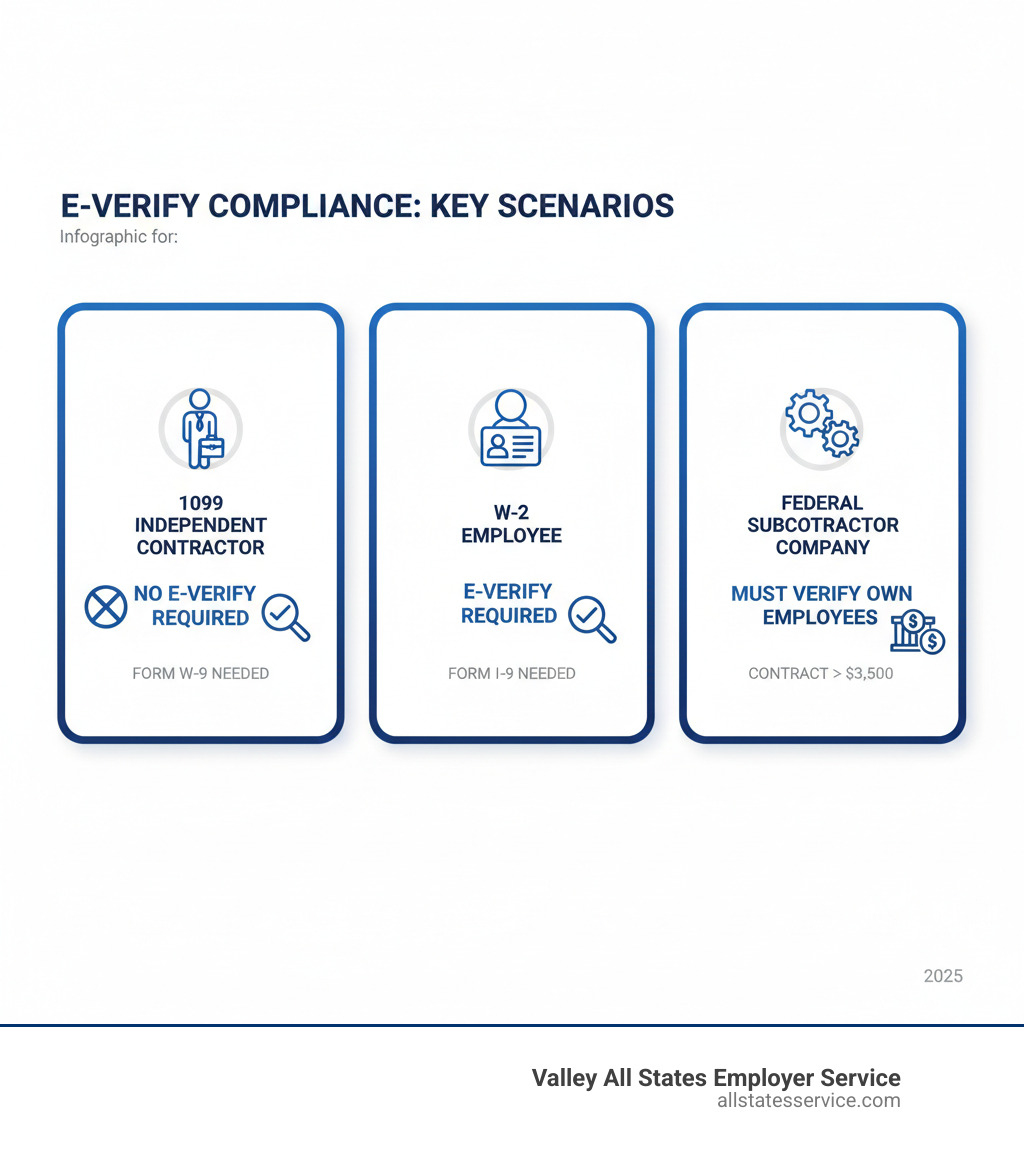
The Core Distinction: Employee (W-2) vs. Independent Contractor (1099)
Before making decisions about e verify 1099 contractors, you must answer a fundamental question: Is this person a contractor or an employee? Getting it wrong affects more than just E-Verify, potentially triggering audits, back taxes, and legal issues. The IRS uses “common law rules” to determine worker status, focusing on three areas.
Behavioral control: Who directs how the work is done? If you control when, where, and how the person works, they look like an employee. An independent contractor controls their own methods to deliver a result.
Financial control: Does the person have their own business? Contractors invest in their own equipment, cover expenses, and can realize a profit or loss. Employees receive a steady paycheck.
The relationship: Is there a contract defining an independent relationship? Does the worker receive employee benefits like health insurance or paid vacation? Is the work project-based with an end date, or ongoing?
Understanding this distinction is crucial because the E-Verify system is built for employees. Misclassification is a costly mistake. For more on employment verification, see our Form I-9 Overview and learn about E-Verify and I-9.
Why You Don’t E-Verify a True 1099 Contractor
To be clear: you do not run E-Verify on a true 1099 independent contractor. The system is built to verify the employment eligibility of employees and will block attempts to create a case for a non-employee.
E-Verify is a companion to Form I-9. You complete Form I-9 for employees, then use E-Verify. Since you do not complete a Form I-9 for a genuine independent contractor, there is no E-Verify step.
However, this doesn’t mean you can ignore work authorization. You cannot knowingly hire or contract with someone unauthorized to work in the U.S. While E-Verify isn’t the tool for contractors, basic due diligence is still required. Understanding your E-Verify I-9 Compliance obligations for employees helps clarify these separate requirements.
Required Documentation for Independent Contractors
While Form I-9 and E-Verify are not for contractors, other documentation is essential to protect your business from misclassification claims and ensure tax compliance.
Here’s what you need:
- A signed independent contractor agreement: This is your first line of defense. It should define the scope of work, payment terms, and explicitly state the worker is an independent contractor who controls their own methods.
- Form W-9: This is required from every contractor to get their Taxpayer Identification Number (TIN). You need it to issue a Form 1099-NEC for payments of $600 or more.
- Invoices for services: Contractors should bill you for their work. Invoices reinforce the business-to-business nature of the relationship.
- Proof of business insurance: Collecting proof of liability insurance is a smart move, as it further demonstrates the contractor is an independent business entity.
Keeping these documents organized is your best defense against worker classification questions from the IRS or Department of Labor. For more guidance, the Small Business Administration Hiring resources are helpful.
The Federal Contractor Exception: When E-Verify Rules Change
If your business works with the federal government, the rules get more nuanced. While you don’t E-Verify individual contractors, a federal contract can introduce an important exception. The E-Verify requirement can flow down to subcontractor companies, who must then verify their own employees.
The Federal Acquisition Regulation (FAR) requires federal contractors to use E-Verify for employees on covered contracts to ensure a legal workforce. If you hold a federal contract or are a subcontractor on one, understanding these rules is essential. Our team helps businesses steer this complexity every day. Learn more with our specialized support for E-Verify for Contractors.
Understanding the FAR E-Verify Clause Triggers
The FAR E-Verify clause (FAR 52.222-54) is not automatic. It’s triggered only when a contract meets specific criteria:
- The contract value exceeds $150,000.
- The performance period is 120 days or longer.
- The work is performed in the United States.
- The contract is not solely for commercially available off-the-shelf (COTS) items.
- The FAR E-Verify clause is explicitly included in the contract language.
If these conditions are met for a contract awarded after September 8, 2009, your business must enroll in E-Verify. For official text, review the Federal Acquisition Regulation (FAR) E-Verify clause (PDF). Understanding these triggers is key to navigating Federal E-Verify Rules.
How E-Verify “Flows Down” to Subcontractors (and 1099s)
The distinction between an individual contractor and a subcontractor company is critical here. If a prime federal contract contains the FAR E-Verify clause, the prime contractor must ensure its subcontractors also comply by including the clause in qualifying subcontracts.
A subcontract triggers the E-Verify requirement if it is for services or construction, has a value exceeding $3,500, and involves work in the U.S. The subcontractor company must then enroll in E-Verify and use it for its own employees assigned to the project.
This rule does not apply to self-employed individual contractors regarding e verify 1099 contractors. They are not required to use E-Verify on themselves. However, the prime contractor cannot knowingly contract with an individual who is unauthorized to work in the U.S.
An exemption exists for subcontractors who provide only supplies. The prime contractor’s role is to oversee compliance, often by requesting proof of E-Verify enrollment from subcontractor companies. For detailed guidance, consult the official information on Subcontractors, Independent Contractors, and Affiliates – E-Verify and our Federal E-Verify Program Complete Guide.
Best Practices and Pitfalls for E-Verify 1099 Contractors
Managing e verify 1099 contractors requires a compliance framework that protects your business. Let’s explore how to get it right and avoid costly mistakes.

Good contractor compliance starts with due diligence. Begin every relationship with a written agreement defining the scope of work and independent nature of the relationship. Also, collect a completed Form W-9 from each contractor for tax reporting.
Relationships evolve. A legitimate contractor engagement can drift into an employee-like arrangement. Reassess your contractor relationships annually to see if the level of control has changed, as this can alter their legal classification. Proactive documentation, including invoices and proof of insurance, is your best defense in an audit. For more guidance, explore our E-Verify Best Practices.
For federal contractors, you must include the FAR E-Verify clause in subcontracts that meet the flow-down criteria (services/construction over $3,500) and keep records of their E-Verify enrollment.
Common Mistakes and Their Consequences
The complexity of e verify 1099 contractors leads to common errors. The most frequent is attempting to run E-Verify on true independent contractors. The system is designed only for employees and will block this action. Trying to force it can raise red flags and lead to discrimination complaints from the Immigrant and Employee Rights Section (IER).
Another pitfall is assuming all workers on a federal contract need E-Verify. Legitimate independent contractors remain exempt. It is the subcontractor companies that must verify their own employees. Also, don’t assume any federal funding triggers E-Verify; the FAR clause must be in the contract. These mistakes can lead to fines, investigations, and audit risks.
The High Cost of Misclassifying Employees as 1099 Contractors
Worker misclassification is the most expensive mistake you can make. Classifying an employee as a contractor means avoiding payroll taxes, workers’ compensation, and benefits. If caught, the financial consequences are severe.
The IRS and state agencies will demand back taxes, interest, and substantial penalties. Misclassified workers can also file claims for unpaid overtime and denied benefits, which can lead to class-action lawsuits.
From an E-Verify perspective, misclassification means you failed to complete Form I-9 and, if applicable, run E-Verify. This compliance failure can jeopardize federal contracts and trigger audits from multiple agencies. Getting worker classification right from the start is fundamental to your business’s health. Understanding your E-Verify Employer Responsibilities is a key part of this.
How to Handle State vs. Federal Rules for E-Verify 1099 Contractors
A patchwork of state laws adds another layer of complexity. For example, Florida now mandates E-Verify for private employers with 25+ employees, while Illinois has added new notification requirements. Many other states have their own E-Verify rules for public or private employers.
Federal rules target federal contractors, while state rules can apply more broadly. Penalties also differ, from loss of federal contracts to state-level fines or loss of business licenses. For multi-state businesses, a one-size-fits-all approach is risky.
Expert guidance is invaluable here. Our E-Verify State Requirements Guide 2025 offers a comprehensive overview to help you steer these varying requirements.
Simplifying Your Compliance Strategy
The rules for e verify 1099 contractors, federal contracts, and state mandates are complex. For businesses with a mixed workforce or federal projects, a streamlined compliance strategy is essential.

You don’t have to tackle this alone. The first step is centralized management through a consistent system. This reduces errors and makes audits much smoother. Technology integration helps automate tasks and maintain digital records, but it can’t replace expert guidance for nuanced situations like contractor classification and FAR clause requirements.
The Role of E-Verify Employer Agents
An E-Verify Employer Agent is a valuable solution for busy employers. At Valley All States Employer Service, we act as your compliance partner. We handle the outsourcing of E-Verify processes with third-party expertise, ensuring accuracy and minimizing time-consuming tasks.
For federal contractors, we can manage compliance for your subcontractors’ employees, taking a significant burden off your shoulders. Partnering with us reduces your internal workload, freeing your HR team to focus on strategic initiatives. Our expert, impartial, and efficient E-Verify processing is designed to minimize errors and administrative headaches. Ready to simplify compliance? Explore our E-Verify Employer Agent Service.
Preparing for Audits and Maintaining Records
An audit doesn’t have to be a crisis. With proper preparation, it’s a routine event. Be aware of USCIS’s records disposal policy: E-Verify cases from before December 31, 2014, will be deleted on January 6, 2025. You must download historic reports now to preserve your proof of compliance.
Treat record retention as an ongoing priority. Retain E-Verify case results with their corresponding Forms I-9 for the legally required period. Consistent documentation, including contractor agreements and W-9s, makes demonstrating compliance straightforward. Regular internal reviews can catch issues before an auditor does. For comprehensive solutions, see our E-Verify Workforce Solutions.
Your Next Step in Mastering Contractor Compliance
The rules for e verify 1099 contractors are clear but nuanced. The foundation is distinguishing between true independent contractors and employees. Get that right, and you know when Form I-9 and E-Verify are required (for employees) and when they are not (for contractors).
For federal contractors, the key is understanding how the FAR E-Verify clause flows down to subcontractor companies, not individual contractors. Meticulous documentation, from contractor agreements to E-Verify records, is your best defense in an audit.
Managing this takes time and expertise. The administrative burden can be overwhelming, especially for businesses with a mixed workforce or federal contracts. That’s where we come in.
At Valley All States Employer Service, we specialize in expert, impartial, and efficient E-Verify processing. We minimize errors and reduce your administrative burden, giving you confidence that your compliance is handled by professionals. We understand the intricacies of federal rules and contractor relationships.
Ready to ensure your contractor relationships are fully compliant? Whether you’re a federal contractor navigating flow-down obligations or a business that wants to get E-Verify right, we can help. Explore our specialized E-Verify for Contractors services and simplify your path to confident compliance.