
Why E-Verify Employer Agent Services Are Essential for Modern Businesses
An e verify employer agent service is a specialized partner that takes the entire E-Verify burden off your team. You share Form I-9 data through a secure portal, and the agent completes the government checks, reports results, and keeps records audit-ready.
Key Benefits
- Cost-effective: fees from about $10 per verification plus a modest one-time setup
- Fast: most cases finished in under 24 hours
- Always compliant: 100 percent aligned with federal I-9 rules
- Unlimited expert help: real people guide you through questions or TNCs
- Fewer errors: smart systems and trained reviewers catch mistakes early
Who Finds These Services Invaluable?
- Federal contractors facing mandatory E-Verify clauses
- Employers in states with E-Verify laws on the books (17-plus and counting)
- HR teams that lack the time or staff for constant system training
- Any business looking to lower compliance risk without adding headcount
If your HR inbox already overflows with onboarding tasks, adding E-Verify training, tests, and updates can feel impossible. Although the federal system is technically free, the hidden price tag includes hours of tutorials, 31-question tests, and constant refreshers each time DHS updates its site. One compliance adviser summed it up well: the system is “free” only if your staff time is worth nothing.
Agents eliminate those hidden costs. They enroll your company, create every E-Verify case, handle follow-ups, and document everything. You stay focused on hiring great people while a pro steers the compliance maze.
Simple guides to common terms:
What Is E-Verify and How Does an Employer Agent Help?
E-Verify is an internet service run by the Department of Homeland Security (DHS) with help from the Social Security Administration (SSA). When you upload I-9 details, the system compares a new hire’s name, Social Security number, and birth date against federal databases to confirm work authorization.
A common misconception is that E-Verify replaces Form I-9. It does not. You still must complete an I-9 for every employee. E-Verify is simply an electronic double-check. For tips on smooth file keeping, find guidance in these E-Verify Best Practices.
What an E-Verify Employer Agent Does
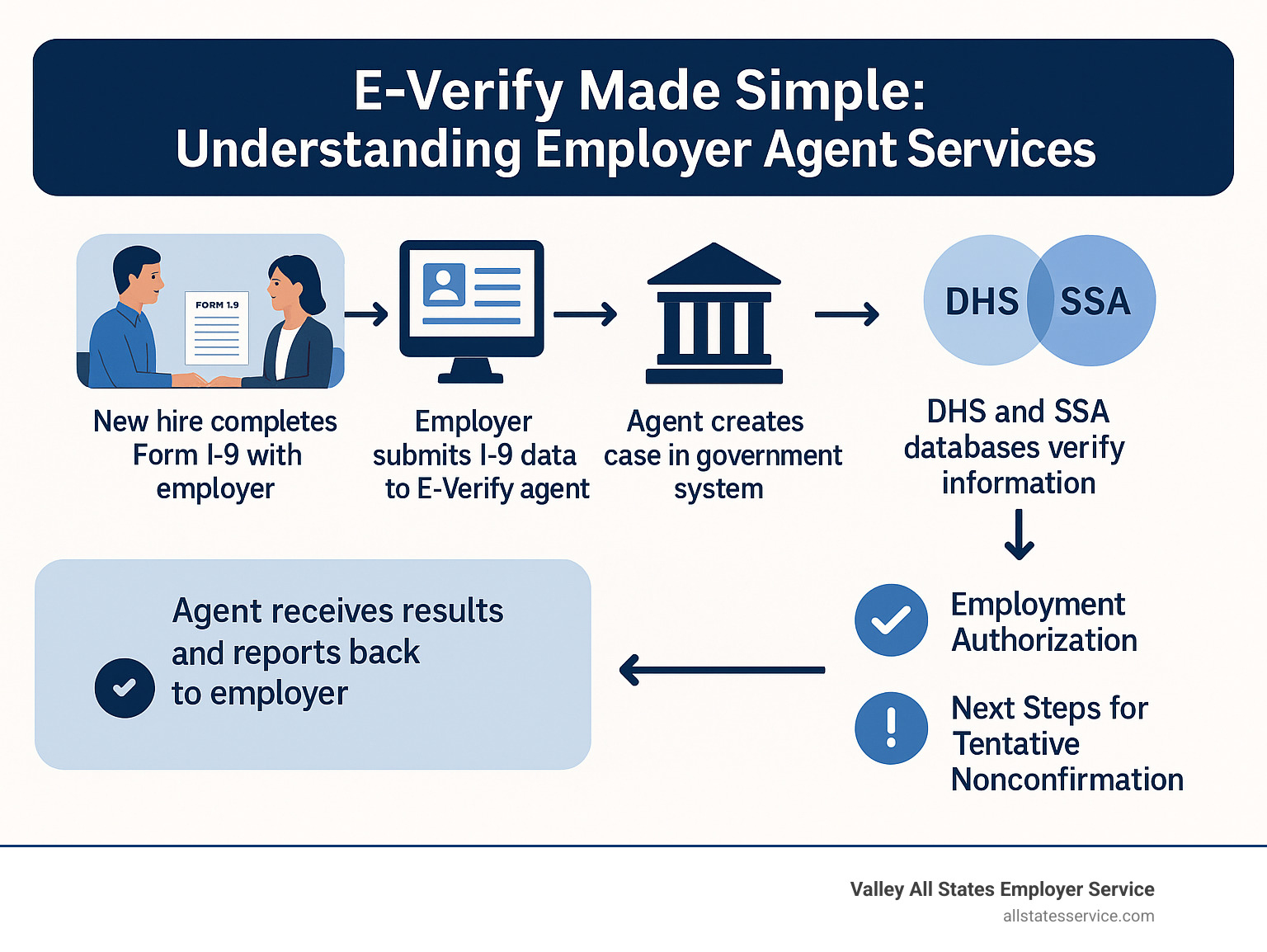
An e verify employer agent service plugs directly into that DHS system on your behalf. The agent:
- Signs the required Memorandum of Understanding (MOU) with you and DHS.
- Enrolls your company online.
- Creates E-Verify cases for each new hire.
- Monitors results and guides you through Tentative Nonconfirmations (TNCs).
- Closes each case and keeps digital records for audits.
Many agents also bundle electronic I-9s, background screening, or payroll to simplify your entire onboarding stack. Explore options for I-9 Verification Assistance.
Is E-Verify Really Free?
Using the government website costs $0, but DIY comes with hidden expenses:
- Staff must complete tutorials and pass a 31-question test, then retake training after every update.
- HR must track tight submission deadlines and store documents securely.
- Mistakes can lead to fines of $230–$2,292 per form.
Most agents charge about $10 per verification plus a one-time setup as low as $40, and no yearly fee. If an HR pro earning $25 an hour spends only two hours a month on E-Verify, that labor alone runs $600 a year—far more than outsourcing.
Why Outsource? The Case for an E-Verify Employer Agent Service
Your HR team already recruits, onboards, and manages benefits. Learning federal verification rules on top of that can push even seasoned pros past capacity. Regulations shift, deadlines are strict, and errors carry steep penalties.
An e verify employer agent service gives you a shortcut. The agent’s specialists work in E-Verify all day, so they finish cases faster, spot issues sooner, and keep your records airtight.
Top Reasons Clients Outsource
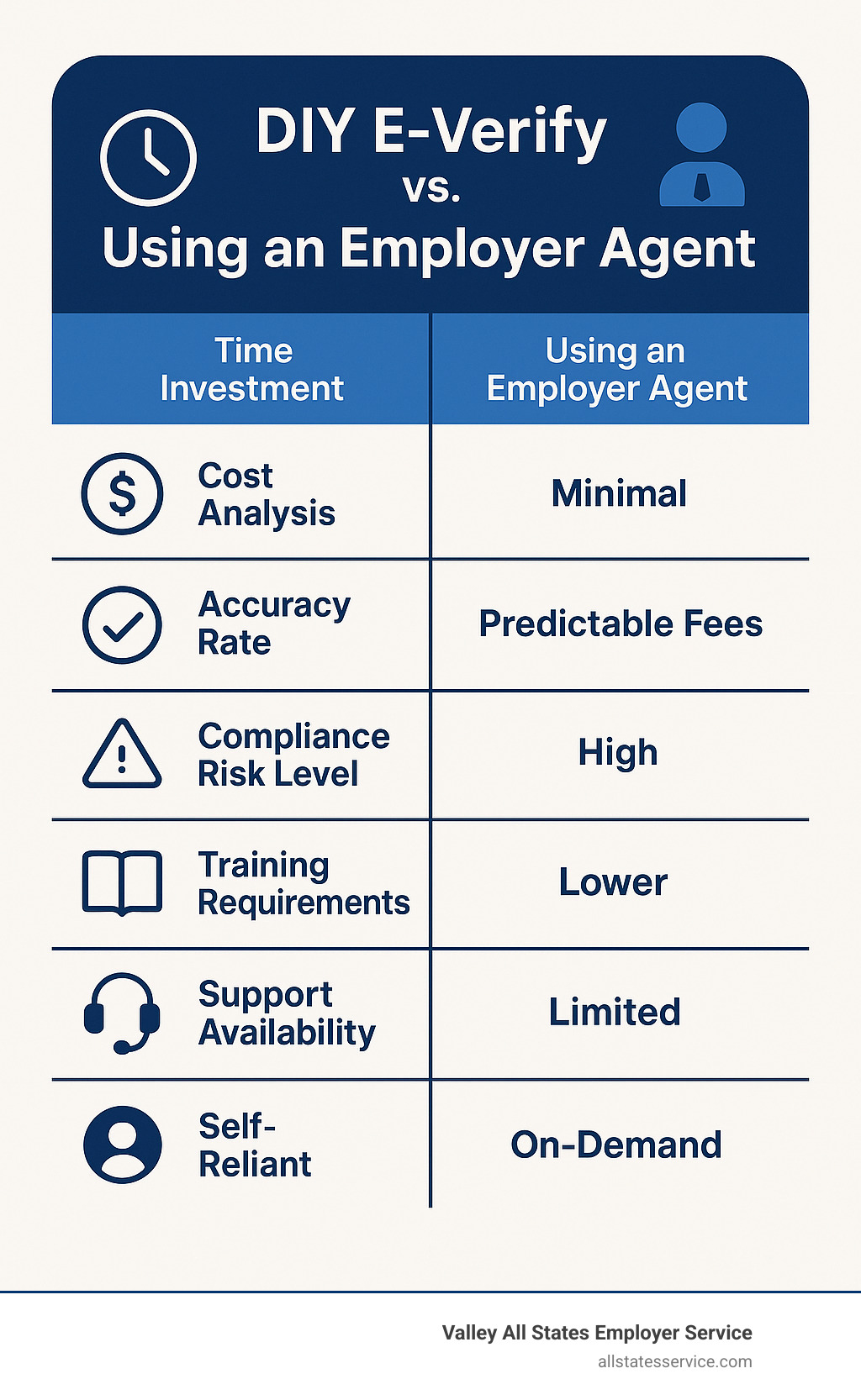
- Save hours: Agents return results in under 24 hours, often within the same business day.
- Lower cost: When you add staff time, training, and potential fines, the $10-per-case fee is usually the cheaper option.
- Better accuracy: Agents maintain 100 percent compliance with I-9 rules by using smart forms and double checks.
- Reduced risk: Professionals handle TNCs correctly, preventing discrimination claims.
- No training curve: Your staff skips tutorials and tests. The agent handles updates.
- On-call guidance: Unlimited support means you are never guessing.
Hidden Pitfalls Agents Help You Avoid
- Paperwork mistakes that trigger fines
- Missed 3-day deadlines for case creation
- Improper TNC handling that can look like discrimination
- Data security gaps around personal identifiers
- Surprise rule changes from DHS or state lawmakers
For a broader look at smooth onboarding, visit the Employee Onboarding Compliance page.
How the E-Verify Process Works with an Agent
Step 1: Onboarding
Your agent walks you through a quick setup, signs the MOU, and collects basic company data—EIN, addresses, NAICS code. Preferred communication methods (email, phone, portal) are set at this stage so updates never get missed.
Step 2: Submitting a New Hire
After the employee finishes Form I-9, you upload or email the information to the agent’s secure portal. Agents track the 3-business-day rule automatically and send reminders if a deadline creeps up.
Typical turnaround: less than 24 hours, sometimes only a few hours when records match on the first try.
Step 3: Results and Case Closure
- Employment Authorized: You are clear to keep the employee on payroll.
- Tentative Nonconfirmation (TNC): The agent provides scripted notices, tells you exactly what to give the employee, and monitors next steps.
- Case in Continuance: DHS or SSA needs more time. The agent checks status until closure.
Every outcome is documented on the I-9, and the agent stores digital records to keep you audit-ready.
Navigating E-Verify Compliance and Mandatory Rules
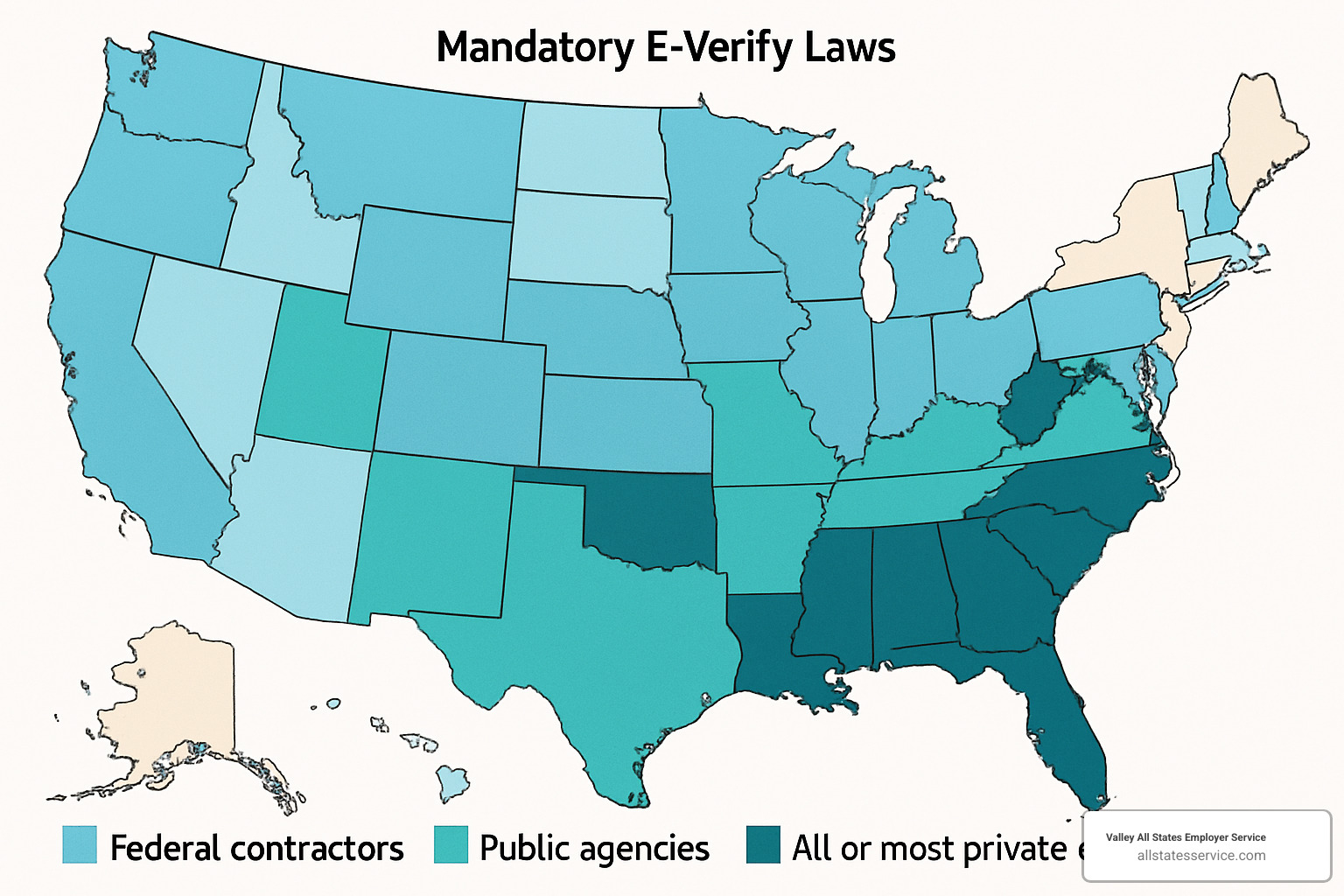
Federal contractors with the FAR E-Verify clause must verify all staff working on those contracts.
State laws vary widely. More than 17 states now require some employers to use E-Verify. Examples:
- Arizona, Mississippi: most private employers
- Georgia: 11 or more employees
- Alabama, South Carolina: 5 or more employees
- Utah, Colorado, Florida: public agencies and their contractors
Regulations change often, and new bills keep emerging at both state and federal levels. The Employer HR Compliance hub tracks those shifts.
How Agents Keep You Compliant
- Monitor new legislation in every state where you hire
- Provide required E-Verify Participation and Right to Work posters
- Maintain audit-ready digital files
- Guide proper TNC handling to protect employee rights
For DHS guidance straight from the source, see Employer Resources.
Choosing the Right E-Verify Employer Agent Service
Picking an agent is like picking a doctor—you want skill, trust, and quick answers, not just a low fee.
Key factors to consider
- Experience: look for multi-year track records in I-9 and E-Verify work.
- Security: ask about encryption, server locations, and staff background checks.
- Support: real experts on the phone during business hours, no chatbots.
- Integration options: payroll, background checks, or electronic I-9 forms in one portal.
What a Quality Agent Provides
- Unlimited questions answered at no extra cost
- 24/7 secure portal for uploads and status checks
- Turnaround in under 24 hours
- Automatic error checking on every I-9
- Compliance alerts any time DHS tweaks the rules
Learn more about these services by visiting E-Verify Customer Support.
Smart Questions to Ask Before You Sign
- What is the full fee schedule, including setup and per-case costs?
- How exactly do you handle TNCs?
- How do you protect personal data, end to end?
- What are your support hours and typical response times?
- How long have you been an authorized employer agent?
- Can you share client references or testimonials?
Frequently Asked Questions about E-Verify
Does using E-Verify replace the need for Form I-9?
This is one of the most common misconceptions about E-Verify. No, Form I-9 remains mandatory for every new hire, regardless of whether you use E-Verify. Think of it this way: Form I-9 is the foundation, and E-Verify is the electronic double-check that builds on that foundation.
Every employer must complete Form I-9 within three business days of an employee’s start date. This federal requirement documents an employee’s eligibility to work by examining acceptable identification documents. E-Verify then takes the information from your completed I-9 and cross-references it with government databases.
Even when working with an e verify employer agent service, you’ll still need to complete Form I-9 for each new hire. Your agent simply uses the information from those completed forms to create and process E-Verify cases. The two processes work together, they don’t replace each other.
Can I use E-Verify before an employee is hired?
No, you cannot create an E-Verify case before an employee has accepted your job offer and completed Section 1 of Form I-9. This timing restriction isn’t just a technicality, it’s designed to protect job applicants from discrimination based on their citizenship status or national origin.
Here’s the proper sequence: extend a job offer, wait for acceptance, have the employee complete Section 1 of Form I-9, then create the E-Verify case. You must complete this entire process no later than the third business day after the employee starts work for pay.
Professional agents understand these timing requirements inside and out. They’ll track deadlines automatically and ensure you meet federal requirements while avoiding premature verification that could lead to discrimination claims. It’s one less thing you need to worry about when you’re focused on getting new hires up to speed.
What happens if an employee receives a Tentative Nonconfirmation (TNC)?
Don’t panic if you encounter a TNC. A Tentative Nonconfirmation doesn’t mean your employee isn’t authorized to work. It simply means the information provided doesn’t initially match what’s in government records. This happens more often than you might think.
Common reasons for TNCs include name changes after marriage or divorce, data entry errors, outdated government records, or simple typos. The employee has the right to contest the TNC by visiting the appropriate government office (either Social Security Administration or Department of Homeland Security) to resolve the discrepancy.
Here’s what’s crucial: you cannot take any adverse action against the employee while they’re resolving the TNC. No firing, no suspending, no reducing hours. The employee is considered work-authorized until the TNC process is complete.
When you work with an e verify employer agent service, they’ll guide you through the entire TNC process. They know exactly how to communicate with the employee, what paperwork to provide, and how to protect both the employee’s rights and your company’s compliance. It’s like having a compliance expert on speed dial when you need them most.
Ready to Simplify Compliance?

With verification costs as low as $10 per employee and results usually back in a day, an e verify employer agent service frees your team from paperwork and lowers legal risk.
Valley All States Employer Service handles every step—enrollment, case creation, TNC guidance, and secure record storage—so you can focus on growing your business.
Ready to ditch the compliance headaches? Learn more about E-Verify services.