
States required to use e verify: 2025 Ultimate Guide
Why Understanding State E-Verify Laws is Critical for Your Business
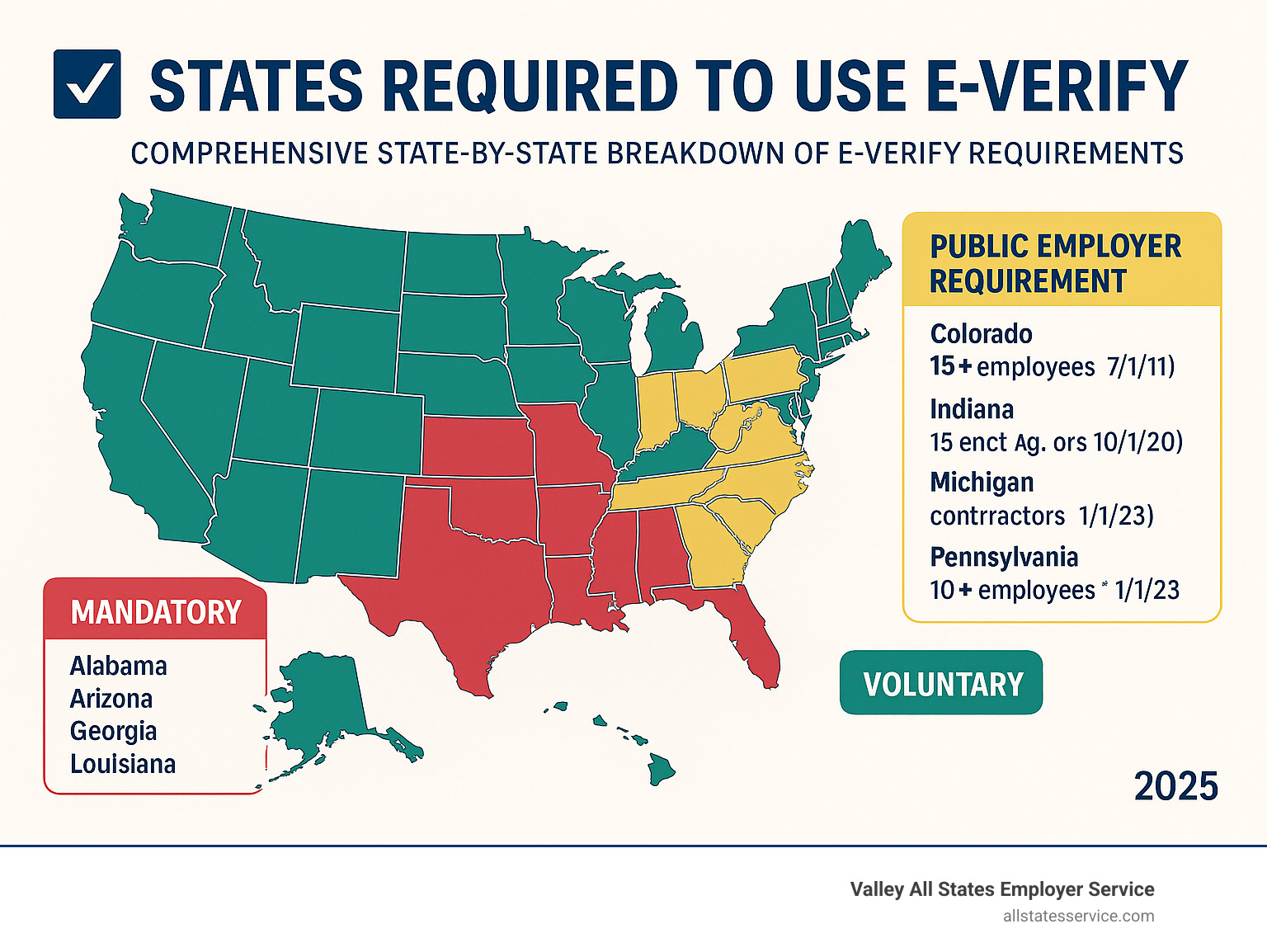
States required to use e verify create a complex patchwork of regulations that can catch even experienced HR managers off guard. While E-Verify started as a voluntary federal program, 22 states now mandate its use for at least some employers.
Here’s the quick breakdown you need:
States Requiring E-Verify for ALL Employers:
- Alabama, Arizona, Georgia, Louisiana, Mississippi, North Carolina, South Carolina, Tennessee, Utah
States Requiring E-Verify for Public Employers/Contractors:
- Colorado, Florida, Idaho, Indiana, Michigan, Missouri, Nebraska, Oklahoma, Pennsylvania, Texas, Virginia, West Virginia
States with Special Rules:
- Minnesota and Pennsylvania (public contractors only)
- California (prohibits mandatory E-Verify)
The stakes are real. Penalties range from fines to business license suspension, and ignorance isn’t a defense. As one compliance expert noted in recent research, “E-Verify requirements can change frequently due to legislative or executive actions,” making it essential to stay current.
What makes this especially tricky? Each state has different rules about who must comply, when to comply, and what happens if you don’t. Some states exempt small businesses. Others have employee number thresholds. A few cities and counties add their own requirements on top of state laws.
First, What is E-Verify and How Does It Work?

Think of E-Verify as your digital detective for employment eligibility. This internet-based system helps you confirm that your new hires are legally authorized to work in the United States. It’s a federal program run through a partnership between the Department of Homeland Security (DHS) and the Social Security Administration (SSA).
The best part? It’s completely free to use and designed to protect jobs for authorized workers while helping you maintain a legal workforce.
Here’s how the process actually works in your day-to-day hiring. When you bring on a new employee, they first complete their Form I-9 for employment eligibility verification. This is the standard form where they provide information about their identity and work authorization status.
Once that I-9 is complete, you’ll enter specific details from the form into the E-Verify system. You’ll input information like the employee’s name, date of birth, Social Security Number, and immigration status if applicable. The system takes this data and cross-references it against government databases from both DHS and SSA.
Within seconds, you’ll get an initial result. Most of the time, you’ll see “Employment Authorized,” which means your new hire is cleared to work. Occasionally, you might receive a “Tentative Nonconfirmation” (TNC). Don’t panic if this happens. It simply means there’s a data mismatch somewhere in the records.
When a TNC occurs, your employee gets the opportunity to resolve the discrepancy directly with the relevant government agency. You can’t make this determination yourself, and you can’t terminate the employee based solely on receiving a TNC.
Understanding how E-Verify works becomes especially important when you’re operating in states required to use e verify. The process remains the same whether you’re using it voluntarily or because your state mandates it, but the compliance stakes are much higher when it’s legally required.
The key to success with E-Verify lies in following each step correctly and in the proper sequence. Rushing through the process or skipping steps can lead to compliance issues that nobody wants to deal with.
E-Verify vs. Form I-9: Understanding the Critical Difference
Here’s where things get confusing for many employers: E-Verify and Form I-9 are completely different requirements. They work together, but one doesn’t replace the other. Think of them as dance partners, not competitors.
Form I-9 is the foundation that every single U.S. employer must use, whether you’re in states required to use e verify or not. This federal form serves one clear purpose: verify that your new employee can legally work in the United States. Both you and your employee fill out specific sections, and you examine their original documents to confirm their identity and work authorization.
The clock starts ticking fast here. You have just three business days from your employee’s first day to complete Form I-9. No exceptions, no extensions.
E-Verify is the electronic confirmation step that comes after Form I-9 is complete. It takes the information from that completed I-9 form and runs it through government databases from DHS and SSA. Within seconds, you get a digital thumbs up or a request for more information.
Here’s the key point many employers miss: E-Verify cannot work without Form I-9. You literally cannot start an E-Verify case until you have a properly completed I-9 in hand. E-Verify doesn’t replace document examination, it improves it with electronic verification.
Picture it this way: Form I-9 is like checking someone’s driver’s license at the door. E-Verify is like calling the DMV to confirm that license is actually valid. Both steps matter, and you need both to stay compliant in mandatory states.
For employers navigating these dual requirements, understanding how they complement each other is crucial. Our comprehensive guide on E-Verify Compliance and I-9 breaks down exactly how to manage both processes smoothly.
| Feature | Form I-9 | E-Verify |
|---|---|---|
| Purpose | Verify identity and work authorization | Electronically confirm work eligibility |
| Timing | Within 3 business days of hire | Within 3 business days of hire (after I-9) |
| Format | Paper or electronic form | Internet-based system |
| Requirement | Mandatory for all U.S. employers | Federally voluntary, but state-mandated for some |
The bottom line? Both processes are essential in states with E-Verify mandates. Master one without the other, and you’re still not compliant.
Which States Required to Use E-Verify? A State-by-State Guide
Navigating states required to use e verify feels a bit like trying to solve a jigsaw puzzle where every piece has different rules. What started as a voluntary federal program has evolved into a complex web of state mandates that can leave even seasoned HR professionals scratching their heads.
The legal foundation for this patchwork was laid by the U.S. Supreme Court on May 26, 2011. In a landmark decision, the Court upheld Arizona’s 2007 law requiring employers to use E-Verify. The ruling clarified that while federal law prevents states from imposing civil or criminal penalties for hiring unauthorized workers, states can absolutely mandate E-Verify through their licensing powers. This opened the floodgates for other states to follow suit.
Today, understanding your state’s specific requirements isn’t just good practice, it’s essential for avoiding serious penalties and keeping your business compliant. Let’s break down how these requirements actually work across the country.
States Mandating E-Verify for All (or Most) Private Employers
These are the states where E-Verify isn’t optional for most businesses. If you’re operating in one of these jurisdictions, you’ll need to make E-Verify part of your standard hiring process.
Alabama takes a straightforward approach, requiring E-Verify for all employers, both public and private. No exceptions, no employee thresholds to worry about.
Arizona holds the distinction of being the trailblazer here. Their law, upheld by the Supreme Court, requires E-Verify for all employers. This state essentially wrote the playbook that others have followed.
Florida recently updated their approach. As of July 1, 2024, employers with 25 or more employees must use E-Verify. Before this change, the requirement mainly applied to public contracts and certain incentive programs.
Georgia requires private employers to use E-Verify once they hit more than 10 employees. It’s one of the lower thresholds among states with employee-number requirements.
Louisiana joins the group of states required to use e verify for all employers, with no size exemptions for private businesses.
Mississippi keeps it simple with mandatory E-Verify for all employers, regardless of size or sector.
North Carolina sets their threshold at 25 employees. Once you cross that line, E-Verify becomes mandatory for your private business.
South Carolina requires E-Verify across the board for all employers, making compliance universal throughout the state.
Tennessee requires E-Verify for employers with six or more employees, though they do allow alternative identification methods in some cases.
Utah takes a comprehensive approach, mandating E-Verify for all public employers and contractors, while private employers with more than 15 employees must also comply (with some exceptions for H-2A and H-2B visa holders).
Notice how many of these states include employee thresholds? These details matter enormously for small businesses trying to understand when compliance kicks in. If you’re running a smaller operation, our guide on E-Verify for Small Businesses can help you steer these nuances.
A closer look at the states required to use E-Verify for Public Employers and Government Contractors
A significant number of states required to use e verify focus their mandates on the public sector and businesses that contract with government entities. If your company does any work with state or local governments, these requirements likely apply to you.
Colorado keeps E-Verify mandatory only for government contractors, leaving private employers free to use the system voluntarily.
Florida extends beyond their private employer requirements to mandate E-Verify for all public employers, contractors, and subcontractors working with the state.
Idaho focuses their requirement on public employers, while leaving the private sector to decide for themselves.
Indiana requires both state and local government agencies to use E-Verify, along with any contractors working with these entities.
Michigan takes a targeted approach, requiring E-Verify primarily for transportation department contractors. Interestingly, some counties like Ingham, Macomb, and Oakland have chosen to extend these requirements to their own contracts.
Missouri ties E-Verify to contract value, requiring it for state contracts exceeding $5,000.
Nebraska and Oklahoma both mandate E-Verify for their public employers while leaving private businesses to choose.
Pennsylvania requires E-Verify for all state and local government contractors, with particular emphasis on public works projects over $25,000.
Texas applies E-Verify requirements broadly across all state employers and contractors.
Virginia combines both approaches, requiring E-Verify for state agencies and also for businesses entering contracts over $50,000 (if they average 50 employees over the previous 12 months).
West Virginia rounds out this group with E-Verify requirements for public employers.
The contract world has its own complexities and compliance requirements. Our specialized guide on E-Verify for Contractors dives deeper into these specific obligations.
States with Unique Rules or Restrictions on E-Verify
Not every state accepts E-Verify mandates. Some have taken notably different approaches, creating their own unique compliance landscapes.
California stands out by actively prohibiting state agencies and local governments from requiring private businesses to use E-Verify as a condition for contracts or licenses. This restriction stems from concerns about potential system misuse and reflects the state’s different approach to employment verification.
Illinois previously prohibited E-Verify use for checking current employees’ status, though this has changed. Now, employers who choose to use E-Verify must follow strict procedures, including completing specific training and posting required notices.
Many states across the country maintain voluntary E-Verify policies, including Alaska, Arkansas, Connecticut, Delaware, Hawaii, Iowa, Kansas, Kentucky, Maine, Maryland, Massachusetts, Montana, Nevada, New Hampshire, New Jersey, New Mexico, New York, North Dakota, Ohio, Oregon, Rhode Island, South Dakota, Vermont, Wisconsin, and Wyoming. Even without mandates, employers in these states often choose E-Verify as a best practice.
Here’s where things get even more interesting: local ordinances can create requirements even where states haven’t acted. In Washington state, counties like Whatcom, Pierce, and Lewis (except Centralia) have their own E-Verify requirements despite no statewide mandate. Oregon’s Columbia County requires all county employers to use the program.
This local variation means you can’t just check state laws and call it done. You need to research city and county regulations wherever you operate. The compliance landscape truly varies from one jurisdiction to the next, making thorough research essential for every business location.
The Stakes are High: Penalties, Benefits, and Common Challenges
Understanding the consequences of E-Verify compliance isn’t just about following the law. It’s about protecting your business from penalties that can literally shut you down, while also recognizing the genuine benefits that come with getting it right.

When Compliance Goes Wrong: Real Penalties That Hurt
For businesses operating in states required to use e verify, the penalties for non-compliance aren’t just theoretical. They’re designed to have real teeth.
Fines are often the first consequence you’ll face. These monetary penalties typically start modest but escalate quickly with repeat offenses. What starts as a manageable fine can snowball into a significant financial burden that impacts your bottom line.
Business license suspension or revocation represents the nuclear option, and yes, states actually use it. Arizona’s law, which was upheld by the Supreme Court ruling on Arizona’s law, specifically allows for business license suspension for repeat E-Verify violations. Imagine having to explain to employees, customers, and vendors that your business can no longer legally operate because of a compliance failure.
Debarment from government contracts can be equally devastating if your business relies on public sector work. Once you’re debarred, you’re essentially blacklisted from bidding on future contracts, cutting off what might be a significant revenue stream.
These aren’t scare tactics. They’re real consequences that have affected real businesses. The Supreme Court’s decision made it clear that states have the authority to enforce these penalties through their licensing powers.
The Upside: Why E-Verify Benefits Go Beyond Compliance
Even if your state doesn’t mandate E-Verify, there are compelling reasons to consider using it voluntarily. Think of it as an investment in your business’s long-term stability.
Maintaining a legal workforce is the most obvious benefit, but it’s worth emphasizing. E-Verify gives you the strongest available confirmation that your employees are authorized to work in the United States. This electronic verification goes beyond what document examination alone can provide.
Remote I-9 options have become increasingly valuable in our flexible work environment. Employers in good standing with E-Verify can often complete Section 2 of Form I-9 virtually, offering flexibility that non-participating employers don’t have.
Peace of mind might sound intangible, but ask any HR manager who’s dealt with an immigration audit. Knowing you’ve taken every reasonable step to verify work eligibility can make the difference between a routine review and a major compliance headache.
Navigating the Challenge Zone
Let’s be honest about the challenges because pretending E-Verify is always smooth sailing won’t help anyone.
Tentative Non-Confirmations (TNCs) are probably the biggest headache you’ll encounter. When the system can’t immediately confirm an employee’s work eligibility, you enter a careful dance of following exact procedures while avoiding discrimination. You must give the employee time to resolve the issue with the appropriate government agency, and you cannot take any adverse action until the process is complete.
Data entry errors cause more problems than you might expect. A simple typo in a Social Security number or a transposed digit in a date of birth can trigger a TNC. The system is only as accurate as the information you put into it.
Keeping up with changing laws requires ongoing attention. E-Verify requirements shift as legislatures meet and regulations evolve. What was compliant last year might not be sufficient today.
The good news? These challenges are manageable with the right approach and proper training. Our E-Verify Best Practices guide can help you avoid the most common pitfalls and establish procedures that work.
The bottom line is straightforward: E-Verify compliance in states required to use e verify isn’t optional, and the penalties for getting it wrong are serious. But with proper understanding and execution, it becomes a manageable part of your hiring process that actually strengthens your business.
Staying Current and Simplifying Your Compliance Journey
Let’s be honest: keeping up with E-Verify laws feels like trying to hit a moving target while blindfolded. Just when you think you’ve got your compliance down pat, a new legislative session rolls around and suddenly the rules have shifted again.
E-Verify laws change constantly. Our research confirms what many employers already suspect: “E-Verify requirements can change frequently due to legislative or executive actions.” New legislation pops up seemingly overnight. Executive orders reshape the landscape. Court rulings can flip everything upside down, sometimes with little warning.
If you’re operating in multiple states required to use e verify, this challenge multiplies exponentially. What works in Alabama might not fly in Arizona. Virginia’s contractor requirements look nothing like Utah’s private employer mandates. It’s enough to make even seasoned HR professionals lose sleep.
Official Resources and Continuous Monitoring
The good news? You don’t have to steer this maze blindfolded. The E-Verify system itself is your primary federal resource, maintained by USCIS with the most up-to-date information and guidance. Think of it as your North Star in the compliance universe.
For state-level changes, the National Conference of State Legislatures tracks State E-Verify Action across all 50 states. Their summaries can be lifesavers when you’re trying to understand what’s happening in each jurisdiction.
But here’s the reality check: dedicating the time and resources to continuously monitor these changes while running your actual business? That’s a full-time job in itself. Most business owners didn’t sign up to become compliance experts. They signed up to grow their companies, serve their customers, and build something meaningful.
The Role of an E-Verify Employer Agent
This is exactly why smart employers turn to an E-Verify Employer Agent. Think of us as your compliance safety net, the team that stays up all night reading regulatory updates so you don’t have to.
At Valley All States Employer Service, we’ve built our entire business around one simple promise: making E-Verify processing so smooth and accurate that you’ll forget it was ever a headache. Our expert, impartial, and efficient E-Verify processing means you get to focus on what you do best while we handle the verification maze.
What does this actually mean for your day-to-day operations? Reduced administrative burden tops the list. Instead of training your HR team on the latest TNC procedures or worrying about data entry mistakes, you hand it off to people who eat, sleep, and breathe employment eligibility verification.
Ensuring accuracy is where we really shine. Those frustrating Tentative Non-Confirmations that pop up from simple typos or formatting errors? We’ve seen them all, and we know how to avoid them. Our experts review every case with the kind of attention to detail that comes from processing thousands of verifications.
The importance of staying updated can’t be overstated, and it’s built into everything we do. While you’re running your business, we’re monitoring federal changes, tracking state legislative sessions, and updating our procedures to match the latest requirements. When Florida changed its rules in 2024 or when new contractor thresholds get announced, we’re already three steps ahead.
Most importantly, you get peace of mind. No more wondering if you missed a deadline, entered data incorrectly, or misunderstood a state requirement. No more losing sleep over compliance audits or potential penalties.
Whether you’re in one of the states required to use e verify for all employers, or you’re a government contractor dealing with complex multi-state requirements, our services are designed to simplify what doesn’t need to be complicated.
Ready to master your E-Verify employer requirements? Let’s talk about how Valley All States Employer Service can turn your compliance headaches into a streamlined, worry-free process. Because you’ve got better things to do than become an E-Verify expert.