
Why Employment Verification Department of Homeland Security Matters for Your Hiring Process
Employment verification department of homeland security is the system that ensures every person hired in the United States is legally authorized to work. If you’re an employer, understanding this process isn’t optional. It’s the law.
Here’s what you need to know right now:
Quick Overview: DHS Employment Verification Process
| Component | What It Means for You |
|---|---|
| Form I-9 | Required for every new hire. Must be completed within 3 days of employment start. |
| E-Verify | Optional electronic system (mandatory for federal contractors and some states) that checks Form I-9 data against DHS and Social Security records. |
| DHS Role | Administers E-Verify and sets all employment verification rules through U.S. Citizenship and Immigration Services (USCIS). |
| Penalties | Non-compliance can result in fines ranging from hundreds to thousands of dollars per violation. |
The Department of Homeland Security (DHS) doesn’t just handle border security. Through its U.S. Citizenship and Immigration Services (USCIS) division, DHS oversees the entire employment verification system in America. This includes managing Form I-9 requirements and running E-Verify, the web-based system that electronically confirms work eligibility.
Every employer in the United States must complete a Form I-9 for each person they hire. This has been true since the Immigration Reform and Control Act (IRCA) passed in 1986. But the process has evolved significantly since then, especially with the introduction of E-Verify in 1997.
Today, E-Verify is available in all 50 states, the District of Columbia, Puerto Rico, Guam, the U.S. Virgin Islands, and the Commonwealth of Northern Mariana Islands. While it remains voluntary for most employers, federal contractors with specific contract clauses and employers in certain states must participate. And even when it’s voluntary, many employers choose E-Verify because it’s currently the best electronic method to confirm employment eligibility.
The stakes are high. Companies face serious legal and financial consequences for hiring unauthorized workers, even unknowingly. ICE audits are on the rise. One small error on a Form I-9 can result in significant penalties.
But here’s the good news: with the right knowledge and systems in place, compliance doesn’t have to be overwhelming. This guide will walk you through everything you need to know about how DHS manages employment verification, what your responsibilities are as an employer, and how to stay compliant without adding unnecessary burden to your hiring team.
The Foundation of Compliance: Mastering Form I-9
The Form I-9, Employment Eligibility Verification, is the cornerstone of employment verification in the United States. It’s a mandatory document that all employers must complete for every individual they hire. This form serves to verify both the identity and the employment authorization of your new employees.
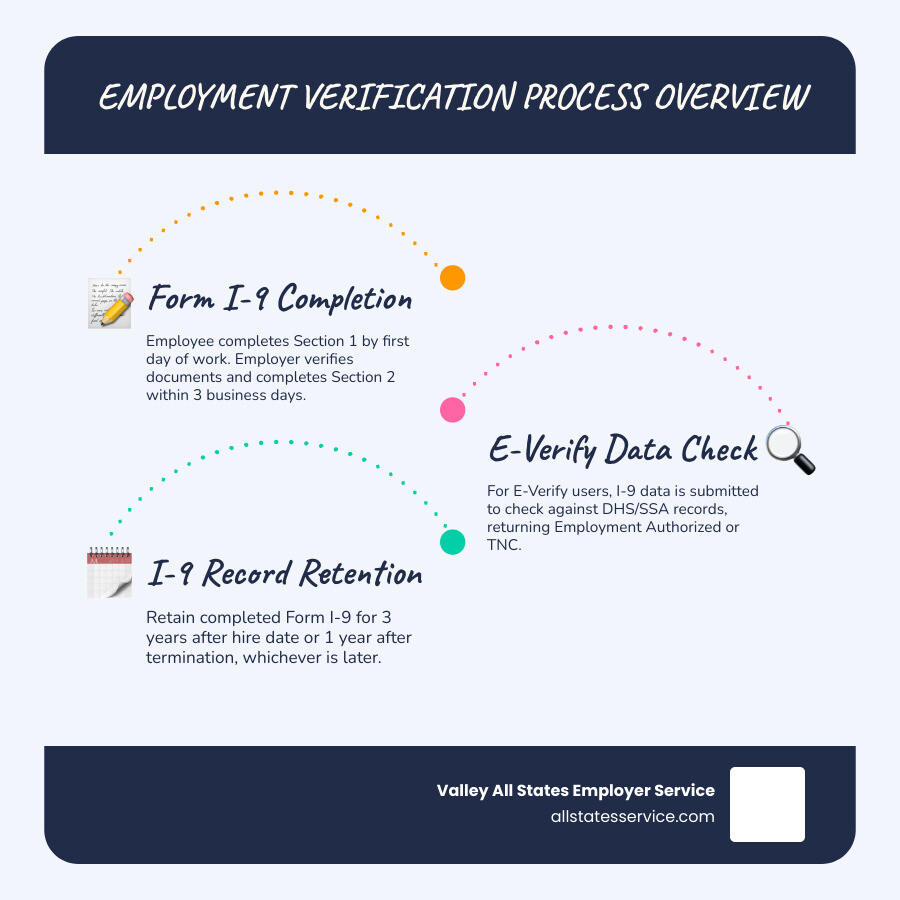
The process begins with the employee, who must complete Section 1 of the Form I-9 no later than their first day of employment. This section requires them to attest to their citizenship or immigration status. Once the employee has completed their part, it’s our turn as employers. We must complete Section 2 within three business days after the employee’s first day of employment. This involves examining the physical documents presented by the employee to establish their identity and eligibility to work.
We are liable for failing to comply with these requirements. For our clients in Maryland, just like those across the U.S., proper Form I-9 completion is non-negotiable. For a deeper dive into the intricacies of this form, we encourage you to visit our comprehensive I-9 Form Verification Guide.
In today’s evolving work environment, remote hiring has become common. The Department of Homeland Security (DHS) has authorized alternative procedures for remote examination of documents, offering flexibility while maintaining compliance. This is a significant development for many businesses, and we’ve covered it extensively in our guide on USCIS I-9 Remote Verification.
Understanding Acceptable Documents
Choosing the right documents for Form I-9 can sometimes feel like navigating a maze. The USCIS provides specific lists of acceptable documents: List A, List B, and List C.
- List A documents establish both identity and employment authorization (e.g., a U.S. passport or a Permanent Resident Card).
- List B documents establish identity only (e.g., a driver’s license).
- List C documents establish employment authorization only (e.g., a Social Security card or an Employment Authorization Document).
Employees have the right to choose which documents they present from these lists. We, as employers, must not ask for specific documents or treat employees differently based on their citizenship, immigration status, or national origin. This is a critical anti-discrimination principle. We must physically examine the original documents (or use authorized alternative procedures for remote hires) to ensure they appear genuine and relate to the employee. Receipts for replacement documents can be acceptable for a temporary period under specific conditions. To make sure you’re always on the right track, check out our I-9 Acceptable Documents Ultimate Guide.
Form I-9 Editions, Retention, and Audits
Keeping up with Form I-9 editions is essential. The current edition date for Form I-9 is 01/20/25, and it’s valid until 05/31/2027. Employers can sometimes use previous editions for a limited time after a new one is released, but it’s always best practice to use the most current form. If you’re using an electronic Form I-9 system, ensure it’s updated to reflect the latest version to remain compliant.
Beyond completion, proper retention is key. We must retain each completed Form I-9 for three years after the date of hire, or for one year after employment is terminated, whichever is later. These forms are not filed with USCIS or ICE; they are kept by the employer and must be made available for inspection upon request by authorized government officials from the Department of Homeland Security, Department of Labor, or Department of Justice.
Non-compliance can lead to significant penalties, especially with ICE audits on the rise. Errors can range from minor technical violations to substantive failures, each carrying its own set of fines. Understanding these risks and implementing robust record-keeping practices is vital. Our ICE I-9 Audit guide offers valuable insights, and you can learn more about best practices for storing these important documents in our I-9 Record Keeping resource.
The Role of the Department of Homeland Security in Employment Verification
The Department of Homeland Security (DHS) plays a central role in the entire framework of employment verification department of homeland security. Through its U.S. Citizenship and Immigration Services (USCIS) division, DHS operates E-Verify, a web-based system that has become an indispensable tool for many employers. E-Verify works in partnership with the Social Security Administration (SSA) to confirm employment eligibility.
E-Verify is available nationwide, covering all 50 states, the District of Columbia, Puerto Rico, Guam, the U.S. Virgin Islands, and the Commonwealth of Northern Mariana Islands. It is widely considered the best electronic means available to confirm employment eligibility, leveraging federal databases for quick and accurate results. For a comprehensive overview, the official E-Verify website is an excellent resource. We also provide insights into how E-Verify integrates with the Form I-9 process in our E-Verify and I-9 guide.
What is E-Verify and How Does It Work?
E-Verify’s purpose is straightforward: it allows enrolled employers to electronically confirm the eligibility of their newly hired employees to work in the United States. The system achieves this by electronically matching information provided by employees on their Form I-9 against records held by the Social Security Administration (SSA) and the Department of Homeland Security (DHS).
Here’s a simplified breakdown of how it works:
- Form I-9 Data Entry: After an employee completes Section 1 and the employer completes Section 2 of Form I-9, the employer enters the relevant data into the E-Verify system.
- Electronic Matching: E-Verify electronically compares this information with millions of government records from the SSA and DHS.
- Results: The system quickly returns a result, usually within seconds:
- Employment Authorized: The employee is cleared to work.
- Tentative Nonconfirmation (Mismatch): The information does not match government records. This doesn’t mean the employee is unauthorized to work, but rather that there’s a discrepancy that needs to be resolved. Employees have specific rights and steps to take to resolve a Mismatch, which we’ll discuss further.
Understanding this process is key to leveraging E-Verify effectively, as detailed in our What is E-Verify? guide.
Who is Required to Use E-Verify?
While E-Verify is a voluntary program for most employers, there are specific circumstances where participation becomes mandatory. This often depends on the nature of your business and your location.
- Federal Contractors: If your company holds federal contracts or subcontracts that include the Federal Acquisition Regulation (FAR) E-Verify clause, then enrollment and use of E-Verify are required. This applies to many businesses working with the U.S. government. For more details, consult our Federal Contractor E-Verify guide.
- State-Level Mandates: Some states have legislation that mandates E-Verify use for certain employers, or as a condition for business licensing. While E-Verify is not generally mandatory for all private employers in Maryland, stay informed about any specific state-level requirements that might apply to your business. We cover these nuances in our E-Verify Mandatory resource.
- Legal Rulings: In some cases, a legal ruling may also require an employer to participate in E-Verify.
If you’re unsure whether E-Verify is mandatory for your operations, it’s always best to consult with compliance experts to ensure you meet all applicable requirements.
Staying Current: E-Verify Updates and Resources
The E-Verify system is continuously updated to improve efficiency and security. We recommend regularly checking the “What’s New” sections on the E-Verify website for important announcements. Recent updates have included new reporting tools, improvements like E-Verify+, and improved account security through Login.gov integration. These innovations aim to streamline the verification process and improve data protection.
USCIS also offers a wealth of resources, including upcoming webinars that cover topics like E-Verify+, myE-Verify, and Form I-9 Document Training. These webinars are invaluable for staying informed about best practices and new features. Employers can also find comprehensive guidance in the E-Verify Handbook for Employers M-274 and on I-9 Central, which provides extensive information on Form I-9. Guidance is also issued for specific situations, such as how to handle employment verification during emergencies and unforeseen circumstances.
How the Employment Verification Department of Homeland Security Supports Employers
The Department of Homeland Security (DHS) is not just a regulatory body; it also provides crucial guidance and resources to help employers steer the complexities of employment verification department of homeland security. DHS’s primary goal is to ensure a legal workforce, and they do this by offering clear instructions, updating systems like E-Verify, and outlining best practices for employers.
DHS guidance helps employers understand their obligations and avoid penalties for non-compliance. They emphasize the importance of working with trusted partners, whether through official E-Verify agents or other service providers, to ensure that federal requirements are met accurately and efficiently. For companies seeking assistance with employment and income verification, exploring professional Employment and Income Verification Services can be a strategic move.
Partnering with a Trusted Employment Verification Provider
Managing Form I-9 and E-Verify compliance can be a significant administrative burden, especially for businesses with high turnover or those operating across multiple locations. This is where partnering with a trusted employment verification provider, like Valley All States Employer Service, can make a world of difference.
As an Employer Agent for E-Verify, we can act on your behalf to process verifications, reducing your risk of errors and freeing up your valuable HR resources. Our expertise ensures that your processes are accurate and compliant with the latest DHS regulations, minimizing the chances of fines and audits. We use smart form technology and robust systems to streamline the onboarding process, making it smooth and efficient. For more on how third-party services can help your business, check out our guide on Third-Party I-9 Verification.
Data Privacy and Security in Employment Verification
In the field of employment verification department of homeland security, data privacy and security are paramount. The collection, use, storage, and transmission of Personally Identifiable Information (PII) and Sensitive Personally Identifiable Information (SPII) are subject to strict regulations, including the Fair Credit Reporting Act (FCRA), the Privacy Act, and the Freedom of Information Act (FOIA).
Even within DHS itself, these functions are carefully managed. For instance, DHS outsources its own Employment Verification and Unemployment Compensation functions to a third-party vendor (currently Equifax Workforce Solutions). This process is governed by a Privacy Impact Assessment (PIA), which details how employee data is handled, from the biweekly data feeds from the National Finance Center’s Payroll/Personnel System (PPS) to the credentialing of verifiers.
For employers, this means ensuring that any system or partner used for employment verification adheres to the highest standards of data protection. Employees should also have access to their own employment and income data, with the ability to review verification history and even restrict access by commercial verifiers. Procedures for correcting inaccuracies are also essential. When you partner with us, we prioritize these privacy considerations, implementing robust security measures and best practices to safeguard sensitive information throughout the entire verification process.
Personnel Security and Background Investigations at DHS
While the core of this guide focuses on general employment verification for private employers, it’s worth noting that the Department of Homeland Security (DHS) itself maintains incredibly stringent personnel security and background investigation requirements for its own employees and contractors. This demonstrates the high bar DHS sets for integrity and trustworthiness within its workforce.
These programs are governed by extensive statutory requirements and Executive Orders. For example, the Anti-Border Corruption Act of 2010 mandates polygraph examinations for certain U.S. Customs and Border Protection law enforcement positions. Other laws, like the Aviation and Transportation Security Act, apply to individuals supporting aviation security, and the Lautenberg Amendment impacts law enforcement personnel by prohibiting firearm possession for those convicted of domestic violence offenses.
DHS uses a tiered system of background investigations, requiring various forms such as SF-86 (for national security positions), SF-85P (for public trust positions), and SF-85 (for non-sensitive positions). These investigations lead to suitability and fitness determinations, and potentially security clearances, depending on the role. Contractor vetting also follows rigorous procedures, sometimes including expedited Entry on Duty (EOD) processes for those with active security clearances. This comprehensive approach underscores the critical importance DHS places on the integrity and security of its personnel.
Frequently Asked Questions about Federal Employment Verification
We know you might have specific questions about employment verification department of homeland security. Here are some of the most common inquiries we receive:
What is the difference between Form I-9 and E-Verify?
This is a fantastic and very common question! Think of it this way:
- Form I-9 is the foundational document. It’s a paper (or electronic equivalent) form that all U.S. employers must complete for every new hire. It serves to document the employee’s identity and their self-attested authorization to work in the U.S., along with the employer’s verification of their presented documents. It’s a mandatory record.
- E-Verify is an electronic system that uses the information from the Form I-9. It’s a web-based tool that electronically compares the data from a new hire’s Form I-9 against records from the Social Security Administration (SSA) and the Department of Homeland Security (DHS). E-Verify is generally voluntary for most employers, but it becomes mandatory for federal contractors with certain clauses and for employers in some states.
So, while Form I-9 is universal, E-Verify is an additional, more robust layer of verification that builds upon the I-9 data. For a complete understanding of how these two components work together, our I-9 E-Verify Ultimate Guide offers detailed insights.
What happens if E-Verify returns a “Mismatch” or Tentative Nonconfirmation?
A Tentative Nonconfirmation (TNC), also known as a “Mismatch,” means that the information entered into E-Verify from the employee’s Form I-9 does not match the records available to the SSA or DHS. This does not automatically mean the employee is unauthorized to work.
Here’s the process:
- Employer Notification: We, as the employer, must promptly notify the employee of the TNC.
- Employee’s Right to Contest: The employee has the right to contest the TNC within eight federal government workdays. They will receive instructions on how to contact the SSA or DHS to resolve the discrepancy.
- Employer Prohibitions: During the contest period, we cannot take any adverse action against the employee, such as terminating their employment, suspending them, delaying training, or treating them differently because of the TNC.
- Resolution: If the employee successfully resolves the discrepancy, E-Verify will update the case to “Employment Authorized.” If they choose not to contest or cannot resolve the discrepancy, the case will result in a “Final Nonconfirmation.”
Can I use a third party for my company’s employment verification department of homeland security process?
Absolutely! Using a third-party provider, often referred to as an Employer Agent, for your employment verification department of homeland security process is not only permissible but can also be highly beneficial.
Many businesses choose to outsource their Form I-9 and E-Verify compliance to specialized providers like Valley All States Employer Service. The advantages include:
- Expertise: These providers are specialists in employment verification laws and procedures, ensuring accuracy and up-to-date compliance.
- Efficiency: They streamline the process, reducing the administrative burden on your HR team.
- Reduced Risk: By leveraging their expertise and robust systems, you minimize the risk of errors, which can lead to significant penalties during an audit.
- Audit Support: Many third-party providers offer support in the event of an I-9 audit.
Partnering with a third party allows you to focus on your core business while ensuring your employment verification process is handled expertly and compliantly. Learn more about the benefits in our Third-Party I-9 Verification guide.
Simplify Your Compliance and Secure Your Workforce
Navigating the complexities of employment verification department of homeland security is a critical responsibility for every employer. From mastering the nuances of Form I-9 to understanding the role and requirements of E-Verify, staying compliant is key to avoiding penalties and fostering a secure, legal workforce.
We’ve covered a lot, from the mandatory Form I-9 procedures and acceptable documents to the electronic verification power of E-Verify and the importance of staying current with DHS updates. We’ve also highlighted the stringent personnel security measures DHS applies to its own workforce, setting a high standard for all employment verification.
The takeaway is clear: proactive compliance isn’t just about avoiding penalties; it’s about building a robust and reliable hiring process that protects your business. By understanding these federal requirements and leveraging available resources, you can streamline your HR functions and gain peace of mind.
For expert assistance with E-Verify and I-9 compliance, consider a dedicated partner like Valley All States Employer Service to ensure accuracy and peace of mind. Our team is here to help you steer these complex regulations effortlessly.