
E Verify Mandatory: Simplify 2025 Compliance
Understanding E-Verify Requirements: When It’s Required vs. Optional
E-Verify mandatory requirements depend on your specific situation, but here’s the quick answer most HR managers need:
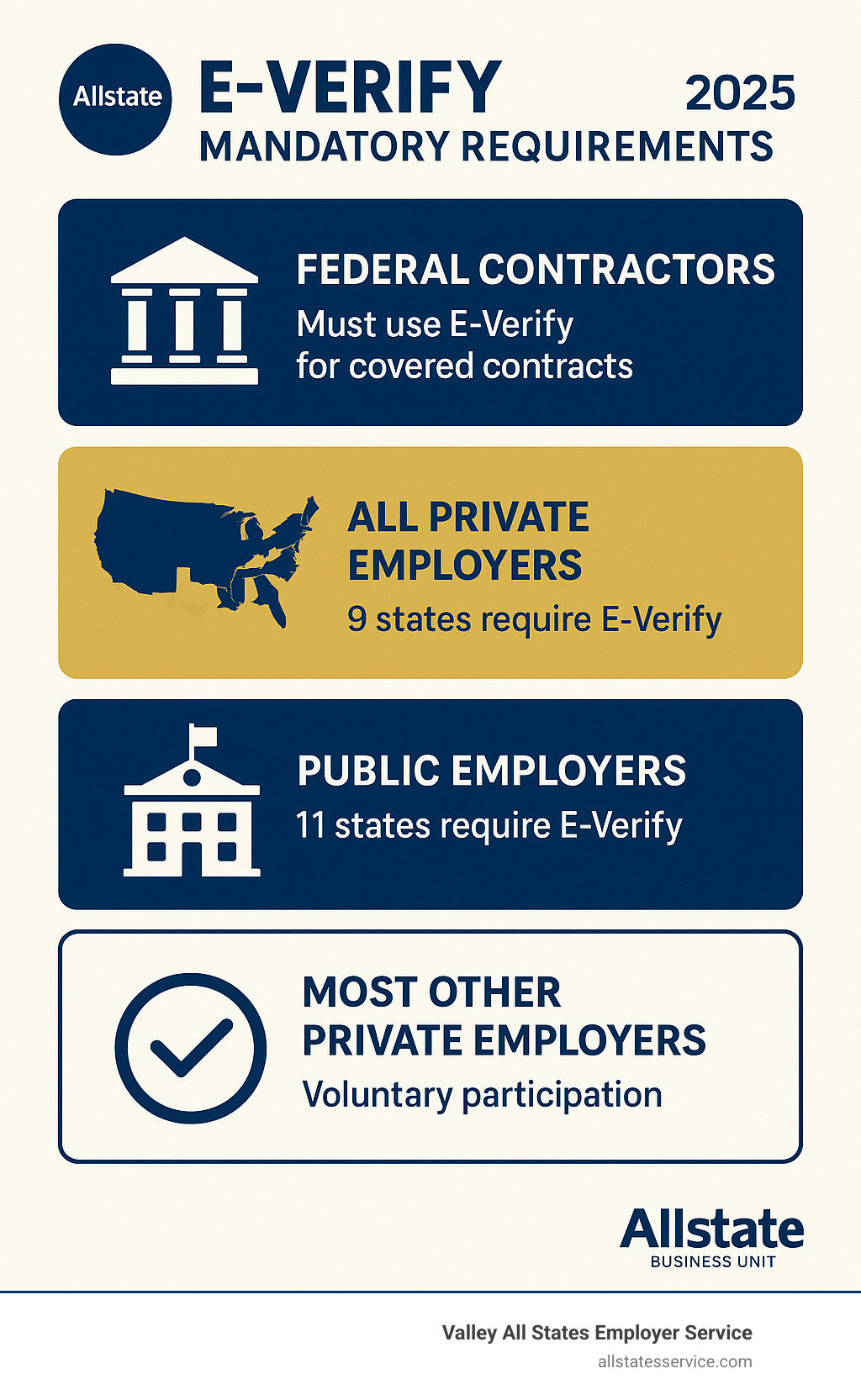
E-Verify is mandatory for:
- Federal contractors with covered contracts (FAR clause)
- Employers in 9 states for all private employers (Alabama, Arizona, Georgia, Louisiana, Mississippi, North Carolina, South Carolina, Tennessee, Utah)
- Public employers in 11 additional states
- Employers subject to court orders or legal settlements
E-Verify is voluntary for:
- Most private employers in states without mandates
- Employers without federal contracts
If you’re an HR manager trying to figure out whether your company must use E-Verify, you’re not alone. The rules vary dramatically by state, contract type, and business situation.
E-Verify is an internet-based system run by U.S. Citizenship and Immigration Services (USCIS) that helps employers confirm their new hires are authorized to work in the United States. While the federal program itself is voluntary, many employers find themselves required to participate due to state laws or federal contracting requirements.
The confusion comes from the patchwork of regulations. Currently, 22 states require E-Verify for at least some employers, but the specifics vary widely. Some states mandate it for all businesses, others only for public contractors, and many have employee count thresholds or other exceptions.
Understanding these requirements isn’t just about compliance. Getting it wrong can mean hefty fines, lost contracts, or even business license suspension in some states.
What is E-Verify and How Does It Work?
Think of E-Verify as your digital verification assistant. This free, internet-based system is run by U.S. Citizenship and Immigration Services (USCIS), which is part of the Department of Homeland Security, working hand-in-hand with the Social Security Administration.
What makes E-Verify so valuable? It takes the information from your new hire’s Form I-9 data and cross-checks it against government records to confirm they’re eligible to work in the United States. It’s not about checking immigration status, but simply confirming employment eligibility for your new hires.
The best part? When used correctly, E-Verify helps you maintain a compliant hiring process while ensuring non-discrimination practices. For a deeper understanding of how this connects to your I-9 responsibilities, check out our guide on What is E-Verify?.
The E-Verify Process Step-by-Step
Here’s where many employers get confused, but the process is actually quite straightforward once you know the steps.
Everything starts with Form I-9 completion. Your new employee fills out their section on day one, and you complete your part within three business days after examining their documents in person. This step is crucial because E-Verify can’t work without a properly completed I-9.
Next comes creating a case within 3 business days. Using the information from the completed Form I-9, you log into E-Verify and create a case for your new hire. The system works fast, usually giving you results in just a few seconds.
Case results come in three flavors. Most of the time, you’ll see “Employment Authorized,” which means everything matches up perfectly and you’re good to go. Sometimes you’ll get a Tentative Nonconfirmation (TNC), which sounds scarier than it is. A TNC simply means there’s a mismatch somewhere that needs sorting out.
Resolving mismatches is where patience pays off. When you get a TNC, your employee has the right to contest it and work with the appropriate government agency to fix the discrepancy. They keep working while this gets resolved. If they choose not to contest it or can’t resolve the issue, then you’ll receive a Final Nonconfirmation.
Preventing Discrimination with E-Verify
Here’s something that trips up many employers: E-Verify mandatory or not, you must use it fairly for everyone. That means consistent use for all new hires, regardless of what they look like, sound like, or where you think they might be from.
Avoiding prohibited practices isn’t just good business, it’s the law. You can’t pick and choose who gets verified based on their accent, appearance, or name. That’s discrimination, plain and simple, and it can land you in serious legal trouble.
Every E-Verify employer must display Right to Work posters in visible areas where employees can see them. These posters explain employee rights and help create a fair, transparent process for everyone involved.
When you follow these guidelines properly, you’re not just staying compliant, you’re building a workplace culture based on fairness and respect. Our E-Verify Best Practices guide can help you implement these principles effectively in your organization.
Is E-Verify Mandatory for Your Business?
This is the million-dollar question, and as we noted in the introduction, the answer isn’t always straightforward. While the federal E-Verify program itself is voluntary for most employers, various factors can make its use e verify mandatory for your specific business. Let’s explore the different scenarios.
Think of E-Verify requirements like a three-layer cake. At the bottom, you have federal contractor rules that affect thousands of businesses nationwide. In the middle, state laws create a patchwork of requirements that vary dramatically depending on where you operate. At the top, you have special circumstances like court orders that might apply to specific companies.
The key is figuring out which layer applies to your business. Get it wrong, and you could face anything from hefty fines to losing your business license.
Federal Contractor E-Verify Requirements
If your company holds federal contracts, you’re likely in the e verify mandatory category. A presidential Executive Order and the Federal Acquisition Regulation (FAR) rule require federal contractors to use E-Verify. This isn’t a suggestion, it’s a hard requirement that ensures organizations doing business with Uncle Sam maintain a legal workforce.
Here’s where it gets interesting: the requirement doesn’t just apply to new hires. Depending on your contract, you might also need to verify existing employees who get assigned to federal contract work. It’s like having two different hiring systems running side by side.
The covered contracts include most federal contracts over $150,000 and subcontracts over $3,000. If you’re wondering whether your specific contract falls under these rules, our E-Verify for Contractors guide breaks down the details. You can also check the official Federal Contractor Rules for the complete regulatory framework.
State-Level E-Verify Mandatory Laws
State laws are where things get really complicated. Currently, 22 states have jumped into the E-Verify game, but they’ve all written their own playbooks. Some states went all-in, requiring every private employer to use E-Verify. Others took a more conservative approach, focusing only on public employers or contractors.
Nine states require E-Verify for all or most private employers: Alabama, Arizona, Georgia, Louisiana, Mississippi, North Carolina, South Carolina, Tennessee, and Utah. If you operate in any of these states, E-Verify isn’t optional, it’s the law. Arizona actually led the charge here, and when their 2007 law went to the U.S. Supreme Court, the justices upheld it, giving other states the green light to follow suit.
Eleven states focus on public employers: Colorado, Florida, Idaho, Indiana, Michigan, Missouri, Nebraska, Oklahoma, Texas, Virginia, and West Virginia primarily require E-Verify for government jobs and public contractors. If you’re bidding on state contracts in these areas, you’ll need to have E-Verify ready to go.
Two states have targeted requirements: Minnesota and Pennsylvania require E-Verify for specific public contractors and subcontractors, creating a more narrow but still important mandate.
The penalties for ignoring state E-Verify laws can be brutal. We’re talking about business license suspension, hefty fines that can reach thousands of dollars per violation, and in some cases, complete revocation of your ability to operate. Because these regulations can change, it’s always best to consult official state labor department websites or USCIS resources for the most current breakdown of what each state requires.
Other Scenarios Making E-Verify Mandatory
Beyond the big two (federal contracts and state laws), there are a few other situations that might make E-Verify mandatory for your business.
Court orders and legal settlements sometimes require companies to use E-Verify as part of resolving employment-related legal issues. If your company has been through immigration-related litigation, there’s a chance E-Verify became part of the settlement agreement.
Certain industries might have specific requirements based on local jurisdictions or industry regulations. While these aren’t common, they do exist, especially in areas with high federal presence or specific security concerns.
Exemptions exist too, even in states with broad mandates. Some states exempt small businesses under a certain employee count. Others have grandfather clauses or industry-specific exceptions. The devil is always in the details, so you’ll want to read the specific language of any law that might apply to your situation.
The bottom line? If you’re unsure whether E-Verify is mandatory for your business, it’s worth getting a definitive answer. The cost of compliance is almost always less than the cost of getting caught without it.
The Critical Link Between E-Verify and Form I-9
Think of Form I-9 as the foundation of your house, and E-Verify as the security system you build on top. You can’t have one without the other when E-Verify mandatory requirements apply to your business.
The Form I-9, Employment Eligibility Verification, is where everything begins. Every employee must complete this form, whether you use E-Verify or not. It’s the document where your new hire attests to their work authorization and you verify their identity by examining their documents in person.
E-Verify doesn’t replace Form I-9. Instead, it takes the information from your completed I-9 and runs it through government databases for an additional layer of verification. This is a common misconception that can lead to compliance headaches.
The three-day rule keeps everything moving smoothly. You have three business days from your employee’s first day of work to complete Form I-9. If you’re required to use E-Verify, you must also create an E-Verify case within that same three-day window. Missing this deadline can trigger penalties, so it’s crucial to stay on top of the timeline.
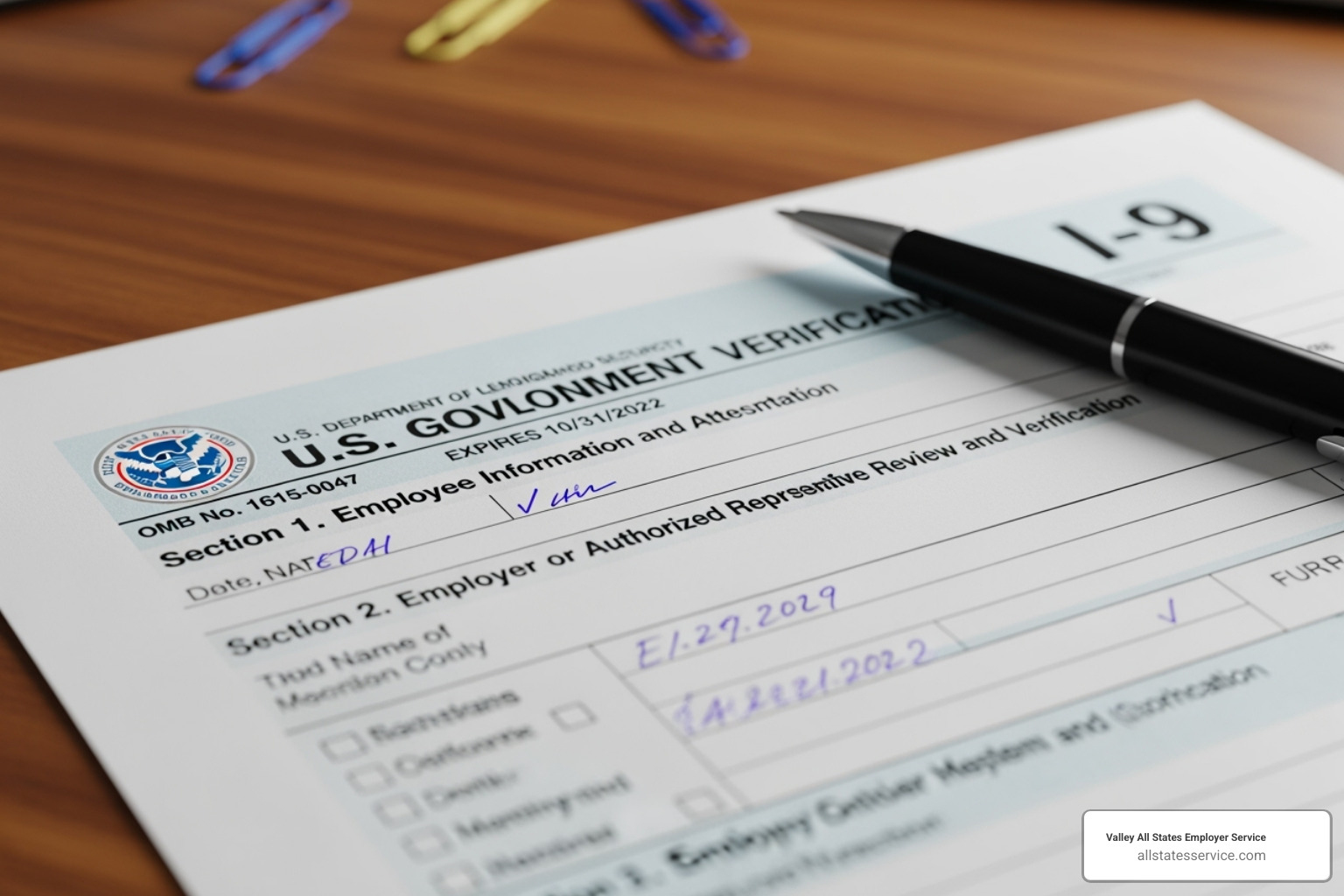
We explore this relationship in much more detail in our comprehensive guide on E-Verify and I-9.
The New Form I-9 and Remote Verification
Here’s some good news for busy HR managers: the latest Form I-9 (dated 08/01/23) is now just one page long. USCIS streamlined the form, making it much easier to complete and manage.
But here’s the real game-changer. If you’re enrolled in E-Verify, you now have the option to examine I-9 documents remotely. This flexibility emerged from the COVID-19 pandemic when remote work became the norm, and the Department of Homeland Security recognized that businesses needed alternatives to in-person document verification.
Remote document examination means you can hire employees who work from different states or even different countries (if they’re authorized to work in the U.S.) without requiring them to visit your office for document inspection. However, this benefit is exclusive to E-Verify employers, giving you another reason to consider enrollment even if it’s not mandatory for your business.
The process requires specific steps and documentation, so it’s not as simple as just looking at documents over video chat. For all the details and requirements, the Handbook for Employers (M-274) is your go-to resource.
Recordkeeping for Compliance
Every E-Verify case generates a case verification number, and this number becomes part of your permanent records. You’ll either write this number directly on the employee’s Form I-9 or print out the case details and attach them to the I-9. Both methods work, but consistency is key.
Your recordkeeping system needs to handle both successful verifications and more complex cases. When you get a Tentative Nonconfirmation (TNC), you’ll have additional documentation to maintain, including proof that you properly notified the employee and gave them the opportunity to resolve the mismatch.
Audit readiness isn’t just a nice-to-have feature. Government agencies regularly conduct I-9 audits, and they’ll want to see both your Forms I-9 and your E-Verify case documentation. Having everything organized and easily accessible can mean the difference between a smooth audit and costly penalties.
While E-Verify itself is free to use, the cost of getting it wrong can be substantial. Poor recordkeeping practices can turn a routine audit into a compliance nightmare. Understanding the full scope of what’s involved helps you make informed decisions about whether to handle E-Verify in-house or work with specialists. You can learn more about the investment involved in our article on E-Verify Compliance Cost.
How Valley All States Employer Service Simplifies E-Verify Compliance
Let’s be honest: figuring out whether e verify mandatory applies to your business is just the beginning. Once you know you need E-Verify, the real work starts. Between tracking three-day deadlines, managing TNCs, and keeping up with ever-changing regulations, E-Verify compliance can quickly become overwhelming for busy HR teams.
That’s exactly why Valley All States Employer Service exists. We take the complexity out of E-Verify so you can focus on what you do best: growing your business and managing your team.

Think of us as your E-Verify safety net. We handle the nitty-gritty details while you stay confident that everything is done correctly and on time. Whether E-Verify is mandatory for your business or you’re choosing to participate voluntarily, our expert team ensures you get all the benefits without the headaches.
Our approach is simple: expert, impartial, and efficient E-Verify processing that minimizes errors and reduces your administrative burden. We’ve seen too many businesses struggle with missed deadlines, incorrect case submissions, and TNC confusion. Our E-Verify Employer Agent Service eliminates these pain points entirely.
The best part? You maintain full control and visibility while we handle the execution. No more wondering if you submitted a case correctly or worrying about compliance gaps during busy hiring periods.
What Our Team Does for You
When you partner with Valley All States, you’re not just outsourcing a task. You’re gaining a dedicated compliance team that becomes an extension of your HR department.
Form I-9 review is where we start. Before any information goes into E-Verify, our experts carefully examine your completed I-9 forms. We catch those common mistakes that can cause problems down the line, like missing signatures, incorrect dates, or incomplete sections.
E-Verify submissions happen seamlessly and on schedule. We ensure every new hire case is created within the required three business days, using accurate information that matches your I-9 records. No more scrambling to remember deadlines or worrying about data entry errors.
Case management means we track every submission from start to finish. You’ll know exactly where each case stands without having to log into the system yourself. We monitor results, update records, and keep everything organized for your files.
TNC support is where our expertise really shines. When a Tentative Nonconfirmation occurs, many employers panic. We guide both you and your employee through the resolution process step by step. We explain what the TNC means, what documents might resolve it, and how to steer the process while keeping everyone comfortable and informed.
Ongoing compliance help keeps you ahead of regulatory changes. E-Verify rules evolve, state requirements shift, and new guidance emerges regularly. We stay on top of these changes so you don’t have to, providing updates and adjustments to keep your program compliant.
The result? You get peace of mind knowing your E-Verify obligations are handled professionally while your team focuses on strategic HR priorities. Find how E-Verify Outsourcing can transform your compliance process and free up valuable internal resources.
Frequently Asked Questions about E-Verify
We get a lot of questions about E-Verify from employers trying to figure out their compliance obligations. Let’s tackle the most common ones we hear every day.
What are the penalties for not using E-Verify when it is mandatory?
The consequences of skipping E-Verify mandatory requirements aren’t something you want to mess around with. The penalties vary depending on who’s enforcing them, but they’re all serious.
If you’re a federal contractor, non-compliance can get you debarred from future federal contracts. That’s essentially being blacklisted from government work, which can devastate businesses that rely on federal projects.
State penalties pack their own punch. Most states with mandates impose substantial fines that get bigger with repeat offenses. Arizona takes it even further, they can actually suspend or revoke your business license for non-compliance. Imagine having to shut down your business because you didn’t follow E-Verify rules.
The bottom line? These penalties exist because governments take workforce verification seriously. Understanding your specific obligations isn’t just good practice, it’s essential protection for your business.
Can I use E-Verify for existing employees?
Here’s where it gets tricky. E-Verify mandatory rules generally apply only to new hires. You shouldn’t use E-Verify to reverify employees who were already working for you before you enrolled in the program. That’s actually against the rules and could land you in hot water for discrimination.
But there’s one big exception that trips up a lot of employers. If you’re a federal contractor with the Federal Acquisition Regulation (FAR) E-Verify clause in your contract, you might need to verify existing employees who get assigned to work on that federal contract. This isn’t about general employment, it’s specifically tied to federal contracting obligations.
Think of it this way: E-Verify follows the employee’s work assignment, not their hire date. If your existing employee gets pulled onto a covered federal project, they’ll need to go through E-Verify verification for that assignment.
What are the benefits of using E-Verify even if it’s not mandatory?
Even when E-Verify mandatory doesn’t apply to your business, voluntary participation offers some compelling advantages that many employers find worthwhile.
Legal workforce assurance tops the list. E-Verify gives you the best electronic confirmation available that your employees are authorized to work in the United States. It’s like having a direct line to government databases to double-check what you learned during the I-9 process.
Good-faith defense is another major benefit. While E-Verify doesn’t provide complete immunity from enforcement actions, it demonstrates your commitment to hiring legally. If questions ever arise about your workforce, having E-Verify records shows you took reasonable steps to verify eligibility.
Lower audit risk naturally follows. Immigration enforcement agencies tend to focus their attention on employers who show patterns of non-compliance. Consistent E-Verify use signals that you’re serious about following the rules, which can lead to smoother outcomes if you’re ever audited.
Here’s a benefit that really excites remote-friendly employers: access to remote I-9 verification. E-Verify participants can now use alternative procedures for remote document examination. This flexibility is incredibly valuable for businesses with distributed workforces or remote hiring processes.
The system also helps catch errors early. Social Security mismatches, document concerns, or other issues surface quickly through E-Verify, letting you address problems before they become bigger compliance headaches.
Take Charge of Your Hiring Compliance
The world of employment eligibility verification can feel overwhelming, but it doesn’t have to keep you up at night. Whether e verify mandatory requirements apply to your business or you’re choosing to participate voluntarily, getting compliance right is one of the smartest investments you can make in your company’s future.
Think about it: your hiring process is the front door to your business. Every new employee who walks through represents potential, growth, and opportunity. But that same process can also expose you to significant risks if you’re not following the rules. The good news? You don’t have to become an E-Verify expert overnight, and you certainly don’t have to go it alone.
At Valley All States Employer Service, we’ve seen how the right support can transform a stressful compliance burden into a smooth, confident hiring process. Our team takes the guesswork out of E-Verify requirements, whether you’re dealing with federal contractor obligations, state mandates, or simply want the peace of mind that comes with voluntary participation.
We know that every business is different. A small tech startup in California has different needs than a manufacturing company with federal contracts in Georgia. That’s why we focus on understanding your specific situation and tailoring our approach accordingly. When you work with us, you’re not just getting E-Verify processing, you’re getting a partner who understands the bigger picture of your hiring compliance needs.
The reality is that employment verification requirements will only continue to evolve. States are regularly updating their laws, federal regulations shift, and new challenges emerge. Rather than trying to keep up with every change while running your business, wouldn’t it make more sense to have experts handle this specialized area for you?
Ready to move forward with confidence? Our comprehensive E-Verify Employer Requirements services are designed to take the complexity out of compliance, so you can focus on what you do best: growing your business and building your team.
Ready to simplify compliance? Contact our team today.