
Employment eligibility forms: Master 2025 Compliance
Why Employment Eligibility Forms Matter for Your Business
Employment eligibility forms are the legal documents that prove a new hire has the right to work in the United States. For employers, these forms are a federal requirement protecting your business from hefty fines and legal trouble.
Here’s what you need to know:
- Form I-9 is required for every person you hire in the U.S., whether they are a citizen or not
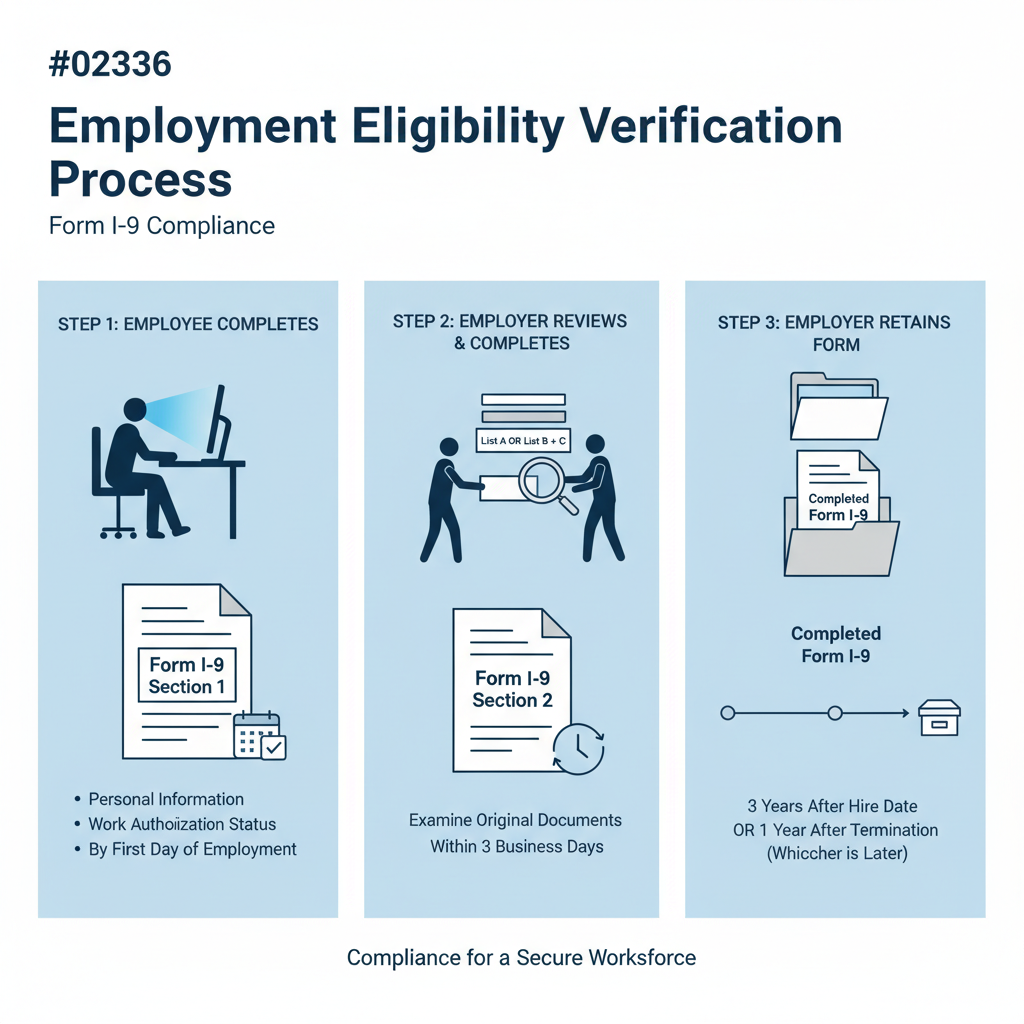
- Employees complete Section 1 on or before their first day of work
- Employers complete Section 2 within three business days by examining original documents
- Documents must be from the official Lists (List A alone, or List B plus List C)
- Retention is mandatory for three years after hire or one year after termination, whichever is later
- Penalties for mistakes can range from hundreds to thousands of dollars per form
Since the Immigration Reform and Control Act of 1986, federal law requires every U.S. employer to complete Form I-9, Employment Eligibility Verification. The form verifies a person’s identity and legal work authorization.
For busy HR managers, the stakes are high. A single mistake can trigger an audit. The good news is that once you understand the system, compliance is manageable.
This guide breaks down employment eligibility verification. We’ll cover the Form I-9 process, acceptable documents, common mistakes, and how E-Verify fits into your workflow. This resource will help you stay on the right side of the law, whether you’re hiring your first employee or your hundredth.
What is the Form I-9? The Cornerstone of US Employment Verification
Think of the Form I-9 as the gatekeeper of your workforce. Every person you hire in the United States must complete one, whether they are a citizen or not. It’s federal law.
The Form I-9, Employment Eligibility Verification, has been mandatory since the Immigration Reform and Control Act of 1986. Its purpose is to establish that your new hire is who they claim to be and is legally authorized to work in the U.S. This prevents unlawful employment and protects businesses.
The Form I-9 is a separate requirement from E-Verify and I-9, an electronic system some employers use as an additional verification step. Think of the I-9 as your baseline obligation and E-Verify as an optional (or sometimes mandatory) extra layer.
Our detailed guide on What is an I-9? walks you through everything you need to know about this critical document.
Employee Responsibilities: Completing Section 1
Your new hire starts the employment eligibility forms process by completing Section 1 of the Form I-9 on or before their first day of work. Crucially, this must not happen before they’ve accepted your job offer, as asking earlier can be a compliance violation.
In Section 1, the employee provides their full legal name, address, date of birth, and Social Security Number (if applicable). They must then attest, under penalty of perjury, to their status by checking one of four boxes: U.S. citizen, noncitizen national of the United States, lawful permanent resident, or noncitizen authorized to work.
If they are a lawful permanent resident or a noncitizen authorized to work, they must provide additional details like their Alien Registration Number or I-94 Admission Number and any expiration dates.
If an employee needs help, an assistant can fill out the form but must complete the Preparer and/or Translator Certification section to ensure transparency. Our resource on Filling Out Employment Eligibility Verification helps with this first step.
Employer Responsibilities: Completing Section 2
As the employer, you have three business days from the employee’s first day to complete Section 2. You can designate an authorized representative to do this if needed.
Your job is to physically examine the original documents your employee presents to prove identity and work authorization. You must see the actual documents, not copies. Then, you record the document title, issuing authority, document number, and expiration date (if any) in Section 2.
By signing and dating the form, you attest that the documents appear genuine and relate to the employee. You are not expected to be a forensic expert, but you should check for obvious signs of fraud.
For remote employees, the Department of Homeland Security has established alternative procedures allowing qualified employers to examine documents remotely. This is helpful for employers enrolled in E-Verify. It’s a practical solution for modern workplaces, though certain conditions apply.
For a walkthrough of your obligations, see our guide on Filling Out an I-9 Employer. If you manage remote hires, our insights on the I-9 Verification Process for Remote Employees will help.
Navigating the Lists of Acceptable Documents
The Form I-9 includes “Lists of Acceptable Documents” that are categorized into three lists: List A, List B, and List C. An employee can either present one document from List A or a combination of one document from List B and one from List C.
Here’s where many employers cross a legal line: you cannot specify which documents an employee must present. Employees have the legal right to choose which acceptable documents they wish to show. Demanding a specific document, like a passport or green card, can be considered illegal discrimination under federal law.
Your job is to verify eligibility, not dictate the form of proof. This protects both you and your employees. For assistance navigating this crucial process, our Verifying I-9 Documents page provides helpful insights.

List A: Documents That Establish Both Identity & Employment Authorization
List A documents are the gold standard of employment eligibility forms because a single document satisfies both requirements at once. These powerful proofs of eligibility make the verification process straightforward.
The most common List A document is the U.S. Passport or U.S. Passport Card. The Permanent Resident Card, often called a “Green Card,” is another frequent List A document. If your employee presents this, our guide on Filling Out I9 With Permanent Resident Card can offer specific guidance.
Other List A documents include a foreign passport with a temporary I-551 stamp or an Employment Authorization Document (EAD) Card (Form I-766). For nonimmigrant aliens authorized to work for a specific employer, a foreign passport with Form I-94 or Form I-94A also works, as long as it meets certain criteria.
List B (Identity) & List C (Authorization)
If an employee doesn’t have a List A document, they’ll need to provide two unexpired documents: one from List B to prove identity and one from List C to prove work authorization. This gives employees flexibility while meeting federal requirements.
List B documents establish identity only. The most common is a driver’s license or ID card issued by a state with a photograph or identifying information. An ID card issued by federal, state, or local government agencies works too. Other options include a school ID card with a photograph, a voter’s registration card, or a U.S. military card.
List C documents establish employment authorization only. The most straightforward is an unrestricted U.S. Social Security card. An original or certified copy of a birth certificate bearing an official seal is another common List C document. Other options include a Certification of Report of Birth issued by the Department of State, a U.S. Citizen ID Card (Form I-197), or an employment authorization document issued by the Department of Homeland Security not already on List A.
For more detailed information on acceptable documents from List C, you can refer to the official USCIS – List C Documents page.
Key Compliance Issues for Employment Eligibility Forms
Staying compliant with employment eligibility forms goes beyond correct completion. The real challenge is proper record-keeping, knowing how to reverify work authorization, handling rehires, and avoiding common pitfalls that trigger audits. The Immigration Reform and Control Act of 1986 requires an ongoing commitment to these rules.

Record-Keeping, Reverification, and Rehires
Once a Form I-9 is complete, you must retain it for each employee while they work for you. The rule is to keep the form for three years after the date of hire or one year after employment ends, whichever is later. These forms stay with you and must be ready for inspection by authorized officials from DHS, DOL, or DOJ.
When an employee’s work authorization has an expiration date, you are responsible for reverifying their eligibility on or before that date. This involves completing Supplement B of the Form I-9, where the employee presents new documents. For detailed guidance, check out our I-9 Record Keeping page.
Supplement B is also used when you rehire a former employee within three years of their original I-9 completion date. Instead of starting over, you can use this supplement to update their information. Our I-9 Process for Rehires resource walks you through this scenario.
Common Errors and How to Avoid Them
Even small mistakes on an employment eligibility form can cost your business thousands per violation. Auditors have little patience for technical errors, and penalties add up fast. Most mistakes are preventable.
Missing signatures or dates is the most common error. Another is accepting photocopied or expired documents. You must physically examine original, unexpired documents unless the employee presents a valid receipt for a replacement. Recording document information incorrectly is another trap.
Over-documenting, or asking for more documents than required, is illegal. Employees have the right to choose which acceptable documents they present. Failing to complete Section 2 within three business days is a strict deadline. Knowingly hiring unauthorized workers can lead to criminal charges. Regular self-audits are your best defense. Our I-9 Compliance Penalties page details what’s at stake.
A Note on International Employment Eligibility Forms
Employment eligibility forms and verification processes are country-specific. What works in the U.S. doesn’t work elsewhere, and assuming otherwise can lead to serious compliance issues when hiring internationally.
Canada, for example, has no single form like the I-9. Instead, Canadian employers must ensure every employee has a valid Social Insurance Number (SIN) and verify work status through documents like a Canadian passport or work permit. The process is integrated with application packages from Immigration, Refugees and Citizenship Canada (IRCC), which you can find on the Find an IRCC application package or form page.
Canada has been increasing its immigration targets to address labor shortages, making it important for businesses to understand these forms. For more on this trend, read our article on Canada Increases Immigration Targets to Address Labor Shortages.
The Role of E-Verify in Modern Hiring
By now, you understand the Form I-9. But there’s another tool in the compliance toolbox: E-Verify. Think of E-Verify as your digital partner, a free, internet-based system run by the U.S. government that takes your employment eligibility forms one step further.
After you complete the Form I-9, E-Verify compares that information to data from the Department of Homeland Security (DHS) and the Social Security Administration (SSA). It’s not a replacement for the Form I-9 but an additional step to confirm employment eligibility, acting as a secondary check against government databases.
For most employers, E-Verify is voluntary. However, if you’re a federal contractor or operate in certain states, it is mandatory. Rules vary, so it’s worth checking where your business falls. Our E-Verify State Requirements Guide 2025 breaks down what’s required in each state.
Why use E-Verify if it’s not mandatory? For peace of mind. It provides an extra layer of compliance, reduces errors, and gives you confidence in your hiring decisions. It significantly decreases the chance of employing unauthorized workers, protecting your business from penalties. For busy HR teams, that assurance is invaluable.
The system is user-friendly. You enter information from the Form I-9 into the E-Verify portal and typically receive a response in seconds. Most cases are “Employment Authorized.” Sometimes you’ll get a Tentative Nonconfirmation (TNC), meaning there’s a data mismatch. The employee has the right to contest the finding, and you must follow specific procedures to avoid discrimination.
Understanding the correct procedures is crucial. You need to know when to create a case and how to handle TNCs properly. Want to dive deeper? Check out What is E-Verify? for an overview. If you’re ready to start, our guide on E-Verify Employer Responsibilities walks you through what you need to know.
For the most current information, visit the official E-Verify website. If managing this process feels overwhelming, expert services can handle it for you, ensuring accuracy and compliance.
Frequently Asked Questions about Employment Eligibility
We know that navigating employment eligibility forms can raise many questions. Here are some of the most common inquiries we encounter, answered in plain English.
Where can I download the latest Form I-9?
You should always download the most current version of the Form I-9 directly from the official U.S. Citizenship and Immigration Services (USCIS) website. Using an outdated form is a compliance violation, plain and simple. Forms are frequently updated to reflect new policies, clarifications, or changes in immigration law. For example, when a new version of Form I-9 was announced in January 2020, employers had a transition period to start using it, but once that period ended, the old version became non-compliant.
The USCIS website is your single source of truth. Make it a habit to check every time you hire someone, not just when you think an update might have happened. You can find the official download page here: US Government I-9 download page. A quick visit to the site takes less than a minute and can save you from costly penalties down the road.
What happens if an employee cannot provide documents within three days?
The three-business-day rule for completing Section 2 of the Form I-9 is strict, but life happens. If an employee’s documents are lost, stolen, or damaged, they may present a receipt for a replacement document from the issuing authority. This receipt is valid for 90 days from the date of hire, during which the employee must provide the actual document.
Here’s the important part: if they fail to provide either the documents or an acceptable receipt within three business days, you cannot continue to employ them. This isn’t optional. The law requires you to halt employment until the situation is resolved. This also applies if an employee presents a document from List B or C that is a receipt for an application for an initial employment authorization document. The receipt serves as a temporary placeholder, but the clock is ticking on that 90-day window. Once it expires, the employee must present the actual document, or you’ll need to complete Supplement B to record the new information.
Can I complete the I-9 verification process remotely?
Yes, under certain conditions. Historically, the Form I-9 required physical examination of documents, which posed challenges for remote teams. The Department of Homeland Security (DHS) has recognized this reality and introduced an alternative procedure that allows qualified employers to examine documents remotely via live video interaction.
To use this alternative procedure, you must be enrolled in E-Verify and in good standing. During the video session, you’ll examine copies of the employee’s documents in real time, retain clear copies of those documents, and annotate the Form I-9 with “alternative procedure” in the additional information field of Section 2. This flexibility has been a game changer for businesses with distributed workforces.
If you’re not enrolled in E-Verify, you still have options. You can designate an authorized representative to complete Section 2 on your behalf. This representative can be anyone you choose, whether that’s a notary, a friend, a family member, or a colleague in another office. The key requirement is that they must physically inspect the original documents and complete the form accurately. Our USCIS I-9 Remote Verification guide offers a deeper dive into these options and walks you through the specific steps for each scenario.
Your Partner in Compliance
Mastering employment eligibility forms is a non-negotiable part of running a business. The rules are complex and the stakes are high, but with the right knowledge and processes, you can steer compliance with confidence.
We understand that for many businesses, staying current with evolving regulations is overwhelming. You’re focused on growing your business, not worrying if an I-9 is documented correctly or if you’re using the latest form.
This is where partnering with an expert service makes all the difference. Valley All States Employer Service specializes in outsourced E-Verify and I-9 compliance, taking the administrative burden off your shoulders. We provide expert, impartial, and efficient processing, allowing you to focus on what you do best while we handle employment eligibility verification. Partnering with us gives you peace of mind knowing your business is protected.
You wouldn’t fix your car’s transmission if you’re not a mechanic, so why tackle complex employment eligibility verification alone? As experts, we stay on top of regulatory changes, new forms, and compliance requirements so you don’t have to.
Ready to master your compliance strategy and safeguard your business? Dive into our Internal I-9 Audit Complete Guide to learn how to proactively protect your business. When you’re ready to simplify your entire compliance process, we’re here to help.