
Filling out employment eligibility verification 2025: Expert Easy
First Things First: What is Form I-9 and Why is it So Important?
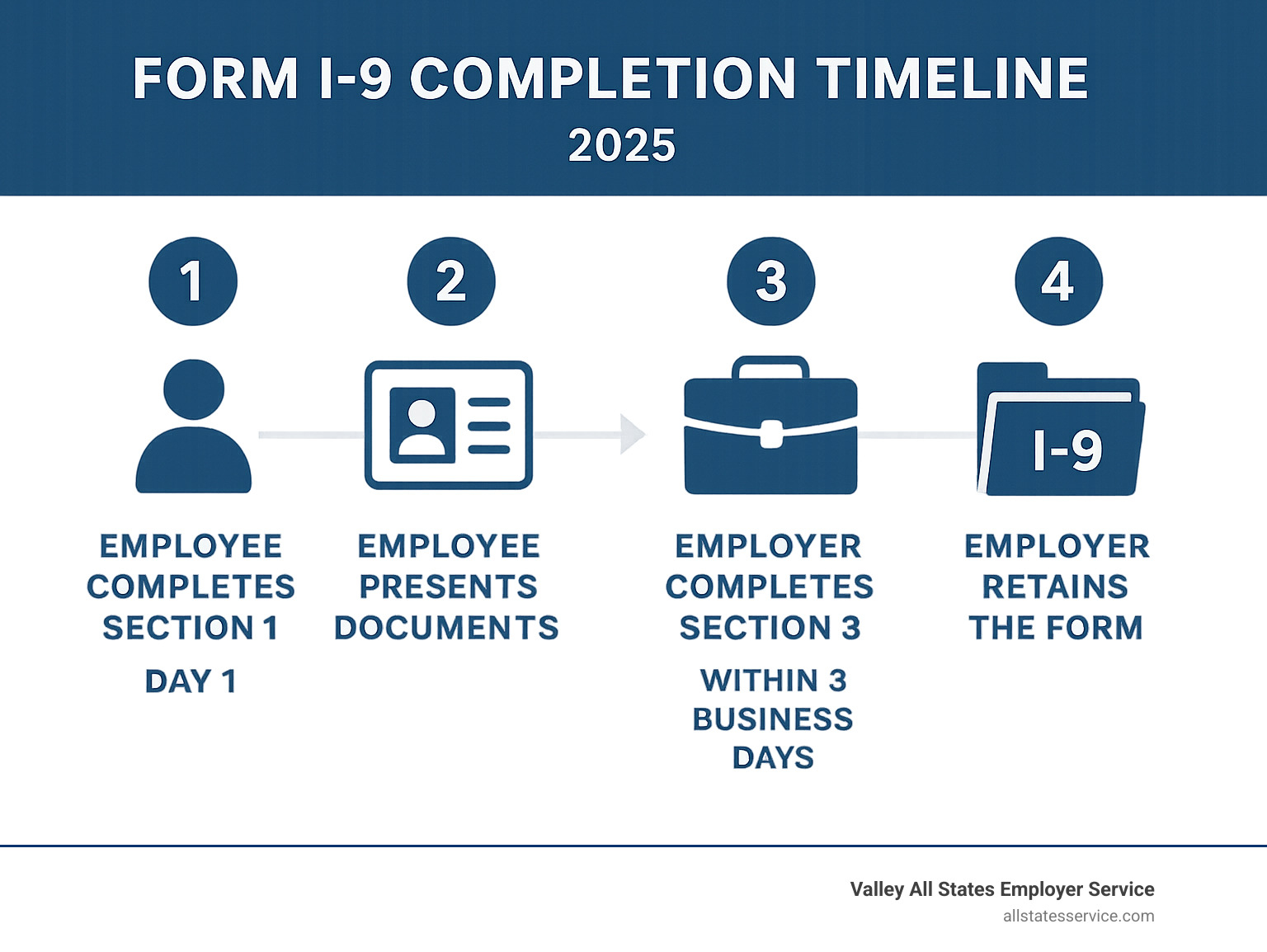
Ready to tackle filling out employment eligibility verification with ease? Here’s a quick roadmap to get you started:
- Employee completes Section 1: This happens on the first day of work. They provide personal information and attest to their work authorization status.
- Employee presents documents: They show original documents proving both identity and the right to work in the U.S.
- Employer completes Section 2: Within three business days of the employee’s first day, the employer examines the documents and records their details.
- Employer retains the form: Keep the completed Form I-9 for the required period.
Every time you bring a new team member on board, there’s a vital piece of paperwork involved: Form I-9, Employment Eligibility Verification. This form ensures that every person hired for employment in the United States is authorized to work here. It’s not just a suggestion; it’s a federal requirement, stemming from the Immigration Reform and Control Act of 1986.
Think of it as a crucial step to protect both your business and your employees. It confirms identity and verifies employment authorization for all new hires. This applies to everyone hired after November 6, 1986, whether they are U.S. citizens or noncitizens. Completing it correctly keeps you compliant and avoids potential headaches down the road.
The purpose of Form I-9 is straightforward: to document that each new employee is authorized to work in the United States. This includes both citizens and non-citizens. The process involves both the employee and the employer, with distinct responsibilities for each party. For more information on Form I-9 procedures, we always recommend referring to the official USCIS I-9 Central website.
The Legal Stakes: Compliance and Anti-Discrimination
Ignoring Form I-9 requirements, or completing them incorrectly, can lead to serious consequences for employers. We’re talking about penalties that can range from civil fines to, in severe cases, criminal charges. For a deeper dive into these potential repercussions, our resource on I-9 Compliance Penalties provides valuable insights. The government takes employment eligibility verification seriously, and so should we.
Beyond mere completion, it’s crucial to understand the anti-discrimination notice related to Form I-9. It’s illegal to discriminate against work-authorized individuals during the hiring or verification process. This means we cannot specify which document(s) an employee must present to establish their identity and employment authorization. The choice of documents, from the acceptable lists, rests solely with the employee.
Furthermore, refusing to hire or continue to employ an individual because their documentation has a future expiration date may also constitute illegal discrimination. Many work authorization documents, like those for certain nonimmigrant visa holders, have expiration dates, but this doesn’t diminish the individual’s current authorization to work. The Immigrant and Employee Rights Section (IER) of the Department of Justice provides guidance on these critical anti-discrimination rules. Our goal is always fair and compliant hiring practices.
A Step-by-Step Guide to Filling Out Employment Eligibility Verification
Let’s be honest: paperwork isn’t anyone’s favorite part of starting a new job or welcoming a new team member. But filling out employment eligibility verification doesn’t have to feel overwhelming. When you break it down into clear steps, the whole process becomes much more manageable for everyone involved.
The Form I-9 is actually pretty straightforward once you understand who does what and when. Think of it as a two-part dance between the employee and employer, each with their own moves to master. The employee kicks things off with Section 1, then the employer steps in to complete Section 2. Simple as that.
Employee Guide to Filling Out Employment Eligibility Verification (Section 1)
Your journey with filling out employment eligibility verification starts bright and early on your first day of work. Section 1 is entirely your responsibility as the new employee. You can actually fill it out after accepting a job offer, but it absolutely must be completed by the end of your first day on the job.
The personal information part is pretty routine stuff. You’ll enter your full legal name, current address, date of birth, and Social Security Number. Here’s something interesting: providing your SSN is usually optional on the I-9, but if your new employer uses E-Verify (and many do), then it becomes required.
Now comes the important part where you attest to your work authorization status. You’ll pick one of four boxes that describes your situation. If you’re a U.S. Citizen, that’s the easy choice. Noncitizen Nationals are folks born in places like American Samoa or Swains Island. If you’re a Lawful Permanent Resident, you’ll need to have your A-Number or USCIS Number handy. For those who are Aliens Authorized to Work, you’ll provide your work authorization expiration date (if there is one) plus either your A-Number, USCIS Number, or Form I-94 Admission Number.
Don’t worry if you need help with this section. Maybe English isn’t your first language, or you just want someone to double-check your work. If a family member, friend, or translator helps you complete Section 1, they’ll need to fill out and sign the Preparer and/or Translator section. This keeps everything above board and accountable.
For more background on what you’re actually filling out, our guide on What is an I-9 Form? breaks down all the basics.
Employer Guide to Filling Out Employment Eligibility Verification (Section 2)
Once your new employee hands over that completed Section 1, the baton passes to you. As the employer, you’re responsible for Section 2, and timing matters here. You have exactly three business days from the employee’s start date to get this done. If someone’s only working for less than three days total, then Section 2 needs to be finished by their first day.
The heart of your job involves examining the documents your employee presents. This isn’t just a quick glance, either. You need to physically look at each original document to make sure it appears genuine and actually belongs to the person standing in front of you. Here’s a crucial point: you cannot tell employees which specific documents to bring. That choice is entirely theirs, as long as they pick from the acceptable document lists.
After you’ve examined everything, it’s time to record the document information. You’ll write down the document title, who issued it, the document number, and when it expires. Don’t forget to note the employee’s actual start date, then sign and date your certification. When you sign, you’re stating under penalty of perjury that you properly examined the documents and believe this person is authorized to work.
Remote work has changed the game for many employers. Thanks to recent developments, certain employers can now use alternative procedures for remote document examination. This means you might not always need that face-to-face document review, which makes life easier for distributed teams. Our resource on USCIS I-9 Remote Verification walks you through these flexible options and helps you understand if your business qualifies.
The key to successful filling out employment eligibility verification is staying organized and sticking to the deadlines. When both employees and employers understand their roles, the whole process flows smoothly and keeps everyone compliant with federal requirements.
Decoding the Lists of Acceptable Documents
When it comes to filling out employment eligibility verification, understanding the acceptable documents is like knowing the rules of the game. The Form I-9 includes three lists of documents that employees can choose from, and knowing these options makes the process smoother for everyone involved.
Think of it this way: employees need to prove two things when they start work. They need to show who they are (identity) and that they’re allowed to work in the United States (employment authorization). The document lists give them flexible ways to meet these requirements.
List A: Documents That Establish Both Identity & Employment Authorization
List A documents are the ultimate multitaskers. These single documents prove both identity and work authorization in one go, making life easier for everyone. If your new employee brings a List A document, you’re all set.
The U.S. Passport or U.S. Passport Card tops this list as one of the most straightforward options. Most people are familiar with these, and they’re widely accepted everywhere. For lawful permanent residents, the Permanent Resident Card (Form I-551), often called a “Green Card,” serves the same purpose.
Things get a bit more specialized with foreign nationals. A Foreign Passport with Form I-94 or Form I-94A can work, but only when it shows a work-authorized status like H-1B or TN visa holders. The Employment Authorization Document (Form I-766) with a photograph, commonly known as an EAD card, is another solid List A option that USCIS issues to various categories of work-authorized individuals.
For newly admitted permanent residents who haven’t received their Green Card yet, a foreign passport with a temporary I-551 stamp or notation on a machine-readable immigrant visa does the trick.
Lists B and C: The Two-Document Combo
When employees don’t have a List A document handy, they can mix and match from Lists B and C. It’s like ordering from a combo menu, you need one from each list to complete the meal.
List B documents establish identity only. The most common choice here is a driver’s license or state-issued ID card with a photo. These need to include key information like name, date of birth, and address. Other options include school ID cards with photos, voter registration cards, U.S. military cards, or federal, state, or local government-issued ID cards with the right details.
List C documents prove employment authorization only. The U.S. Social Security card is the go-to choice here, but watch out for those with restrictive language like “NOT VALID FOR EMPLOYMENT.” A birth certificate issued by a U.S. state, county, or municipal authority with an official seal also works perfectly. Other valid options include Certification of Birth Abroad forms from the State Department, Native American tribal documents, and various USCIS-issued citizenship or employment authorization documents.
Here’s where it gets important for E-Verify users: if your company participates in E-Verify, any List B document must include a photograph. This rule helps align the identity verification process with E-Verify’s photo-matching capabilities. If an employee has religious objections to providing a photo document, reach out to E-Verify directly for guidance on how to handle the situation.
The beauty of this system is that employees get to choose which documents they present from the acceptable lists. As employers, we can’t demand specific documents or refuse valid ones just because we’d prefer something else. Understanding how these document requirements work with E-Verify can be tricky, which is why our detailed guide on E-Verify and I-9 breaks down all the connections between these two systems.
Beyond the Basics: Retention, Reverification, and Special Cases

Think filling out employment eligibility verification ends once you sign that Form I-9? Not quite! The real work continues long after that initial paperwork is complete. From keeping those forms safe and sound to knowing when updates are needed, there’s a whole world of ongoing responsibilities that keep your business compliant and audit-ready.
I-9 Record-Keeping and Retention Rules
Here’s where things get interesting (and where many employers stumble). You can’t just toss those completed I-9 forms into a drawer and forget about them. The government has very specific rules about how long you need to keep these documents, and getting it wrong can be costly.
The retention rule is actually pretty straightforward once you understand it: keep each Form I-9 for 3 years after the date of hire or 1 year after the date employment ended, whichever is later. Let’s break this down with some real examples. Say you hire someone who stays with your company for five years. You’d keep their I-9 for one year after their last day. But if someone only works for you for six months, you’d hang onto that form for the full three years from when you first hired them.
Whether you store these forms in a locked file cabinet or use electronic storage, security is key. If you’re going digital (and many businesses are), you need to make sure your system meets DHS regulations for electronic generation, storage, and retention. This means proper indexing, solid security measures, and easy accessibility when government officials come knocking. Our detailed guide on I-9 Record Keeping walks you through the best practices for managing these critical documents so they’re always ready for inspection.
When to Use Section 3: Rehires and Reverification
Section 3 of the Form I-9 might seem like an afterthought, but it’s actually a powerful tool for handling two very common workplace situations. Think of it as your “update” section for when circumstances change.
Rehiring employees is where Section 3 really shines. If you’re bringing back a former employee within three years of completing their original I-9, you might be able to use that existing form. Just fill out Section 3 with the rehire date, and you’re good to go. But if it’s been more than three years? Time for a brand new I-9.
The other big use for Section 3 is updating expired work authorization, also known as reverification. This is crucial for employees whose work permits have expiration dates. Think about that H-1B worker whose status is set to expire, or the F-1 student whose Optional Practical Training (OPT) period is ending. You’re required to reverify their employment authorization on or before that expiration date. No exceptions.
Section 3 also handles name changes when employees get married, divorced, or legally change their names for other reasons. It keeps everything current and compliant without starting from scratch. For a deeper dive into these scenarios, check out our comprehensive article on I-9 Form Completion.
Handling Specific Employee Situations
Not every employee fits the standard mold, and that’s where things can get tricky. Some situations require extra attention and a deeper understanding of the rules.
Nonimmigrant workers like F-1, J-1, and H-1B visa holders often present unique documentation challenges. An F-1 student with OPT will typically have an EAD card with specific dates tied to their academic program. H-1B workers usually have authorization tied to their I-94 record and their specific employer. These aren’t one-size-fits-all situations, and understanding the nuances can save you from compliance headaches later.
Minors and employees with disabilities sometimes need special accommodations. A 16-year-old might not have a driver’s license yet, and someone with certain disabilities might not have access to standard identity documents. In these cases, there are alternative procedures, like having a parent or legal guardian attest to identity, or accepting documents like school records.
Then there are regional considerations like the Commonwealth of the Northern Mariana Islands (CNMI), which historically had its own specific requirements before aligning with standard U.S. procedures after November 28, 2011. While these situations are less common, they remind us that employment eligibility verification isn’t always straightforward.
The Handbook for Employers: Guidance for Completing Form I-9 (M-274) is your best friend for navigating these complex situations. It’s packed with specific guidance that can help you handle even the trickiest cases with confidence.
Simplify Your Compliance and Stay Audit-Ready
Mastering filling out employment eligibility verification might seem daunting at first, but it’s really about building good habits and staying organized. Think of it like learning to drive—once you understand the rules and practice the steps, it becomes second nature.
The key is treating I-9 compliance as an ongoing process, not just a one-time task. When you understand what employees need to do in Section 1, how to properly examine documents in Section 2, and when to use Section 3 for rehires or reverification, you’re already ahead of the game. Add solid record-keeping practices and awareness of special situations, and you’ve got a compliance system that actually works.
But here’s the thing—even with the best intentions, staying on top of every rule change, deadline, and special case can feel overwhelming. Between running your business and managing your team, who has time to become an I-9 expert?
That’s where partnering with specialists makes perfect sense. Valley All States Employer Service offers comprehensive Workforce Eligibility Verification services that take the complexity out of I-9 and E-Verify compliance. We handle the details so you can focus on what really matters—growing your business and supporting your employees.
Ready to simplify your compliance process and stay audit-ready without the stress? Our expert team is here to help you steer employment eligibility verification with confidence.