
E-Verify Processing Times Explained for Employers
How Long Does E-Verify Actually Take? Here’s the Short Answer
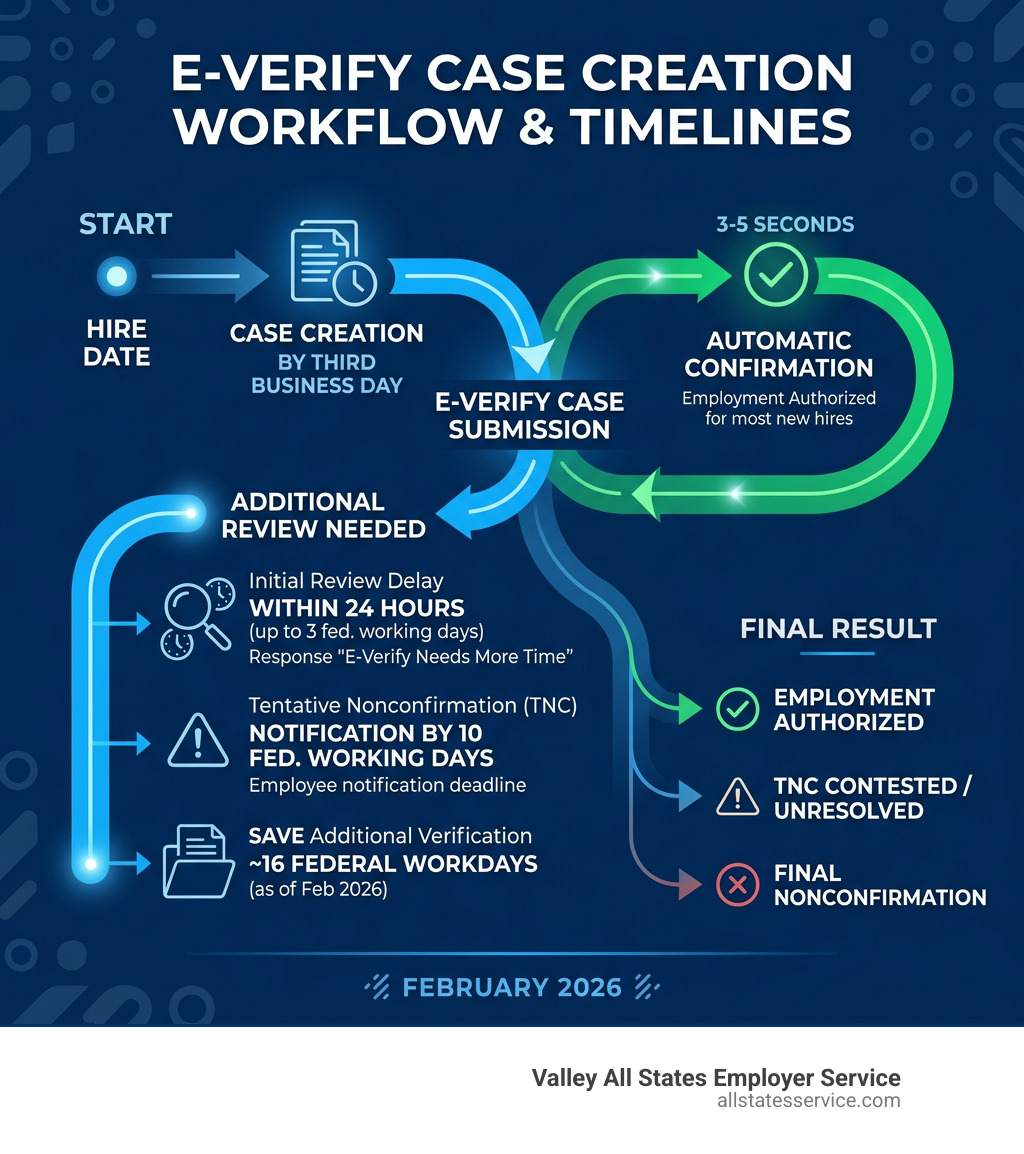
The average e-verify verification time is just 3 to 5 seconds for most new hires. Here’s a quick breakdown of what to expect at each stage:
| Stage | Typical Time |
|---|---|
| Initial case result | 3-5 seconds |
| “E-Verify Needs More Time” response | Within 24 hours (up to 3 federal working days) |
| SAVE additional verification | ~16 federal workdays (as of February 2026) |
| TNC employee notification deadline | Within 10 federal working days |
| Case creation deadline after hire | Within 3 business days |
Nearly 98.93% of cases are automatically confirmed as work authorized, and 99% of all cases are resolved without any extra intervention.
So for most employers, E-Verify is fast. But when a case gets flagged, the timeline stretches significantly, and that’s where things get complicated.
If you manage hiring at a mid-sized company, you know the pressure. New employees need to start working, managers want fast answers, and HR is stuck waiting on systems and deadlines that aren’t always clear.
E-Verify is supposed to make employment eligibility verification simple. And most of the time, it does. The system checks employee information against records held by the Department of Homeland Security (DHS) and the Social Security Administration (SSA), and returns a result almost instantly.
But not every case is that simple. Some get referred for additional review, some trigger a mismatch, and others get caught in the middle of a government shutdown. Knowing what to expect at each step can save your team real time and keep your business compliant.
What is the average e-verify verification time for New Hires?
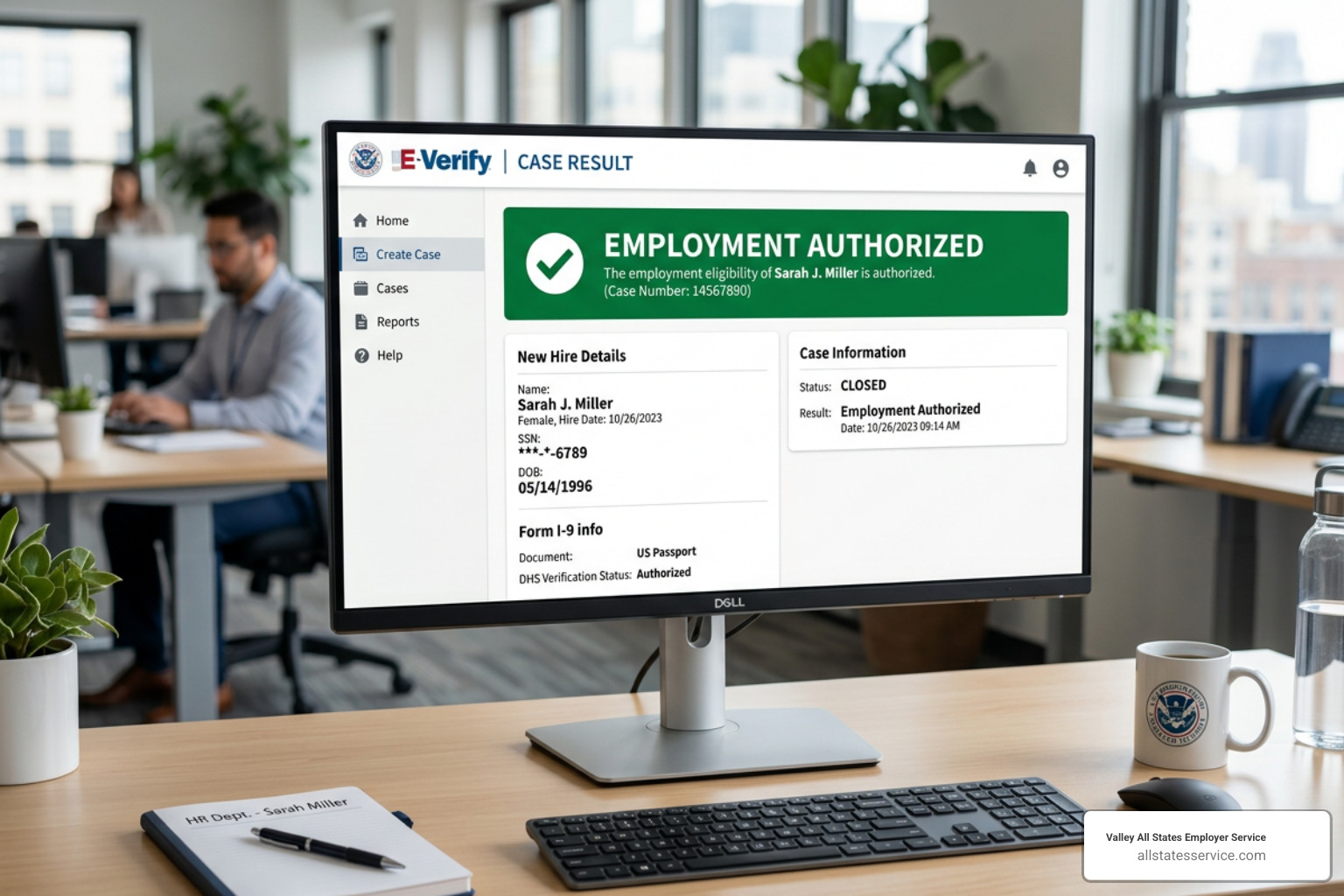
When we talk about the average e-verify verification time, we are usually looking at the initial response from the system. For the vast majority of your new hires, this happens in the blink of an eye. Once you enter the information from the Form I-9 into the portal, E-Verify typically delivers a result within 3 to 5 seconds.
This lightning fast speed is because the system is designed to cross reference data automatically. It checks the Social Security number, name, and date of birth against massive federal databases. If everything aligns perfectly, you get an “Employment Authorized” status immediately.
In fact, statistics show that 98.93% of cases are automatically confirmed as authorized to work. This means that for almost every hire you make, the process adds less than ten minutes to your total onboarding time when you include the I-9 completion. We find that for most businesses, this efficiency is the primary reason to use the system, even when it isn’t legally required.
However, the clock starts ticking before you even log in. You must create the E-Verify case no later than the third business day after the employee starts work for pay. If you miss this window, you may need to provide a reason for the delay within the system.
For more details on how these services fit into your workflow, you can explore our E-Verify services page or review the Official E-Verify Verification Process directly from the government.
How E-Verify+ Influences the average e-verify verification time
The landscape of verification is changing with the introduction of E-Verify+. This program is designed to streamline the workflow by combining the Form I-9 and E-Verify into a single digital experience.
In a standard workflow, the employer enters all the data. With E-Verify+, the employee takes a more active role. They can use the myE-Verify portal to enter their own personal information and upload documents. This shift can significantly reduce the average e-verify verification time from an administrative standpoint because it eliminates the double entry of data.
When the employee completes their portion, the system can trigger the verification process automatically. This reduces manual errors and ensures that the three day deadline is met with much less stress for the HR team. You can find more E-Verify+ program details to see if this digital workflow is right for your specific account type.
State Mandates and the average e-verify verification time
While E-Verify is a federal program, state laws play a huge role in how quickly you need to act. In Maryland, for example, many employers use the system voluntarily to ensure a legal workforce, but federal contractors in the Lutherville area must follow strict timelines.
Other states have recently updated their rules. Starting January 1, 2025, Illinois enhanced protections under the Right to Privacy in the Workplace Act. Even though E-Verify remains voluntary for most in Illinois, the state now requires specific notifications if there is a discrepancy.
In states like Arizona and Florida, the mandates are even stricter. Many employers in these regions must use E-Verify for every single hire, which means the “effective” verification timeline is baked into every hiring decision. Staying on top of these rules is critical, so we recommend checking out our E-Verify state laws guide for the latest 2025 updates.
Understanding the ‘E-Verify Needs More Time’ Status
Every now and then, you will see a status that says “E-Verify Needs More Time.” This can be a bit frustrating when you are used to the 3 second response, but it is not a reason to panic. It simply means that DHS cannot verify the data immediately against their automated records.
When this happens, the case is automatically referred to DHS for a manual review. You don’t need to take any action at this stage, and neither does your employee. Most of these cases are resolved within 24 hours, though the government officially asks for up to 3 federal working days to provide a final answer.
During this waiting period, it is vital that you do not take any adverse action against the employee. You cannot fire them, delay their training, or cut their pay just because the system needs more time. We always remind our clients that the employee is still considered authorized to work while the case is pending.
If you want to dive deeper into the technical steps of this status, you can read the E-Verify Needs More Time Manual. You can also check your E-Verify case status through our portal to see if the status has updated.
Resolving Tentative Nonconfirmations and Mismatches
A Tentative Nonconfirmation (TNC), also known as a mismatch, is the most common cause for a delay in the average e-verify verification time. A TNC occurs when the information entered doesn’t match SSA or DHS records. This could be due to a name change that wasn’t updated, a typo in the Social Security number, or an error in immigration records.
If you receive a TNC, the timeline shifts from seconds to weeks. Here is how the resolution process typically looks:
- Employer Notification: You must notify the employee of the TNC as soon as possible. The system requires you to provide them with a Further Action Notice within 10 federal working days.
- Employee Decision: The employee must decide whether to contest the mismatch. They have 8 federal government working days to contact the appropriate agency (SSA or DHS).
- Agency Review: Once the employee takes action, the case enters a “Case in Continuance” status. The agency then has time to resolve the issue.
| Result | What it Means | Impact on Timeline |
|---|---|---|
| TNC (Mismatch) | Data doesn’t match federal records. | Adds 10+ days to resolution. |
| Employment Authorized | Verification successful. | Instant (3-5 seconds). |
| Case in Continuance | Employee is working with SSA/DHS. | Can take several weeks. |
| Final Nonconfirmation | Verification failed after review. | Ends the process; termination usually follows. |
It is important to remember that you are prohibited from taking adverse action against an employee while they are contesting a TNC. For a step-by-step walkthrough on handling these mismatches, see our Guide to E-Verify TNCs.
Factors That Impact Verification Timelines
Why do some cases take longer than others? In our experience, the biggest factor isn’t a problem with the employee’s status, but rather a simple human error.
Data Entry Errors Typos are the number one enemy of a fast average e-verify verification time. If a name is misspelled or a digit is swapped in a Social Security number, the system will trigger a TNC or a manual review. We always suggest double checking the Form I-9 against the physical documents before typing anything into E-Verify.
SAVE Additional Verification If an employee provides immigration documents that the system can’t verify instantly, the case may be sent to the Systematic Alien Verification for Entitlements (SAVE) system. This is a more intensive manual review process. As of February 2026, the additional verification response time for SAVE is approximately 16 federal workdays.
This is a significant jump from the 3 second initial check. These delays often happen because a manual review is required by a government officer to look at complex immigration histories or document types. You can stay updated on these timelines via the SAVE Verification Response Time Update.
Photo Matching For certain documents like Permanent Resident Cards (Green Cards) or Employment Authorization Documents (EADs), E-Verify will trigger a Photo Matching step. The system will display a photo from the government’s records, and you must compare it to the photo on the actual document provided by the employee. This only takes a few seconds, but it is a critical step to ensure document authenticity.
To keep your process as fast as possible, follow our E-Verify best practices for employers.
How System Outages and Shutdowns Affect Timelines
One of the most overlooked factors in the average e-verify verification time is the availability of the system itself. Because E-Verify is federally funded through congressional appropriations, it is vulnerable to government shutdowns.
We saw a clear precedent for this in October 2025. When the government shut down, the E-Verify system went dark. Employers couldn’t create cases, resolve TNCs, or even log in. If this happens, the standard rules are usually suspended:
- The Three-Day Rule: During past shutdowns, USCIS has suspended the requirement to create a case within three business days. Employers are typically told to submit the cases once the system comes back online.
- TNC Deadlines: If an employee is in the middle of resolving a TNC, their time to contact the SSA or DHS is extended by the number of days the system was unavailable.
- Grace Periods: When the system resumes, the government usually provides a short grace period (often about a week) to get all backlogged cases submitted.
Even if E-Verify is down, you must still complete the Form I-9. E-Verify is a supplement to the I-9, not a replacement. If you are a federal contractor, you should contact your contracting officer if a shutdown prevents you from meeting a deadline.
For more on how to navigate these rare but stressful events, check the E-Verify Resumes Operations page and our guide on Federal E-Verify rules and compliance.
Frequently Asked Questions about E-Verify Durations
What is the fastest way to get an E-Verify result?
The fastest way is to ensure absolute data accuracy. Use the information exactly as it appears on the employee’s Form I-9 and double check for typos. Using automated systems that integrate OCR (Optical Character Recognition) can also help eliminate manual entry errors that lead to delays.
Can I hire someone before the E-Verify result is back?
Yes. In fact, you must hire them first. You cannot create an E-Verify case until an employee has accepted a job offer and completed Section 1 of the Form I-9. Since the average e-verify verification time is so short, most employers have a result before the employee even finishes their first day of orientation.
What happens to deadlines if the E-Verify system is down?
If the system is down due to a government outage or maintenance, the “three-day rule” is generally paused. You should document the reason for the delay and submit the case as soon as the system is restored. You should never stop your hiring or I-9 process just because E-Verify is unavailable.
Conclusion
Navigating the average e-verify verification time doesn’t have to be a headache for your HR team. While most cases resolve in just a few seconds, the outliers—the TNCs, the SAVE referrals, and the system outages—are where the real compliance risks live.
At Valley All States Employer Service, we specialize in taking that administrative burden off your plate. We provide outsourced E-Verify workforce eligibility verification that is expert, impartial, and incredibly efficient. By letting us handle the processing, you minimize the risk of manual errors and ensure that your business stays compliant with both federal and state laws, regardless of how complex a case becomes.
Whether you are a small business in Lutherville or a large federal contractor with employees across the country, we are here to help you streamline your onboarding. Ready to simplify your compliance? Get a pre-employment background check quote today and let us manage the clock for you.