Everything you need to know about E-Verify and employer agents
Why Every U.S. Employer Needs to Understand E-Verify
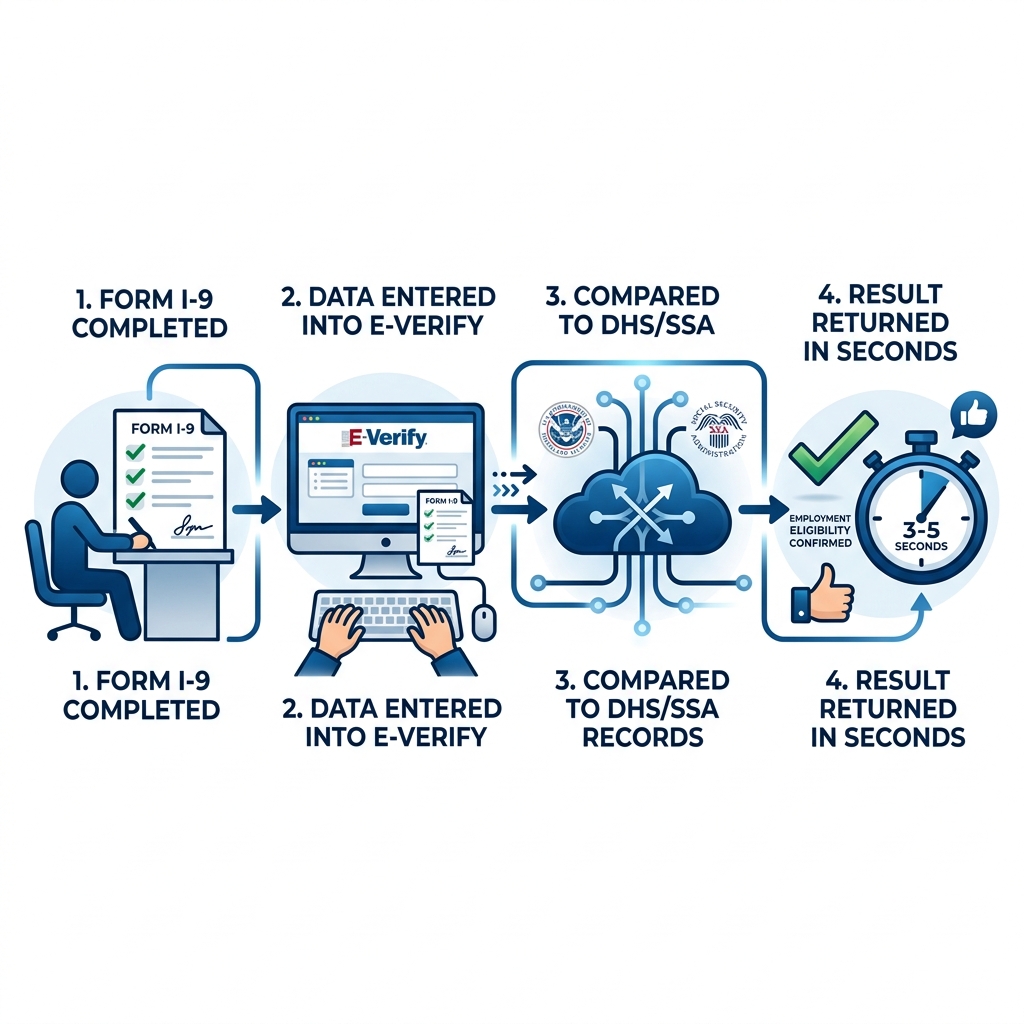
What is E-Verify? It’s a free, internet-based system run by the U.S. Department of Homeland Security (DHS) and the Social Security Administration (SSA) that lets employers electronically confirm whether a new hire is legally authorized to work in the United States.
Here’s the quick version:
- What it does: Compares information from a new employee’s Form I-9 against government records from DHS and SSA
- How fast: Returns a result in as little as 3 to 5 seconds
- Who uses it: Over 1 million enrolled employers across more than 2.4 million hiring sites
- Is it required? Mandatory for federal contractors and employers in certain states, voluntary for most others
- What it costs: Nothing, it’s free to use
- What it’s not: A replacement for Form I-9, a background check, or an identity verification tool
For HR managers, the stakes are real. Hiring someone who isn’t authorized to work in the U.S. can mean serious fines, lawsuits, and reputational damage. E-Verify is designed to be your safety net, but only if you use it correctly and on time.
About 1,500 new companies enroll every week, and it’s rated as one of the federal government’s highest-scoring services for user satisfaction. Still, mismatches happen, state laws vary, and the rules around employer agents add another layer of complexity.
That’s exactly what this guide is here to clear up.
What is e-verify word list:
- E-Verify employer agent
- What is an E-Verify employer agent
- E-Verify employer agent vs E-Verify employer
What is E-Verify and how does it work?
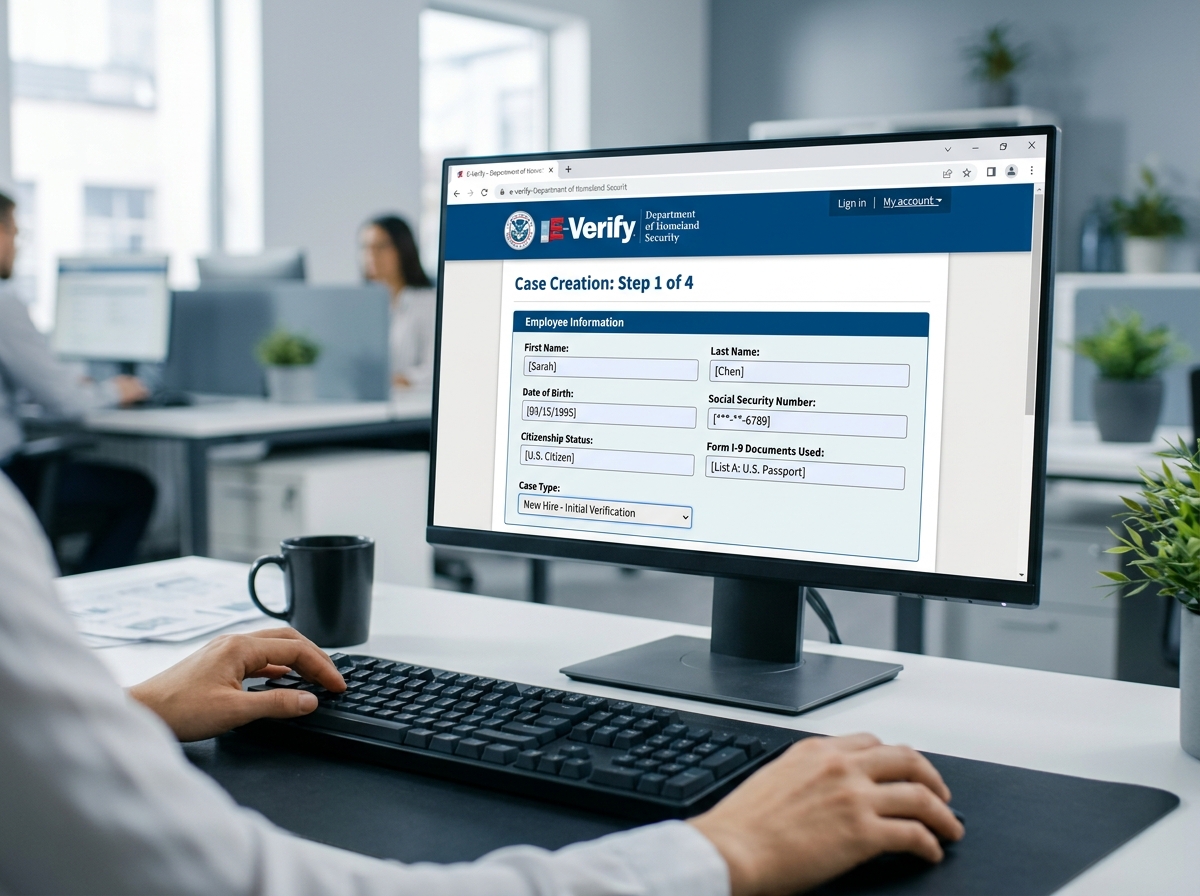
At its heart, the system is a high speed bridge between your office and the federal government. When we talk about what is e-verify, we are describing a platform that verifies a person’s right to work by checking their details against millions of records held by the DHS and the SSA.
The process is remarkably fast. While traditional background checks might take days, this system usually gives us an answer in just 3 to 5 seconds. This speed is a major reason why it has become one of the highest rated services for user satisfaction in the federal government.
For a deeper look at the mechanics, you can check out the official E-Verify Overview or read our more info about E-Verify employment verification. Currently, over 1 million employers are enrolled, covering more than 2.4 million hiring sites across the country.
Defining what is e-verify in the context of Form I-9
It is impossible to separate E-Verify from the Form I-9. Think of the Form I-9 as the foundation and E-Verify as the digital inspector that double checks the work. Every employer in the United States must complete a Form I-9 for every new hire, regardless of whether they use the electronic system or not.
When you use the electronic system, you take the information that the employee provided in Section 1 and the document details you verified in Section 2 of the Form I-9 and enter them into the portal. You are essentially asking the government, “Does this name, social security number, and birth date match what you have on file?”
To learn more about the paperwork side, you can learn about the Form I-9 directly from USCIS. For those looking to see how they fit together, our E-Verify and I-9 guide offers a step by step breakdown. It is important to remember that the digital check does not replace the physical requirement to inspect documents and keep the Form I-9 on file.
Why businesses ask what is e-verify for their hiring process
Beyond simple compliance, many businesses find that the system offers a competitive edge in recruiting and retention. For example, if your company wants to hire international students on a STEM OPT extension, you must be enrolled. F-1 students in these programs are only allowed to work for employers who participate in the program.
You can find more details on the E-Verify program for students to see how this impacts your talent pool. There are also significant benefits of E-Verify for general business health. It provides a “rebuttable presumption” that you have not knowingly hired an unauthorized worker, which can be a vital legal shield.
Mandatory vs. voluntary participation across the United States
While the federal government offers the system as a voluntary tool for most, the landscape changes quickly depending on who you are and where you do business. If you are a federal contractor with a contract that includes the Federal Acquisition Regulation (FAR) E-Verify clause, participation is no longer optional.
State laws also play a massive role. In Maryland, while there is no broad mandate for all private employers, other states have much stricter rules. For instance, Arizona and Mississippi require almost all employers to use the system. Florida has also recently passed significant legislation requiring certain employers to use it.
To stay on top of these shifting rules, we recommend our E-Verify state laws guide and our article on navigating which states require it. Whether you are dealing with public construction projects or private hiring, knowing your local requirements is the first step in avoiding costly penalties.
Managing case results and employee rights
When you submit a case, you usually get one of two results immediately. “Employment Authorized” is the one we all want to see. It means the records match, and you can close the case. However, sometimes you will receive a Tentative Nonconfirmation (TNC), also known as a mismatch.
A TNC does not mean the employee is not authorized to work. It simply means the information didn’t match government records. This could be due to a name change that wasn’t updated, a typo in the system, or a data entry error.
Employee rights are a huge part of what is e-verify compliance. You cannot take any adverse action against an employee, like firing them or delaying their training, just because of a TNC. The employee has the right to contest the finding. If they choose to do so, you must allow them to continue working while the issue is resolved.
For a detailed walkthrough on handling these situations, see our guide on E-Verify TNC handling. Protecting your workers’ rights is just as important as verifying their eligibility.
The role of E-Verify employer agents in modern business
For many small to mid sized businesses, managing the digital portal, staying updated on state laws, and handling TNCs can be an administrative headache. This is where an E-Verify employer agent comes in.
An agent is a third party company, like us at Valley All States Employer Service, that handles the entire verification process for you. We act as your expert partner, ensuring that cases are created within the required three business day window and that all data is entered accurately to minimize errors.
Outsourcing this task can significantly boost your HR efficiency. Instead of your team spending hours on training and data entry, we handle the heavy lifting. If you are curious about the differences in roles, our E-Verify employer agent vs employer guide is a great resource. You can also explore our E-Verify employer agent complete guide to see how we can streamline your workflow.
Frequently Asked Questions about E-Verify
Is E-Verify mandatory for all employers?
Participation is largely voluntary at the federal level for most private businesses. However, it is mandatory for federal contractors and subcontractors. Additionally, many states have passed their own laws. Some states require it for all employers, while others only require it for public employers or contractors.
To find out if you fall under these rules, read our post on what employers are required to use E-Verify.
How accurate is the E-Verify system?
The system is highly accurate, but it is not perfect. As of 2018, the approval rate was approximately 98.88%. Recent data from 2023 shows a mismatch rate of about 1.54%. Most of these mismatches are resolved quickly and often stem from simple data entry mistakes or outdated records.
You can read more about error rates in E-Verify to understand the common sources of these discrepancies.
How do I enroll my company in E-Verify?
Enrolling involves visiting the official website, signing a Memorandum of Understanding (MOU), and completing a set of required tutorials. You will need to provide your company’s basic info, including your North American Industry Classification System (NAICS) code and your Federal Employer Identification Number (EIN).
For a smoother experience, we have created an E-Verify registration process guide and a walkthrough for E-Verify account setup.
Final thoughts on employment compliance
Navigating workforce eligibility doesn’t have to be a solo mission. At Valley All States Employer Service, we specialize in taking the complexity out of the process. We provide expert, impartial, and efficient processing that lets you focus on growing your business while we handle the compliance details.
Using an agent gives you peace of mind, knowing that your verifications are being handled by professionals who stay on top of every update from the DHS and SSA. Whether you are in Lutherville, MD, or anywhere else in the United States, we are here to help.
Ready to simplify your workflow? Simplify compliance with an E-Verify employer agent and let us handle the paperwork for you.