
Don’t Get Letter-Locked: Choosing the Best Job Verification Letter System
The Right Job Verification Letter System Can Save You Hours Every Week
A job verification letter is one of those documents that seems simple until you’re the one responsible for producing dozens of them accurately, quickly, and in full compliance with state and federal laws.
Here’s a quick breakdown of what you need to know:
| Question | Quick Answer |
|---|---|
| What is it? | An official employer-provided letter confirming someone’s employment status, job title, dates, and sometimes salary |
| Who needs it? | Employees applying for loans, rentals, visas, government benefits, or new jobs |
| Who writes it? | HR, a manager, or an authorized employer representative |
| What’s included? | Employee name, job title, employment dates, pay rate (where permitted), employer contact |
| What’s excluded? | Social Security numbers, performance opinions, salary history (banned in some states) |
| How long does it take? | Typically a few business days, though this varies by employer |
For HR teams at mid-sized businesses, the challenge isn’t understanding what the letter is. It’s managing the volume, staying compliant, and not letting one-off requests derail your whole week.
Employees need these letters for mortgages, apartment leases, visa renewals, loan applications, and background checks. Each request can have slightly different requirements. Each state may have different rules about what you can and can’t include. And if your process isn’t standardized, every letter becomes a small fire to put out.
That’s exactly what this guide addresses: how to evaluate and choose a job verification letter system that keeps your team efficient, your employees supported, and your business protected.
Discover more about job verification letter:
What is a Job Verification Letter and Why Does it Matter?
At its core, a job verification letter is a formal document we provide to confirm the facts of an individual’s work history. Think of it as a professional “receipt” for employment. While it might seem like just another piece of paperwork, this letter is often the key that unlocks major life milestones for your team members.

When an employee applies for a mortgage, the lender needs to ensure they have a stable source of funds to pay back the loan. A pay stub shows what they earned last week, but the verification letter confirms they are still employed and have a history of reliability. This process of income verification for loans is a standard requirement for banks and credit unions.
Beyond financial loans, these letters are vital for visa application support. For staff members on H-1B or J-1 visas, or those applying for Green Cards, the U.S. Citizenship and Immigration Services (USCIS) requires proof that the individual is maintaining their status through valid employment. Without a precisely worded letter, an employee’s residency status could be at risk.
Landlords also rely on these documents for rental agreements to mitigate the risk of non-payment. By providing a factual confirmation of a person’s current status and past employment, we help our employees secure housing and financial stability. If you want to dive deeper into the mechanics of these requests, you can learn more about the employment verification process to see how it fits into your broader HR strategy.
Key details in a job verification letter
To be considered valid by most institutions, a job verification letter must follow a professional format. It should always be printed on official company letterhead to establish authenticity. If you are sending it digitally, a high-resolution PDF with an electronic signature is usually the standard.
Here is what we typically include:
- Employee Name: Full legal name as it appears in payroll records.
- Job Title: The official position held by the employee.
- Employment Dates: The exact start date and, if applicable, the end date.
- Work Schedule: Whether they are full-time or part-time, often including the average hours worked per week.
- Employer Contact Info: A phone number or email where the recipient can verify the letter’s contents.
What to exclude from a job verification letter
Knowing what to leave out is just as important as knowing what to include. Privacy and legal compliance are the top priorities here. We must never include sensitive Personally Identifiable Information (PII) like Social Security numbers. Including such data creates an unnecessary identity theft risk for the employee.
We also steer clear of subjective commentary. This isn’t a recommendation letter. Avoid phrases like “John is a great guy” or “Sarah is our best salesperson.” Stick strictly to the facts. Performance feedback or disciplinary records have no place in a standard verification.
One of the biggest traps for HR professionals is salary history. Many locations, including Maryland, have implemented salary history bans that restrict what an employer can disclose. While you can usually confirm a current salary if the employee gives written consent (which is common for mortgages), you should be very careful about providing historical pay data or responding to requests from prospective employers about what a candidate used to earn. Finally, always exclude private medical data or reasons for sick leave to remain compliant with privacy laws.
Navigating the Differences Between Verification and Eligibility
It is very common for managers and employees to get confused between a job verification letter, an Employment Authorization Document (EAD), and Form I-9. While they all relate to a person’s job, they serve completely different legal purposes.
A job verification letter is a private document created by us to confirm employment history. In contrast, an EAD (often called a “work permit”) is an official government document that proves an individual is authorized to work in the U.S. for a specific timeframe. You can read more about these work authorization documents on the USCIS website.
Then there is Form I-9 compliance. Every employer must complete a Form I-9 for every new hire to verify their identity and legal authorization to work. This involves reviewing “List A” documents (like a passport) or a combination of “List B” and “List C” documents (like a driver’s license and birth certificate).
| Feature | Job Verification Letter | EAD Card (Work Permit) | Form I-9 |
|---|---|---|---|
| Purpose | Confirms job history/income | Proves right to work in U.S. | Verifies identity & eligibility |
| Issuer | The Employer | USCIS (Government) | The Employer & Employee |
| Common Use | Loans, Rentals, Visas | Job applications for non-citizens | Mandatory for every new hire |
| Legal Basis | Company Policy / HR | Immigration Law | Federal Law (DHS/USCIS) |
Confusing these can lead to major compliance headaches. For example, you cannot use a job verification letter as a substitute for I-9 documents. If you are feeling overwhelmed by the paperwork, you might want to explore our employment verification services to see how we can handle the heavy lifting for you.
Streamlining Your Workflow with a Job Verification Letter System
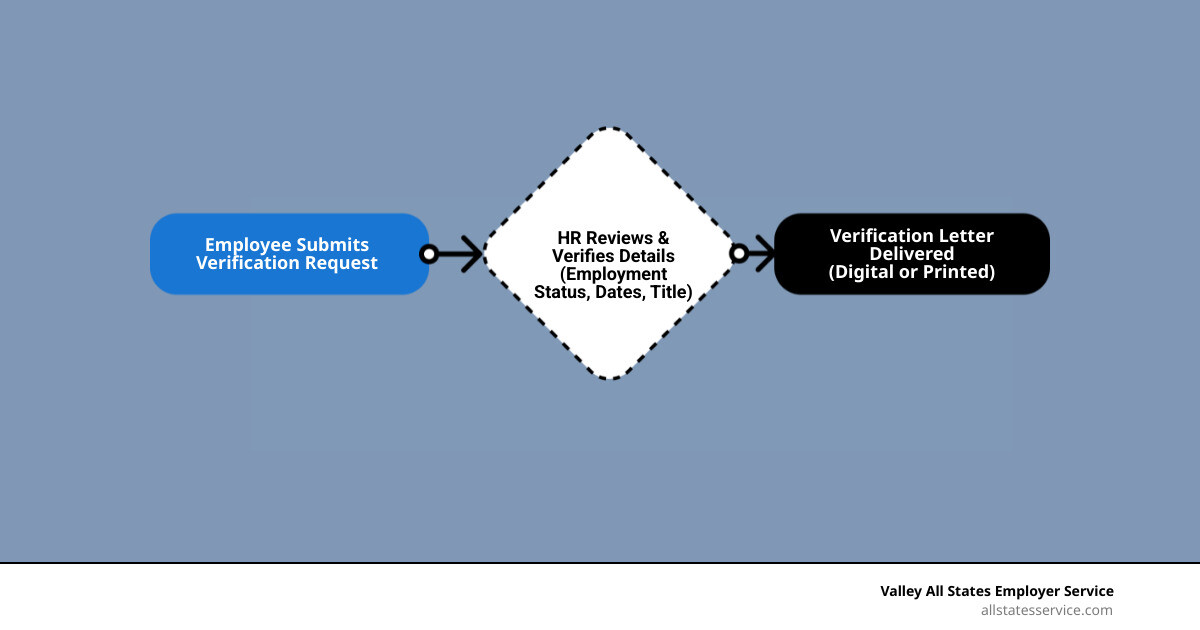
If your HR team is still writing these letters from scratch every time a request comes in, you are losing valuable time. A modern job verification letter system uses digital tools and standardized templates to turn a thirty-minute task into a thirty-second one.
At Valley All States Employer Service, we see how administrative burden can slow down a growing company. By using a centralized system, you ensure that every letter looks professional and contains the exact same categories of information. This consistency is your best defense against errors.
A good system also tracks turnaround time. In a fast-moving real estate market, an employee might need that letter within 24 hours to secure their dream home. If your HR department takes two weeks to respond, you aren’t just being “slow,” you’re actively hindering your employee’s life goals.
Many businesses are now seeing the outsourced verification benefits of letting experts handle these requests. Outsourcing ensures that every response is checked against current state laws, such as Maryland’s specific regulations, and that data accuracy is maintained at the highest level. It frees your internal team to focus on culture and strategy rather than chasing down start dates in old spreadsheets.
Frequently Asked Questions about Employment Verification
We get a lot of questions about the “rules” of these letters. Here are the most common ones we encounter.
How long does it take to receive a letter?
The processing time usually depends on the size of the company and the complexity of the request. In a manual environment, it can take 5 to 10 business days. However, many organizations aim for a four day turnaround. If you use digital delivery and automated systems, these letters can often be generated almost instantly once the request is approved by HR.
Can an employer deny a verification request?
Technically, there is no federal law that forces a private employer to provide a job verification letter, but it is extremely rare for a company to refuse. Most employers view it as a basic professional courtesy and a way to support their staff. However, we may deny a request if the employee hasn’t provided written consent, or if the requester is asking for information that violates our company policy or state privacy laws. For former employees, we generally stick to confirming dates of service and job titles to minimize legal risk.
Is an offer letter the same as a verification letter?
No. An offer letter is a document that outlines the terms of future employment. A job verification letter confirms historical or current data. While some landlords might accept an offer letter for a new hire who hasn’t started yet, most mortgage lenders will insist on a formal verification once the person is actually on the payroll. Lenders want to see that the job is active and the income is currently being earned.
Final Thoughts on Compliance and Support
Choosing the right system for your job verification letter requests is about more than just efficiency. It is about building employee trust. When you handle these requests quickly and professionally, you show your team that you have their back during the most important moments of their lives, whether they are buying a home or renewing a visa.
By maintaining high professional standards and strict data privacy, you protect your business from the administrative burden of compliance errors. Whether you choose to keep the process in-house with better templates or look for an expert partner, the goal remains the same: accuracy, speed, and safety.
Ready to simplify your compliance? Check out our automated verification system guide and see how you can take the stress out of your HR workflow today.