
Why Manual Verification is Holding Your Business Back
Automated verification systems use artificial intelligence, machine learning, and biometric technology to instantly validate identities, documents, and credentials without manual human review. These systems can verify a person’s identity in seconds by analyzing government-issued IDs, comparing facial biometrics, and cross-referencing data against trusted sources.
What an Automated Verification System Does:
- Validates identity documents from 2,500+ types across 195+ countries using OCR and AI
- Confirms identity authenticity through facial recognition and liveness detection
- Checks eligibility against government databases (like E-Verify for work authorization)
- Detects fraud by analyzing security features, watermarks, and document tampering
- Delivers results in under 10 seconds with 95%+ accuracy on first attempts
Every time your HR team manually reviews an I-9 form or verifies a new hire’s documents, you’re burning time and money. You’re also opening the door to human error, which can lead to compliance penalties that cost your business thousands of dollars.
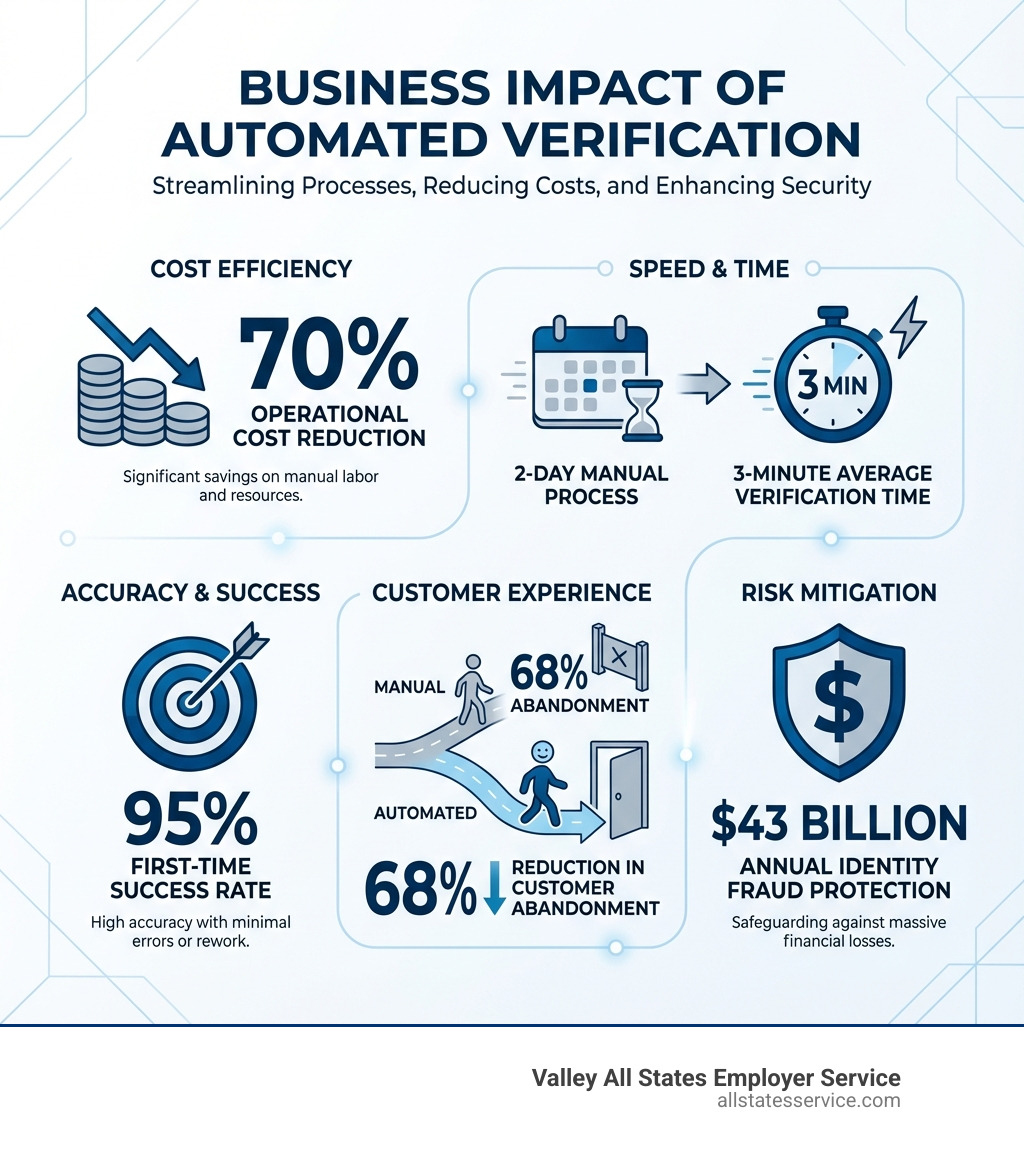
The numbers tell a stark story. Identity fraud cost the global economy over $43 billion in 2023. Meanwhile, 68% of customers abandon applications during onboarding when the process is too slow or cumbersome. Traditional verification can take days. Automated systems do it in under 3 minutes, slashing operational costs by up to 70%.
For HR managers drowning in compliance requirements, this technology isn’t just convenient. It’s transformative. Instead of your team spending hours cross-checking documents and worrying about ICE audits, an automated verification system handles the heavy lifting while you focus on building your workforce.
This guide breaks down how these systems work, why they matter for your business, and how to implement them without disrupting your current operations.
Relevant articles related to Automated verification system:
How an Automated Verification System Works
At its heart, an automated verification system is a digital detective, designed to quickly and accurately confirm identities, documents, or eligibility. It takes what used to be a tedious, error-prone human process and transforms it into a streamlined, high-tech operation. Imagine a system that can instantly tell if an ID is fake or if an applicant is truly who they claim to be. That’s the power we’re talking about.
The process typically begins with data capture. This could involve an individual uploading a document or taking a selfie. Once the system has this initial information, it springs into action, using a sophisticated array of technologies to analyze, cross-reference, and ultimately verify. The goal is to make a confident decision about the validity of the information presented, all within seconds.
The Core Technologies Driving Automation
The magic behind an automated verification system lies in its advanced technological toolkit. These aren’t just simple scanners; they’re intelligent platforms leveraging cutting-edge innovations.
Let’s explore the core technologies that make this possible:
-
Optical Character Recognition (OCR): This is where it all begins for document-based verification. OCR technology reads text from images, converting physical or scanned documents into machine-readable data. So, when an employee uploads their driver’s license, OCR extracts their name, birthdate, and other details, ready for the system to process. It’s like having a super-fast, perfectly accurate typist for every document.
-
Artificial Intelligence (AI): AI is the brain of the operation, enabling the system to “think” and make complex decisions. It powers the analysis of various data points, learning from vast datasets to identify patterns that indicate authenticity or fraud. AI allows the system to adapt and improve over time, making it smarter with every verification it performs.
-
Machine Learning (ML) for Identity Verification: A subset of AI, machine learning is crucial for refining the system’s accuracy. ML algorithms are trained on millions of examples of genuine and fraudulent documents, faces, and data points. This training allows the system to recognize abnormalities and potential forgery, even in new or sophisticated fraud attempts. For instance, Coinbase, a leading crypto exchange, implemented machine learning for identity verification to recognize abnormalities and potential forgery across documents. This is invaluable in staying ahead of evolving fraud tactics.
-
Biometric Verification: This involves using unique biological characteristics to confirm identity. The most common application in automated verification is facial recognition. When an individual takes a selfie, the system analyzes their facial features and compares them to the photo on their government-issued ID. This ensures the person presenting the document is indeed its rightful owner.
-
Liveness Detection: This critical layer works hand-in-hand with biometric verification. Liveness detection technology distinguishes between a real, live person and a static image, video, or 3D mask. It uses subtle cues, like micro-movements, reflections, or depth perception, to prevent fraudsters from using photos or deepfakes to bypass the system. It’s how we ensure the person on the other side of the screen is actually there, in real-time.
Together, these technologies form a formidable defense against fraud and a powerful engine for efficiency.
An Automated Verification System vs. Manual Processes
To truly appreciate the change an automated verification system brings, it’s helpful to compare it directly with its manual counterpart. We’ve all been there: filling out forms, waiting for approvals, and dealing with human errors.
Here’s how the two stack up:
| Feature | Manual Verification | Automated Verification System |
|---|---|---|
| Speed | Slow, often days or weeks | Instant, typically under 10 seconds |
| Accuracy | Prone to human error, fatigue, and oversight | High accuracy, AI-driven, consistent |
| Cost | High labor costs, physical storage, administrative burden | Significantly lower operational costs, scalable |
| Scalability | Limited by human resources, difficult to scale | Highly scalable, handles vast volumes without degradation |
| User Experience | Frustrating, high abandonment rates, inconvenient | Seamless, frictionless, 24/7 availability |
The contrast is clear. While manual processes might have felt familiar, they are increasingly ill-suited for the speed and demands of today’s digital world.
The Business Case: Why Adopt Automated Verification?
Adopting an automated verification system isn’t just about keeping up with technology; it’s about gaining a significant competitive edge. For businesses like ours, operating in the employment compliance and HR services industry, the benefits are profound. We’re talking about a tangible impact on your bottom line, your security posture, and your relationship with customers and employees alike.
Imagine a world where fraud attempts are thwarted before they even begin, where onboarding new hires takes minutes instead of days, and where your customers rave about their seamless experience. This isn’t a pipe dream; it’s the reality that automated verification offers.

Improve Security and Prevent Fraud
One of the most compelling reasons to accept an automated verification system is its unparalleled ability to improve security and prevent fraud. The digital landscape is rife with threats, and manual checks simply aren’t robust enough to stand against sophisticated attacks.
- Combating Identity Theft: Identity theft is a pervasive and costly problem. In 2023 alone, identity fraud cost the global economy over $43 billion. Automated systems act as a critical first line of defense, making it incredibly difficult for fraudsters to use stolen identities.
- Detecting Forged Documents: Manual review often struggles to spot expertly forged documents. However, advanced automated systems analyze security features like holograms, watermarks, and font types, comparing them against known standards to identify inconsistencies indicative of fraud. They can detect tampered documents with far greater accuracy than the human eye.
- Real-time Threat Detection: Fraudsters are constantly evolving their tactics. Automated systems, especially those powered by AI and machine learning, continuously learn from new data. This enables them to perform real-time threat detection, identifying suspicious patterns or anomalies that might indicate a novel fraud attempt. This proactive approach is essential in an ever-changing threat environment.
- Robust Biometric Security: By incorporating biometric verification and liveness detection, these systems ensure that the person presenting the document is a live, genuine individual. This prevents the use of photos, videos, or masks, adding a powerful layer of security against impersonation fraud. Flutter Entertainment, for example, reported a 92% reduction in underage gambling attempts after implementing an AI-powered age verification system.
Open up Major Efficiency and Cost Savings
Beyond security, the financial and operational benefits of an automated verification system are truly game-changing. We’re talking about changing your operational efficiency and significantly reducing costs.
- Reduced Operational Costs: Manual verification is labor-intensive and expensive. Think about the staff hours, printing costs, and storage needed for physical documents. Automated systems dramatically cut these expenses. A 2023 study by Juniper Research highlighted that advanced document verification software can reduce KYC checks from 2 days to under 3 minutes, slashing operational costs by up to 70%. That’s a massive saving that directly impacts your bottom line.
- Faster Onboarding: Time is money, especially when it comes to onboarding new employees or customers. Lengthy manual processes lead to frustration and abandonment. Automated systems complete verifications in seconds, accelerating your onboarding workflow. HSBC Bank reported a 40% reduction in onboarding time after implementing real-time verification, leading to a 25% increase in completed applications.
- Boosted Staff Productivity: When your team isn’t bogged down with repetitive, manual verification tasks, they’re free to focus on more strategic, value-added work. This shift not only improves morale but also maximizes the return on your investment in human capital. It’s about empowering your employees to do what they do best, rather than acting as human data processors. When we streamline HR processes, we help your team become more efficient and engaged.
Improve the Customer Journey
A smooth, fast, and secure verification process isn’t just good for your business; it’s fantastic for your customers and new hires. In today’s digital-first world, expectations are high, and friction is a deal-breaker.
- Reduced Abandonment Rates: Nobody likes a cumbersome process. A staggering 68% of customers abandon applications during onboarding if the experience is too slow or difficult. Automated verification eliminates this friction. JP Morgan Chase, for example, saw an 80% decrease in abandonment rates for new applications after reducing account opening times from days to minutes.
- Frictionless Experience: An automated verification system provides a nearly invisible, seamless experience. Users can complete verification from their own device, often in just a few clicks or a quick selfie. This ease of use translates directly into higher completion rates and happier customers. Zest Money, a fast-growing consumer lending company, reduced its document authentication process from 8 minutes to 10 seconds using robust automated solutions.
- 24/7 Availability: Unlike human-powered processes that are limited by business hours, automated systems are always on. This means customers can complete their verification whenever and wherever it’s convenient for them, leading to a more positive experience and greater flexibility.
- Increased Conversions: By making the verification process fast, easy, and accessible, you remove significant problems for potential customers or employees. This frictionless journey leads to higher conversion rates, allowing you to onboard more genuine individuals efficiently. We believe that a streamlined onboarding process is key to success.
Key Applications and Use Cases
The versatility of an automated verification system is truly remarkable. These systems aren’t confined to a single industry; their ability to rapidly and accurately confirm identities and data makes them invaluable across a wide spectrum of sectors. From finance to healthcare, HR, and even government services, the adoption of automated verification is on the rise, driven by the need for efficiency, security, and compliance.
The beauty of these solutions lies in their scalability. Whether you’re a small business or a large enterprise, an automated system can handle varying volumes of verifications without compromising speed or accuracy. This adaptability means that as your business grows, your verification processes can effortlessly scale with you.
Financial Services and Fintech
The financial sector is a prime example of an industry that has been profoundly transformed by automated verification. With the enormous volume of transactions and sensitive data involved, robust verification is not just a best practice—it’s a legal and ethical imperative.
- Know Your Customer (KYC): Financial institutions are mandated to verify the identity of their clients to prevent financial crime. Automated KYC processes streamline this requirement, allowing banks and fintech companies to onboard customers quickly while meeting strict regulatory guidelines.
- Anti-Money Laundering (AML): Automated systems play a crucial role in AML efforts by screening individuals and transactions against sanctions lists, politically exposed persons (PEPs) databases, and adverse media. This helps detect and prevent illicit financial activities in real-time.
- Secure Account Opening: Automated verification ensures that new accounts are opened by legitimate individuals, significantly reducing the risk of synthetic identity fraud and account takeover.
- Transaction Monitoring: Beyond onboarding, these systems can continuously monitor transactions for suspicious patterns, flagging potential fraud or money laundering activities.
An Automated Verification System for HR and Employment
For us at Valley All States Employer Service, the application of automated verification system in HR and employment is particularly close to our hearts. We understand the complexities of workforce eligibility and the critical need for compliance in the United States, Maryland, and Lutherville, MD. This is where automated solutions shine, especially for our clients.
- Automated I-9 Verification: The Form I-9 is a cornerstone of employment eligibility verification in the U.S. An Automated I-9 Verification system simplifies this process, guiding employers and employees through completion, ensuring accuracy, and reducing the risk of costly errors. This is crucial given the rising number of ICE audits.
- Work Authorization Verification: Beyond the I-9, employers must confirm that new hires are authorized to work in the U.S. Our services focus on providing seamless Work Authorization Verification through expert-led processes.
- E-Verify Program: The E-Verify Program is a federal online system that compares information from an employee’s Form I-9 to data from the U.S. Department of Homeland Security (DHS) and Social Security Administration (SSA). For many employers, especially federal contractors or those in certain states like Maryland, E-Verify participation is mandatory. An automated system streamlines E-Verify submissions, minimizing errors and administrative burden. Our expertise in I-9 E-Verify Compliance ensures your business meets all federal and state requirements.
- New Hire Onboarding: Speeding up the verification process means new employees can get to work faster. Automated systems integrate seamlessly into new hire onboarding workflows, ensuring compliance from day one without delays.
- Compliance Management: With constantly evolving regulations, staying compliant can be a headache. An automated system provides a consistent, auditable trail of all verifications, simplifying compliance management and reducing the risk of penalties. This is vital for any business operating in Maryland or the wider U.S.
Other Benefitting Industries
The reach of automated verification extends far beyond finance and HR, touching various aspects of our daily lives.
- Gaming (Age Verification): Online gaming platforms use automated systems to verify the age of players, ensuring compliance with legal age restrictions and promoting responsible gaming.
- Healthcare (Eligibility Verification): In healthcare, automated systems can verify patient eligibility for insurance benefits, streamlining administrative tasks and ensuring accurate billing. Maryland, for instance, has an Eligibility Verification System (EVS) to confirm health benefits.
- Sharing Economy (User Verification): Companies like Uber and Airbnb rely heavily on automated verification to screen users and service providers, building trust and enhancing safety within their platforms.
- Government Services: Governments leverage automated systems for various purposes, from issuing digital IDs to processing applications for benefits, improving efficiency and reducing bureaucratic problems. The E-Verify program itself is a prime example of a government-led automated verification system.
A Practical Guide to Implementing Automated Verification
Implementing an automated verification system might sound daunting, but with a clear strategy, the right vendor, and careful consideration of regulatory requirements, it can be a smooth and incredibly rewarding process. Our goal is to help you steer this landscape effectively.
The key is to approach implementation strategically. This involves understanding your specific needs, evaluating available solutions, and ensuring seamless integration with your existing systems. It’s not just about buying a piece of software; it’s about adopting a new, more efficient way of operating.
Key Features to Look For in a Solution
When you’re ready to choose an automated verification system, not all solutions are created equal. To ensure you invest in a system that truly meets your business needs, particularly in a diverse country like the U.S. with a global workforce, here are the key features we recommend looking for:
- Global Document Support (2,500+ types): For businesses hiring internationally or serving a diverse customer base in the U.S., a system that can verify a wide array of government-issued documents from various countries is essential. This includes passports, driver’s licenses, and national IDs from around the world. Veriff, for example, supports over 12,000 document specimens from more than 230 countries.
- High Accuracy Rate (98%+): The system’s ability to accurately verify identities and detect fraud is paramount. Look for solutions boasting a high first-time pass rate for genuine users (some claim 95%) and a low false-positive rate. AI-powered automation can achieve 98% check automation.
- Fast Processing Speed (under 10 seconds): Speed is a core advantage of automation. The system should deliver verification results almost instantly. Many leading providers can process verifications in under 10 seconds, with some even claiming 0.02 seconds for data extraction.
- Robust API/SDK Integration: Your chosen solution needs to integrate seamlessly with your existing HR, onboarding, or customer management systems. Strong APIs (Application Programming Interfaces) and SDKs (Software Development Kits) are crucial for a smooth, custom integration experience.
- Customization and Branding: The verification process should feel like an extension of your brand. Look for solutions that allow you to customize the user interface with your logos, colors, and messaging, creating a cohesive experience for your employees or customers.
- Strong Security and Compliance Protocols: This is non-negotiable. The system must adhere to the highest standards of data security (e.g., end-to-end encryption) and comply with relevant regulations, including those specific to the U.S. and Maryland.
Navigating Compliance and Regulations
Compliance is not just a buzzword; it’s a legal necessity that protects your business from significant penalties and reputational damage. When implementing an automated verification system, understanding the regulatory landscape is paramount.
While some regulations like GDPR are specific to the EU, many U.S. businesses interact with global customers, making general data protection principles universally important. For us, operating in the U.S., Maryland, and Lutherville, MD, our focus is squarely on domestic compliance:
- KYC/AML: For financial institutions and many other regulated entities, Know Your Customer (KYC) and Anti-Money Laundering (AML) regulations are critical. Automated systems assist in fulfilling these obligations by verifying identities and screening for illicit activities.
- CCPA: The California Consumer Privacy Act (CCPA) and similar state-level privacy laws in the U.S. dictate how businesses collect, use, and share personal data. Your automated verification system must be designed to respect these consumer privacy rights.
- I-9 E-Verify Compliance: This is particularly relevant for our clients. Employers in the U.S. must complete Form I-9 for every new hire, and many are required or choose to use E-Verify. An automated system simplifies I-9 E-Verify Compliance, reducing errors and ensuring that your workforce is legally authorized. Choosing a compliant partner, like us, is crucial to steer these complex requirements effectively.
The Future of Automated Verification Technology
The evolution of the automated verification system is relentless, driven by advancements in AI, the increasing sophistication of fraud, and the demand for ever more seamless digital experiences. We’re on the cusp of a future where verification is not just automated but intelligent, continuous, and deeply integrated into our digital lives.
- By 2030, 85% of Verifications Will Be Automated: This isn’t just a prediction; it’s a trajectory. According to Frost & Sullivan, by 2030, 85% of all digital identity verifications will be automated and instantaneous. This highlights the inevitable shift away from manual processes towards fully digital, AI-driven solutions.
- Blockchain Identity: Imagine an identity that is decentralized, tamper-proof, and entirely controlled by the individual. Blockchain technology is paving the way for self-sovereign identities, where personal data is securely stored and shared only with explicit consent, potentially revolutionizing how verification occurs.
- Continuous Authentication: Instead of verifying identity only at the point of entry, continuous authentication monitors user behavior throughout a session. This could involve analyzing keystroke dynamics, mouse movements, or even passive biometrics to ensure the user’s identity remains constant, adding a dynamic layer of security.
- Deeper AI Integration: AI will become even more sophisticated, moving beyond current capabilities to predict fraud with greater accuracy, detect subtle anomalies that currently go unnoticed, and adapt to new threats in real-time. This deeper integration will make verification systems truly intelligent, always learning and always improving.
Frequently Asked Questions about Automated Verification
We hear a lot of questions about automated verification, and that’s great! It shows a genuine interest in making processes better and more secure. Here are some of the most common inquiries we receive:
What is the main benefit of an automated verification system?
The primary benefits are a powerful combination of speed, improved security, and significant cost savings. It transforms slow, manual processes into a near-instantaneous workflow, reduces the risk of fraud, and frees up valuable human resources. For businesses, this means faster onboarding, happier customers, and a healthier bottom line.
Can these systems completely replace human oversight?
While many verifications can be fully automated, the most robust systems often use a hybrid model. Automation handles the vast majority of cases quickly, while complex or high-risk verifications are flagged for expert human review. This approach combines the efficiency of AI with the judgment of a trained professional, ensuring both speed and meticulous accuracy where it matters most.
Is automated verification secure for handling sensitive data?
Yes. Reputable automated verification systems are built with security as a top priority. They use end-to-end encryption, secure data handling protocols, and comply with data protection regulations like GDPR (for global interactions) and CCPA (for U.S. consumers) to ensure sensitive information is always protected, often more securely than in manual, paper-based systems. We prioritize the safety and privacy of your data, always.
Conclusion
Moving beyond manual checks is no longer an option but a necessity for modern businesses. An automated verification system is a strategic tool that strengthens security, ensures compliance, and delivers the seamless experience that today’s customers expect. By leveraging technologies like AI and biometrics, you can protect your business from fraud while accelerating growth.
For businesses looking to specifically streamline workforce eligibility and E-Verify compliance, partnering with an expert service like Valley All States Employer Service can provide the specialized support needed to steer complex HR requirements with confidence. Ready to automate your compliance process? Learn more about our Automated Eligibility Verification System.