
Work authorization verification: Simplify 2025
Why Work Authorization Verification is Critical for Every U.S. Employer
Work authorization verification is the legal process U.S. employers use to confirm every new hire is authorized to work. This involves completing Form I-9 and, often, using the E-Verify system to cross-check information against federal databases.
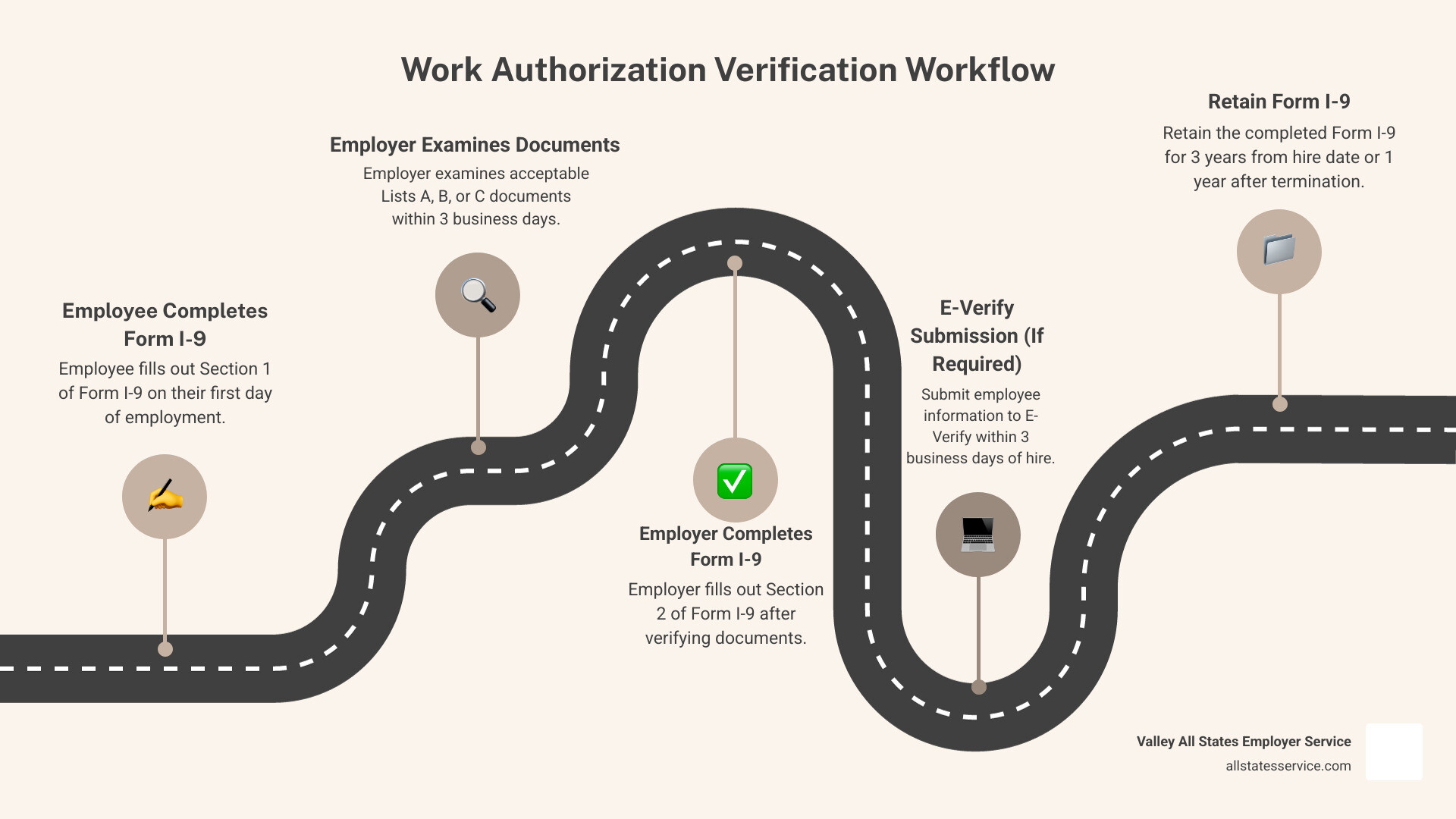
Quick Answer: Work Authorization Verification Steps
- Employee completes Section 1 of Form I-9 on their first day
- Employer examines documents from acceptable Lists A, B, or C within 3 business days
- Employer completes Section 2 of Form I-9 after document review
- Submit to E-Verify (if required) within 3 business days of hire
- Retain Form I-9 for 3 years from hire date or 1 year after termination
Federal law mandates Form I-9 for every new hire. This isn’t optional. The stakes are high, with fines for violations starting at hundreds of dollars and reaching tens of thousands for repeat offenses. Discrimination during verification can trigger additional penalties.
The rules constantly change, affecting various groups and work authorization dates. Staying compliant means staying current. Once you understand the core process, managing verification becomes much more straightforward, protecting your business from penalties and ensuring fair treatment for all employees.
The “Why”: Purpose and Legal Stakes of Verification
Work authorization verification is the legal foundation that protects your business. The Immigration Reform and Control Act (IRCA) of 1986 made it illegal to knowingly hire someone who lacks work authorization.
As the employer, this responsibility is yours. While you can get help from our HR Compliance Assistance, you are ultimately accountable. Proper verification is also about fairness. When done correctly, it protects your business and employees from discrimination.
The High Cost of Non-Compliance
The government takes work authorization verification seriously, with penalties to match.
- Financial penalties range from hundreds to tens of thousands of dollars per violation. A pattern of non-compliance can be financially devastating.
- Criminal charges, including imprisonment for managers, are possible for knowingly and repeatedly hiring unauthorized workers.
- Debarment from government contracts is a risk for federal contractors, which can destroy a key revenue stream.
- Audit risks from Immigration and Customs Enforcement (ICE) are time-consuming and expensive. Our Compliance Management Solutions help you stay prepared.
Preventing Discrimination During Verification
You must verify work authorization without discriminating. The Department of Justice’s Immigrant and Employee Rights Section (IER) prosecutes unfair documentary practices.
- Citizenship discrimination, like asking only certain employees for extra documents, is illegal.
- National origin discrimination is also prohibited. The verification process must be the same for everyone.
- Over-documentation is a common mistake. If an employee presents a valid List A document (e.g., a U.S. passport), you cannot ask for more.
- Document refusal is another error. You must accept any valid, genuine-looking document from the acceptable lists and cannot specify which one.
A Canadian case, Imperial Oil Limited v. Haseeb, highlights a key principle: focus on whether someone is “legally entitled to work,” not their citizenship status. This lesson in avoiding bias applies everywhere. You can learn more from best practices for verifying eligibility to work in Canada.
Verification protects your business, while discrimination destroys it. Balancing both creates a compliant, fair workplace.
The “How”: Mastering Form I-9 and Acceptable Documents
Mastering Form I-9 is the first step in proper work authorization verification. For a primer, see our guide What is an I-9?.
The process is straightforward. Your new hire completes Section 1 on or before their first day, attesting to their work authorization status. You must then complete Section 2 within three business days of their start date. This involves physically examining their documents to ensure they “reasonably appear to be genuine and to relate to the person presenting them.” Section 3 is used later for reverification or for rehires within three years.
You cannot specify which documents an employee provides or ask for more than required, as clarified by I-9, Employment Eligibility Verification – USCIS.
Understanding List A, B, and C Documents
The document lists are logical. List A documents prove both identity and work authorization.
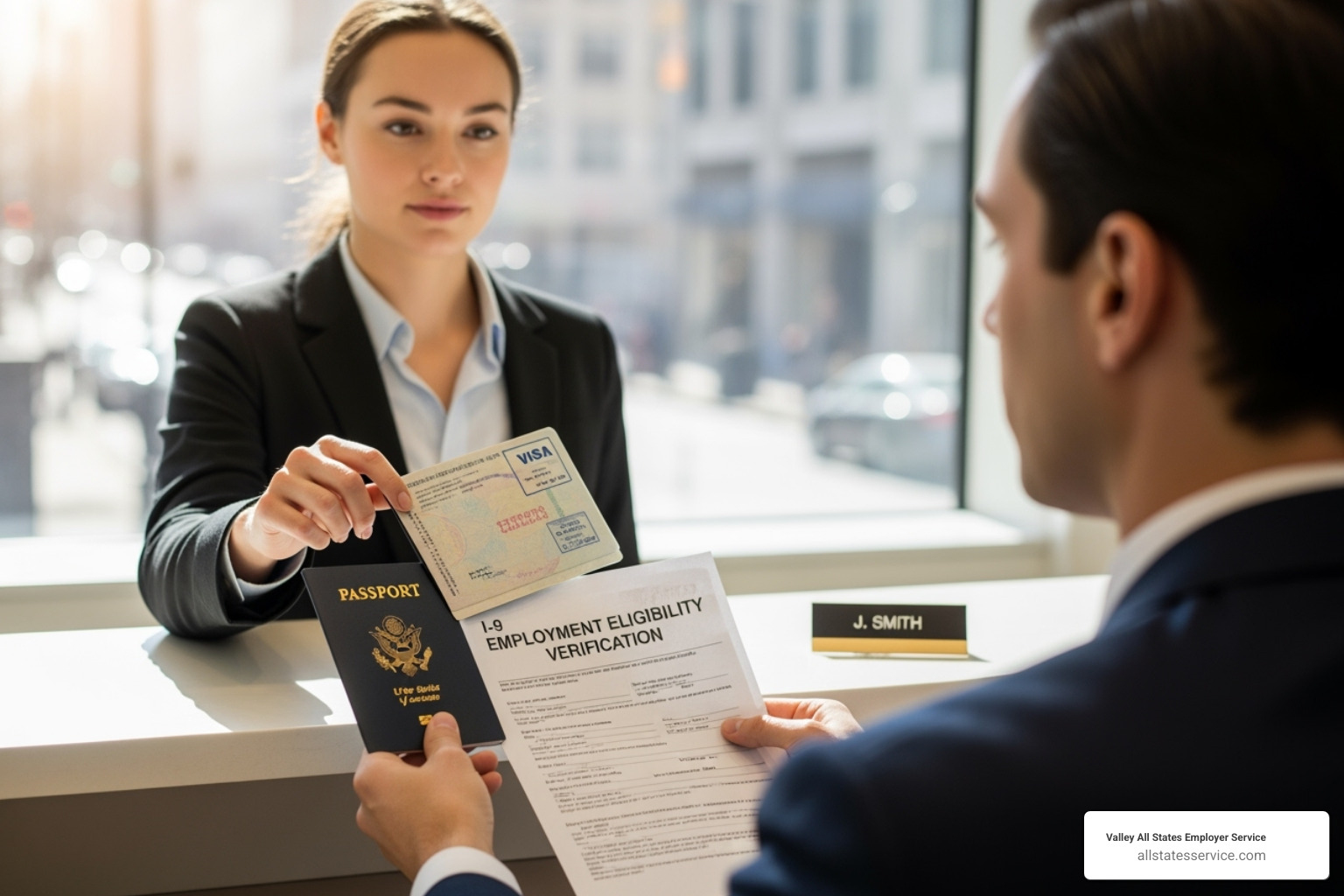
- List A includes a U.S. passport or passport card, permanent resident card, and employment authorization document (Form I-766). These are one-document solutions.
- List B documents establish identity only. Examples include a driver’s license, school ID with photo, or military ID.
- List C documents establish work authorization only. Common examples are a U.S. Social Security card (without employment restrictions) or a U.S. birth certificate.
If an employee lacks a List A document, they must present one document from List B and one from List C.
Handling Receipts and Reverification
If an employee’s documents are lost, stolen, or damaged, they can present a receipt for a replacement document, which is acceptable for 90 days.
Reverification is required when an employee’s work authorization is set to expire. You use Section 3 of the Form I-9, but not all employees need reverification. U.S. passports and permanent resident cards do not require it. However, an employment authorization document with an expiration date does. For complex cases, our I-9 Verification Assistance can help.
Form I-9 Retention and Storage Rules
You must keep completed I-9 forms for three years from the hire date or one year after termination, whichever is later. A tracking system is crucial to avoid penalties.
Forms must be available for inspection by government officials upon request. Storage, whether physical or electronic, must be secure and accessible. A Compliance Management System automates retention tracking and keeps records organized, avoiding the risks of manual management.
The Next Level: Integrating E-Verify with Your Process
Work authorization verification often involves two steps: Form I-9 and E-Verify. E-Verify adds a layer of confirmation by checking Form I-9 information against Department of Homeland Security (DHS) and Social Security Administration (SSA) databases. Our guide on E-Verify and I-9 explains how they work together.
After completing Form I-9, you enter the employee’s information into E-Verify. The system usually returns an instant “Employment Authorized” result. If information doesn’t match, it issues a Tentative Nonconfirmation (TNC). This indicates a discrepancy the employee must resolve with the relevant agency. Failure to resolve it results in a Final Nonconfirmation (FNC), meaning the person is not authorized to work.
E-Verify is mandatory for many employers, including certain federal contractors and employers in states with specific mandates. The official E-Verify I-9 CentralE-Verify site lists current requirements.
E-Verify Best Practices and Requirements
Using E-Verify means following strict rules.
- Timing: You must submit cases by the third business day after a new hire’s start date.
- Notices: You must display the official “Right to Work” and “E-Verify Participation” posters.
- Record Keeping: You must record the case verification number on the employee’s Form I-9 or attach the case details printout.
- Consistency: You must use E-Verify for all new hires, not selectively. It cannot be used to pre-screen applicants.
Our E-Verify Best Practices guide dives deeper into these E-Verify Employer Requirements.
Using an E-Verify Employer Agent
Managing E-Verify in-house can be overwhelming. Outsourcing verification to an E-Verify Employer Agent provides expert compliance support without the overhead of a full-time hire.
The primary benefits are reducing administrative burden and minimizing errors. Your team is freed from data entry and case monitoring, while experts catch potential issues. Professional agents stay current on constantly evolving E-Verify rules, so you don’t have to.
Our E-Verify Employer Agent Service takes the complexity out of verification. We handle data entry, case monitoring, and compliance tracking. Learn more about our Third-Party I-9 Verification services.

Navigating Complex Scenarios in Work Authorization Verification
Real-world work authorization verification can be complex. While the standard I-9 process is common, some immigration statuses require special handling. Understanding these cases is essential for compliance.
Immigration law changes frequently. A court order can suddenly extend work authorization for a group of employees, altering your reverification deadlines. Temporary Protected Status (TPS) and Deferred Enforced Departure (DED) are dynamic humanitarian programs where work authorization is often extended automatically, sometimes at the last minute.
Verifying Employees with TPS or DED
For example, a court order on March 31, 2025, automatically extended certain EADs for Venezuelans with TPS until April 2, 2026. Reverification for these employees is now due by April 3, 2026, not the date on their card. The official Compliance with Court Order Regarding 2023 Designation of TPS Venezuela guidance has details.
Similarly, DED for Hong Kong residents was extended to February 5, 2027. Certain EADs are automatically extended, with reverification due before February 6, 2027. To manage these cases, monitor official updates. The I-9 Central TPS page is a key resource. Our Workforce Eligibility Verification service can help.
Verifying Specific Immigration Statuses
Other immigration categories also require special handling during work authorization verification.
- Parolees, such as certain Afghans and Ukrainians, may present an unexpired Form I-94 as temporary proof of work authorization, valid for 90 days. After that, they must provide an EAD or a List B and C document combination. See the official guidance for specifics.
- Refugees can present a Form I-94 with a refugee stamp or a Refugee Travel Document (Form I-571) as a List A document.
- Minors under 18 who cannot present a List B document have special rules. A parent or guardian can complete Section 2 for them.
- Individuals with disabilities follow the same rules, but employers must provide reasonable accommodations to ensure the process is accessible.
A Comparative Look: U.S. vs. Canadian Verification
While the U.S. and Canada share a border, their approaches to work authorization verification are very different. The U.S. uses a “document-centric” approach centered on Form I-9 and its document lists, with E-Verify adding another layer of database checks.
Canada uses a “status-centric” approach. Employers confirm legal entitlement to work, mainly by checking a person’s Social Insurance Number (SIN) and work permit. A SIN starting with ‘9’ indicates a temporary resident who requires a valid work permit.
| Feature | United States | Canada |
|---|---|---|
| Primary Verification Tool | Form I-9, E-Verify (for many employers) | Social Insurance Number (SIN), Work Permits |
| Focus | Document-centric (List A, B, C) | Status-centric (legal entitlement to work) |
| Employer Obligation | Verify identity & work authorization via I-9 | Confirm legal entitlement to work (e.g., valid SIN, work permit) |
| Legal Framework | Immigration and Nationality Act (INA), IRCA | Immigration and Refugee Protection Act, Provincial Human Rights Codes |
| Discrimination | Enforced by DOJ (IER) | Enforced by Human Rights Commissions/Tribunals |
The U.S. operates under the Immigration and Nationality Act and IRCA, while Canada follows the Immigration and Refugee Protection Act. Both countries take discrimination seriously, but enforcement differs. A Canadian court decision, 2023 ONCA 364, emphasized asking about “legal entitlement to work” rather than citizenship status.
The key lesson from both countries is to verify work authorization fairly. Accept valid documents, don’t ask for more than needed, and focus on eligibility, not national origin.
Frequently Asked Questions about Employment Verification
Here are answers to common questions about work authorization verification.
How can an individual check their own work authorization status?
Employees can check their own status using Self Check, a free service from myE-Verify. It allows individuals to check their information against the same DHS and SSA databases used by E-Verify. If a mismatch occurs, it provides instructions for correction.
Proactive use of Self Check can prevent TNCs for authorized workers. You cannot require applicants to use this service; it is voluntary.
What are the rules for verifying remote employees?
Remote work has changed verification. DHS now has alternative procedures that don’t require in-person document examination. E-Verify employers in good standing can examine documents remotely via live video. The employee shows their documents on camera for real-time inspection, and you must retain copies.
Our guides on Remote Form I-9 and I-9 for Remote Employees explain how to do this compliantly.
What happens if an employee presents an expired document?
Generally, you cannot accept expired documents for Form I-9. However, there are key exceptions:
- U.S. Passports are always acceptable for I-9 purposes, regardless of the expiration date.
- Certain military IDs may also be acceptable when expired.
- The most complex exception is automatically extended EADs for groups like TPS beneficiaries.
The key is to know when an “expired” document remains valid. If a document is truly expired and not subject to an extension, the employee must provide a different, valid one. If their work authorization itself has expired, you must reverify using Section 3.
Simplify Your Compliance Journey
Work authorization verification is complex. Keeping up with changing immigration rules, court orders, and anti-discrimination laws can be overwhelming for any HR professional. Juggling regulations for TPS extensions or parolees, while worrying about fines and lawsuits, makes compliance feel like a minefield.

It doesn’t have to be this stressful. You can outsource these challenges to experts who specialize in immigration compliance and know how to handle every E-Verify scenario.
At Valley All States Employer Service, we make your compliance journey smooth. We handle the details so you can focus on your business and your team. Our Automated Eligibility Verification System removes the guesswork from I-9 and E-Verify processing, ensuring accuracy and timeliness.
With us, you get expert assistance from specialists who catch errors, track regulatory changes, and provide the peace of mind that your workforce is compliant. Ready to turn your compliance challenges into someone else’s specialty? Get expert help with employment verification in Maryland and find what it feels like to have true compliance confidence.