
A Complete Guide to the USCIS Approved I9 List
Why Knowing the Approved Documents for I9 Matters for Every U.S. Employer
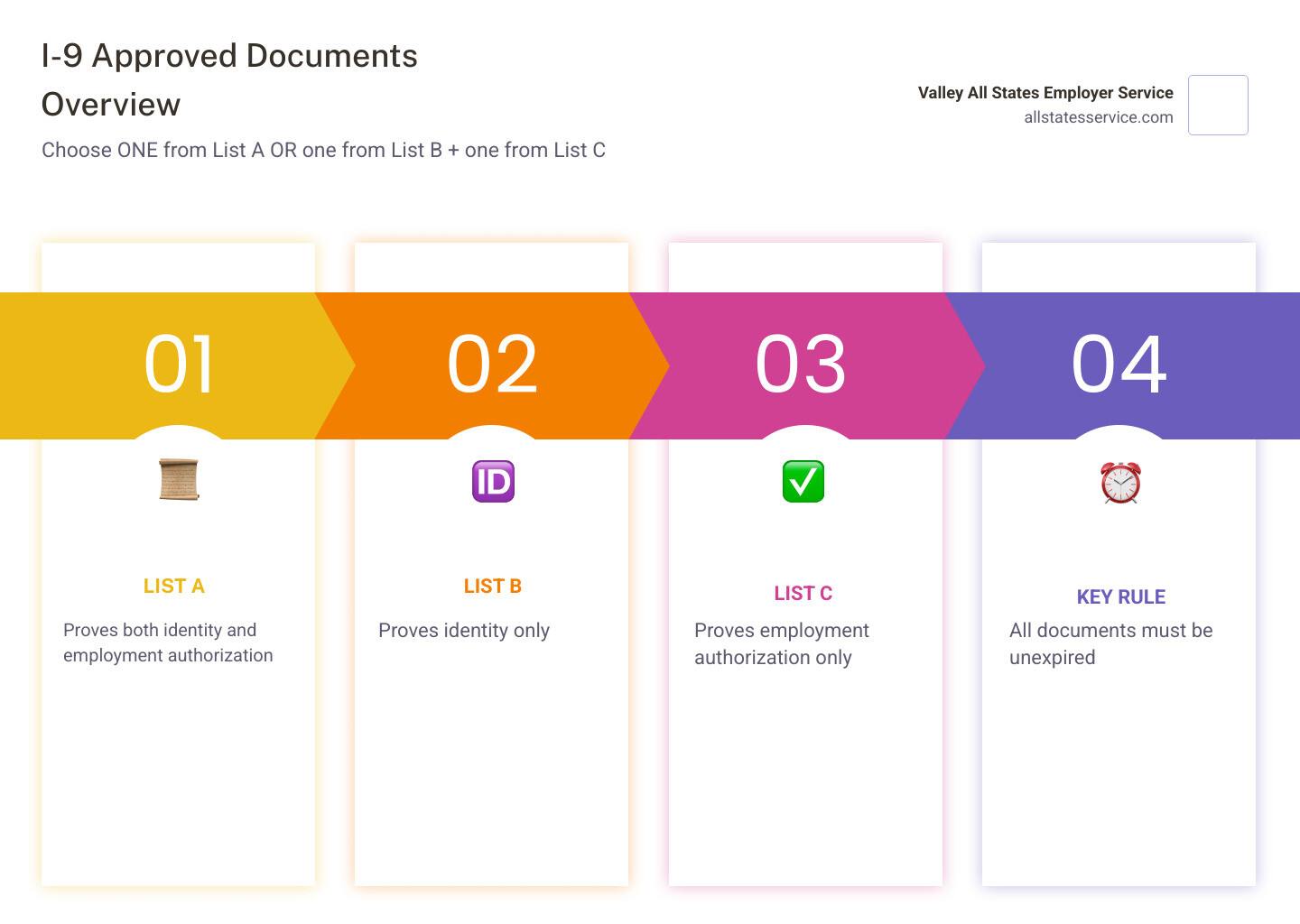
The approved documents for i9 verification fall into three categories, and every U.S. employer must collect them correctly for every new hire. Here’s a quick overview:
Employees must present either:
| Option | What to Present |
|---|---|
| Option 1 | One document from List A (proves both identity AND work authorization) |
| Option 2 | One document from List B (identity) + one from List C (work authorization) |
Common List A documents include:
- U.S. Passport or Passport Card
- Permanent Resident Card (Form I-551)
- Employment Authorization Document (Form I-766)
All documents must be unexpired (unless extended by the issuing authority).
Federal law has required employers to verify the identity and work eligibility of every new hire since November 6, 1986. The tool for doing that is Form I-9, and getting it wrong can mean real penalties.
For a busy HR team, the hardest part isn’t the form itself. It’s knowing which documents are actually acceptable, what the rules are around expired papers, receipts, and minors, and how to stay compliant without slowing down your onboarding process.
This guide breaks all of it down clearly, so your team can move fast and stay compliant.
Understanding the Three Lists of Approved Documents for I9
When we talk about the approved documents for i9, we are looking at a very specific menu of items authorized by U.S. Citizenship and Immigration Services (USCIS). These documents are divided into three distinct lists, each serving a specific legal purpose.
- List A: These are the “all-in-one” documents. They prove who the person is and that they have the right to work in the United States.
- List B: These documents only prove identity. If an employee uses a List B item, they must also provide something from List C.
- List C: These documents only prove employment authorization. They must be paired with a List B item.
One of the most important rules to remember is that all documents must be unexpired. However, there is a small caveat: if an issuing authority (like USCIS) has officially extended a document, it is still considered “unexpired” for I-9 purposes even if the date on the card has passed.
Employers must ensure that the Form I-9 Acceptable Documents list is available to employees during the hiring process. This helps prevent confusion and ensures everyone knows their rights. If you want to dive deeper into the nuances of these requirements, you can learn more about I-9 document requirements on our blog.
List A: Documents Establishing Identity and Employment Authorization
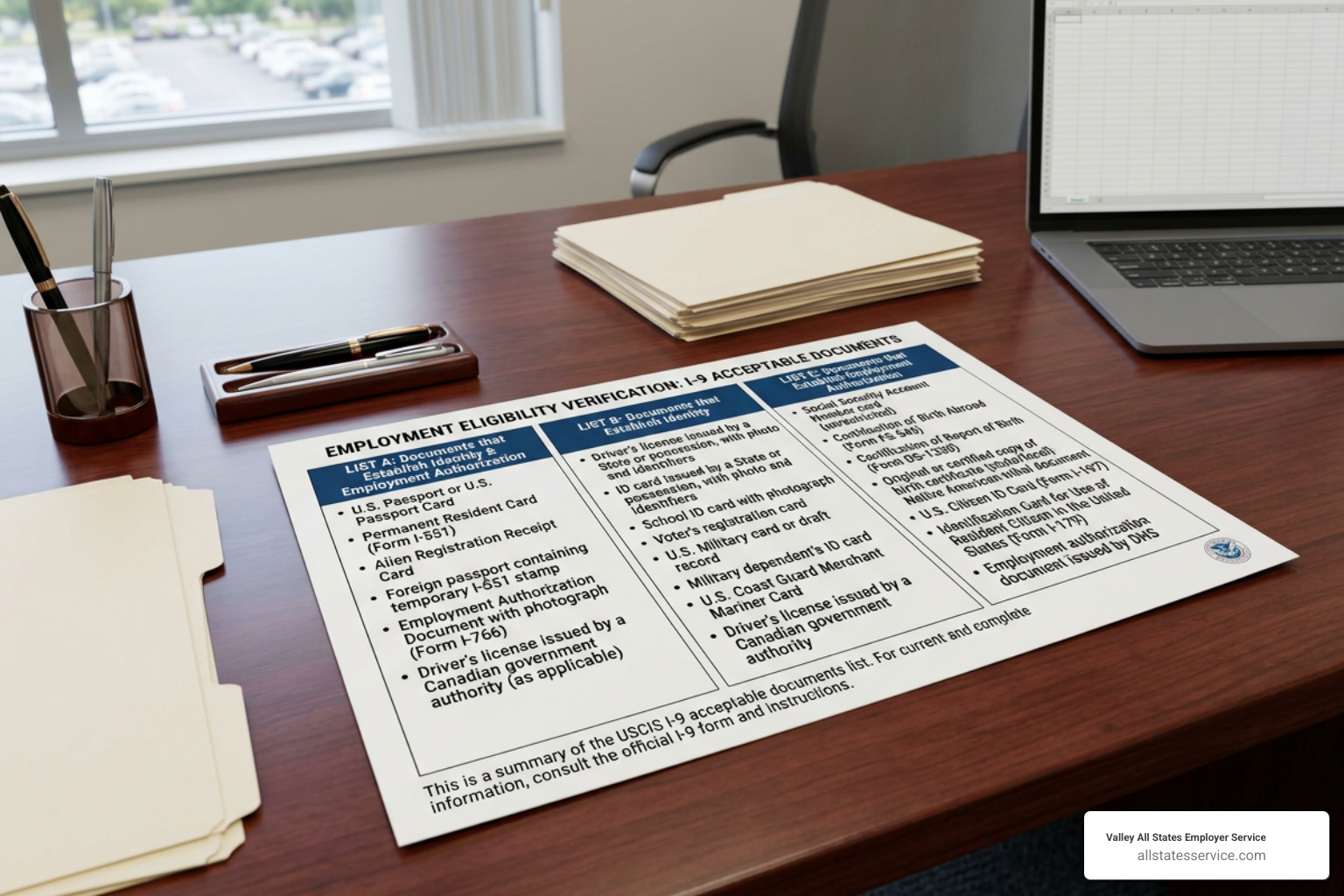
List A documents are the most straightforward for employers because they satisfy all requirements in one go. If an employee presents a valid List A document, you should not ask for anything else.
The most common List A documents include:
- U.S. Passport or U.S. Passport Card: These are gold standard documents for U.S. citizens and non-citizen nationals.
- Permanent Resident Card (Form I-551): Commonly known as a “Green Card.” USCIS redesigns these every few years to prevent fraud, so older versions may look different but are still valid until they expire.
- Employment Authorization Document (Form I-766): Often called an EAD, this contains a photograph and is issued to non-citizens authorized to work in the U.S.
- Foreign Passport with a Temporary I-551 Stamp: This serves as temporary evidence of permanent residence.
- Foreign Passport with Form I-94: This is used by non-immigrants authorized to work for a specific employer because of their status (like an H-1B visa holder).
For a detailed breakdown of these items, the 13.1 List A Documents | USCIS page is an excellent resource. You can also read our guide to List A documents for practical tips on spotting genuine versions of these papers.
List B and List C: Proving Who You Are and Your Right to Work
If an employee doesn’t have a List A document, they must provide a combination: one from List B and one from List C. This “B+C” combo is very common, especially for young workers or those who haven’t traveled internationally.
As an employer, you are required to physically examine these documents to ensure they reasonably appear to be genuine and relate to the person presenting them. This means looking at the photo, checking for tampering, and verifying that the names match.
When you check acceptable documents for Section 2, you cannot specify which documents the employee chooses. If they want to give you a state ID and a birth certificate, you cannot demand a passport instead.
Key List B Identity Documents
List B documents are all about identity. For most adults, this is a state-issued driver’s license. However, there are many other options:
- Driver’s License or ID Card: Issued by a state or outlying possession of the U.S., provided it contains a photograph or identifying information (name, date of birth, gender, height, eye color, and address).
- School ID with a Photograph: Very common for students.
- Voter’s Registration Card: A valid way to prove identity, though it lacks a photo.
- U.S. Military Card or Draft Record: Official government-issued military identification.
- Military Dependent’s ID Card: For family members of service personnel.
If you are unsure about what to bring to your first day of work, you can find out what I-9 documents you need to make the process smoother.
List C Approved Documents for I9 Employment Authorization
List C documents prove that the person has the legal right to work in the U.S. They do not prove identity, which is why they must be paired with List B.
The most frequent List C items include:
- Unrestricted Social Security Card: This is a big one. However, if the card says “NOT VALID FOR EMPLOYMENT” or “VALID FOR WORK ONLY WITH DHS AUTHORIZATION,” it is not an approved List C document.
- Birth Certificate: An original or certified copy of a birth certificate issued by a state, county, municipal authority, or territory of the U.S. bearing an official seal.
- Consular Report of Birth Abroad (Form FS-240): For U.S. citizens born outside the country.
- Native American Tribal Document: Accepted for both identity (List B) and work authorization (List C), though usually used for the latter.
The 13.3 List C Documents | USCIS section provides more technical details. For a simplified overview, you can view the guide to federal I-9 documents on our site.
Special Rules for Receipts and Minors
Sometimes, life happens. Documents get lost, stolen, or damaged. In these cases, USCIS allows for the use of “receipts” in place of the actual document for a temporary period.
An acceptable receipt is usually a document showing that the employee has applied for a replacement. This receipt is typically valid for 90 days. By the end of that period, the employee must present the actual original document. Receipts are generally not acceptable if the employment lasts less than three business days.
What About Minors?
If you are hiring someone under the age of 18 who does not have a standard List B document (like a driver’s license or school ID), there are special rules. We can accept:
- School records or report cards.
- Clinic, doctor, or hospital records.
- Daycare or nursery school records.
If a minor cannot provide any of these, a parent or legal guardian can complete the identity section of the Form I-9 on their behalf. To learn more about these edge cases, explore our eligibility documents guide.
Employer Compliance: Timelines, Retention, and Avoiding Discrimination
Compliance isn’t just about the documents; it is about the process. There are strict timelines that we must follow to avoid hefty fines.
- Section 1: The employee must complete this no later than their first day of work.
- Section 2: The employer must complete this within three business days of the employee’s first day of work. For example, if they start on Monday, you must finish Section 2 by Thursday.
- Retention: You must keep the Form I-9 for either three years after the date of hire or one year after the date employment ends, whichever is later.
Avoiding Discrimination
One of the biggest mistakes employers make is “over-documenting.” If an employee gives you a valid U.S. Passport (List A), you cannot ask to see their Social Security card “just to be safe.” This can be seen as a form of discrimination. The law says the employee gets to choose which approved documents for i9 they want to present.
Supplement B and Reverification
Some work authorizations expire. When this happens, we use Supplement B (formerly Section 3) to reverify that the employee is still eligible to work. U.S. citizens and lawful permanent residents with “Green Cards” generally do not need reverification, but those on temporary work visas do.
For more on these procedures, the E-Verify Handbook for Employers is a great resource. You can also see the ultimate guide to acceptable documents for a comprehensive look at the whole lifecycle of the I-9 form.
Frequently Asked Questions about Approved Documents for I9
Can I use an expired passport for my I-9?
Generally, no. All documents must be unexpired. The only exception is if the document has been officially extended by the issuing authority, such as certain Permanent Resident Cards or EADs that are extended via a Form I-797 Notice of Action.
What is Supplement B and when is it required?
Supplement B is used for reverification and rehires. If an employee’s work authorization expires, you use this section to record their new document information. It is also used if you rehire an employee within three years of the date their previous Form I-9 was completed.
Which edition of Form I-9 is currently valid?
As of early 2025, the valid edition date is 01/20/25. However, the 08/01/23 edition is still acceptable through certain transition periods. Always check the bottom of the form for the edition date to ensure you are using the most current version.
Summary of Workforce Eligibility
Managing the approved documents for i9 can feel like a full-time job, especially as immigration rules and document designs change. That is where we come in.
At Valley All States Employer Service, we specialize in taking the weight of E-Verify and I-9 compliance off your shoulders. We provide expert, impartial, and efficient E-Verify processing that minimizes errors and reduces the administrative burden on your HR team. Whether you are in Maryland or anywhere else in the United States, we help ensure your workforce is eligible and your business is protected.
Ready to simplify compliance and stop worrying about audits? Ready to simplify compliance? Visit our E-Verify and I-9 service page to see how we can help your business thrive.