
The Secret Sauce to Handling I-797C Notices During I-9 Reverification
Why Getting I-9 Reverification Form I-797C Right Could Save Your Business
I-9 reverification form i-797c is one of the trickiest compliance tasks HR teams face, and getting it wrong can lead to serious penalties.
Here’s the short version of what you need to know:
- Form I-797C is a USCIS Notice of Action (a receipt notice) that can serve as a List A document for I-9 purposes when paired with an expired Employment Authorization Document (EAD)
- Eligible employees get an automatic extension of their work authorization, either 180 days or up to 540 days, depending on when they applied
- A temporary final rule effective May 4, 2022 increased that extension from 180 days to 540 days for certain EAD renewal applicants
- Between May 4 and June 2, 2022, USCIS accidentally printed the old 180-day language on some I-797C notices, creating confusion for employers
- Employers who received those incorrect notices still had to honor the full 540-day extension and may need to update their I-9 records
This matters because if you miss a reverification deadline or fill out Section 2 incorrectly, your business is exposed to compliance risk during an ICE audit.
The good news? Once you understand the rules, the process is straightforward. Let’s walk through exactly how to handle it.
Understanding the I-9 Reverification Form I-797C Process
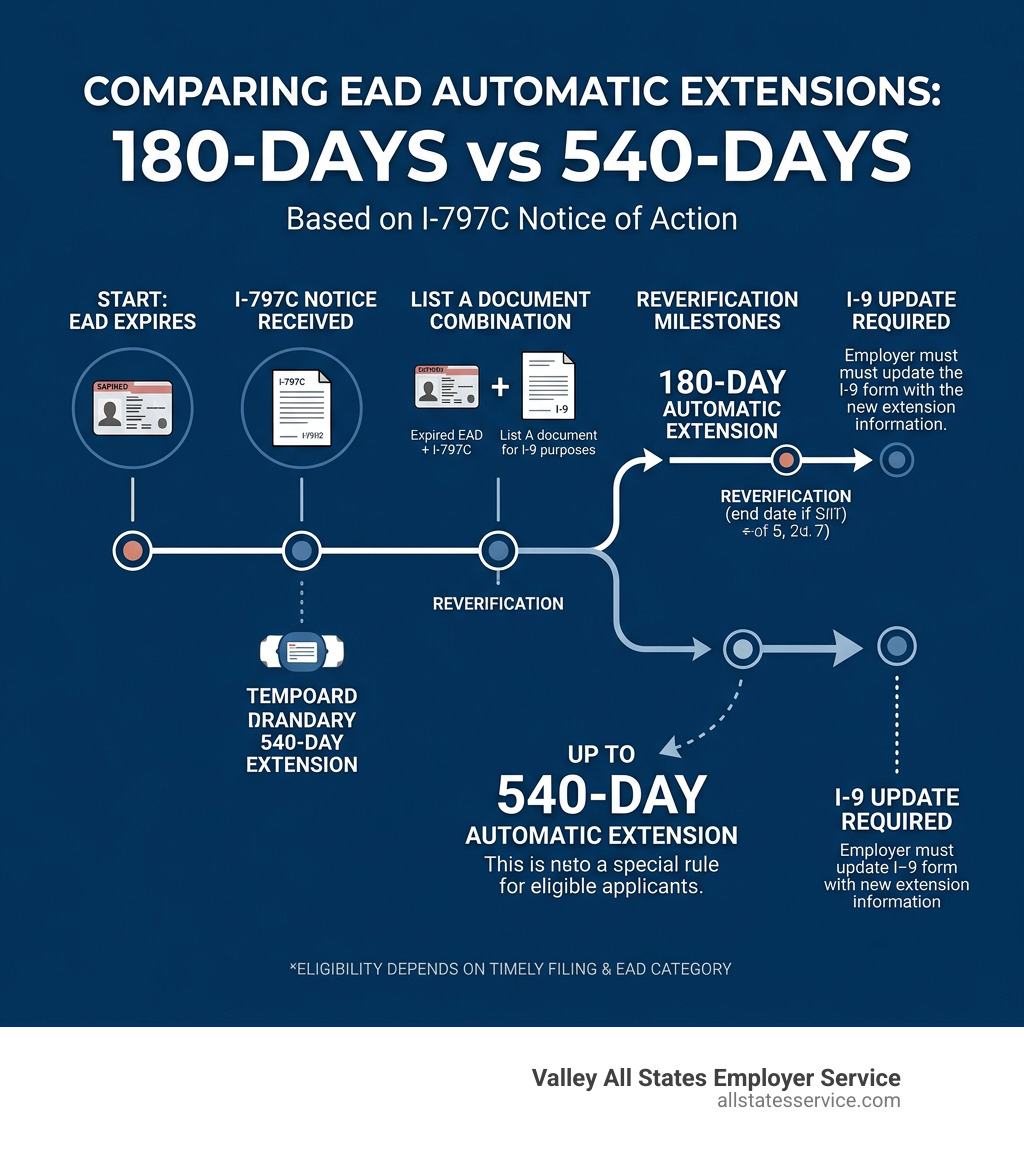
When we talk about the i-9 reverification form i-797c, we are really talking about how to handle a specific piece of paper that tells us an employee’s work permit is still valid, even if the date on their plastic card says otherwise. Form I-797C, Notice of Action, is the receipt USCIS sends out when someone applies to renew their Employment Authorization Document (EAD).
For many years, this receipt only provided a 180-day extension. However, due to massive processing backlogs, USCIS implemented a temporary final rule that boosted this to a 540-day extension for certain categories. To use this as a List A document, the employee must present the I-797C along with their expired EAD. The “Category” code on the EAD (like C08 or A05) must match the “Class Requested” on the I-797C.
There are specific automatic EAD extension eligibility requirements that must be met. For instance, the renewal application must have been filed before the current EAD expired. If an employee comes to you with a card that looks expired, don’t panic. If they have that golden ticket, the I-797C, they may still be perfectly legal to work. You can find more info about expired documents to help you distinguish between a document that is truly “dead” and one that has been “resurrected” by a USCIS extension.
Managing the 540-Day Extension for New and Current Hires
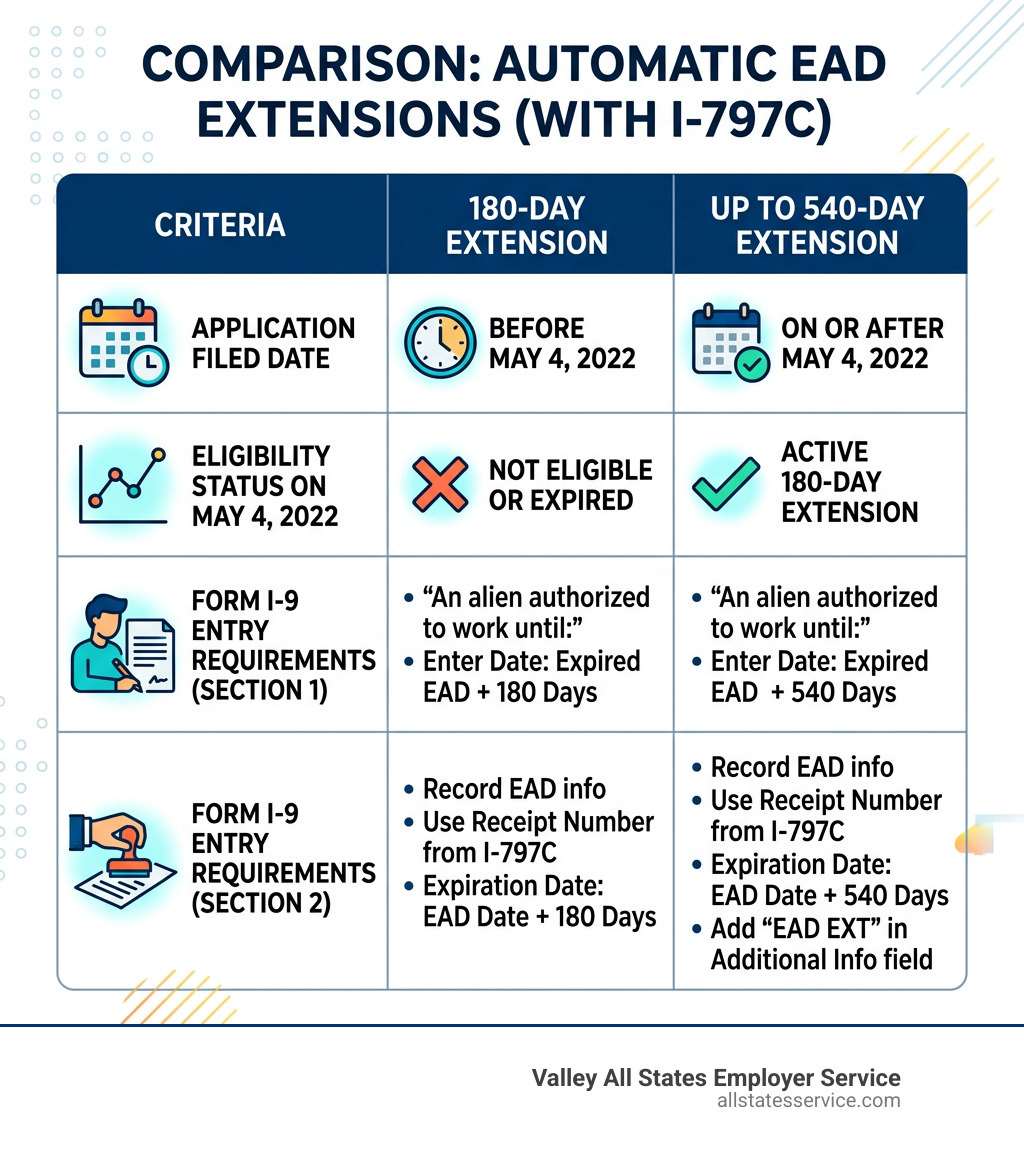
The jump from 180 days to 540 days was a game-changer for HR compliance. This rule, known as 87 FR 26614, was designed to keep people working while the government caught up on paperwork. It applies to certain renewal applicants who filed their Form I-765 on or after May 4, 2022, or those whose 180-day extension was still active on that date.
When you are hiring someone new who is in this boat, they need to complete Section 1 of the Form I-9 by checking the box for “An alien authorized to work until” and entering the date that is 540 days from the “Card Expires” date on their EAD. As the employer, you have to do some math in Section 2.
Updating Section 2 for an i-9 reverification form i-797c
In Section 2, you will record the expired EAD information. Under the document title, you list the EAD. Then, you record the receipt number from the Form I-797C. For the expiration date, you don’t put the date printed on the card. Instead, you enter the date that is 540 days after the card’s expiration.
To make sure your math is perfect, we highly recommend using the EAD Automatic Extension Calculator provided by USCIS. Once you have that date, you should also write “EAD EXT” in the Additional Information field. Keeping your records straight is vital, so check out more info about I-9 updates to see how these changes fit into the bigger picture of your compliance file.
Handling the 540-Day Update for i-9 reverification form i-797c
Between May 4 and June 2, 2022, USCIS had a bit of a “printing oopsie.” They issued I-797C notices that still mentioned the old 180-day extension instead of the new 540-day rule. If your employee brings you one of these “incorrect” notices, you must still grant them the full 540 days if they are in an eligible category.
If you already recorded a 180-day extension and the employee later shows you a corrected notice, or if you realize the mistake, you need to update the Form I-9. You don’t necessarily need a whole new form. In the Section 2 “Additional Information” box, you should draw a line through the old date, enter the new 540-day expiration date, and write “EAD EXT” along with your initials and the date of the change.
Special Rules for Dependent Spouses and TPS Categories
Not every EAD category gets the same treatment. There are specific rules for dependent spouses, specifically those in categories A17 (E dependent spouses), A18 (L-2 dependent spouses), and C26 (certain H-4 dependent spouses). For these folks, the i-9 reverification form i-797c isn’t enough on its own. They also need to show an unexpired Form I-94 showing their valid nonimmigrant status.
The automatic extension for these spouses is only valid until the earlier of two dates: the end of the 540-day (or 180-day) extension period, or the expiration date on their Form I-94. This means you have to check two different documents to find the “real” expiration date.
Temporary Protected Status (TPS) beneficiaries also have unique rules. Sometimes USCIS extends TPS EADs through a Federal Register notice rather than individual I-797C forms. In these cases, the “Class Requested” on the receipt might be A12 or C19, and it doesn’t always have to match the category on the physical card. You should always refer to Section 4.4 of the M-274 for the most detailed category-specific guidance.
How to Complete Supplement B for Reverification
When an automatic extension finally runs out, or if an employee’s initial work authorization expires, you must perform a formal reverification. In the past, this was done in Section 3 of the Form I-9. On the newest version of the form, this has been moved to Supplement B, Reverification and Rehires.
To complete Supplement B, you must:
- Examine a new, unexpired document from List A or List C.
- Record the document title, number, and expiration date.
- Sign and date the supplement.
We suggest reminding your employees at least 90 days before their extension or authorization expires. This gives them plenty of time to get their new documents in order. If you are bringing back an old employee, you can also use this supplement for rehires if they return within three years of the original form’s completion. You can find more info about rehires to ensure you aren’t making more work for yourself than necessary.
Frequently Asked Questions
What happens if the automatic extension expires before the new EAD arrives?
If the 540-day or 180-day extension period ends and the employee has not received their new EAD, they are generally no longer authorized to work. You must stop their employment until they can provide a new, valid document from List A or List C. Continuing to employ someone after their authorization expires can lead to heavy fines.
Can I accept a Form I-797C receipt for a lost or stolen EAD?
Yes, but this falls under the “Receipt Rule.” If an employee loses their EAD, they can present the I-797C as a receipt for a replacement document. This allows them to work for 90 days. By the end of that 90-day period, they must show you the actual replacement card. This is different from the automatic extension rule, which allows for much longer work authorization.
Do I need to reverify Lawful Permanent Residents who present an I-551?
Generally, no. You should not reverify U.S. citizens or Lawful Permanent Residents (LPRs) who presented a “Green Card” (Form I-551). Even if the physical card expires, their status as a permanent resident does not. However, if an LPR presents a temporary I-551 stamp in a passport or on a Form I-94, that does require reverification when the stamp expires.
Mastering Compliance with Valley All States Employer Service
Handling the i-9 reverification form i-797c is just one piece of the massive compliance puzzle. Between shifting USCIS rules, temporary final regulations, and the technicalities of Supplement B, it is easy for a busy business to make a mistake.
That is where we come in. Valley All States Employer Service provides outsourced E-Verify workforce eligibility verification for employers. We operate as your expert partner in the HR services industry, offering impartial and efficient processing that minimizes errors. Our goal is to take the administrative burden off your shoulders so you can focus on growing your business.
By letting us handle your E-Verify and I-9 needs, you significantly reduce your risk of fines during an audit. We stay on top of every USCIS update, from the May 2022 extension rule to the latest version of the I-9 form, ensuring your records are always “audit-ready.”
Ready to simplify compliance? Simplify your I-9 and E-Verify process with our expert team today and breathe a sigh of relief.