Why HR Compliance Assistance Matters More Than Ever
HR compliance assistance helps businesses steer complex employment laws, avoid costly penalties, and build compliant workplaces through expert guidance, technology tools, and outsourced support services.
Quick Answer: Top HR Compliance Assistance Options
- HR Software – Automates updates, stores documents, tracks legal changes
- Outsourced HR Services – Provides on-demand access to compliance experts
- Government Resources – Free tools from DOL, EEOC, and state labor offices
- Compliance Consulting – Custom guidance for specific business needs
- Professional Employer Organizations (PEOs) – Comprehensive HR management and compliance
If you’re among the many HR managers feeling overwhelmed by compliance, you’re not alone. The numbers tell a sobering story: only one-third of organizations take a proactive approach to compliance, while most rely on outdated or reactive processes. Even more concerning, one in three organizations faced an enforcement action in the past year.
The stakes are high. In 2024 alone, the EEOC recovered nearly $700 million in relief for discrimination victims. That’s not just a statistic; it represents real businesses that got compliance wrong and paid dearly for it.
The problem is getting harder, not easier. Federal, state, and local employment laws are constantly evolving. Remote work has added layers of complexity with multi-state workforce issues. And according to recent research, while 78 percent of employers say they feel well-prepared, nearly half admit their compliance efforts are underfunded.
Here’s the reality: 95% of employers who aren’t complying simply don’t know their obligations. They’re not intentionally breaking the law. They’re just trying to run their businesses without the resources to keep up with over 250 annual changes in employment law.
But there’s good news. You don’t have to steer this alone. HR compliance assistance comes in many forms, from affordable software solutions to expert consulting services. The right support can reduce your time spent on HR research by up to 99% and cost less than hiring a lawyer.
Getting the right help is the key to protecting your business and building a workplace that’s both compliant and resilient.
Find more about hr compliance assistance:
What is HR Compliance and Why Is It So Critical?
HR compliance is the comprehensive process of aligning your business’ human resources policies, procedures, and practices with all applicable federal, state, and local employment laws and regulations. It is not merely about ticking boxes; it is about creating a fair, safe, and legal workplace for everyone.
Beyond simply avoiding penalties, strong HR compliance fosters a positive working environment. When employees feel protected and treated fairly, it improves staff retention, improves employee wellbeing, and ultimately boosts productivity. For us, this means building a foundation of trust and respect that benefits everyone.
The financial consequences of getting HR compliance wrong can be steep. We have seen that in 2024, the U.S. Equal Employment Opportunity Commission (EEOC) recovered nearly $700 million in relief for discrimination victims. This figure underscores the critical importance of proactive compliance. It is a stark reminder that neglecting HR compliance can lead to massive financial losses and significant reputational damage.
Want to understand your potential risks? Consider a thorough HR Compliance Risk Assessment.
The Pillars of HR Compliance
HR compliance touches every aspect of the employee lifecycle within your organization. Here are the core pillars we focus on:
- Recruitment and Hiring: Ensuring fair hiring practices, non-discriminatory job postings, proper background checks, and compliant onboarding processes, including I-9 verification.
- Compensation and Benefits: Adhering to minimum wage, overtime rules, pay equity, and proper administration of benefits like health insurance and leave policies.
- Employee Relations: Managing performance, disciplinary actions, terminations, and workplace investigations in a legally sound and equitable manner.
- Health and Safety: Maintaining a safe workplace environment, complying with Occupational Safety and Health Administration (OSHA) standards, and addressing workplace injuries and illnesses.
- Recordkeeping and Documentation: Properly maintaining employee files, payroll records, and other essential documentation as required by law.
Understanding these pillars is the first step towards a compliant operation. For a deeper dive into the legal landscape, explore Employment Law Laws.
Consequences of Non-Compliance
Ignoring HR compliance is like driving without insurance: you might get away with it for a while, but the consequences of an accident can be devastating. For businesses, these consequences include:
- Hefty Fines and Penalties: Government agencies, both federal and state, can impose significant fines for violations of employment laws. These can accumulate quickly and severely impact your bottom line.
- Costly Lawsuits: Employees or former employees can file lawsuits for discrimination, wrongful termination, wage and hour violations, and other non-compliance issues. Legal defense fees alone can be crippling, even if you win.
- Government Audits: Non-compliance can trigger audits from agencies like the Department of Labor, the EEOC, or state labor boards, which can be time-consuming, disruptive, and costly.
- Reputational Damage: News of compliance failures can quickly spread, damaging your brand’s reputation, making it harder to attract talent, and eroding customer trust.
- Decreased Employee Morale: A workplace perceived as unfair or unsafe due to compliance breaches can lead to low morale, high turnover, and reduced productivity.
The goal is always to Reduce Compliance Risk before it becomes a problem.
Top HR Compliance Challenges for US Businesses

The landscape of HR compliance in the United States is a dynamic and challenging one. Businesses operating across state lines, or even within a single state, face a constant barrage of evolving regulations. We’ve noticed that while many employers feel prepared, nearly half admit their compliance efforts are underfunded. This gap creates significant vulnerabilities.
One of the biggest problems is the sheer volume of changes. Laws regarding wages, benefits, worker classification, and anti-discrimination are constantly being updated at federal, state, and local levels. Add to this the complexities introduced by remote work, and you have a recipe for confusion. Managing a multi-state workforce means understanding and adhering to the laws of every state where your employees reside, not just where your business is headquartered.
Let’s explore some of the most pressing challenges we see for US businesses.
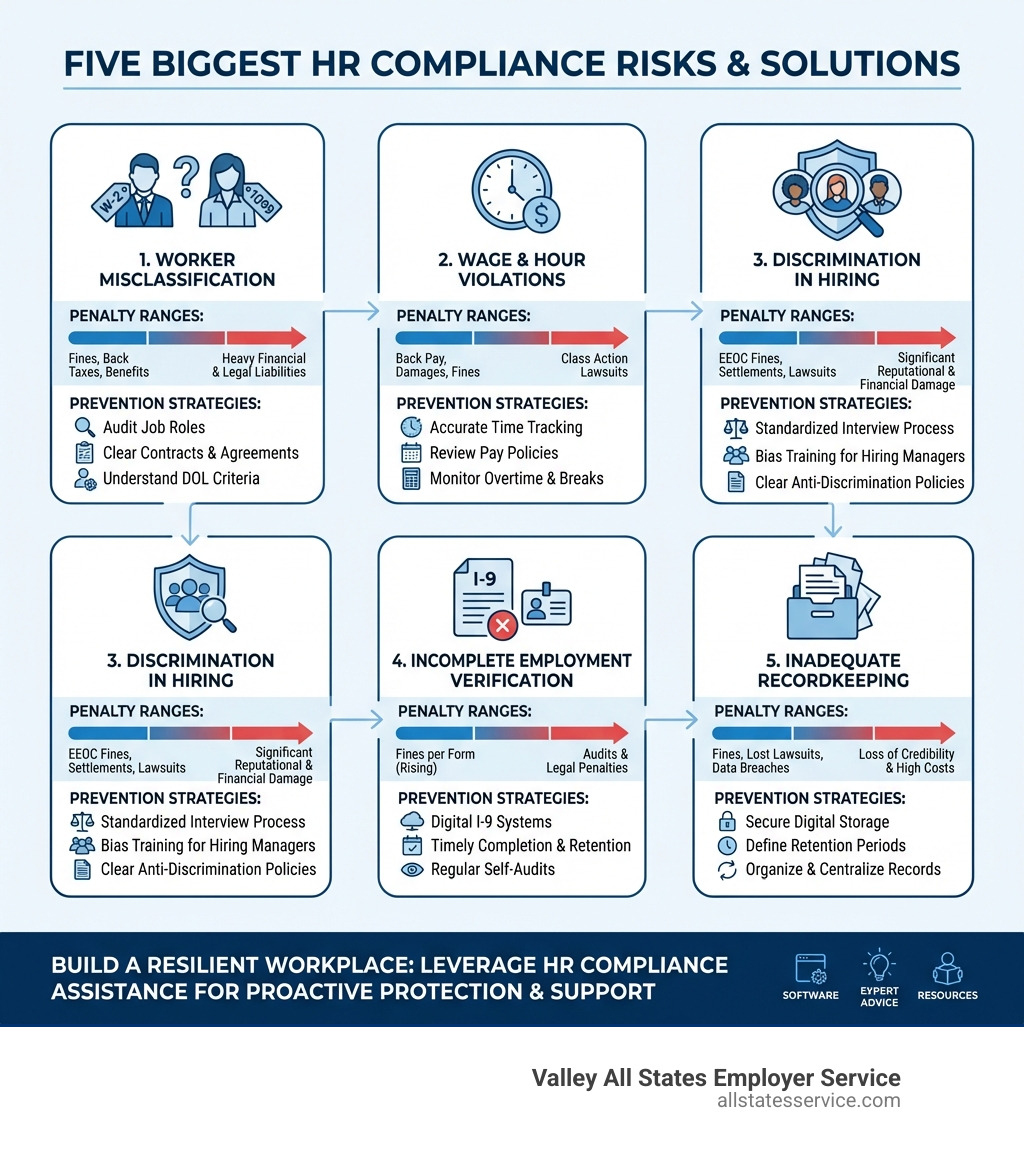
1. Worker Classification: Employee vs. Contractor
Correctly classifying your workers as either employees or independent contractors is paramount. Misclassification is a common and costly mistake, leading to significant tax implications and legal penalties.
- Tax Implications: Employees (W-2) require employers to withhold income taxes, pay Social Security, Medicare, and unemployment taxes. Independent contractors (1099) are responsible for their own self-employment taxes.
- Behavioral and Financial Control Factors: The IRS and state agencies use tests to determine classification, often looking at who controls how, when, and where the work is done (behavioral control) and who controls the business aspects of the worker’s job (financial control). The type of relationship, such as written contracts and benefits, also plays a role.
- State-Specific Rules: Some states have stricter tests. For example, California uses the “ABC test” which presumes a worker is an employee unless the hiring entity can prove otherwise.
The risks of misclassification include back taxes, penalties, and even potential lawsuits for unpaid wages and benefits. If you’re utilizing contractors, ensure you’re compliant. Learn more with our E-Verify 1099 Contractors Complete Guide.
2. Wage and Hour Laws
Wage and hour compliance is a cornerstone of federal and state employment law, primarily governed by the Fair Labor Standards Act (FLSA). This act sets standards for minimum wage, overtime pay, recordkeeping, and child labor.
- Federal vs. State Minimum Wage: While the federal minimum wage is $7.25 per hour, many states and even some cities have set their own, higher minimum wages. As an employer, you must pay the higher of the two.
- Overtime Calculation: Nonexempt employees must generally receive 1.5 times their regular rate of pay for all hours worked over 40 in a workweek. This can become complicated with various pay structures and bonuses.
- Exempt vs. Nonexempt Status: Employees are generally either “exempt” from overtime pay and minimum wage requirements or “nonexempt.” To be exempt, an employee must typically be paid on a salary basis, earn at least a specified minimum salary threshold, and primarily perform certain executive, administrative, or professional duties.
- Salary Threshold Changes: The minimum salary threshold for exempt employees is subject to periodic updates, making it crucial to stay informed to avoid misclassification.
Navigating these rules can be complex, especially if you have a diverse workforce. Many businesses find relief through Payroll Outsourcing Solutions.
3. Preventing Discrimination and Harassment
A fair and equitable workplace is not just good for morale; it’s legally mandated. The EEOC enforces protections against various forms of discrimination, including:
- Gender bias
- Race, color, religion, national origin
- Age (workers 40 and older are protected under the Age Discrimination in Employment Act)
- Disability
- Genetic information
Avoiding Bias in Hiring: Employers must be thoughtful about job applications and interview questions, steering clear of inquiries about protected characteristics like criminal history, salary history, age, or family status. We’ve even seen the EEOC secure a $365,000 settlement against a company whose AI tools unfairly screened out applicants in protected groups, highlighting the new frontier of algorithmic bias.
Creating Anti-Harassment Policies: A robust anti-harassment policy is essential. It should clearly define prohibited conduct, outline a clear complaint handling procedure, and state that corrective action will be taken when warranted. Provide regular training to employees so they understand how to protect themselves, support co-workers, and contribute to a respectful, harassment-free environment.
4. Employee Benefits and Leave
Providing competitive benefits and managing employee leave compliantly are critical components of HR.
- Affordable Care Act (ACA) Requirements: For employers with 50 or more full-time equivalent employees (FTEs), the ACA mandates that you offer health insurance or face potential penalties. For 2025, the Section 4980H(a) penalty is $2,900 per full-time employee (minus the first 30), and the Section 4980H(b) penalty is $4,350 per affected employee.
- Family and Medical Leave Act (FMLA): This federal law requires eligible employers to provide up to 12 weeks of unpaid, job-protected leave for certain family or medical reasons. While FMLA is federal, many states have their own, often more generous, family and medical leave laws.
- State-Mandated Paid Sick Leave: While federal law does not mandate paid sick leave, numerous states and localities have passed their own laws requiring employers to provide it. You must stay abreast of the requirements in any jurisdiction where you operate.
- Pay Transparency Laws: A growing number of states and localities are implementing pay transparency laws, requiring employers to disclose compensation ranges in job postings. For example, as of January 1, 2025, Illinois employers with 15 or more employees must include pay scale and benefits information in all job postings, with penalties ranging from $250 to $10,000 for violations.
Managing these complex requirements can be overwhelming, which is why many businesses turn to Employee Benefits Outsourcing Companies.
Your Essential Employer Compliance Checklist
Staying compliant requires a proactive and systematic approach. We recommend developing and adhering to an employer compliance checklist that covers all key areas of your HR operations. This isn’t just a one-time task; it’s an ongoing commitment that involves regular reviews and updates.

A comprehensive checklist helps ensure you’re not missing critical steps and that your practices align with the latest regulations. It’s an invaluable tool for any business owner or HR professional. For a more detailed guide, check out our Employer Compliance Checklist and our HR Compliance Audit Guide 2025.
Hiring and Onboarding
The hiring and onboarding process is your first opportunity to establish compliance.
- Standardized Interview Questions: Develop a set of standardized, job-related interview questions to ensure fairness and consistency, reducing the risk of discrimination claims. Avoid questions that could inadvertently reveal protected characteristics.
- Compliant Job Applications: Design job applications that comply with “ban the box” laws and avoid requesting information about salary history or other potentially discriminatory data.
- Background Checks: Conduct background checks legally, ensuring you have proper consent and adhere to federal and state fair credit reporting acts.
A smooth and compliant onboarding process is crucial for new hires. Learn more with our New Employee Onboarding guide and our Complete Onboarding Compliance Checklist Guide.
Employment Eligibility Verification
One of the most critical aspects of onboarding is verifying an employee’s authorization to work in the United States. This involves two key components:
- I-9 Documentation and Deadlines: The Form I-9, Employment Eligibility Verification, is mandatory for all new hires. You must complete Section 1 by the end of the first day of employment and Section 2 within three business days of the hire date. Proper completion, document review, and retention are essential. To understand its importance, ask yourself: What is I-9 Form Needed For?
- E-Verify Requirements: What is E-Verify? E-Verify is an internet-based system that compares information from an employee’s Form I-9 to data from U.S. Department of Homeland Security and Social Security Administration records to confirm employment eligibility. While federal E-Verify is generally voluntary for most private employers, it is mandatory for federal contractors and in some states, including Maryland. As experts in E-Verify processing, we ensure your compliance, minimizing errors and administrative burden.
- Remote I-9 Verification: With the rise of remote work, verifying I-9 documents for employees not physically present can be tricky. We provide comprehensive solutions for Remote I-9 Verification, ensuring your remote workforce is compliant.
Policies and Recordkeeping
Well-defined policies and meticulous recordkeeping are your first line of defense in any compliance challenge.
- Employee Handbook Creation and Updates: Your employee handbook is a vital communication tool. It should clearly outline your policies on everything from conduct and attendance to leave and anti-harassment. It’s crucial to review and update it regularly to reflect changes in federal, state, and local laws.
- Document Retention Policies: Establish clear policies for how long various HR documents (applications, I-9s, payroll records, performance reviews) must be retained. Failure to keep records for the required periods can result in penalties.
- Securely Storing Employee Data: Protecting sensitive employee information is not just good practice, it’s a legal requirement under various data protection laws. Implement secure systems for storing all your documentation and data. The DOL offers a helpful resource to understand these requirements with their elaws – FirstStep Recordkeeping, Reporting and Notices Advisor.
Workplace Safety
The Occupational Safety and Health Act (OSHA) mandates that employers provide a workplace free from recognized hazards that are causing or are likely to cause death or serious physical harm to employees.
- Industry-Specific Safety Standards: OSHA sets specific safety standards for various industries. It’s vital to identify and comply with those applicable to your business.
- Emergency Action Plans: Develop and communicate clear emergency action plans for situations like fires, natural disasters, or other workplace emergencies.
- Regular Safety Reviews: Regularly review your occupational health and safety procedures to ensure they are up-to-date and effectively mitigate risks. You can find detailed guidance on OSHA’s laws and regulations to help you stay compliant.
How to Get Expert HR Compliance Assistance
Many businesses, especially small to medium-sized enterprises, operate without a dedicated HR team. This often leaves owners and managers feeling like they are navigating a HR minefield alone, trying to interpret complex legal jargon and keep up with constant changes. The good news is, you do not have to handle this on your own. There are several effective options for obtaining expert HR compliance assistance that fit different budgets and levels of need.
Whether you are a small business or a growing enterprise, finding the right support is crucial for protecting your operations and fostering a thriving workplace. For more custom advice, consider our HR Compliance for Small Business and Compliance for Employers guides.
The Role of Technology in HR Compliance Assistance
Technology has transformed how businesses manage HR compliance. HR software and digital tools can be invaluable assets, especially for organizations without extensive HR departments.
- Automating Compliance Tasks: Modern HR software can automate many routine compliance tasks, such as tracking employee training completion, managing leave requests, monitoring license expirations, and reminding you of important deadlines.
- Document Management: These systems provide a secure, centralized location to store all HR documents, from employee handbooks and policies to I-9 forms and performance reviews, making them easy to access and audit.
- Learning Management Systems (LMS) for Training: An LMS can deliver and track mandatory compliance training, ensuring all employees receive necessary education on topics like harassment prevention, workplace safety, and data privacy.
- Real-time Updates: Some advanced platforms track changes in federal and state HR laws, alerting you to new obligations and helping you stay ahead of the curve instead of reacting after issues arise.
Implementing a robust Compliance Management System can streamline your efforts and significantly reduce risk.
Outsourcing: Your On-Demand Compliance Partner
For many businesses, outsourcing HR functions is the most effective way to ensure compliance without the overhead of a full-time HR department.
- Access to Expertise: Outsourcing provides immediate access to HR professionals who understand federal and state employment laws and how they apply to your situation.
- Cost-Effectiveness: Hiring a full-time senior HR professional is expensive. Outsourcing lets you tap into expert knowledge at a fraction of the cost, often on a predictable monthly fee.
- Reduced Administrative Burden: Outsourcing partners can handle tasks like policy development, employee handbook creation, wage and hour audits, and employment eligibility verification, freeing up your internal resources.
- Risk Mitigation: With experts managing your compliance, your business is better protected against costly fines, lawsuits, and reputational damage.
We dig deeper into the benefits in our Outsourced HR Compliance Ultimate Guide. Outsourcing is a powerful strategy to Reduce HR Compliance Risk by Outsourcing.
Choosing the Right HR Compliance Assistance Model
Selecting the best HR compliance assistance model for your business depends on several factors. There is no single approach that works for everyone.
- Assessing Your Business Needs: Consider your company size, industry, growth trajectory, and the complexity of your workforce, such as remote or multi-state employees. Decide whether you need full-service HR support or targeted help with specific areas like I-9 and E-Verify.
- Budget Considerations: Evaluate the financial resources you can allocate to compliance. Software solutions may be more affordable for basic needs, while full outsourcing provides comprehensive support at a higher, but predictable, cost.
- Scalability: Choose a solution that can grow with your business. As you hire more employees, expand into new states, or add shifts, your compliance needs will increase.
- Integration: Consider how easily any new solution will integrate with your existing systems, such as payroll, timekeeping, and onboarding tools.
For guidance on making this crucial decision, explore our Compliance Consulting Firms Guide 2025.
When evaluating potential compliance partners, here are some questions we recommend asking:
- What is your experience with federal and state employment laws relevant to our industry and size?
- How do you stay updated on legal changes, and how do you communicate those changes to clients?
- What specific services do you offer for employment eligibility verification (I-9 and E-Verify)?
- Can you provide examples of how you have helped businesses like ours reduce compliance risk?
- What are your pricing structures, and what is included in each service tier?
- How do you ensure data security and confidentiality of our employee information?
Frequently Asked Questions about HR Compliance
What are the most common HR compliance mistakes?
We frequently see businesses stumble on a few key areas:
- Misclassifying Employees: Incorrectly classifying workers as independent contractors to avoid payroll taxes and benefits is a major red flag for regulators.
- Improper Overtime Pay: Failing to correctly calculate and pay overtime to nonexempt employees, often due to misunderstandings about exempt status or hours worked.
- Inconsistent Policy Enforcement: Having policies in place but not applying them consistently to all employees, which can lead to claims of discrimination or unfair treatment.
- Incomplete I-9 Forms: Errors or omissions on Form I-9, Employment Eligibility Verification, are among the most common and easily avoidable compliance violations, often resulting in significant fines.
Where can I find free government resources for compliance?
The U.S. government offers a wealth of free resources to help employers understand their obligations:
- The U.S. Department of Labor (DOL) provides numerous tools, including their elaws – Compliance Assistance Resources and a broader Compliance Assistance | U.S. Department of Labor page.
- Employer.gov offers information about employer responsibilities regarding pay, benefits, workplace safety, and more.
- Your State Labor Office is an excellent resource for state-specific employment laws and regulations.
How often should I conduct an HR compliance audit?
We recommend conducting a comprehensive HR compliance audit at least annually. This regular review helps you identify gaps, update policies, and ensure your practices remain compliant with evolving laws.
In addition to annual audits, it’s wise to conduct audits after any major legal changes, significant business growth (e.g., reaching 50 employees, which triggers FMLA and ACA mandates), or if you expand into new states. A proactive HR Compliance Review can save you immense trouble and cost down the line.
Conclusion: Build a Compliant and Resilient Workplace
Navigating the complexities of HR compliance is an ongoing journey, not a destination. Federal, state, and local laws are constantly evolving, and staying ahead of these changes requires vigilance and expertise. But here’s the truth: investing in proactive HR compliance assistance isn’t just about avoiding penalties; it’s about building a stronger, more resilient business. It protects your organization, fosters employee trust, and creates a fair and productive work environment.
Attempting to manage compliance alone can lead to unnecessary stress, wasted time, and potentially devastating financial repercussions. By partnering with experts or leveraging smart technology, you can free up your valuable resources to focus on what you do best: growing your business.
At Valley All States Employer Service, we understand these challenges. We provide expert E-Verify and I-9 support, ensuring your workforce is compliant from day one and minimizing administrative burden. Our goal is to give you peace of mind, knowing your employment eligibility verification is handled efficiently and accurately.
Ready to simplify your HR compliance? Explore our HR Compliance Assistance services.