
HR Compliance Review: 5-Step Ultimate Guide
Why an HR Compliance Review Could Save Your Business From Costly Penalties
An HR compliance review is a comprehensive examination of your company’s HR policies, practices, and documentation to ensure you’re following all applicable employment laws. With the U.S. Equal Employment Opportunity Commission (EEOC) recovering nearly $700 million for workplace discrimination victims in 2024 alone, the stakes have never been higher.
Think of it as a health check for your business that spots potential problems before they become expensive lawsuits or government penalties. A thorough review typically examines:
- Recruitment and hiring (job postings, interviews, I-9 forms)
- Compensation and benefits (wage and hour compliance, pay equity)
- Workplace safety (OSHA requirements, injury reporting)
- Policies and documentation (employee handbook, record retention)
- Termination procedures (final pay, COBRA)
Ever-changing employment regulations make HR compliance increasingly complex. The consequences of getting it wrong can be severe. One retailer paid $1 million in settlements due to discriminatory hiring practices, while UPS was ordered to pay $150,000 for violating the Americans with Disabilities Act. These aren’t isolated incidents, they’re warnings.
An HR compliance review is your proactive defense. It’s not just about avoiding fines, it’s about creating a workplace where employees feel safe, valued, and fairly treated. This guide will walk you through how to conduct a thorough review to spot gaps and fix issues before they escalate.
Why an HR Compliance Review is Non-Negotiable for Your Business
Think of an HR compliance review as a regular checkup for your business. This systematic examination of your human resources functions ensures everything from hiring to termination aligns with federal, state, and local employment laws. It’s proactive risk management that reduces your legal exposure, helps you avoid crippling financial penalties, and protects the reputation you’ve worked so hard to build.
The Staggering Costs of Non-Compliance
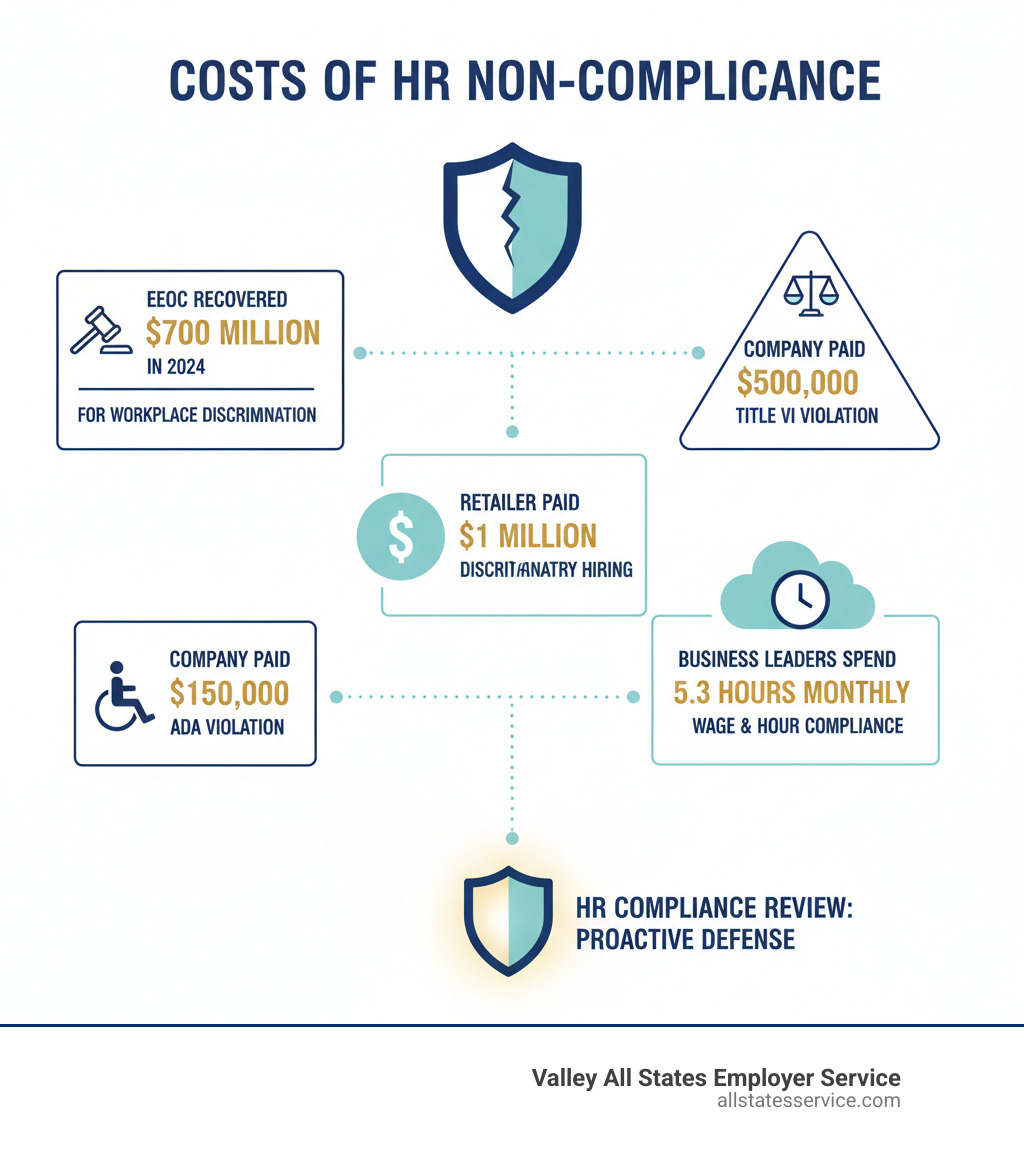
The price of getting HR compliance wrong goes far beyond a simple fine. The U.S. Equal Employment Opportunity Commission (EEOC) recovered nearly $700 million for victims of discrimination in 2024. These aren’t abstract risks. Real companies face real consequences:
- A retailer paid $1 million in settlements for discriminatory hiring at a single distribution center.
- UPS was ordered to pay $150,000 for an ADA violation after denying a reasonable accommodation.
- Schuff Steel paid $500,000 for Title VII violations related to workplace harassment and retaliation.
In today’s connected world, news of non-compliance spreads fast, damaging your employer brand and affecting your ability to attract top talent. You can learn more about protecting your business with our guide on Employer HR Compliance.
Building a Fair, Equitable, and Safe Workplace
Beyond avoiding penalties, regular HR compliance reviews help you build a workplace people are proud to be part of. Compliance creates fairness and supports your Diversity, Equity, Inclusion, and Belonging (DEIB) initiatives by ensuring policies are applied consistently.
It also ensures safety by protecting your team’s physical and psychological well-being. Employees who feel safe and valued are more engaged, productive, and loyal. This commitment to a fair environment improves your employer brand and creates a positive culture where people want to contribute their best work. Find more strategies in our Workplace Compliance Solutions.
The Ultimate HR Compliance Checklist: Key Areas to Scrutinize

A thorough HR compliance review touches every part of the employee lifecycle. Here are the key areas to examine to catch problems before they become emergencies.
1. Recruitment, Hiring, and Onboarding
Your hiring process is a common source of compliance issues. Review job descriptions for language that could unintentionally signal discrimination. Ensure managers are trained on legally permissible interview questions. Your background check process must be consistent and comply with the Fair Credit Reporting Act and any state “Ban the Box” laws.
Crucially, Form I-9 verification is required for every new hire within three business days of their start date, per U.S. Citizenship and Immigration Services (USCIS) rules. If you use E-Verify, the rules are even more detailed. Valley All States Employer Service specializes in expert E-Verify processing, taking this administrative burden off your plate. Don’t forget state-mandated new hire reporting, which has its own strict deadlines. For more guidance, see our Employee Onboarding Compliance resources.
2. Compensation, Benefits, and Employee Classification
Wage and hour laws are a major tripwire for businesses. Employee classification under the Fair Labor Standards Act (FLSA) determines overtime eligibility. Misclassifying an employee as exempt or as an independent contractor can lead to devastating back pay and penalties.
Ensure you are paying the correct minimum wage, which varies by location. For example, the minimum wage for the state of Oregon is significantly higher than the federal rate. Also, verify that overtime calculations correctly include all compensation, such as bonuses and commissions. Conduct regular pay equity audits to identify and correct gender or racial pay gaps. Finally, confirm your benefits administration for programs like FMLA and health insurance meets all legal requirements. Our Employment Compliance Ultimate Guide can help you steer these complexities.
3. Workplace Safety and Workers’ Compensation
OSHA compliance is non-negotiable. You must provide a workplace free from recognized hazards and follow safety standards specific to your industry. You can use the North American Industry Classification System (NAICS) to identify applicable standards.
Document all safety training and ensure your hazard communication program is up to date. Injury reporting has strict timelines for both OSHA and state workers’ compensation. Speaking of which, workers’ compensation insurance is mandatory in nearly every state, so confirm your coverage is active and adequate.
4. Employee Handbook, Policies, and Record-Keeping
Your employee handbook is a critical legal document that requires at least an annual review. Ensure your anti-discrimination, harassment, and leave policies are current. Use acknowledgment forms to document that employees have received and understood these policies.
Follow legal record retention schedules for all employee-related documents, from applications to payroll records. Storing records for too long or not long enough can create legal risks. Protect sensitive employee information to comply with data privacy laws like the California Consumer Privacy Act (CCPA) and HIPAA, using secure storage and strict access controls.
5. Termination and Separation
Compliance obligations continue even after an employee leaves. Follow consistent and legally sound termination procedures to defend against wrongful termination claims. Use exit interviews to identify potential compliance issues.
Meet state-specific deadlines for final paychecks to avoid penalties. If your company is subject to COBRA, ensure notifications are sent correctly. Finally, be vigilant about retaliation prevention. Document the legitimate, non-retaliatory reasons for termination, especially if the employee recently engaged in protected activity, as retaliation claims are the most common charge filed with the EEOC.
How to Conduct a Flawless HR Compliance Review: A 5-Step Process

Breaking the HR compliance review into five manageable steps makes the process less overwhelming and more effective.
Step 1: Define the Scope and Assemble Your Team
First, set clear objectives. Are you conducting a comprehensive audit or focusing on a high-risk area like wage and hour compliance? Next, decide who will conduct the review. An internal HR team knows your business but may have biases. External consultants offer fresh eyes and specialized expertise but come at a higher cost. A hybrid approach often works well. For high-risk areas, consider involving legal counsel early. Our Compliance Outsourcing Solutions can provide the expertise you need.
Step 2: Gather and Review Documentation
This is the detective work. Collect key documents to get a clear picture of your practices. This includes your employee handbook, policy manuals, job descriptions, and a sample of personnel files. You will also need to review:
- Recruitment records (applications, interview notes)
- Form I-9s and any E-Verify records
- Compensation and payroll reports
- Benefits enrollment and leave documentation
- Performance reviews and disciplinary actions
- Workplace safety logs and training records
Step 3: Analyze Practices and Identify Gaps
Now, compare your written policies to what actually happens day-to-day. Interview managers and employees to understand how procedures are followed in practice. You might find the official process and the real process are two different things.
As you analyze, identify areas of non-compliance, such as missing documentation or inconsistent policy enforcement. Assess the risk level of each gap you find. A miscalculation of overtime for your entire team is a higher risk than a missing signature on a single form. Finally, perform a root cause analysis to understand why a problem is occurring so you can create a solution that sticks.
Step 4: Develop and Implement a Corrective Action Plan
Finding problems is only half the battle. Now you must fix them. Create a report that documents each issue, its risk level, and its root cause. Prioritize the highest-risk items first, like fixing employee misclassification or updating your harassment policy.
Assign clear responsibility and set realistic deadlines for each corrective action. Then, implement the changes. This could involve revising policies, conducting training sessions, or adjusting payroll practices. A Compliance Management System can help track these moving pieces.
Step 5: Follow Up and Maintain Ongoing Compliance
An HR compliance review is not a one-time project. It’s the start of an ongoing cycle. Monitor the progress of your corrective action plan to ensure changes are being implemented effectively.
Continuously update policies as laws change. Train your staff on any updates to ensure they understand the new requirements. Most importantly, schedule your next review now. Experts recommend a comprehensive review annually, with more frequent check-ins for rapidly growing businesses or after major regulatory shifts. Our Workforce Management Best Practices guide offers more strategies for maintaining compliance.
Beyond the Audit: Tools and Best Practices for Continuous Compliance
An HR compliance review provides a snapshot in time, but compliance is an ongoing effort. Laws change and businesses evolve, so you need tools and strategies to stay compliant every day, not just on audit day.
Leveraging Technology for a Streamlined HR Compliance Review
Managing compliance with spreadsheets is inefficient and prone to error. Technology can transform this burden into a manageable process. A Human Resources Information System (HRIS) can act as a central hub for employee data, training records, and documentation.
Dedicated compliance software can monitor regulatory changes, send automated reminders for deadlines, and create audit trails. Automation is especially powerful for tasks like new hire onboarding, where systems can track I-9 completion and policy acknowledgments. This saves time and reduces the human errors that often lead to compliance issues.
Secure, cloud-based data storage is also essential for protecting sensitive employee information and complying with privacy laws like the CCPA. At Valley All States Employer Service, we use technology to simplify compliance. Our expert E-Verify processing service takes one of the most error-prone tasks off your plate, handling it with precision so you can focus on your business. Explore our Compliance Management Solutions to learn more.
Best Practices for Staying Ahead of Regulatory Changes
The regulatory landscape is always shifting. To keep up, subscribe to trusted compliance newsletters like those from HR Dive and Corporate Compliance Insights. Follow government agencies like the EEOC, Department of Labor (DOL), and OSHA directly for official updates.
Provide regular training for your team, especially when policies or regulations change. Use a compliance calendar to track key dates for policy reviews, wage increases, and reporting deadlines. This proactive approach prevents last-minute scrambles.
Finally, don’t hesitate to engage external experts like employment attorneys or HR consultants for complex issues. The cost of expert advice is often a fraction of the cost of getting it wrong.
Frequently Asked Questions about HR Compliance Reviews
Here are answers to some of the most common questions about conducting an HR compliance review.
How often should we conduct an HR compliance review?
Most experts recommend a comprehensive HR compliance review at least annually. However, you should conduct a review immediately following certain events, such as:
- Major business changes like a merger, acquisition, or rapid growth.
- The introduction of significant new federal or state regulations.
- Any compliance incident, such as an employee complaint or a government audit.
Regular, proactive audits are the best way to spot issues before they escalate into costly legal problems.
What are the most common HR compliance mistakes?
During an HR compliance review, several common mistakes tend to appear frequently. Being aware of these can help you avoid them.
- Employee Misclassification: Incorrectly classifying employees as exempt from overtime or as independent contractors.
- I-9 and E-Verify Errors: Improperly completing, storing, or failing to verify Form I-9s in a timely manner.
- Outdated Employee Handbooks: Using policies that do not reflect current laws or company practices.
- Inconsistent Policy Enforcement: Applying rules and disciplinary actions unevenly, which can lead to discrimination claims.
- Improper Overtime Pay: Failing to include all required compensation in overtime calculations or not paying for all hours worked.
- Failure to Accommodate: Not providing reasonable accommodations for employees with disabilities or for religious beliefs.
Can a small business handle its own HR compliance review?
Yes, a small business can conduct its own HR compliance review, but it’s important to be realistic about the challenges. While an internal review saves money, it can be difficult to remain objective. It’s easy to overlook issues in systems you created yourself.
Furthermore, employment law is complex and constantly changing. Without dedicated legal expertise, you might miss critical requirements. The time commitment can also be overwhelming for small teams.
Many small businesses find a hybrid approach works best. They handle straightforward areas internally and engage external consultants for complex issues like benefits administration or E-Verify processing. Experts provide an unbiased, up-to-date evaluation that ensures comprehensive coverage. Our guide on HR Compliance for Small Business offers more custom advice.
Simplify Your Compliance and Focus on Growth
Think of an HR compliance review as more than just checking boxes. It’s your chance to strengthen the foundation of your business. When you regularly assess your HR practices, you’re not simply dodging fines or penalties. You’re building a workplace where people actually want to work, where policies are fair, and where everyone feels valued.
We know that navigating HR compliance can feel like trying to solve a puzzle while someone keeps changing the pieces. Federal laws, state regulations, local ordinances, and they all seem to shift just when you think you’ve got everything figured out. For many business owners and HR managers, this means hours spent researching regulations instead of focusing on what really matters: growing your business and serving your customers.
That’s exactly why Valley All States Employer Service exists. We specialize in expert, impartial, and efficient E-Verify processing, taking one of the most error-prone and time-consuming compliance tasks completely off your plate. No more worrying about I-9 mistakes or verification deadlines. We handle it all, minimizing errors and freeing up your team to focus on strategic work.
Whether you’re a small business owner juggling multiple responsibilities or an HR professional managing a growing team, you don’t have to steer compliance alone. We understand the unique challenges you face because we work with businesses like yours every day. Our approach is straightforward: we make E-Verify processing simple, accurate, and stress-free.
Ready to reclaim those hours you spend on compliance paperwork? Let us handle the details while you focus on building your business. Get expert help with your HR compliance today and find how much easier workforce eligibility verification can be when you have the right partner.