
HR compliance risk assessment: 5 Essential Steps for 2025
Why Proactive HR Risk Management is Non-Negotiable
HR compliance risk assessment is the systematic process of identifying, analyzing, and prioritizing potential legal and regulatory risks in your human resources practices. Here is what you need to know:
Quick Answer: The 5 Core Steps
- Map Your Regulations Identify all federal, state, and local laws that apply to your workforce
- Audit Your Practices Review current policies, procedures, and past incidents
- Prioritize Your Risks Assess which compliance gaps pose the greatest threat
- Create Action Plans Develop specific solutions with assigned owners and deadlines
- Monitor Continuously Track metrics and update your approach as laws change
The stakes for HR compliance have never been higher. As Ethena’s CEO Roxanne Petraeus puts it, “It is not about preventing misconduct, it is about anticipating and preparing for when it inevitably happens.”
The numbers back this up. According to a recent study, only 33% of organizations have mature legal compliance processes that employees fully understand. That means more than two-thirds of companies are operating with significant blind spots in their HR risk management.
For busy HR managers like you, this is not just about avoiding penalties. It is about creating a workplace where people feel safe, treated fairly, and engaged. When 42% of employees say their needs at work are not being met (up from just 19% in previous years), the connection between compliance and culture becomes crystal clear.
The good news is that you do not need to overhaul everything at once. A structured HR compliance risk assessment gives you a roadmap to tackle the highest priority issues first, protect your organization from costly violations, and build a stronger foundation for your workforce.
Quick look at HR compliance risk assessment:
Identifying Common HR Compliance Hotspots

Every organization faces a unique set of challenges, but certain HR areas consistently emerge as compliance hotspots. Overlooking these can lead to significant legal, financial, and reputational damage. As we steer the complexities of managing our workforce, understanding these common risks is the first step toward effective mitigation.
Let’s explore some of the most frequent areas where HR compliance risks arise:
- Recruitment and Hiring: This is often the first point of contact for compliance issues. Risks here include discriminatory hiring practices, improper background checks, and failures in employment eligibility verification. For instance, employment screening laws are a top concern for nearly a quarter of organizations. We must ensure our processes adhere to federal regulations like the Fair Credit Reporting Act (FCRA) and properly handle employment eligibility verification, such as E-Verify, to avoid penalties.
- Wage and Hour Compliance: This area is a frequent source of legal action. Misclassifying employees as exempt versus non-exempt, incorrect overtime calculations, and failing to adhere to minimum wage laws can lead to significant back pay liabilities and fines. We must carefully track hours, apply correct pay rates, and understand federal wage and hour regulations.
- Employee Relations: A toxic work environment due to ineffective communication or unresolved conflicts can lead to high turnover, low morale, and potential discrimination or harassment claims. Ensuring fair and consistent application of policies, providing avenues for complaint resolution, and fostering an inclusive culture are paramount.
- Data Privacy and Security: Handling sensitive employee information, from personal details to health records, requires stringent data privacy policies. Breaches can lead to severe reputational damage and legal repercussions. We must safeguard data through secure systems, limited access, and regular staff training.
- Compensation and Benefits: Beyond just wages, fair and equitable compensation and benefits are crucial. Only 38% of employees believe their employer is open about pay, and just a third feel promotion decisions are fair. This lack of transparency can erode trust and lead to claims of pay inequity. Additionally, providing competitive and compliant benefits, especially wellbeing benefits, is increasingly important, with 46% of employees willing to trade a 10% pay increase for better wellbeing options.
- Leave Management: Navigating the various federal and state leave laws, such as the Family and Medical Leave Act (FMLA), requires careful attention. Mismanagement of leave requests, inconsistent application of policies, or failure to provide required notices can result in costly lawsuits.
- Geographic Variations: With the rise of remote work, tracking where our employees physically work has become a critical compliance concern. Laws and regulations vary significantly by state and even local jurisdiction, impacting everything from minimum wage to pay transparency and even specific employment practices. We must maintain accurate records of employee locations to apply the correct laws.
These areas represent just a snapshot of the potential pitfalls. For more in-depth insights into managing your workforce’s compliance needs, you can explore our resources on employer HR compliance.
Your 5-Step Guide to an Effective HR Compliance Risk Assessment

Conducting an effective HR compliance risk assessment doesn’t have to be overwhelming. By adopting a systematic, continuous process, we can proactively identify vulnerabilities and build a more resilient organization. Think of it as a journey, not a destination.
A structured approach allows us to break down a complex task into manageable steps, ensuring that no stone is left unturned. For further guidance on reviewing your HR processes, refer to our HR compliance review guide.
Step 1: Identify and Map Your Regulatory Landscape
The first crucial step is to understand the legal framework governing your HR practices. The regulatory environment for HR departments is constantly evolving at federal, state, and local levels. We need a clear “compliance map” to steer this landscape effectively.
- Federal Laws: These are the bedrock of HR compliance, covering areas like anti-discrimination (Title VII, ADA), wage and hour (FLSA), and employee benefits (ERISA).
- State and Local Laws: Beyond federal mandates, each state and local jurisdiction often has its own set of unique HR laws. For businesses operating in Maryland, this means understanding state-specific regulations that might differ from federal standards, such as specific leave policies or local minimum wage requirements.
- Remote Work Impact: The rise of remote work adds a layer of complexity. If your employees work remotely from different states, you must comply with the laws of each state where they reside. This requires us to accurately track employee locations and ensure our policies adapt to these geographic variations.
- Use Resources: Organizations like the Equal Employment Opportunity Commission (EEOC) and the Society for Human Resource Management (SHRM) offer valuable resources, checklists, and guidance to help us identify applicable laws and stay updated on changes.
Creating this compliance map is a foundational element of effective HR governance. For comprehensive details on regulatory adherence, visit our HR regulatory compliance page.
Step 2: Conduct a Thorough Internal Audit
Once we understand the regulatory landscape, it’s time to look inward. An internal audit helps us assess how well our current HR practices align with those requirements. This isn’t just about checking boxes, it’s about uncovering potential gaps and inconsistencies.
- Reviewing Policies and Handbooks: Our employee handbooks and HR policies are the backbone of our operational compliance. We must carefully review them to ensure they are up-to-date, consistent with current laws, and clearly communicated to all employees. Are there any outdated clauses? Are new federal or Maryland-specific laws reflected?
- Analyzing Past Incidents: Learning from our past is invaluable. We should analyze records of employee complaints, grievances, disciplinary actions, and terminations. Were these handled consistently and in accordance with our policies and legal requirements? This can highlight areas where our procedures might be weak or inconsistently applied.
- Interviewing Key Staff: Engaging with our HR team, managers, and even a sample of employees can provide crucial insights. Do managers understand and consistently apply HR policies? Do employees feel comfortable reporting concerns? These conversations can reveal practical challenges and areas of misunderstanding.
A detailed HR audit guide can be found on our HR compliance audit guide 2025 page, offering a roadmap for this critical step.
Step 3: Analyze and Prioritize Your HR Compliance Risks
After identifying potential issues, the next step is to analyze and prioritize them. Not all risks carry the same weight. We need to focus our resources on the most significant threats to our organization.
- Risk Matrix (Likelihood vs. Impact): A common tool for prioritization is a risk matrix. We can plot each identified risk based on its:
- Likelihood: How probable is it that this risk will occur? (e.g., low, medium, high)
- Impact: If this risk occurs, what would be the severity of its consequences? (e.g., low financial cost, moderate reputational damage, high legal penalty)
High-likelihood, high-impact risks should be our top priority.
- Prioritization Techniques: When assessing risk, we should consider not just the immediate cost, but the long-term impact on our organization’s reputation, employee morale, and financial stability. As one expert suggests, it’s about planning for the long-term, even if it means addressing short-term costs.
- Focusing on High-Impact Risks: We should pay close attention to risks that are common sources of legal action or have severe consequences.
Here is a list of common high-priority HR compliance risks we often encounter:
- Wage and Hour Violations: Misclassification, incorrect overtime, off-the-clock work.
- Harassment and Discrimination: Lack of clear policies, insufficient training, ineffective complaint procedures.
- Data Security Breaches: Inadequate protection of employee personal information, weak access controls.
- Improper Background Checks: Non-compliance with FCRA, inconsistent application.
- Inconsistent Leave Management: Misapplying FMLA or state-specific leave laws.
- Workplace Safety Issues: Non-compliance with OSHA regulations, inadequate safety training.
Step 4: Develop and Implement a Corrective Action Plan
Identifying risks is only half the battle; the other half is doing something about them! This step involves creating concrete strategies to address the identified compliance gaps.
- Creating Solutions: For each prioritized risk, we need to brainstorm and design specific solutions. This might involve drafting new policies, revising existing procedures, or implementing new technologies.
- Updating Policies: If our audit revealed outdated or insufficient policies, we must revise them to reflect current federal and Maryland-specific laws. For instance, ensuring our E-Verify procedures are explicitly documented and followed is crucial.
- Implementing Training: Many compliance risks can be mitigated through effective training. This includes mandatory anti-harassment training, manager training on wage and hour laws, and data privacy awareness for all employees. Training is a major tool HR teams can use to tackle risks proactively.
- Assigning Ownership and Deadlines: Each corrective action needs a clear owner responsible for its implementation and a realistic deadline for completion. This ensures accountability and progress.
- Documentation: We must carefully document all changes, training sessions, and implementation efforts. This documentation serves as proof of our due diligence if ever challenged.
For a deeper dive into managing your compliance efforts systematically, explore our insights on compliance management system.
Step 5: Monitor, Review, and Continuously Improve
Compliance is not a one-time event; it’s an ongoing commitment. The regulatory landscape is dynamic, and our organization’s needs evolve. Therefore, continuous monitoring and improvement are essential.
- Ongoing Monitoring with KPIs: We should establish Key Performance Indicators (KPIs) to track our compliance efforts. This could include metrics like training completion rates, incident reports, or audit findings. Regularly tracking these helps us identify developing issues early.
- Regular Reviews and Updates: Schedule periodic reviews of our HR compliance risk assessment, ideally annually, but also after any significant changes to laws or our business operations (e.g., mergers, rapid growth, or changes in remote work policies).
- Adapting to New Laws and Business Changes: We must stay informed about new federal and Maryland-specific legislation. This means continuously scanning the horizon for emerging HR-related threats and rapidly adopting innovations that bolster our risk assessment.
- Fostering a Culture of Compliance: Effective compliance is a shared responsibility. By promoting open communication, encouraging ethical behavior, and ensuring all employees understand their roles in maintaining compliance, we build a strong, risk-aware culture.
Leveraging Technology and Expertise in Your HR Compliance Risk Assessment
In today’s environment, manually managing all aspects of HR compliance risk assessment can be daunting. Thankfully, technology and external expertise can be powerful allies.
- Role of Technology: Technology plays a pivotal role in streamlining compliance efforts. Yet, less than 40% of organizations report using up-to-date technologies for HR compliance processes. This is a missed opportunity.
- Automation: HR software can automate routine tasks like policy dissemination, training assignments, and document management, reducing human error and ensuring consistency.
- Data Analysis: HRIS (Human Resources Information Systems) and HRMS (Human Resources Management Systems) centralize employee data. This allows for real-time visibility into potential risks, such as high turnover in specific departments or inconsistencies in pay equity data. These systems provide process efficiency, data integrity, and actionable insights for risk management.
- Compliance Tools: Specialized tools can help track legislative changes, manage I-9 forms, and even conduct bias audits for AI-driven hiring tools, which are becoming more common in the modern workplace.
- When to Seek External Help: While internal capabilities are crucial, complex legal questions or specialized areas often warrant external expertise.
- Legal Counsel: For interpreting nuanced laws, drafting complex policies, or navigating potential litigation, consulting with employment law specialists is always advised.
- Compliance Consulting Firms: These firms can provide an impartial, expert perspective on your current practices, conduct thorough audits, and help develop robust risk mitigation strategies.
- Specialized Service Providers: For tasks like E-Verify, leveraging an outsourced partner, like Valley All States Employer Service, ensures accurate, impartial, and efficient processing, minimizing errors and administrative burden for your team. Our expertise in workforce eligibility verification helps you steer complex federal requirements seamlessly.
For guidance on choosing the right partners, refer to our compliance consulting firms guide 2025.
The Tangible Benefits of a Proactive Compliance Strategy
Adopting a proactive approach to HR compliance risk assessment isn’t just about avoiding trouble; it’s about open uping significant advantages for our organization. The benefits extend far beyond legal protection, positively impacting our bottom line and our people.
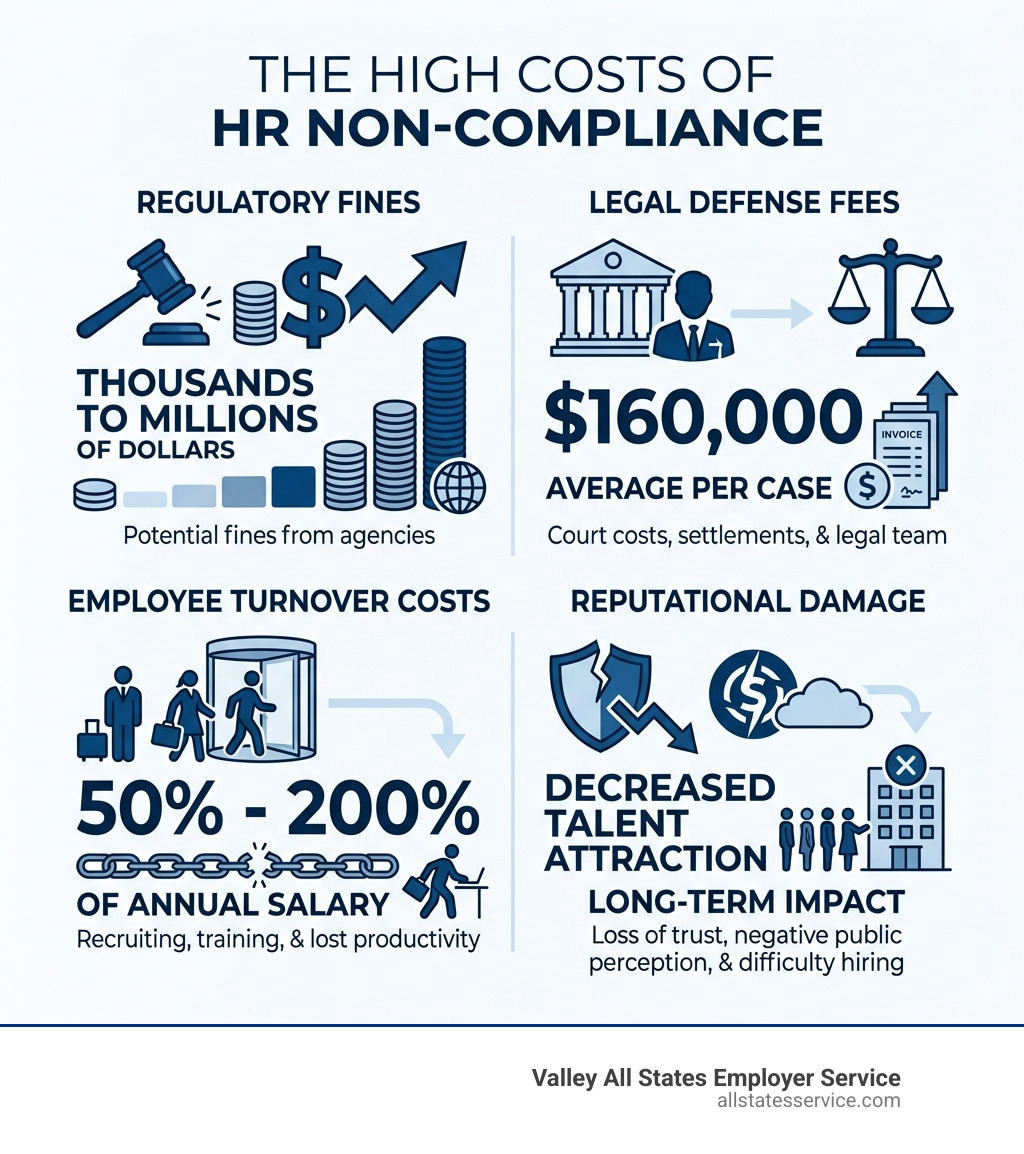
- Reduced Legal Costs and Lower Fines: This is perhaps the most immediate and obvious benefit. By identifying and mitigating risks early, we significantly reduce the likelihood of costly lawsuits, regulatory fines, and government penalties. The cost of non-compliance almost always far outweighs the investment in proactive risk management.
- Improved Operational Efficiency: A clear, compliant HR framework leads to standardized processes, reduced administrative burdens, and fewer reactive crises. This frees up our HR team to focus on strategic initiatives rather than firefighting.
- Improved Reputation: Organizations known for their strong ethical practices and commitment to compliance attract better talent and earn the trust of customers and stakeholders. A positive reputation built on fair employment practices is an invaluable asset.
- Fairer Workplace: At its core, compliance is about ensuring fairness and equity. A proactive approach helps us create a workplace free from discrimination, harassment, and unfair practices, fostering a sense of psychological safety for everyone.
- Increased Employee Trust: When employees see that their organization is committed to following the rules, treating everyone equitably, and protecting their rights, trust flourishes. This trust is a cornerstone of a positive workplace culture.
- Talent Attraction and Retention: A fair, inclusive, and compliant workplace is a magnet for top talent. Research shows that organizations with robust and inclusive policies attract more talent (80% of candidates value inclusion when choosing an employer) and have far less turnover than their peers. This directly translates to reduced recruitment costs and a more stable, experienced workforce.
A proactive compliance strategy protects our organization, empowers our employees, and strengthens our position in the market.
Frequently Asked Questions about HR Compliance Risk Assessment
Navigating HR compliance can bring up many questions. Let’s address some of the most common ones we hear.
How often should we conduct an HR compliance risk assessment?
While a comprehensive HR compliance risk assessment should ideally be conducted at least annually, it’s crucial to understand that compliance is an ongoing process. We should also initiate an assessment or review our existing one after any major organizational changes, such as:
- The introduction of new federal, state, or local laws.
- Mergers, acquisitions, or significant restructuring.
- Periods of rapid growth or downsizing.
- Changes in workforce composition (e.g., a shift to more remote workers).
Beyond these formal assessments, continuous monitoring of HR practices and the regulatory environment is key to staying ahead of potential risks.
Can a small business really afford to do this?
Absolutely. In fact, small businesses often have fewer resources to absorb the impact of non-compliance, making a proactive HR compliance risk assessment even more critical. The cost of non-compliance—ranging from hefty fines to legal fees and reputational damage—far outweighs the investment in a risk assessment.
The process can be scaled to fit your business size and budget. We recommend focusing on the highest-risk areas first, such as wage and hour compliance or employment eligibility verification, where errors can be particularly costly. Many resources and tools are available that are specifically designed for smaller operations. For custom advice, you can explore our resources on HR compliance for small business.
What’s the difference between an HR audit and an HR compliance risk assessment?
While often used interchangeably, an HR audit and an HR compliance risk assessment serve distinct but complementary purposes:
- HR Audit: This is essentially a snapshot that checks if your current HR policies, procedures, and practices are in compliance with existing laws and regulations. It verifies that you are following the rules as they are written today. An audit looks backward and at the present state, ensuring operational adherence.
- HR Compliance Risk Assessment: This is a forward-looking process. It not only identifies current compliance gaps but also evaluates the likelihood and potential impact of future risks. It asks “What could go wrong?” and “How severe would it be if it did?” A risk assessment aims to anticipate potential problems, prioritize them based on their threat level, and develop strategies to prevent or mitigate them before they occur.
Think of it this way: an audit confirms you’re driving within the speed limit, while a risk assessment helps you anticipate sharp turns, bad weather, or potential roadblocks ahead. Both are essential for safe and compliant navigation.
Conclusion: From Risk to Resilience
In the dynamic world of human resources, a proactive HR compliance risk assessment isn’t just a best practice; it’s a strategic imperative. We’ve seen how identifying and addressing compliance hotspots, from hiring practices to data privacy, can safeguard our organization from significant legal and financial repercussions. By following a structured five-step guide – mapping regulations, conducting internal audits, prioritizing risks, developing action plans, and continuously monitoring – we build a robust framework for long-term success.
Leveraging technology and external expertise, like our specialized E-Verify processing at Valley All States Employer Service, can dramatically streamline these efforts, allowing us to focus on what matters most: our people. The benefits are clear: reduced costs, an improved reputation, and a workplace built on trust and fairness, which ultimately attracts and retains top talent.
Ready to strengthen your compliance framework and ensure your HR practices are not just compliant, but truly resilient? Explore our comprehensive workforce compliance solutions today.