
HR regulatory compliance: Simplify for 2025
Why HR Regulatory Compliance is Critical for Your Business Success
HR regulatory compliance is your organization’s adherence to all employment laws governing how you hire, manage, and treat employees. It’s the foundation for legal protection and a fair, safe workplace.
What HR Regulatory Compliance Covers:
- Anti-discrimination laws (Title VII, ADA, ADEA)
- Wage and hour requirements (Fair Labor Standards Act)
- Workplace safety standards (OSHA regulations)
- Employee benefits compliance (FMLA, ACA, ERISA)
- Immigration and work eligibility (Form I-9, E-Verify)
- Data privacy and security (employee information protection)
The stakes are high. The U.S. Equal Employment Opportunity Commission filed 110 lawsuits for unlawful employment discrimination last fiscal year alone. Beyond avoiding lawsuits, proper compliance builds employee trust, protects your reputation, and creates a desirable workplace.
The challenge lies in the complexity of employment laws, which constantly change and vary by federal, state, and local levels. Remote work adds another layer of difficulty. For busy HR managers, staying current is overwhelming, making a clear compliance strategy essential.
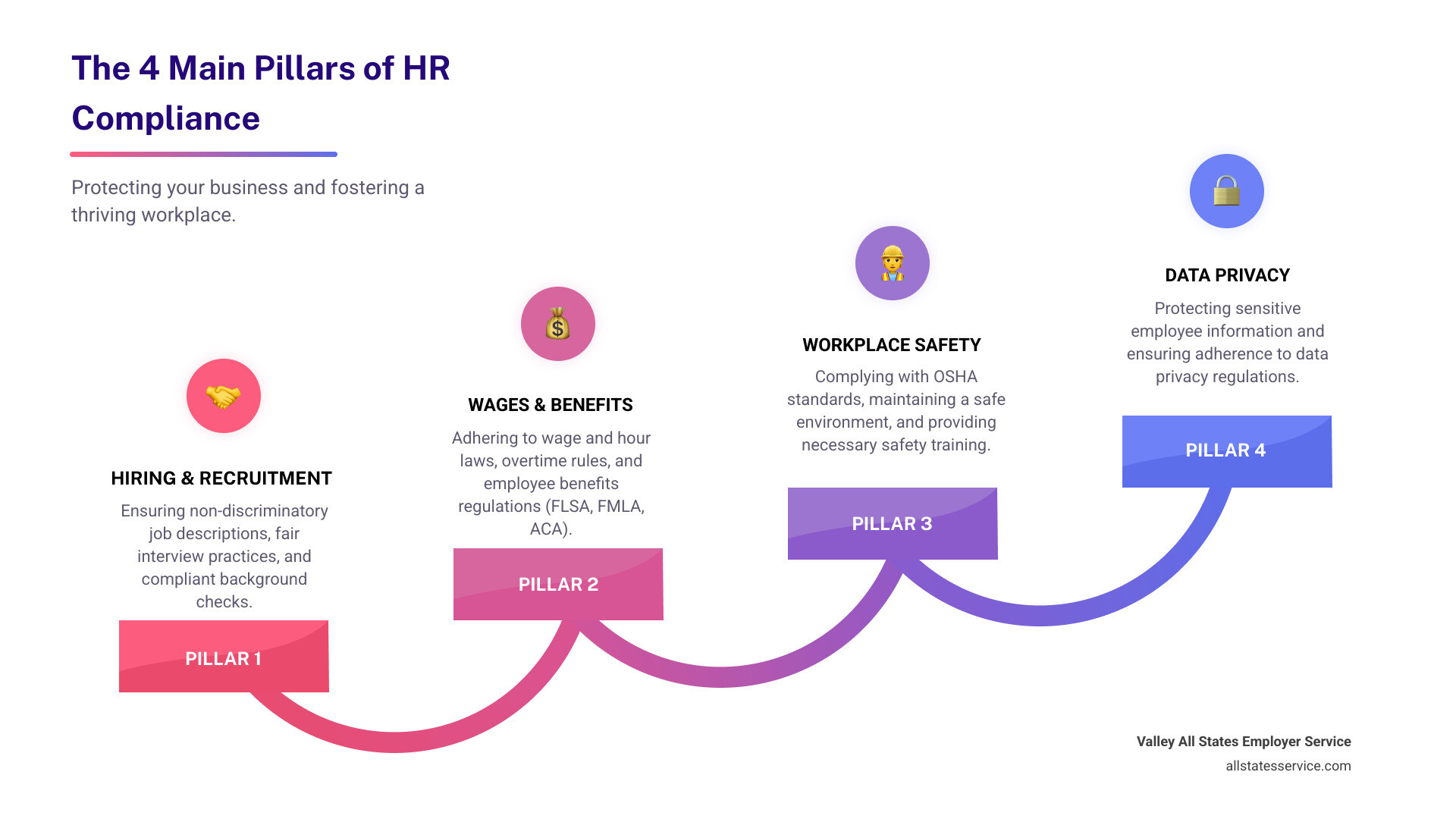
What is HR Compliance and Why Does It Matter?
Think of HR regulatory compliance as a safety net. It’s the practice of ensuring every aspect of employment follows federal, state, and local laws. This strategic investment protects your business from expensive lawsuits and penalties while guaranteeing a fair, safe environment for employees. When you get compliance right, you create a workplace built on trust where people can do their best work.
Compliance breaks down into three main types: Statutory (following government laws like the Fair Labor Standards Act), Regulatory (meeting agency standards like OSHA’s), and Contractual (honoring employment agreements and company policies). Since 2000, U.S. corporations have paid out $3 billion in employment-related lawsuits, affecting businesses of all sizes.
Key Areas of HR Compliance Every Business Must Know
The world of employment law is vast, but some areas are critical for every business.
Anti-discrimination laws like Title VII of the Civil Rights Act of 1964, the Americans with Disabilities Act (ADA), and the Age Discrimination in Employment Act (ADEA) prohibit discrimination based on protected characteristics like race, gender, age, and disability.
Wage and hour laws are governed by the Fair Labor Standards Act, but state and local laws often mandate higher wages. For example, Oregon requires $14.70 per hour and Washington D.C. requires $17.50 per hour, far exceeding the federal minimum.
Employee benefits compliance involves laws like the Family and Medical Leave Act (FMLA), ERISA, and the ACA, which govern medical leave, health insurance, and retirement plans.
Workplace safety is overseen by OSHA, which requires a hazard-free workplace with standards varying by industry, as detailed in the North American Industry Classification System (NAICS).
Employee data privacy is a growing concern, with laws like the California Consumer Privacy Act (CCPA) setting strict rules for how companies handle employee personal information.
Immigration and work eligibility under the Immigration and Nationality Act (INA) requires all employers to verify work authorization using Form I-9, managed by U.S. Citizenship and Immigration Services (USCIS).
The High Cost of Non-Compliance
Ignoring HR regulatory compliance can have severe consequences.
Legal disputes from employees or agencies like the EEOC can lead to years of costly battles that divert attention from your business.
Government audits can result in immediate fines and strict deadlines for corrections if you fail their review.
Fines and penalties can be severe. For example, I-9 compliance penalties can reach $30,000 per violation.
Damaged employee trust leads to lower productivity, higher turnover, and a poor reputation in the job market.
Negative publicity from compliance failures can damage your brand with customers, partners, and future talent for years.
Navigating the Complex World of HR Regulatory Compliance
Viewing HR regulatory compliance through the employee lifecycle, from hiring to termination, provides a clear framework. This journey includes hiring, onboarding, compensation, employee relations, and termination. Compliance is complex, with rules varying by location and the rise of remote work adding another layer of difficulty.
Stage 1: Compliant Hiring and Onboarding
Your compliance journey begins with your first job posting.
Non-discriminatory job descriptions are essential. Focus on required skills and experience to avoid discriminatory language, such as phrases that could imply age bias.
For fair interview practices, train managers to ask only job-related questions and avoid protected topics like family status or religion.
Follow the Fair Credit Reporting Act (FCRA) for background checks, which includes providing notice and getting consent. Also, be aware of state and local “ban-the-box” laws.
Misclassifying employees and independent contractors can lead to significant penalties. The Department of Labor’s rules focus on the economic reality of the relationship to determine status.
| Feature | Employee | Independent Contractor |
|---|---|---|
| Control | Employer controls how work is done | Contractor controls how work is done |
| Training | Employer provides training | Contractor uses own training/expertise |
| Tools/Equipment | Employer provides tools | Contractor provides own tools |
| Reimbursement | Employer reimburses expenses | Contractor covers own expenses |
| Benefits | Eligible for benefits (health, 401k, etc.) | Not eligible for employer benefits |
| Taxes | W-2, employer withholds taxes | 1099, contractor pays self-employment taxes |
Getting your Employee Onboarding Compliance right from day one prevents future headaches.
Stage 2: Managing Workforce Eligibility and I-9 Compliance
After a hire, you must verify their legal right to work in the U.S.
All employees must complete Form I-9 requirements. The employee completes Section 1 on their first day, and you must complete Section 2 within three business days. The three-day rule is strict, and missing it can result in fines.
For secure document storage, I-9 forms must be kept separate from other personnel files and retained for three years from the hire date or one year after termination, whichever is longer.
The E-Verify process compares I-9 information against government databases to confirm work authorization. It is required for federal contractors and employers in some states. Our Workforce Eligibility Verification services can help ensure this process is accurate.
Remote work complicates I-9 document verification. Our Remote I-9 Compliance solutions address these challenges while maintaining compliance with the Immigration and Nationality Act (INA).
Stage 3: Ongoing Employment Compliance
Compliance is a continuous process throughout an employee’s tenure.
Wage and hour laws under the FLSA require careful employee classification (exempt vs. non-exempt), accurate time tracking, and correct overtime calculation.
The Family and Medical Leave Act (FMLA), which covers 56% of U.S. employees, requires managing complex eligibility, notice procedures, and job protection obligations.
Workplace safety under OSHA involves maintaining a hazard-free environment, providing safety training, and keeping detailed injury records.
Managing these ongoing requirements is challenging. Solutions like our Payroll Outsourcing Solutions can streamline processes and reduce the risk of costly mistakes.
Best Practices for Maintaining HR Compliance
Maintaining HR regulatory compliance requires a proactive approach. Instead of reacting to problems, successful organizations anticipate risks and address them before they escalate.
Your employee handbook is your compliance blueprint. Keep it updated to reflect current laws and business practices. A handbook is only useful if it’s a living document.
Consistent policy enforcement is critical. Applying rules fairly to all employees, without favoritism, is essential for preventing discrimination claims and maintaining morale.
Finally, remember this rule: if it’s not documented, it didn’t happen. Good records are your best defense in an audit or legal dispute.

Conducting Regular HR Compliance Audits
How do you know if you’re compliant? You check. Regular HR compliance audits are like health checkups that identify risks before they become costly problems.
An audit involves defining its scope, reviewing policies against legal requirements, documenting gaps, creating a corrective action plan, and following up. According to SHRM guidance on HR audits, a comprehensive audit should be conducted at least annually or when major laws change.
The Role of Employee and Manager Training
Even the best policies are ineffective if no one understands them. Training brings policies to life, ensuring employees and managers understand their roles in maintaining compliance.

Anti-harassment training, often state-mandated, is critical for a respectful workplace. Data security training is also vital to teach employees how to protect sensitive information and recognize cyber threats.
Manager training is especially important, as managers are on the front lines of compliance. They need specific knowledge of FMLA, ADA accommodations, and wage laws, as SHRM recommends. Make training engaging with real-world scenarios to avoid “compliance fatigue” and build a true compliance culture.
Leveraging Technology and Outsourced Solutions
Managing HR regulatory compliance manually is unnecessarily difficult. Technology and expert partners can turn compliance from a burden into an advantage.
HRIS platforms act as a compliance command center, automating tasks, tracking training, and securing data. Automated record-keeping eliminates human error and ensures documents are secure and accessible for audits. Our Compliance Management System shows how technology can streamline these efforts.
For many businesses, outsourcing is a smart solution. Partnering with experts provides specialized knowledge without the in-house overhead. Our Outsourced HR Compliance: The Ultimate Guide explores how this partnership can help you focus on growing your business.
Frequently Asked Questions about HR Compliance
Navigating HR regulatory compliance raises many questions. Here are answers to some of the most common ones we hear from business owners and HR professionals.
What are the most common HR compliance issues for small businesses?
Small businesses often face unique compliance challenges due to limited resources. Common pitfalls include:
- Misclassifying employees as independent contractors, which can lead to severe penalties for back taxes and wages.
- Improper overtime pay. Paying a salary does not automatically make an employee exempt from overtime rules.
- I-9 errors, such as missed deadlines or incorrect documentation, which can result in significant fines during an audit.
- Inconsistent policy enforcement, which can easily turn into a discrimination claim.
- Outdated employee handbooks that don’t reflect current laws, creating unnecessary risk.
Our HR Compliance for Small Business resource offers more guidance on these challenges.
What is the difference between federal, state, and local employment laws?
Think of employment laws as three layers of requirements.
- Federal laws like the FLSA and Title VII set the minimum standard for all U.S. employers.
- State laws often provide more protection than federal law. For example, Oregon’s minimum wage of $14.70 per hour is much higher than the federal rate.
- Local laws from cities or counties can add further requirements, such as paid sick leave or “ban-the-box” ordinances.
The golden rule is to always comply with the law that is most generous to the employee. If you have remote employees, you must understand the laws in each location where they work.
How can I stay updated on changing HR regulations?
Staying current with HR regulatory compliance requires a system to receive updates automatically.
- Subscribe to newsletters from trusted sources like HR Dive’s Compliance newsletter.
- Follow government agency websites like the Department of Labor, EEOC, OSHA, and USCIS, and sign up for their email alerts.
- Partner with HR experts or employment law attorneys who specialize in compliance and can translate changes into actionable steps for your business.
- Attend webinars and seminars to learn about legislative changes and best practices from industry professionals.
The regulatory landscape changes too quickly to leave to chance. A reliable system for staying informed is essential.
Simplify Your Compliance Strategy
Managing HR regulatory compliance is complex, but you don’t have to do it alone. The key is proactive management, building compliance into your company’s DNA from the start rather than scrambling to fix problems.
A culture of integrity goes beyond avoiding lawsuits. When employees trust that you are doing things the right way, they are more engaged and loyal, making your business a place people are proud to work for.
However, compliance can be a distraction from your core business, which is why partnering with experts is so valuable.
At Valley All States Employer Service, we understand that I-9 and E-Verify compliance isn’t your primary focus. We specialize in taking that burden off your shoulders. Our outsourced E-Verify workforce eligibility verification services provide impartial, efficient processing that minimizes errors and administrative headaches.
Partnering with us lets you focus on your core business, confident that your workforce verification is handled correctly and consistently.
Ready to ensure your workforce is verified and compliant? Learn more about our E-Verify Services and find how much easier compliance can be when you have the right partner on your side.