Onboarding compliance checklist: Flawless 2025
Why Your Onboarding Process Is Your First Line of Defense
An onboarding compliance checklist ensures your business completes all required legal and regulatory tasks when hiring new employees, protecting you from fines and creating a smooth start for your team. Here’s what every checklist must include:
Essential Onboarding Compliance Tasks:
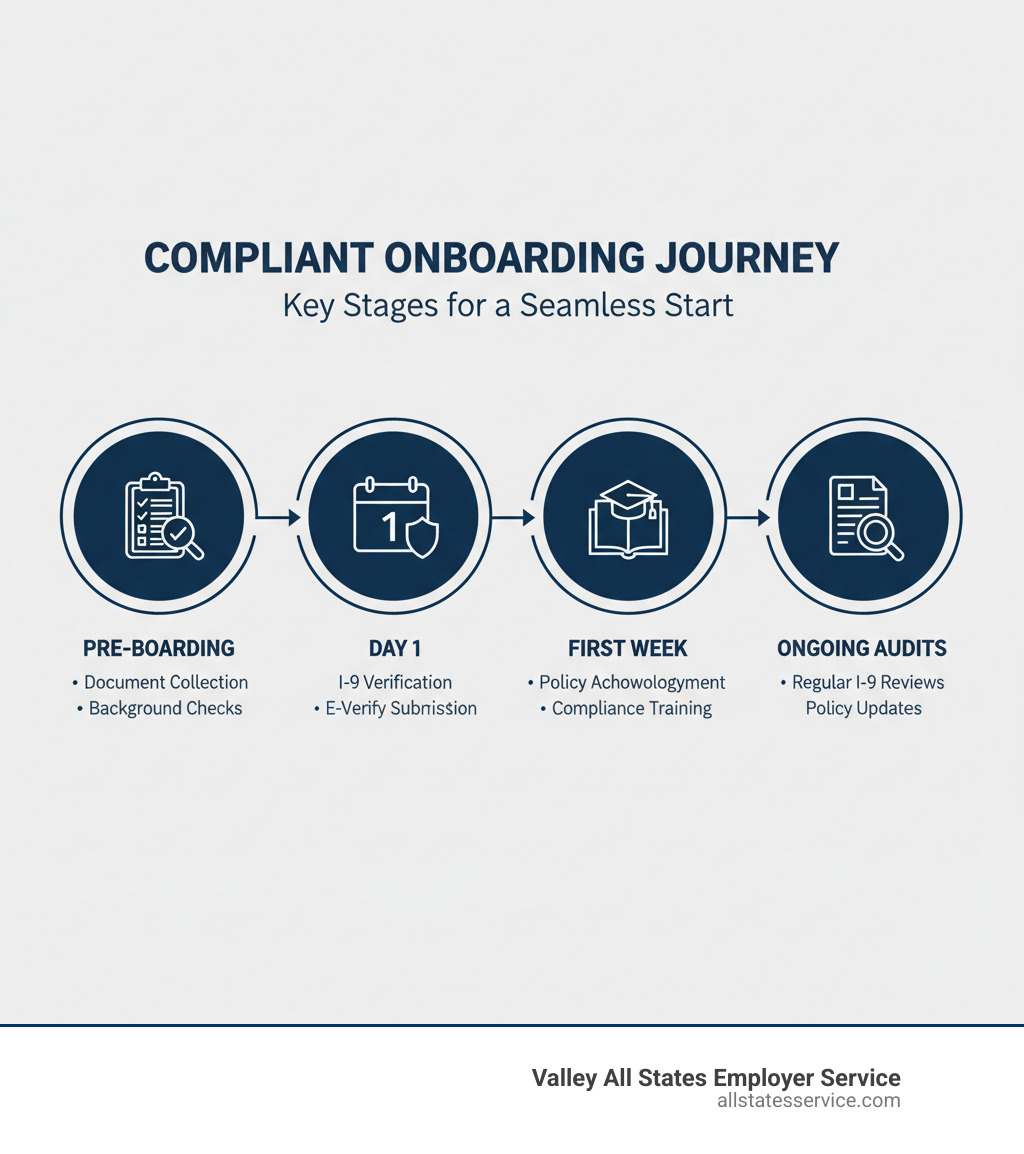
- Pre-Boarding: Signed offer letter, background check consent, W-4 and state tax forms
- Day One: Form I-9 verification, E-Verify submission, new hire reporting to state agencies
- First Week: Employee handbook acknowledgment, anti-harassment training, industry-specific compliance training
- Ongoing: Regular I-9 audits, policy updates, performance check-ins
Starting a new job should feel exciting, not overwhelming. But for employers, that first day carries serious weight. A single missed form or incomplete verification can lead to fines ranging from hundreds to thousands of dollars per violation. Recent data shows that only 22% of workers feel their onboarding exceeded expectations, while a troubling 34% report it fell short.
Here’s the reality: compliance onboarding is different from traditional onboarding. While traditional onboarding focuses on company culture and job training, compliance onboarding zeroes in on legal requirements like Form I-9, E-Verify, tax withholding, and mandatory policy acknowledgments. Miss these steps, and you’re not just disappointing a new hire. You’re opening your business to legal trouble.
For every dollar spent on compliance, companies save $1.37 by avoiding fines, lawsuits, and reputation damage. That’s not just smart business. It’s essential protection.
Companies with strong compliance programs and whistleblower reporting systems saw a 4% reduction in pending lawsuits the year following increased compliance activity. Over three years, that improvement jumped to 6.9%, with overall litigation settlements dropping nearly 20%.
Your onboarding process isn’t just paperwork. It’s your first impression and your first line of defense. Get it right, and you build trust, reduce risk, and set your new hires up for success from day one.
Why a Flawless Onboarding Process is Non-Negotiable
Here’s something most employers don’t realize until it’s too late: traditional onboarding and compliance onboarding are two completely different animals. And treating them the same way? That’s where businesses get into trouble.
Traditional onboarding is the warm, fuzzy part of bringing someone new onto your team. It’s about introductions, office tours (virtual or otherwise), explaining job duties, and helping new hires feel like they belong. It’s important stuff, no question. But compliance onboarding has a different job entirely. It’s about making sure every legal requirement is met, every form is completed correctly, and every mandatory policy is acknowledged. Miss a step here, and you’re not just dealing with an awkward first day. You’re looking at potential fines, audits, and legal headaches.
Think of it this way: traditional onboarding builds culture and connection. Compliance onboarding builds your legal foundation and protects your business from risk.
| Aspect | Traditional Onboarding | Compliance Onboarding |
|---|---|---|
| Primary Focus | Culture, team integration, job duties, engagement | Legal forms, policy acknowledgment, regulatory training |
| Goal | Employee comfort, productivity, retention | Risk reduction, legal adherence, ethical conduct |
| Key Activities | Introductions, office tours, mentorship, goal setting | I-9 verification, policy sign-offs, mandatory training |
| Timeline | Often spans weeks to months | Critical tasks typically completed within first few days |
Now, here’s the good news: these two approaches don’t have to compete. The best onboarding programs weave them together seamlessly. When new hires understand their compliance responsibilities from day one, they actually feel more confident and committed. Research from BambooHR shows that effective onboarding makes new employees 18 times more committed to their employer and 30 times more likely to report overall job satisfaction. That’s not just paperwork paying off. That’s smart business creating real engagement.
Let’s talk about the bottom line for a second. For every dollar spent on compliance, companies save $1.37 by avoiding fines, legal fees, and reputation damage. That’s a tangible return on investment you can take to the bank. And the impact goes even further. Companies with strong compliance programs and clear whistleblower policies saw a 4% reduction in pending lawsuits within the first year, jumping to nearly 7% over three years. Litigation settlements dropped almost 20% during that same period.
Our focus on onboarding compliance at Valley All States Employer Service is built around this reality: a solid onboarding compliance checklist isn’t just about checking boxes. It’s about fostering a culture of integrity from the very first day. It’s about reducing organizational risk while empowering your new team members to make ethical decisions with confidence. And it’s about streamlining HR processes so you can focus on what really matters: building a strong, engaged, compliant workforce.
When you get compliance right from the start, everything else gets easier. Your new hires feel supported. Your business stays protected. And you build a foundation that can withstand scrutiny, audits, and the inevitable challenges that come with growth. That’s not just good HR. That’s human resources compliance working exactly as it should.
The Ultimate Onboarding Compliance Checklist: A Step-by-Step Guide
Think of your onboarding compliance checklist as a roadmap through what could otherwise feel like a confusing maze of regulations and paperwork. When you break it down into clear phases, suddenly those overwhelming first-day formalities become manageable steps that protect your business and welcome your new hire properly.
This systematic approach does more than keep you organized. It helps streamline HR processes and catches potential compliance gaps before they turn into expensive problems. Let’s walk through each phase together.
Phase 1: Pre-Boarding Compliance (Before Day One)
Pre-boarding is your chance to get ahead of the paperwork avalanche. Instead of overwhelming your new hire on their first day, you’re setting them up for a smooth, confident start. This phase also gives you time to complete essential screenings and gather critical information.
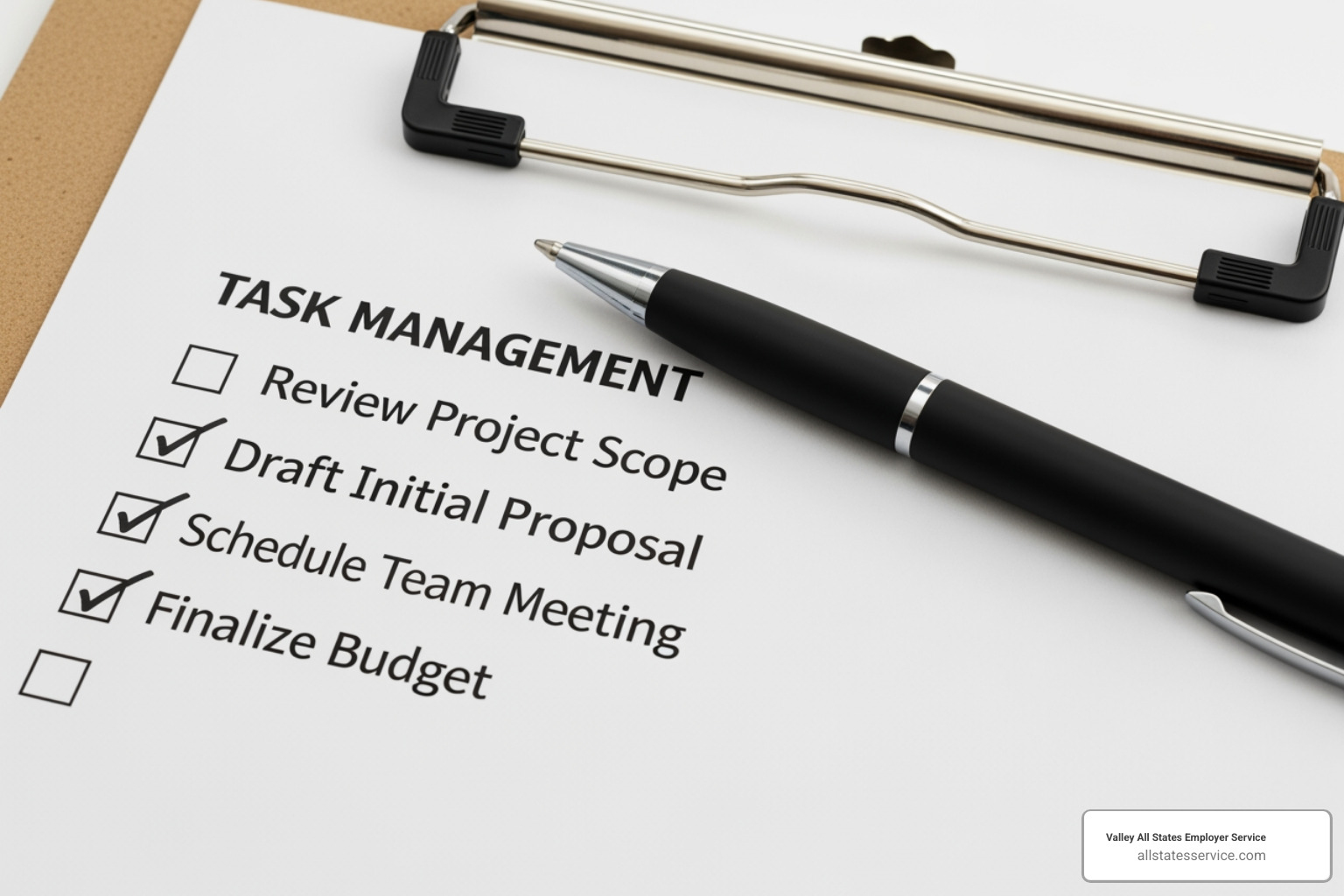
The process starts with a signed offer letter, your formal agreement that outlines employment terms and sets clear expectations. Before you can move forward with hiring decisions, you’ll need background check consent in writing. This protects both you and the candidate by ensuring transparency in your due diligence process.
If your company requires drug testing, now’s the time to secure drug test consent, following all applicable state and federal regulations. These screening steps matter for workplace safety and Human Resources Compliance.
Your welcome packet can make or break a new hire’s first impression. Many employers now use secure digital portals to distribute forms like the W-4 and state tax forms, along with direct deposit information. This approach lets new hires complete paperwork at their own pace, reducing that first-day stress.
Don’t forget to collect basic details through an employee information form. This gathers personal and contact information required by the Fair Labor Standards Act (FLSA) and creates the foundation for your HR records.
Phase 2: Your Day-One Onboarding Compliance Checklist
The first day brings excitement, introductions, and office tours. But tucked between the welcome conversations are time-sensitive compliance tasks that absolutely cannot wait. Missing these deadlines can trigger serious penalties.
Form I-9 verification sits at the top of your day-one priorities. What is an I-9? It’s the federal form that verifies every new hire’s identity and work authorization. Your new employee must complete Section 1 no later than their first day. Then you have three business days to examine their original documents and complete Section 2. The Documents for I-9 guide shows exactly which documents are acceptable.
Right after Form I-9 comes the E-Verify process. What is E-Verify? It’s an online system that confirms employment eligibility by checking information against government databases. Some states and federal contractors must use E-Verify, so check whether your Maryland business falls under these requirements. Valley All States Employer Service specializes in handling E-Verify verification, taking this complex task off your plate entirely.
New hire reporting is another day-one must. Every state requires employers to report new hires to help the Office of Child Support Services (OCSS) enforce child support obligations through the National Directory of New Hires.
Federal law also requires you to provide required notices to new employees. The Affordable Care Act mandates that all FLSA-covered employers distribute a Notice of Coverage Options. Maryland may have additional state-specific notice requirements worth reviewing.
Finally, collect an emergency contact form. This simple step ensures you can reach someone quickly if your employee faces a health or safety issue at work.
Phase 3: First-Week Compliance: Policies and Training
The paperwork is done, but your compliance work isn’t finished yet. The first week focuses on education, helping new hires understand the rules, policies, and ethical standards that guide your workplace. This phase builds the foundation for a culture of integrity.
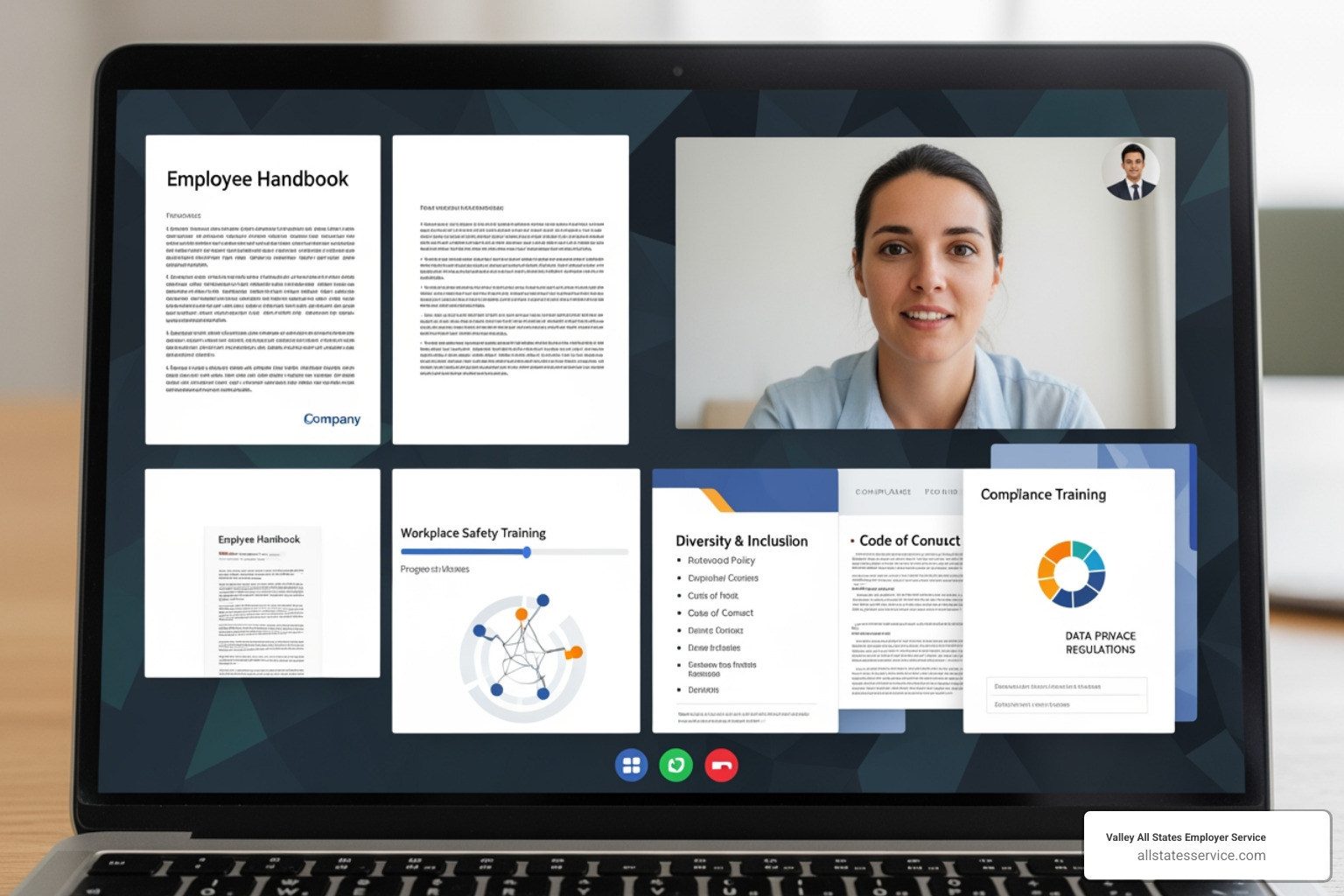
Start by distributing your employee handbook and collecting a signed acknowledgment. While federal law doesn’t strictly require a handbook, it’s your best tool for communicating policies clearly and meeting various notice requirements. Think of it as your company’s rulebook, covering everything from dress codes to benefits.
Your code of conduct deserves a thorough review during this week. This document sets expectations for ethical behavior and professional standards. When employees understand these principles from day one, they’re better equipped to make good decisions.
Anti-harassment training isn’t optional, it’s essential. This training protects your employees and your business by creating a respectful, inclusive environment where everyone understands boundaries and reporting procedures.
Don’t overlook cybersecurity policies in our digital age. New hires need to know how to protect sensitive information, recognize phishing attempts, and follow your technology use guidelines. A single security breach can cost far more than the time invested in proper training.
Explain your whistleblower policy clearly. Employees should know how to report unethical or illegal activities without fear of retaliation. Companies with strong whistleblower reporting systems saw a 4% reduction in pending lawsuits the year after increasing hotline activity. That number jumped to 6.9% over three years.
Finally, consider industry-specific training requirements. Healthcare workers need HIPAA training to protect patient privacy. Companies doing international business must address the Foreign Corrupt Practices Act (FCPA). Our expertise in HR Regulatory Compliance helps you identify and deliver the right training for your specific industry.
Mastering Modern Onboarding: Best Practices for Remote and Hybrid Teams
The world of work has changed. Remote and hybrid teams are now the norm, not the exception. And while the core requirements of your onboarding compliance checklist haven’t budged, how you deliver and verify them absolutely has.
Remote I-9 Verification used to be a real headache. How do you physically examine documents when your new hire is 1,000 miles away? The good news is that USCIS offers a practical solution. You can designate an authorized representative to examine the documents on your behalf. This person can be almost anyone (a friend, a neighbor, even a professional service), just not the employee themselves. They physically review the documents, complete Section 2 of the Form I-9, and sign off. It’s that straightforward. For step-by-step guidance custom to your remote workforce, check out our resources on the I-9 Verification Process for Remote Employees and USCIS I-9 Remote Verification.
Digital Training Delivery has become essential for reaching remote new hires effectively. A solid Learning Management System (LMS) can transform how you deliver compliance training. These platforms let you break down dense regulatory content into manageable, bite-sized modules that won’t overwhelm your new team members. Think short videos, interactive quizzes, even gamified elements that make learning feel less like a chore. You can track who’s completed what, monitor quiz scores, and ensure everyone actually understands the material. Plus, employees can access training on their phones, tablets, or laptops, whenever and wherever works best for them.
Overcoming Information Overload is critical. Dumping 50 policies and three hours of training videos on someone’s first day is a recipe for glazed eyes and forgotten details. Instead, prioritize what’s truly urgent. Focus on the most critical compliance areas first, like I-9 verification and anti-harassment policies. Then, personalize the experience. Tailor training to match the new hire’s specific role and the regulations that will actually impact their daily work. Spread out the training over the first few weeks, not all at once. This spaced approach improves retention and keeps your new hire engaged rather than exhausted.
Technology’s Role in modern onboarding can’t be overstated. From automated I-9 solutions that catch errors before they become fines, to centralized Compliance Management Systems that track every acknowledgment and training completion, digital tools are game changers. They improve accuracy, save time, and create a smoother experience for everyone involved. When compliance feels seamless, new hires can focus on what really matters: learning their role and contributing to your team.
Measuring Success and Avoiding Costly Compliance Pitfalls
Your onboarding compliance checklist isn’t something you set up once and forget about. Think of it more like maintaining a car: regular check-ups keep everything running smoothly and prevent expensive breakdowns down the road.
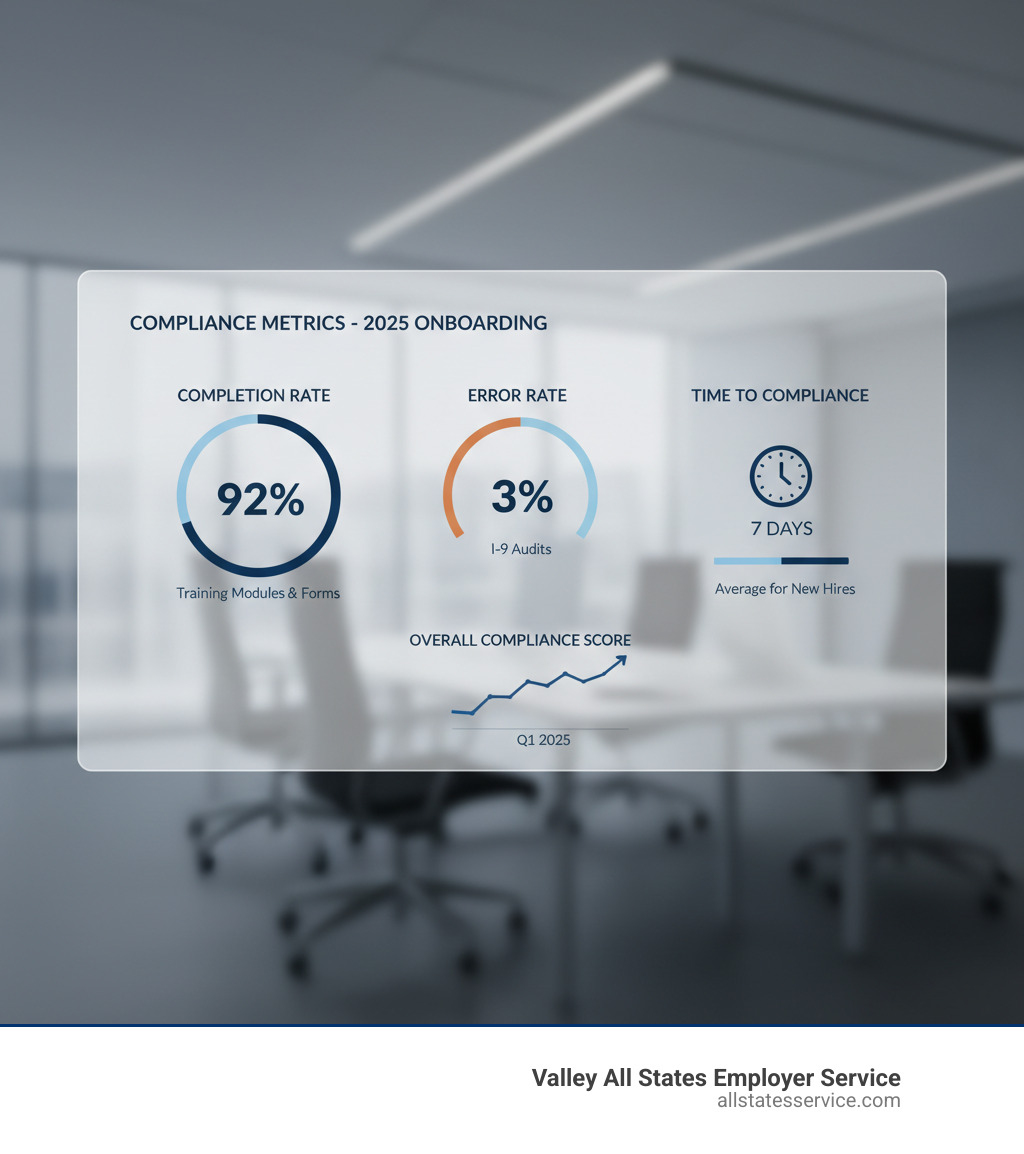
So how do you know if your compliance onboarding is actually working? Start by tracking the right metrics. Completion rates tell you whether new hires are finishing all required forms and training modules on time. If you’re seeing gaps, it might signal that your process is too complicated or unclear. Assessment scores from post-training quizzes reveal whether people actually understand the material, not just click through it. And don’t underestimate the power of feedback surveys. Anonymous input from new hires often uncovers issues you’d never spot from your side of the desk. You might also track time to compliance, measuring how long it takes the average new hire to complete all requirements. This helps you identify bottlenecks and streamline your process.
One of the smartest moves you can make is conducting regular internal I-9 audits. These proactive reviews help you catch and correct errors before they become expensive problems during an external government audit. Our I-9 Audit Services can help ensure your records are spotless and ready for scrutiny.
Even with the best intentions, I-9 errors are incredibly common. Missing the three-day deadline for Section 2 completion happens more often than you’d think, especially during busy hiring periods. Inconsistent processes across different managers or locations can lead to some forms being completed perfectly while others have critical gaps. Accepting expired documents or failing to properly verify authenticity creates serious liability. And incorrect record keeping, whether it’s not retaining forms for the required period or storing them insecurely, can result in hefty fines even if the underlying employment was legitimate.
Here’s something that catches many businesses off guard: state-specific requirements. While federal laws like Form I-9 apply everywhere, Maryland and other states layer on additional Employment Law Laws covering new hire notices, reporting timelines, and sometimes extra compliance training. What works perfectly in one state might leave you non-compliant in another. Staying current with these local variations isn’t optional, it’s essential.
The good news? When you measure these metrics regularly and address issues promptly, you transform compliance from a worry into a competitive advantage. Your new hires feel supported, your business stays protected, and you sleep better at night knowing everything is handled correctly.
Frequently Asked Questions about the Onboarding Compliance Checklist
When you’re juggling the demands of hiring, certain questions about compliance tend to pop up again and again. Let’s tackle the most common ones we hear from employers who are working hard to get their onboarding compliance checklist right.
How long do we need to keep Form I-9 records?
The retention rules for Form I-9 aren’t arbitrary, and getting them wrong can trigger problems during an audit. You’re required to keep each completed Form I-9 for three years after the date of hire or one year after the employee’s employment ends, whichever date comes later.
Think of it this way: if you hire someone on January 1, 2024, you must keep their I-9 until at least January 1, 2027. But if that employee leaves on December 31, 2025, you need to hold onto the form until December 31, 2026 (one year after termination), which is actually earlier than the three-year mark. So you’d keep it until January 1, 2027.
Calculating this period accurately for each employee matters. Destroy records too early, and you’re non-compliant. Keep them indefinitely, and you’re creating unnecessary storage headaches and potential privacy concerns. For a deeper dive into the specifics, check out our guide on I-9 Record Keeping.
What are the penalties for Form I-9 mistakes?
Here’s where things get serious. Immigration and Customs Enforcement (ICE) conducts audits, and the financial consequences of I-9 errors can be painful.
Paperwork violations cover things like missing signatures, incorrect dates, or incomplete fields. These aren’t about hiring unauthorized workers, just sloppy record-keeping. Even so, fines can range from hundreds to thousands of dollars per form. The exact amount depends on whether it’s your first offense and how many violations ICE finds.
Knowingly hiring violations are a different beast entirely. If ICE determines you knowingly hired or continued to employ someone not authorized to work in the United States, fines skyrocket into tens of thousands of dollars per unauthorized worker.
In the most egregious cases, criminal penalties can include imprisonment, especially when there’s a pattern of violations or evidence of harboring unauthorized workers.
These aren’t theoretical risks. They’re real consequences that affect real businesses every year. That’s why having a thorough onboarding compliance checklist and understanding I-9 Compliance Penalties isn’t just smart, it’s essential protection for your company.
Can we use a notary for remote I-9 verification?
This question comes up constantly, and there’s a lot of confusion around it. The short answer is yes, but not in the way you might think.
A notary public can absolutely serve as an authorized representative for I-9 verification, but they’re not acting in their notarial capacity when they do this. They’re not performing a notarial act like certifying a copy or administering an oath. They’re simply acting as your designated agent to physically examine the employee’s original documents and complete Section 2 of the Form I-9.
In fact, any person you designate can serve as your authorized representative. It could be a colleague at a remote office, a trusted business contact in the employee’s city, or yes, a notary who understands I-9 requirements. The key is that this person must physically examine the original documents (not copies or scans) and verify them on your behalf.
For remote employees, this is often the most practical solution. If you need help finding someone or want to understand the process better, our resources on Where to Find Notary for I-9 Verification for Remote Employees and I-9 Verification Process for Remote Employees walk you through every step.
The bottom line? You have options for remote verification, and understanding them properly keeps you compliant while accommodating your distributed workforce.
Take the Guesswork Out of Onboarding Compliance
Your onboarding compliance checklist isn’t just another administrative task. Think of it as your business’s insurance policy, the kind that actually pays off. When you get compliance right from day one, you’re not just checking boxes. You’re building a foundation that protects your company from fines, lawsuits, and the kind of headaches that keep business owners up at night.
Here’s what we know for certain: every dollar you invest in getting compliance right saves you $1.37 down the road. That’s money you’re not spending on penalties, legal fees, or scrambling to fix mistakes during an audit. And those critical steps we’ve walked through, like Form I-9 verification and E-Verify submission, aren’t bureaucratic busywork. They’re your shield against significant financial and legal risks.
But let’s be honest. Managing all these moving parts while running your business and welcoming new team members can feel overwhelming. You’re juggling state-specific requirements in Maryland, federal regulations, industry standards, and constantly changing guidelines. One small oversight, like missing an I-9 deadline by a single day or accepting an expired document, can trigger fines that add up fast.
That’s exactly why many smart businesses choose to partner with experts who live and breathe employment eligibility verification. At Valley All States Employer Service, we specialize in taking the complexity out of compliance. We handle the intricate details of federal and state employment eligibility verification, so you can focus on what you do best: growing your business and supporting your team. Our approach is simple: we process your E-Verify cases with precision, catch errors before they become problems, and give you the peace of mind that comes from knowing it’s done right.
Think of us as your compliance safety net. We stay current on every regulation change, understand the nuances of Maryland employment law, and bring years of specialized experience to every verification. No more second-guessing whether you completed a form correctly or worrying about what happens if ICE shows up for an audit.
Ready to perfect your I-9 process and make your new hire onboarding bulletproof? Start with our Ultimate Guide to Form I-9 to build your knowledge, then reach out when you’re ready to hand off the heavy lifting to experts who guarantee compliance. Your future self (and your bottom line) will thank you.