
What is i 9 form needed for: Ultimate 3-Step Guide
Why Every U.S. Employer Must Understand Form I-9
What is i 9 form needed for? Form I-9 is federally required to verify the identity and employment authorization of every person hired in the United States. All employers must complete and retain this form for each new hire after November 6, 1986, regardless of their citizenship status.
Quick Answer: What is Form I-9 Used For?
- Verify Identity: Confirms that the employee is who they claim to be.
- Confirm Work Authorization: Ensures the person is legally allowed to work in the U.S.
- Legal Compliance: Required by the Immigration Reform and Control Act of 1986.
- Employer Protection: Shields businesses from penalties for hiring unauthorized workers.
- Universal Requirement: Applies to all employees, regardless of citizenship status.
While it may seem like just another piece of paperwork, Form I-9 carries serious weight. Mistakes can lead to fines from $281 to $2,789 per form for a first offense.
The good news is that the I-9 process can be straightforward. Understanding its purpose and correct completion protects your business, streamlines onboarding, and ensures you only hire authorized workers.
This guide covers everything you need to know about Form I-9, including who completes it, when it’s due, what documents are acceptable, and how to avoid common mistakes.
What is Form I-9 and Why Is It So Important?
Form I-9, the Employment Eligibility Verification form, proves that every person you hire can legally work in the United States. What is i 9 form needed for? It’s required to verify two critical things: your new employee’s identity and their authorization to work in this country.
This requirement stems from the Immigration Reform and Control Act of 1986, which created a standard for confirming work authorization and brought clarity to hiring practices.
What matters for your business is that every single new hire needs a completed Form I-9, regardless of citizenship status. If they started work after November 6, 1986, they need an I-9 on file. Think of it as the foundation for employer compliance.
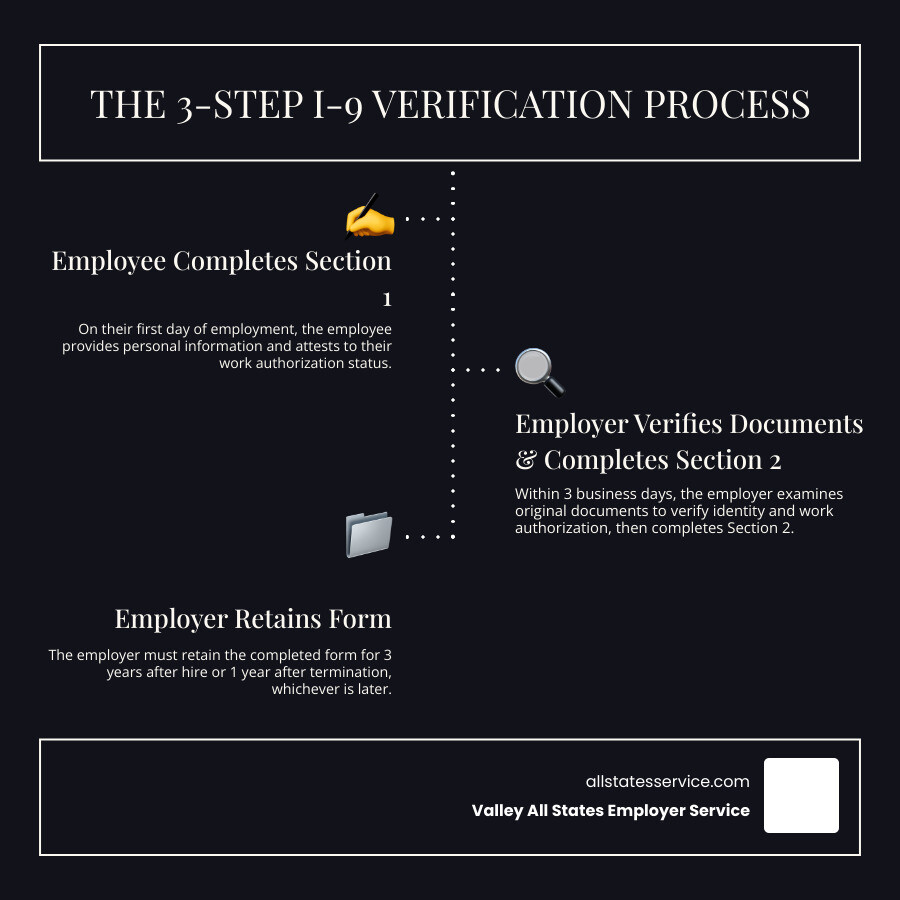
The process involves three steps: the employee completes their section by day one, you examine their documents and complete your section within three business days, and you retain the form for a specific period.
Correctly verifying identity and work authorization protects your business, ensures fair competition, and maintains the integrity of the U.S. labor market. Getting the I-9 right means your new hire paperwork meets federal standards and you avoid the risk of fines, audits, and other legal complications.
What is an I-9 Form Needed For? The Core Requirements
In your daily hiring, what is i 9 form needed for? It’s needed to verify every new hire’s identity and legal authorization to work in the United States.
This rule applies to all U.S. employers for anyone hired for pay after November 6, 1986. Every new hire needs an I-9, regardless of their citizenship status. Whether they are a U.S. citizen, a lawful permanent resident, or have temporary work authorization, the process is the same.
The responsibilities are clear. The employee’s job is to complete Section 1 by their first day, attesting to their status and providing personal information. They must then present original documents proving their identity and work authorization.
Your employer responsibilities begin with examining those documents. You or an authorized representative must determine if the documents appear genuine and relate to the employee. You then complete Section 2, recording the document details.
Finally, you must retain the completed form as required by law. Getting these core requirements right protects your business from day one. For more details, our guide on What is an I-9 Form? and the official USCIS I-9 Page are excellent resources.
A Step-by-Step Guide to Completing Form I-9
Completing Form I-9 is a straightforward process once you understand the flow. Let’s walk through each stage.
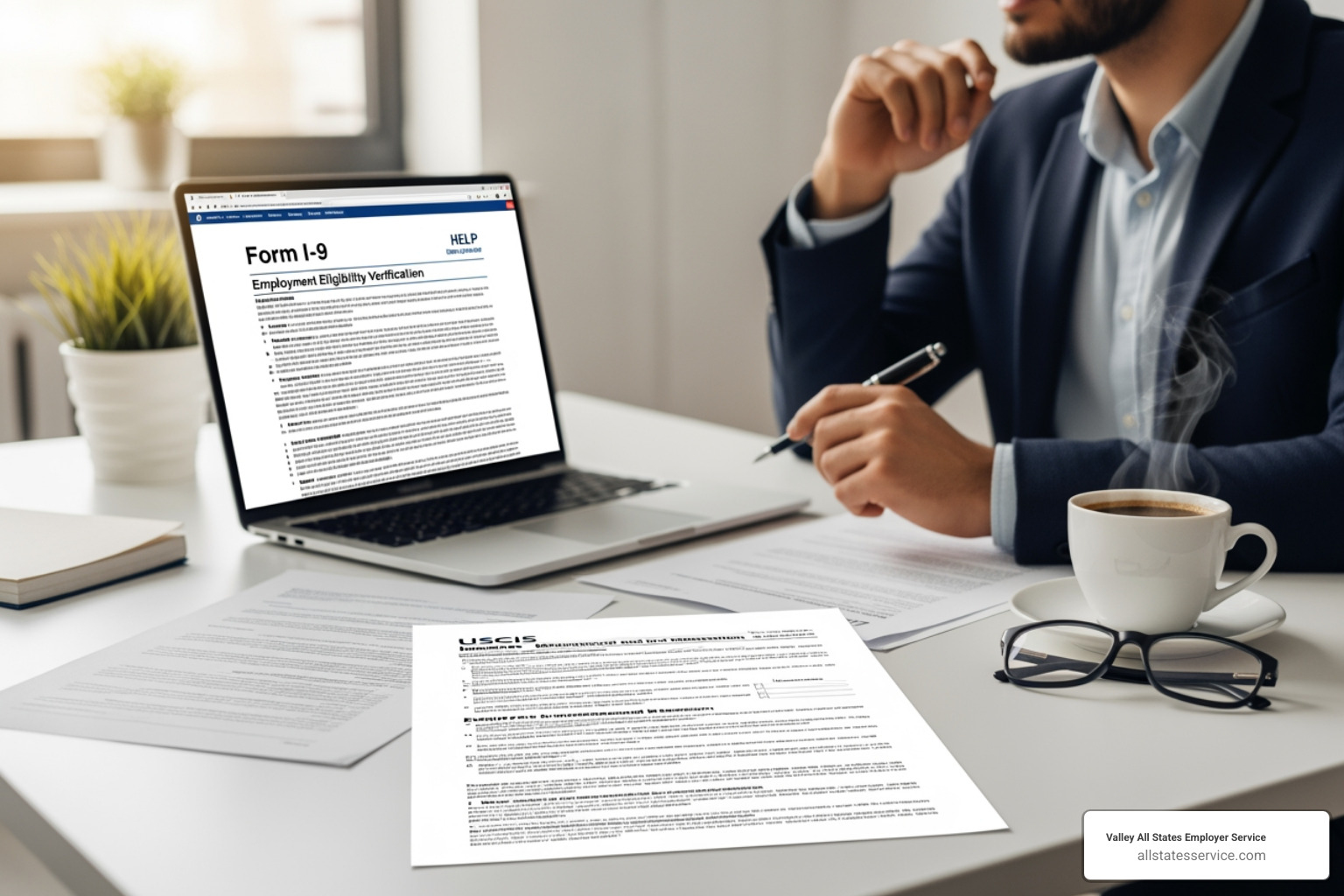
Employee’s Role: Completing Section 1
The new employee must complete Section 1 no later than their first day of employment for pay.
They provide their legal name, address, date of birth, and Social Security number (if applicable). Critically, they must attest to their status by checking one of four boxes: U.S. Citizen, Noncitizen National of the United States, Lawful Permanent Resident, or Alien Authorized to Work. Depending on the selection, they may need to provide an Alien Number, USCIS Number, or other details.
If an employee needs help, a preparer or translator can assist but must complete Supplement A. For more on this step, see our guide on Filling Out Employment Eligibility Verification.
Employer’s Role: Verifying Documents and Completing Section 2
You or your authorized representative must complete Section 2 within three business days of the employee’s first day. This is the three-day rule. For jobs lasting less than three days, it must be done on day one.
Your main job is to examine the original documents the employee presents. They choose from the official lists: either one document from List A or a combination of one from List B and one from List C. You cannot specify which documents they provide, as this could lead to discrimination claims.
You must determine if the documents appear genuine and reasonably relate to the employee. While this was traditionally an in-person review, DHS now allows alternative procedures like live video verification for some employers, provided specific rules are followed.
Remember the anti-discrimination notice and treat all employees equally throughout the process. For more, see our Form I-9 Section 2 Complete Guide and Employer I-9 Verification Guide.
What is an I-9 form needed for when rehiring or reverifying? (Supplement B)
What is i 9 form needed for after the initial hire? Supplement B, “Reverification and Rehire,” is used in three main situations:
- An employee’s work authorization is expiring and needs reverification.
- You rehire a former employee within three years of their original I-9 completion.
- An employee has a legal name change.
Using Supplement B can save time compared to starting a new form. Staying on top of these dates is crucial for compliance. Our I-9 Process for Rehires guide offers more insight.
The Lists of Acceptable Documents: What You Can and Cannot Accept
The Lists of Acceptable Documents are central to Form I-9. It’s not about demanding specific documents, but understanding the options available to employees and respecting their right to choose.
What documents are needed for an I-9 form?
Employees have the right to choose which unexpired documents they present from the official lists. You cannot ask for specific documents or refuse valid ones. The goal is to establish both identity and employment authorization.
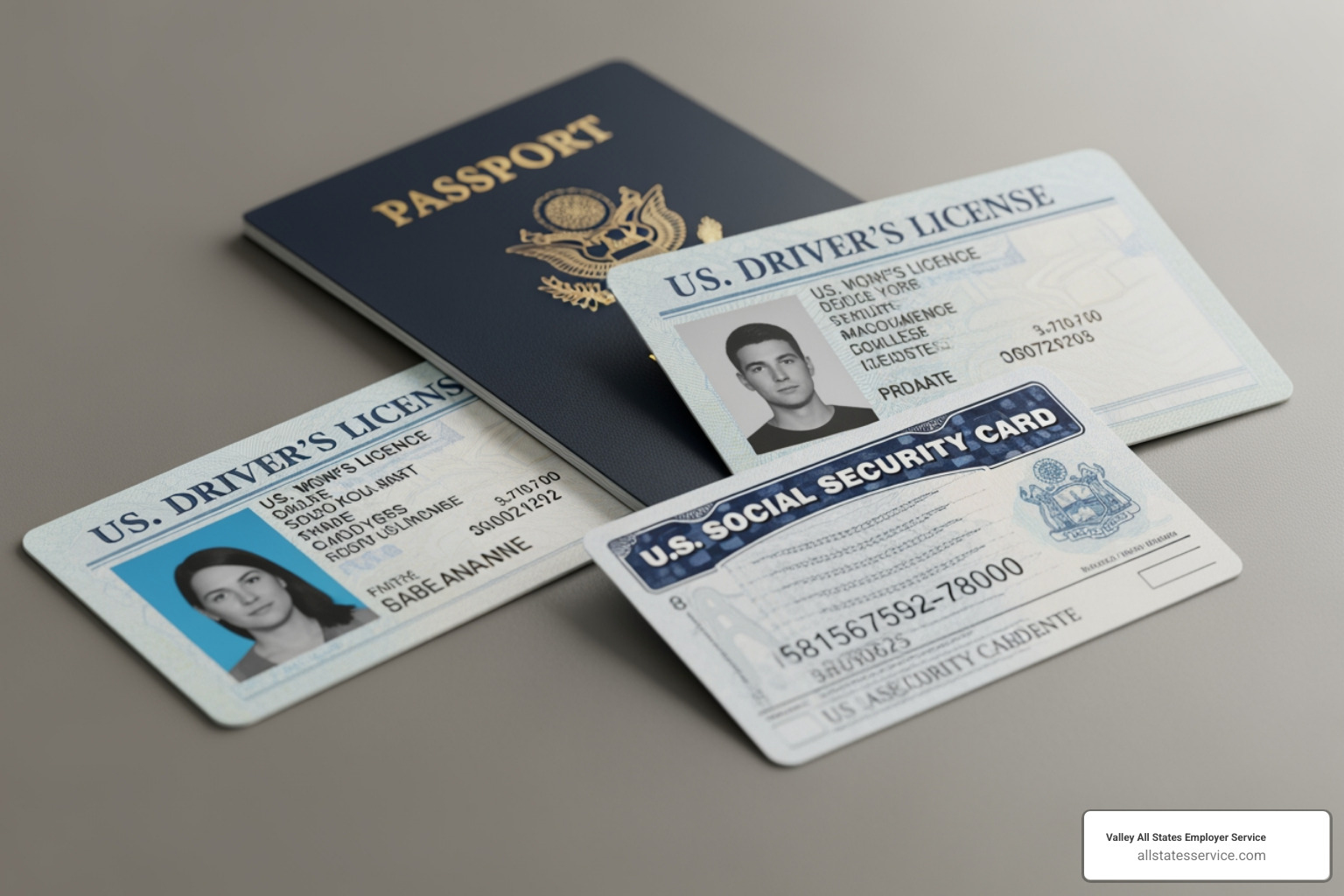
The rule is simple: an employee must present either one document from List A (which proves both identity and work authorization) or a combination of one document from List B (identity) and one from List C (work authorization).
Avoid over-documentation, which is asking for more documents than legally required, as it can be viewed as discriminatory. For an overview, see our guide on Documents for I-9 or the official Form I-9 Acceptable Documents – USCIS page.
List A: Documents That Establish Both Identity and Employment Authorization
These are “one-stop shop” documents. If an employee presents one, no other documents are needed. Common examples include:
- U.S. Passport or U.S. Passport Card
- Permanent Resident Card (Form I-551, “Green Card”)
- Foreign passport with a temporary I-551 stamp or notation
- Employment Authorization Document (EAD) with a photograph (Form I-766)
Older versions of these documents are valid until they expire.
List B & List C: Combining Documents for Verification
If an employee doesn’t have a List A document, they must provide one from List B and one from List C.
List B documents establish identity. They must have a photo or identifying information. Common examples are a driver’s license or state ID card, a federal or local government ID card, a school ID with a photo, or a U.S. Military card. For minors, alternatives like school or clinic records may be used.
List C documents establish employment authorization. The most common is an unrestricted U.S. Social Security card. A card stating “NOT VALID FOR EMPLOYMENT” is not acceptable. Other options include an original or certified copy of a birth certificate from a U.S. state or territory, a Certification of Report of Birth from the Department of State, or a Native American tribal document.
For the most current and detailed list, always consult the official Handbook for Employers (M-274).
Beyond the Form: I-9 Retention, Audits, and Penalties
Completing Form I-9 is only the first step. Ongoing responsibilities for storage and maintenance are just as critical. An improperly stored or prematurely discarded I-9 can cause as much trouble as one that was never completed.
How Long to Keep Form I-9 Records
The retention rule is to keep each Form I-9 for three years after the hire date OR one year after employment ends, whichever is later. For example, if an employee hired in 2024 leaves in 2028, you must keep their I-9 until 2029 (one year after termination).
You can store forms in paper format or use an electronic storage system that meets DHS security and accessibility requirements. Records must be organized and ready for quick production. Our guide on I-9 Record Keeping details best practices for both methods.
The High Cost of Non-Compliance: Penalties and Audits
The stakes for I-9 violations are high. Penalties are divided into two main categories.
First are substantive violations and uncorrected technical errors, like missing signatures or incomplete sections. Fines currently range from $281 to $2,789 per form for first offenses. These add up quickly in an audit.
The second, more serious category is knowingly hiring or continuing to employ an unauthorized worker. This can lead to steeper fines, criminal charges, and debarment from government contracts.
Immigration and Customs Enforcement (ICE) conducts audits via a Notice of Inspection (NOI), typically giving you three business days to produce all I-9s. The best defense is conducting regular self-audits to find and correct errors properly before the government does.
Understanding these risks is part of knowing what is i 9 form needed for. For more, see our resources on I-9 Compliance Penalties and our I-9 Audit Complete Guide.
Clearing Up Confusion: I-9 vs. W-9 and the Role of E-Verify
Let’s untangle two common sources of confusion: the difference between Form I-9 and W-9, and the role of E-Verify.
Form I-9 vs. Form W-9: What’s the Difference?
Though their names are similar, these forms serve entirely different purposes.
- Form I-9 (USCIS): Verifies employment eligibility for employees (W-2 recipients). It’s about immigration law compliance.
- Form W-9 (IRS): Collects a Taxpayer Identification Number (TIN) from independent contractors and vendors (1099 recipients). It’s a tax document.
In short: I-9 is for employees to verify work authorization, while W-9 is for contractors for tax purposes. Mixing them up can cause serious compliance issues.
What is E-Verify and How Does It Relate to Form I-9?
E-Verify is an electronic system from USCIS and the Social Security Administration that confirms an employee’s work eligibility by checking federal databases.
Crucially, E-Verify is an additional step, not a substitute for Form I-9. You must still complete an I-9 for every new hire. E-Verify simply adds an electronic layer of verification.
For most employers, E-Verify is voluntary, but it is required for federal contractors and in some states. Using it correctly provides extra confidence in your hiring and helps avoid penalties. At Valley All States Employer Service, we specialize in efficient E-Verify processing to reduce your administrative burden.
Learn more in our guide on E-Verify and I-9 or visit the E-Verify Official Site. What is i 9 form needed for remains the same: verifying identity and work authorization. E-Verify just improves that process.
Conclusion: Mastering I-9 Compliance
Understanding what is i 9 form needed for is about building a legal and trustworthy workforce. From the employee’s first day to long-term record retention, each step is crucial for protecting your business.
Getting Form I-9 right protects you from costly penalties, ensures you hire only authorized individuals, and demonstrates a commitment to fair employment practices.
Proactive compliance makes all the difference. Regular self-audits, understanding key distinctions like I-9 vs. W-9, and knowing how E-Verify can support your process are key to success.
At Valley All States Employer Service, we know employment compliance can be overwhelming. We provide expert, impartial, and efficient E-Verify processing and I-9 services, handling the details so you can focus on your business.
Want to dive deeper? Our Form I-9 Ultimate Guide covers every detail.
Ready to simplify compliance? Contact our team today.