
Why Understanding i9 and everify Matters for Your Business
Understanding i9 and everify is essential if you want to build a legal, reliable workforce and avoid expensive compliance mistakes. Form I-9 is the mandatory paper or electronic form that verifies every new hire’s identity and work authorization. E-Verify is a separate, mostly voluntary electronic system that uses I-9 data to confirm employment eligibility against government records.
Quick Answer: The Key Differences
| Aspect | Form I-9 | E-Verify |
|---|---|---|
| Requirement | Mandatory for all U.S. employers | Required for federal contractors, some states; voluntary otherwise |
| Function | Paper/electronic form documenting employee eligibility | Electronic verification against SSA and DHS records |
| Social Security Number | Not required | Required |
| Photo ID | Not required for List B documents | Required for List B documents |
| Reverification | Must be used for expired work authorization | Cannot be used for reverification |
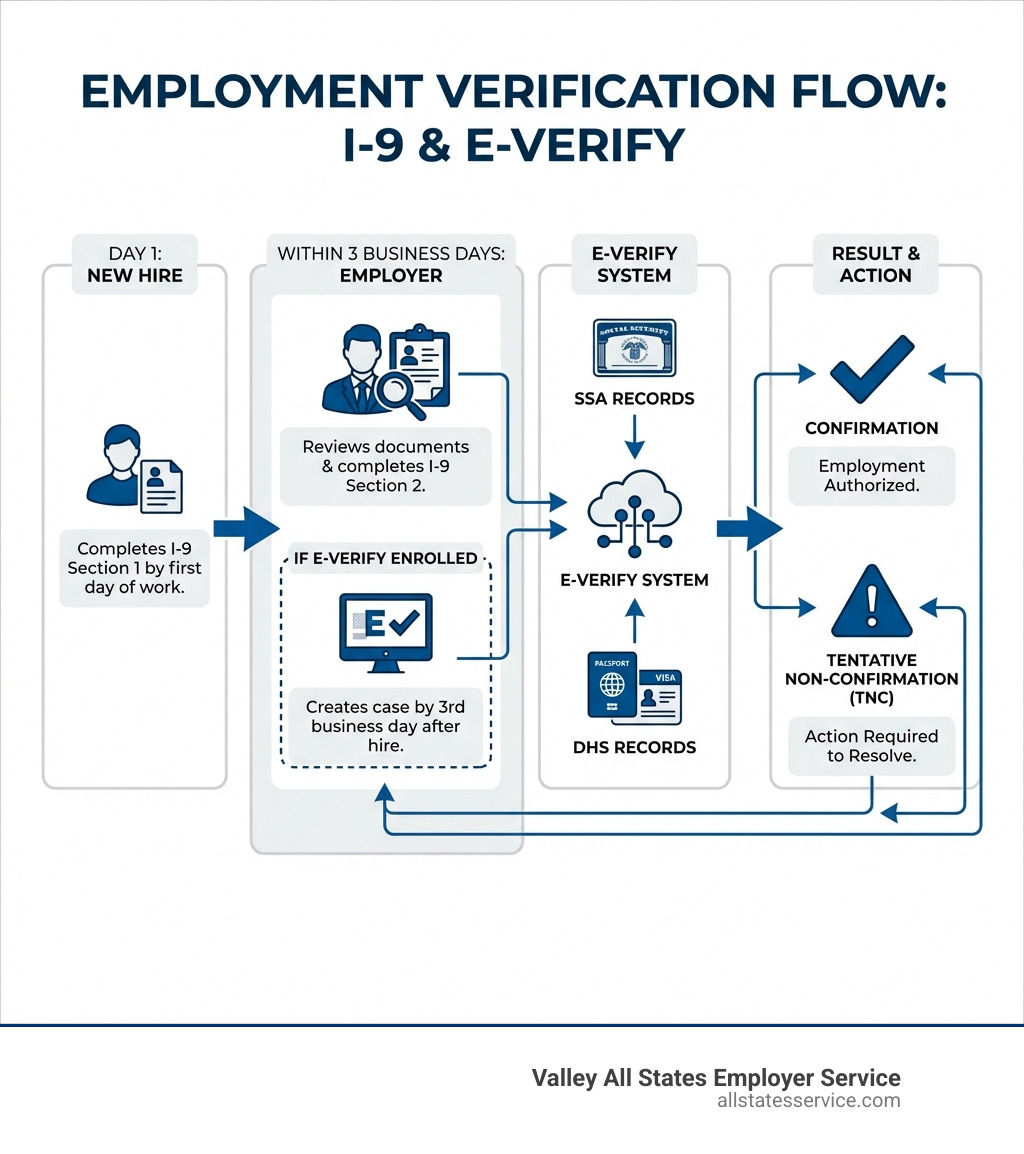
| Timeline | Section 2 due within 3 business days of hire | Case created by 3rd business day after hire |
Since the Immigration Reform and Control Act (IRCA) of 1986, U.S. employers have been legally required to verify that every person they hire is authorized to work in the United States. Failure to do this properly can result in civil fines ranging from $272 to $27,000 per violation.
The challenge is that many employers still confuse Form I-9 and E-Verify or assume that using one automatically covers the other. That misunderstanding can lead to missed deadlines, incomplete records, or inconsistent use of E-Verify across locations.
Form I-9 is always the foundation, the mandatory first step for every new employee. E-Verify builds on top of it, adding an extra layer of electronic verification. Knowing when you must use each one, how they work together, and what sets them apart is critical if you want to stay compliant without creating unnecessary risk for your business.
If you are an HR manager juggling onboarding, benefits, and day-to-day employee questions, the complexity of i9 and everify rules can feel overwhelming. The I-9 form alone has over 300 possible errors. Add state-specific E-Verify mandates, federal contractor requirements, and new remote verification procedures, and it is easy to see why many businesses struggle.
This guide walks through what you need to know about both systems, when you must use them, and how to stay compliant without drowning in administrative work.
i9 and everify basics:
The Foundation: Understanding Form I-9 Requirements
When we talk about employment eligibility verification in the U.S., the journey always begins with Form I-9. This crucial document is the cornerstone of ensuring a legal workforce.
What is Form I-9 and Its Purpose?
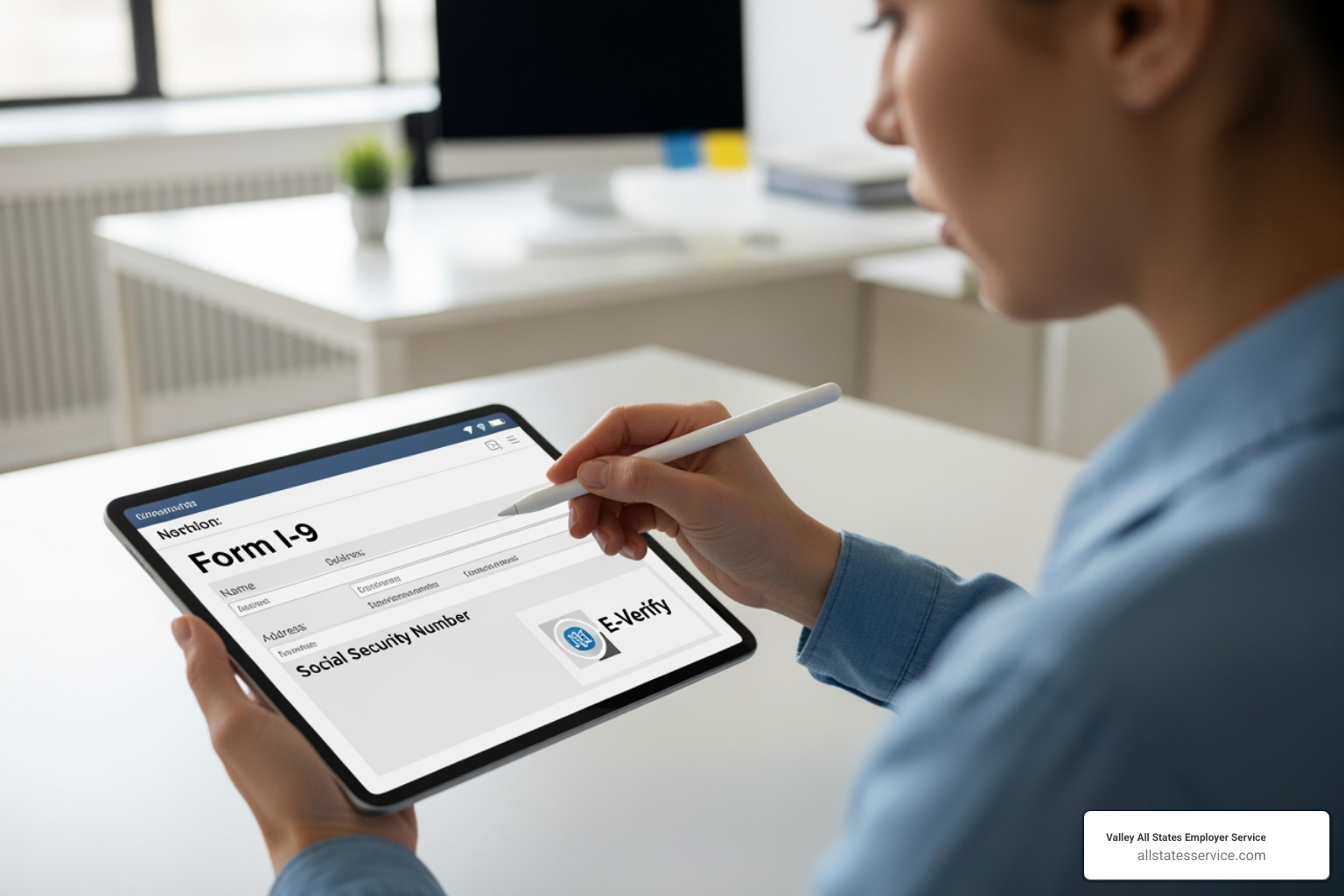
Form I-9, officially known as the Employment Eligibility Verification form, is a federal document that all U.S. employers must complete for every new employee hired after November 6, 1986. Its primary purpose is to verify the identity and employment authorization of individuals hired for employment in the United States. It’s not just a formality, it’s a legal requirement to prevent the hiring of unauthorized workers. You can learn more about what an I-9 is on our website.
Who Must Complete Form I-9?
Simply put, if you’re a U.S. employer, you must complete Form I-9 for every employee. This applies to all employees, regardless of their nationality or citizenship status. The form collects information from the employee and requires the employer to examine documents proving the employee’s identity and authorization to work.
Timelines for Completing Form I-9
Compliance with deadlines is critical for Form I-9. Here’s what we need to know:
- Employee’s Responsibility (Section 1): The new hire must complete and sign Section 1 of Form I-9 no later than their first day of employment for pay. They can complete it earlier, but only after accepting a job offer.
- Employer’s Responsibility (Section 2): As the employer, we must complete Section 2 within three business days of the employee’s first day of work. During this time, we examine the documents the employee presents to establish their identity and work authorization.
Document Requirements for Form I-9
To complete Section 2, employees must present original documents from the “Lists of Acceptable Documents.” These lists are provided with the Form I-9 instructions and are categorized into:
- List A: Documents that establish both identity and employment authorization (e.g., U.S. Passport, Permanent Resident Card).
- List B: Documents that establish identity (e.g., driver’s license, state ID card).
- List C: Documents that establish employment authorization (e.g., Social Security card, birth certificate).
An employee must present either one document from List A, or one document from List B and one document from List C. We must physically examine these documents or remotely examine them using an alternative procedure authorized by the Secretary of Homeland Security. For a comprehensive guide on what documents are acceptable, visit our page on Acceptable I-9 Documents.
Retention Requirements for Form I-9 Documents
The responsibility doesn’t end with completing the form. We must also properly retain it. Employers must keep a completed Form I-9 for each employee for a specific period. This period is the later of:
- Three years after the date of hire, or
- One year after the date employment is terminated.
This ensures we can present the forms for inspection if requested by authorized government officials. Proper I-9 Record Keeping is essential. You can also use the USCIS retention calculator to help determine specific retention dates.
E-Verify Explained: The Digital Companion to Form I-9
While Form I-9 lays the groundwork for employment eligibility verification, E-Verify takes it a step further. It’s a powerful tool that complements the I-9 process, adding an electronic layer of confirmation.
What is E-Verify?
E-Verify is an internet-based system operated by U.S. Citizenship and Immigration Services (USCIS) that allows employers to electronically confirm the employment eligibility of their newly hired employees. It works by comparing the information from an employee’s Form I-9 against government records from the Social Security Administration (SSA) and the U.S. Department of Homeland Security (DHS). This comparison helps ensure that the information provided on the I-9 is accurate and that the employee is authorized to work in the U.S. To get a deeper understanding, explore what E-Verify is on our site.
How E-Verify Works
After we complete Form I-9 with a new employee, if we are an E-Verify participant, we enter the employee’s information from their I-9 into the E-Verify system. The system then rapidly checks this data against millions of government records. The result is typically a “Employment Authorized” status, or in some cases, a “Tentative Non-confirmation” (TNC) if there’s a mismatch. If a TNC occurs, the employee has an opportunity to resolve the discrepancy.
Who Must Use E-Verify?
While E-Verify is voluntary for most employers, there are specific situations where participation becomes mandatory:
- Federal Contractors: If we hold federal contracts that include the Federal Acquisition Regulation (FAR) E-Verify clause, then we are required to use E-Verify for all new hires and, in some cases, existing employees working on those contracts. This also often extends to subcontractors. Our E-Verify Federal Contracts Complete Guide provides more detail.
- State-Mandated Employers: Some states have laws mandating the use of E-Verify for certain public and/or private employers. While Maryland is not currently on the list of states with universal E-Verify mandates, it’s crucial to stay informed about potential legislative changes. Our E-Verify State Requirements Guide 2025 offers insights into state-specific requirements.
- Voluntary Participation: Many employers choose to use E-Verify voluntarily, even when not required. This often stems from a desire to improve compliance, reduce the risk of hiring unauthorized workers, and leverage the “safe harbor” protection E-Verify offers.
E-Verify Case Creation Timelines
Just like Form I-9, E-Verify has strict timelines that we must adhere to:
- We must create an E-Verify case for a new hire no later than the third business day after the employee starts work for pay. This aligns closely with the Form I-9 Section 2 completion deadline.
- If an employee has applied for but not yet received their Social Security Number (SSN), we must still complete their Form I-9 and attach an explanation. We then create the E-Verify case as soon as the SSN is available.
Understanding these timelines is a key part of the E-Verify Onboarding Process.
The Core Differences: A Deep Dive into i9 and everify
It’s clear that Form I-9 and E-Verify are intertwined, but they are not interchangeable. Let’s really dig into the distinctions that matter for our compliance efforts.
While Form I-9 is the foundational document, E-Verify is an additional verification step. Our E-Verify vs I-9 Guide offers an in-depth look at these differences.
Key Document Differences for i9 and everify
One of the most common areas of confusion lies in the document requirements:
- Social Security Number (SSN): For Form I-9 completion, an SSN is generally not required for Section 1, although employees are encouraged to provide it. However, for E-Verify, an employee’s SSN is mandatory to create a case and verify their eligibility. If an employee hasn’t received their SSN yet, we must note this on the I-9 and create the E-Verify case once it’s available.
- Photo ID on List B Documents: When an employee presents a List B document (identity only) for Form I-9, it does not necessarily need to contain a photo. However, for employers participating in E-Verify, any List B document presented by the employee must contain a photograph. The only exception is if the employee objects for religious reasons, in which case they should contact the E-Verify Contact Center for guidance.
These nuances are vital for correct processing and avoiding errors. For detailed information on acceptable documents, refer to our I-9 Document Requirements Complete Guide.
The E-Verify ‘Safe Harbor’ Advantage
One significant benefit of using E-Verify, especially for those not federally mandated to do so, is the “safe harbor” provision. This provides a level of protection for employers. If E-Verify confirms an employee is authorized to work, and it’s later finded that the employee was actually unauthorized, the employer is presumed to have not knowingly hired an unauthorized alien.
This presumption is a powerful defense against certain penalties, particularly those related to knowingly hiring unauthorized workers. It doesn’t absolve us of all responsibility, but it demonstrates our good-faith effort to comply with employment verification laws. This “safe harbor” is a key reason many businesses choose to participate voluntarily. We can dig deeper into the Benefits of E-Verify on our website.
Staying Compliant and Avoiding Penalties
Compliance with i9 and everify regulations is not just about following rules, it’s about protecting our business from significant legal and financial repercussions. The government takes employment eligibility verification seriously, and enforcement is on the rise.
Penalties for Non-Compliance
Failure to properly complete and retain Form I-9, or to comply with E-Verify requirements, can lead to substantial penalties. These can include:
- Civil Fines: These are the most common penalties. For paperwork violations (errors on Form I-9), fines can range from $272 to $2,700 per violation. For knowingly hiring or continuing to employ unauthorized workers, civil fines can escalate from $676 to $5,500 for a first offense, and up to $27,000 for multiple offenses. These civil monetary penalties are subject to inflation adjustments, as noted by federalregister.gov penalty adjustments.
- Criminal Penalties: In cases of egregious or repeated violations, especially those involving patterns of knowingly hiring unauthorized workers, employers can face criminal charges, including jail time.
- Debarment from Federal Contracts: For federal contractors, non-compliance with E-Verify can lead to debarment, meaning we could lose our ability to bid on or receive government contracts.
We are seeing increased enforcement efforts, with U.S. Immigration and Customs Enforcement (ICE) expanding its investigative and enforcement capabilities. This means that ICE I-9 Audits are a very real possibility, and being unprepared can be costly.
Navigating Remote Verification for i9 and everify
The shift to remote work has introduced new considerations for I-9 compliance. Recognizing the challenges, the Department of Homeland Security (DHS) has implemented new remote I-9 verification procedures.
Under these new rules, employers who are enrolled in E-Verify and in good standing can remotely examine I-9 documents. This means that instead of physically inspecting documents in person, we can conduct a live video interaction with the employee to verify their identity and work authorization documents. However, this remote option is only available to E-Verify participants. If we are not enrolled in E-Verify, we must continue with in-person physical inspection or use an authorized representative.
This development makes E-Verify even more critical for businesses with remote or hybrid workforces. Our guides on I-9 for Remote Employees and the E-Verify Remote Hiring Complete Guide offer comprehensive advice on these procedures.
Best Practices for Compliance
To ensure we remain compliant with both Form I-9 and E-Verify requirements, we recommend several best practices:
- Conduct Regular Internal Audits: Proactively reviewing our I-9 forms helps us catch and correct errors before a government audit does. This includes checking for completeness, accuracy, and proper retention. Our Internal I-9 Audit Complete Guide can help us get started.
- Provide Comprehensive Staff Training: Ensure that all personnel involved in the hiring and onboarding process, especially those completing Form I-9 and E-Verify cases, are thoroughly trained. The Form I-9 has over 300 possible errors, so proper training is paramount. Our I-9 Form Training resources can be invaluable here.
- Use Official Resources: The U.S. government provides extensive guidance. The Handbook for Employers: Guidance for Completing Form I-9 (M-274) is an indispensable resource that we should consult regularly.
- Stay Informed on Legislative Changes: Employment laws, particularly those related to immigration and verification, can change. Keeping abreast of new regulations and administrative priorities, such as increased focus on DHS growth, is crucial for proactive compliance.
Streamlining Your Verification Process with Third-Party Solutions
Managing i9 and everify compliance can be a significant administrative burden, especially for growing businesses or those with high turnover. The complexity of the regulations, coupled with the potential for costly errors, often leads employers to seek external support.
Challenges of In-House Management
Let’s face it, keeping up with Form I-9 and E-Verify requirements internally can be a full-time job. Consider these challenges:
- High Error Rate: The Form I-9, despite being seemingly straightforward, has over 300 possible errors. A single mistake can lead to a fine.
- Administrative Burden: From ensuring timely completion and document examination to proper retention and potential reverification, the paperwork and process management can be overwhelming for HR teams.
- Keeping Up with Changes: Federal and state regulations, acceptable document lists, and remote verification procedures are subject to change. Staying current requires dedicated effort and expertise.
Benefits of Integrated Solutions and Third-Party Providers
This is where integrated solutions and third-party service providers like Valley All States Employer Service become invaluable. We specialize in changing these challenges into streamlined, compliant processes. The benefits are clear:
- Accuracy: Our expert, impartial processing minimizes errors, helping us avoid those costly fines. We ensure every step of the Form I-9 and E-Verify process is completed correctly the first time.
- Efficiency: Automated systems and experienced professionals significantly reduce the time and effort our team spends on verification tasks. What can take minutes with an expert might take hours of painstaking review otherwise.
- Reduced Risk: By leveraging our expertise, we reduce the risk of non-compliance, paperwork violations, and potential penalties. We help you maintain that crucial “safe harbor” status with E-Verify.
- Expert Guidance: We stay on top of all legislative changes and provide timely advice, ensuring our clients are always compliant with the latest regulations, whether it’s for remote I-9s or state-specific E-Verify mandates.
The Role of an E-Verify Employer Agent
As an E-Verify Employer Agent, Valley All States Employer Service acts on your behalf to manage the E-Verify process. This means we handle the submission of employee data, monitor case statuses, and assist with any Tentative Non-confirmations, all while ensuring adherence to USCIS guidelines. Our E-Verify Employer Agent Guide 2026 details how this partnership works.
By outsourcing HR compliance to us, you gain peace of mind and free up your internal resources to focus on strategic HR initiatives. Our comprehensive Employment Verification Services Complete Guide explains how we can simplify your entire employment eligibility verification process.
Ready to simplify your i9 and everify compliance and ensure a secure, legal workforce? Contact our team today to learn how Valley All States Employer Service can support your business.