What is Workforce Compliance and Why Does It Matter?
Workforce compliance management ensures your business follows all legal, ethical, and contractual rules governing how you employ people. It protects both your organization and your employees by creating fair, safe, and lawful workplaces.
Quick Answer: Core Elements of Workforce Compliance Management
- Labor Laws – minimum wage, working hours, collective bargaining rights
- Equal Employment Opportunity (EEO) – anti-discrimination, diversity and inclusion
- Health and Safety – OSHA standards, workplace inspections, protective equipment
- Wage and Hour Rules – overtime pay, meal breaks, recordkeeping
- Employee Classification – distinguishing employees from contractors
- Leave Entitlements – FMLA, paid sick leave, state-specific requirements
- Data Protection – GDPR, CCPA, employee privacy rights
- Termination Procedures – severance, notice periods, documentation
As a busy HR manager, you’re juggling dozens of regulations that change constantly. One day it’s a new state minimum wage law. The next, it’s updated OSHA guidelines or a local sick leave ordinance. Meanwhile, you’re trying to onboard new hires, process I-9 forms, and keep your team compliant with E-Verify requirements.
The stakes are real. The financial services industry alone faced fines of approximately £476 million between 2020 and 2021 due to non-compliance with anti-money laundering regulations. OSHA has cited major companies for unsafe working conditions at multiple warehouses, citing poor working conditions, excessive workloads, and inadequate safety measures.
But here’s the good news: workforce compliance isn’t just about avoiding penalties. When done right, it creates real business value. Studies on the direct costs of workplace accidents show that companies save $4 to $6 for every dollar invested in safety and health programs. High-trust organizations report 70% less stress, 106% more energy at work, and 50% higher productivity.
This guide breaks down workforce compliance management into practical steps you can actually implement. No legal jargon. No overwhelming complexity. Just clear guidance on protecting your business, supporting your employees, and building a workplace where everyone thrives.
Workforce compliance management terms to learn:
The Core Components of Workforce Compliance Management
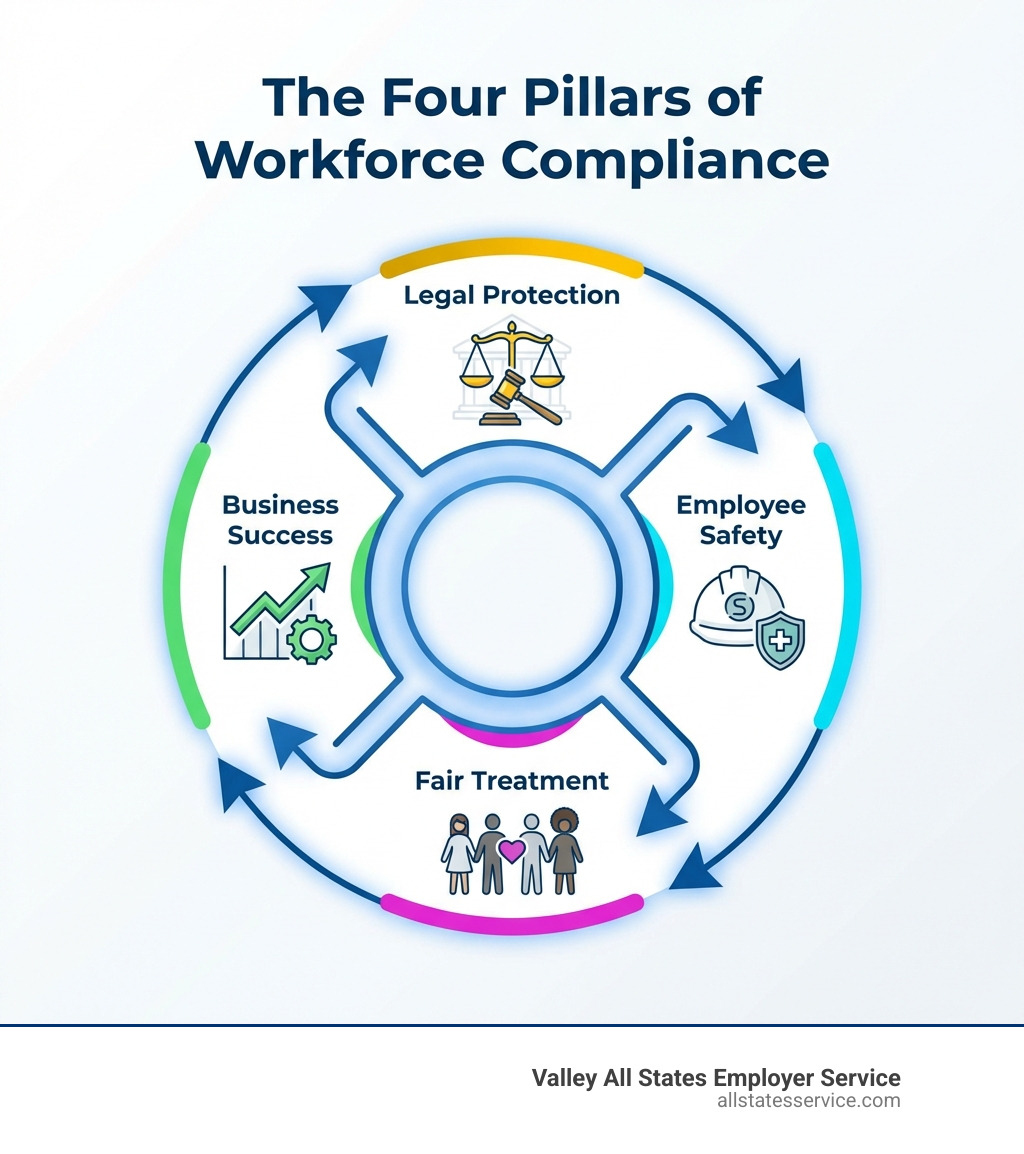
Effective workforce compliance management is built on several foundational pillars. Each component plays a crucial role in ensuring that your organization operates legally and ethically, fostering a positive environment for everyone involved. Let’s explore these key areas:
- Labor Laws: These are the bedrock of employment. They dictate everything from minimum wage and overtime pay, often guided by the federal Fair Labor Standards Act, to working hours, child labor restrictions, and the right to collective bargaining. Staying on top of these, especially as they evolve at federal, state, and local levels, is paramount.
- HR Compliance: Beyond specific laws, HR compliance involves the broader policies and practices that govern the employment lifecycle. This includes proper hiring, onboarding, performance management, and disciplinary actions, all conducted in a fair and consistent manner. Effective HR compliance makes things smoother for everyone, building trust and protecting the business.
- Safety Regulations: Ensuring a safe working environment is not just good practice, it’s the law. The Occupational Safety and Health Act (OSHA) sets national standards in the U.S., requiring employers to provide workplaces free from recognized hazards. This means regular inspections, providing necessary safety gear, and comprehensive training.
- Equal Employment Opportunity (EEO): These laws prohibit discrimination based on protected characteristics like race, color, religion, sex, national origin, age, disability, or genetic information. Federal laws like Title VII (U.S.) establish a baseline, but state and local regulations, such as New York City’s Human Rights Law, often offer even broader protections.
- Wage and Hour Laws: Getting pay right is one of the most regulated areas. The Fair Labor Standards Act (FLSA) sets federal standards for minimum wage and overtime, but states and localities can, and often do, have higher minimum wages and stricter overtime rules. Accurate record-keeping of hours worked is essential here.
- Data Protection: With increasing digitization, protecting employee data is critical. Laws like California’s CCPA and Virginia’s CDPA exemplify state-level privacy requirements in the U.S. While the EU’s GDPR sets a high global standard, U.S. businesses must still steer a complex patchwork of federal and state laws regarding employee data privacy.
- Employee Classification: Correctly classifying workers as employees or independent contractors is crucial. Misclassification carries serious consequences, as seen with strict state laws like California’s AB5, which created stringent criteria.
- Leave Entitlements: Employees have rights to various types of leave. The federal Family and Medical Leave Act (FMLA) provides for unpaid, job-protected leave. However, many states, like Massachusetts with its Paid Family and Medical Leave or California with CFRA, offer additional paid leave benefits.
- Termination Rules: Even ending an employment relationship requires compliance. While many U.S. states follow “at-will” employment, meaning termination can occur without cause, some states like Montana require just cause for termination after a probation period. Severance pay and notice periods also vary by state and contractual agreements.
The High Stakes: Balancing Risks, Rewards, and Regulations
Ignoring workforce compliance management isn’t just cutting corners; it’s playing with fire. The consequences of non-compliance can be devastating, impacting your business financially, legally, and reputationally.

The Risks and Consequences of Non-Compliance
- Financial Penalties: Regulatory bodies don’t just issue warnings. Fines for violations can be steep and quickly add up. As highlighted, the financial services industry faced fines of approximately £476 million between 2020 and 2021 due to non-compliance with anti-money laundering regulations. That’s a staggering sum!
- Legal Liabilities: Non-compliance can lead to lawsuits from employees, former employees, or government agencies. This means expensive legal battles, potential settlements, and judgments that can drain company resources and divert management attention.
- Reputational Damage: News of compliance failures spreads fast. Whether it’s an OSHA citation for unsafe working conditions, like those faced by Amazon, or a lawsuit over discrimination, such incidents can severely tarnish your brand image. This can lead to loss of customer trust, difficulty attracting top talent, and even investor reluctance.
- Operational Disruption: Investigations, audits, and legal proceedings can disrupt your daily operations, pulling key personnel away from their core duties. This can lead to decreased productivity and efficiency, impacting your bottom line.
The Rewards of a Strong Compliance Strategy
While the risks of non-compliance are daunting, the benefits of effective workforce compliance management are equally compelling. It’s not just about avoiding trouble; it’s about building a stronger, more resilient, and more successful business.
- Cost Savings and Financial Stability: Proactive compliance prevents costly fines and lawsuits. Moreover, investing in safety programs, for instance, has a remarkable return. OSHA estimates that companies save $4 to $6 for every dollar invested in safety and health programs. This translates directly to financial stability.
- Improved Brand Reputation: A strong compliance record improves your company’s image among customers, investors, and the public. It demonstrates ethical leadership and a commitment to fair practices, building trust and loyalty.
- Improved Employee Engagement and Retention: When employees feel safe, respected, and fairly treated, they are more engaged and less likely to leave. Consistent application of policies builds trust. As neuroscientist Paul Zak found, high-trust organizations report 70% less stress, 106% more energy at work, and 50% higher productivity. This directly impacts your talent acquisition and retention efforts.
- Increased Productivity: A compliant workplace is often a well-organized and efficient one. Clear policies, proper training, and a focus on safety reduce incidents and distractions, allowing employees to focus on their work.
- Positive Company Culture: At its heart, compliance fosters a culture of respect, fairness, and safety. This creates an environment where employees feel valued, leading to higher morale and a stronger sense of community.
Navigating Federal, State, and Local Laws
The regulatory landscape for workforce compliance management in the United States is a complex, multi-layered system. We must steer federal laws, state-specific mandates, and even local ordinances.
- Federal Baseline: U.S. federal regulations set the foundational employment laws across the country. These include the minimum wage (established by the Fair Labor Standards Act), anti-discrimination policies (like Title VII (U.S.)), and workplace safety standards (under the Occupational Safety and Health Act). These laws provide a uniform floor of protection nationwide.
- State-Level Specifics: States often build upon federal laws, introducing their own, sometimes stricter, requirements. For instance, while the federal minimum wage is $7.25 per hour, many states, including Maryland, have significantly higher rates. Additionally, states may have unique leave laws, like Massachusetts’ Paid Family and Medical Leave or California’s CFRA, that expand upon the federal FMLA. Data privacy, too, sees state-specific rules like California’s CCPA and Virginia’s CDPA.
- Local Ordinances: Further complicating matters, cities and counties can enact their own ordinances that go beyond both federal and state laws. This often includes even higher minimum wages or specific sick leave requirements. For example, New York City’s Human Rights Law offers broader protections than federal law.
It’s crucial for us to understand that compliance is not a “one-size-fits-all” scenario. What’s legal in one part of the country might not be in another.
| Regulation Type | Minimum Wage (Example) | Overtime Rules (Example) | Leave Laws (Example) |
|---|---|---|---|
| Federal | $7.25/hour (FLSA) | 1.5x regular rate over 40 hours/week | FMLA (unpaid, job-protected) |
| State (MD) | $15.00/hour (effective 2024) | 1.5x regular rate over 40 hours/week (often mirrors federal) | Maryland Healthy Working Families Act (paid sick and safe leave) |
| Local (Example City) | Potentially higher than state | May have specific daily overtime rules for certain industries | May have additional paid leave requirements |
Industry-Specific Compliance Requirements
Beyond the general federal, state, and local employment laws, certain industries face their own unique and rigorous compliance requirements. These are designed to protect specific stakeholders, maintain market integrity, or ensure public safety.
- Healthcare: The healthcare industry, for example, is heavily regulated by the Health Insurance Portability and Accountability Act (HIPAA). This federal law mandates strict data privacy and security measures to protect sensitive patient information. Non-compliance can result in substantial fines and reputational damage.
- Finance: The financial sector operates under an intricate web of regulations aimed at preventing fraud, ensuring transparency, and protecting consumers. Key laws include the Dodd-Frank Act and the [Sarbanes-Oxley Act](https://www.law.cornell.edu/wex/sarbanes-oxley_act#:~:text=The%20Sarbanes%2DOxley%20Act%20(SOX,scandals%20in%20the%20early%2D2000s.), which dictate everything from anti-money laundering (AML) protocols to rigorous reporting and auditing standards.
- Manufacturing: This industry places a significant emphasis on worker safety and environmental protection. Compliance here often revolves around adherence to Occupational Safety and Health Administration (OSHA) standards for worker safety and Environmental Protection Agency (EPA) regulations for environmental impact.
Here’s a list of key industry regulations:
- HIPAA (Healthcare)
- Dodd-Frank Act (Finance)
- Sarbanes-Oxley Act (Finance)
- Anti-Money Laundering (AML) Regulations (Finance)
- OSHA Standards (Manufacturing, Construction, General Industry)
- EPA Regulations (Manufacturing, various others)
A Practical Guide to Effective Workforce Compliance Management
Workforce compliance management isn’t a passive activity; it demands a proactive approach. Think of it as a continuous cycle of planning, implementing, monitoring, and improving. It’s about more than just reacting to problems; it’s about anticipating them and building a robust system to prevent them. This involves clear policies, regular audits, and a commitment to continuous improvement.

Conducting Audits and Addressing Gaps
Regular compliance audits are like a health check-up for your business. They help us identify potential weaknesses before they become serious issues.
- Planning the Audit: Define the scope. Are we auditing all HR functions, or focusing on a specific area like wage and hour? Determine who will conduct the audit (internal team, external experts).
- Reviewing Records: This involves carefully examining employee files, payroll records, training documentation, safety logs, and policy acknowledgments. This is where diligent record-keeping pays off.
- Interviewing Employees: Speaking with employees and managers can provide invaluable insights into how policies are understood and applied in practice. Are there discrepancies between written policy and daily operations?
- Identifying Gaps: Analyze your findings against current federal, state, and local regulations. The OSHA Safety and Health Program Audit Tool is an excellent resource for systematically evaluating your safety protocols and pinpointing areas for improvement.
- Developing an Action Plan: Once gaps are identified, create a clear, actionable plan to address each one. Assign responsibilities, set deadlines, and allocate necessary resources.
- Updating Policies and Implementing New Controls: This might involve revising your employee handbook, introducing new safety procedures, or implementing new software to track compliance.
Best Practices for Employee Training
Even the best policies are useless if employees don’t understand them. Training is a cornerstone of effective workforce compliance management.
- Ongoing Training Sessions: Compliance isn’t a one-and-done lesson. Regular refreshers and new training modules are essential, especially as regulations change.
- Role-Specific Programs: Tailor training to different roles and departments. A manufacturing floor worker needs different safety training than an office administrator.
- Interactive Learning: Engage employees with quizzes, scenarios, and discussions. This makes learning more effective and memorable than simply reading a manual.
- Regular Assessments: Test comprehension to ensure the training is effective. This also helps identify areas where further education might be needed.
- Accessible Resources: Provide easy access to policies, FAQs, and contact information for compliance questions.
- Keeping Up with the Latest Compliance Requirements: Rules change fast, so we need mechanisms to stay informed and update our training materials accordingly.
- Creating Safe Feedback Channels: Encourage employees to report concerns or ask questions without fear of retaliation. This helps uncover issues before they escalate.
Fostering a Culture of Compliance and Trust
Compliance isn’t just about rules; it’s about relationships. A strong culture of compliance contributes significantly to a positive company culture and employee retention.
When we apply policies consistently and fairly, employees feel safer and more respected. This builds trust, which is a powerful driver of organizational success. As neuroscientist Paul Zak finded, high-trust organizations enjoy remarkable benefits: 70% less stress, 106% more energy at work, and 50% higher productivity.
A culture of compliance means:
- Leadership Buy-in: When leaders visibly commit to compliance, it sets the tone for the entire organization.
- Transparency: Clearly communicate why policies exist and how they benefit everyone.
- Empowerment: Give employees the knowledge and confidence to make compliant decisions and report concerns.
- Fairness: Ensure policies are applied equally to all, reinforcing a sense of justice and equity.
Common Challenges in Workforce Compliance Management
Even with the best intentions, workforce compliance management presents its share of problems. Acknowledging these challenges is the first step toward overcoming them.
- Keeping Up with Changing Laws: The regulatory landscape is a moving target. Federal, state, and local laws are constantly being updated, introduced, or reinterpreted. Staying informed requires dedicated resources and continuous monitoring.
- Poor Record-Keeping: Incomplete or disorganized records can turn an audit into a nightmare. Without proper documentation of training, policy acknowledgments, and hours worked, proving compliance becomes nearly impossible.
- Inconsistent Policy Enforcement: Applying policies inconsistently can lead to claims of discrimination, erode employee trust, and undermine your compliance efforts. Fairness and uniformity are key.
- Outdated Policies: What was compliant five years ago might not be today. Regularly reviewing and updating your policies is crucial to reflect current laws and best practices.
- Managing a Remote or Hybrid Workforce: The shift to remote and hybrid work models introduces new compliance complexities. How do you ensure safety for home-based employees? What about state-specific labor laws if employees work from different states? These scenarios require careful consideration.
- Misclassifying Workers: The distinction between an employee and an independent contractor can be blurry, but the legal implications of misclassification are severe. States like California, with its strict AB5 law, have made this a particularly challenging area for businesses.
How Technology and Services Streamline Compliance
In today’s business world, relying solely on manual processes for workforce compliance management is an uphill battle. Technology and specialized services are no longer luxuries; they are essential tools for efficiency, accuracy, and peace of mind.
The Role of Services in Workforce Compliance Management
Specialized services can be game-changers for organizations striving for comprehensive workforce compliance management. They offer solutions that automate routine tasks, track regulatory changes, and streamline crucial processes, freeing up your internal teams to focus on strategic initiatives.
- Automating Routine Tasks: Imagine the time saved by automating the distribution of policy updates, scheduling mandatory training, or digitizing employee records. Services can handle these repetitive, yet critical, tasks with precision.
- Tracking Regulatory Changes: Keeping tabs on every federal, state, and local legislative change is a monumental undertaking. Compliance services often employ teams dedicated to monitoring these shifts, providing alerts and guidance on how to adapt. For example, they can provide alerts about important deadlines, legal updates, or changes to minimum wage laws.
- Sending Policy Updates: Ensuring every employee acknowledges and understands updated policies can be a logistical challenge. Services can manage this process, distributing updates and tracking acknowledgments efficiently.
- Scheduling Training: From onboarding to ongoing compliance training, services can help schedule, deliver, and track completion, ensuring your workforce is always up-to-date.
- Digitizing Records: Moving from paper to digital records improves accessibility, security, and audit-readiness. Compliance services can facilitate this transition and provide secure digital storage solutions.
- I-9 and E-Verify Processing: For businesses in the United States, managing I-9 forms and E-Verify processes is a critical aspect of workforce compliance. It’s also an area prone to errors if not handled carefully. Our services at Valley All States Employer Service specialize in providing expert, impartial, and efficient E-Verify processing, minimizing errors and administrative burden for our clients. We help ensure that all new hires are legally authorized to work, protecting your business from potential penalties. Learn more about our E-Verify services and how we can simplify this complex requirement for you.
Key Features to Look For in Compliance Solutions
When evaluating technology for workforce compliance management, look for solutions that offer a robust set of features designed to simplify complexity and improve accuracy.
- Integrated Templates: Pre-built templates for common labor laws and contractual rules can save immense time and ensure consistency.
- Configurable Rules: Every business has unique needs. The ability to configure rules-based engines to automate specific compliance requirements is vital.
- Automated Alerts: Timely notifications about expiring certifications, upcoming training deadlines, or regulatory changes prevent oversight.
- Minimum Wage Updates: Solutions that automatically update pay rules based on federal, state, and local minimum wage changes are invaluable.
- Leave Management: Robust features for tracking various types of leave (FMLA, paid sick leave, etc.), including eligibility determination, documentation, and balance tracking.
- Data Security: With employee data involved, strong security measures like encryption, firewalls, and disaster recovery are non-negotiable. Independent certifications like ISO 27001 or SOC audits are a plus.
- Analytics and Reporting: The ability to generate reports on compliance status, identify trends, and analyze potential risks helps us make informed decisions and demonstrate due diligence.
- Data Protection: Beyond general security, the solution should help us adhere to specific data protection laws relevant to our operations, like state-specific privacy acts.
Frequently Asked Questions about Workforce Compliance Management
What are the first steps to creating a compliance program?
Starting a workforce compliance management program might seem overwhelming, but we can break it down into manageable steps. First, assign responsibility. This might be a dedicated compliance officer or a team within HR. Next, assess your current risks by identifying the federal, state, and local regulations most applicable to your business. Then, develop clear, written policies that reflect these requirements. Finally, schedule initial training for all employees to ensure they understand their roles and responsibilities within the new framework. The Recommended Practices for Safety and Health Programs from OSHA offers excellent guidance on establishing foundational elements for safety, which can be adapted for broader compliance.
How often should we review our compliance policies?
Compliance policies are not static documents. We should review them at least annually to ensure they remain current and effective. However, it’s also crucial to conduct reviews whenever there are major regulatory changes, such as new federal or state laws, or after any compliance-related incident, like a workplace accident or a discrimination complaint. This continuous review cycle helps us stay agile and responsive to the evolving legal landscape. It is essential to keep up with the latest compliance responsibilities.
Can a small business manage workforce compliance without expensive software?
Yes, a small business can manage workforce compliance management without expensive software, but it requires diligence and strong organizational skills. We can leverage free government resources, such as the Department of Labor’s Compliance Assistance Toolkits, which offer guides for various industries and topics. Creating manual checklists, maintaining organized physical or digital files, and setting calendar reminders for key deadlines can also help. However, as your business grows and its complexity increases, investing in professional services or software becomes increasingly beneficial for efficiency, accuracy, and reducing administrative burden.
Achieve Total Compliance Confidence
Mastering workforce compliance management is more than just checking boxes; it’s a strategic imperative that safeguards your business, empowers your employees, and fuels sustainable growth. We’ve seen how a proactive approach can prevent costly penalties, improve your reputation, and foster a high-trust, productive work environment.
By understanding the nuanced interplay of federal, state, and local regulations, implementing robust audit processes, and committing to ongoing employee training, we build a foundation of compliance confidence. Leveraging technology and specialized services can further streamline these efforts, changing complex challenges into manageable tasks.
At Valley All States Employer Service, we are dedicated to helping businesses steer the intricate world of employment compliance. By outsourcing complex compliance tasks, like our expert E-Verify processing, you can focus on what you do best: running your business.
Are you ready to transform your compliance challenges into a strategic advantage? Simplify your I-9 and E-Verify compliance today and achieve total compliance confidence.